The conversation usually starts the same way. A project is well underway, the drawings are done, the screens are bought, and someone finally asks what is going to play on them.
By then a surprising number of creative decisions have already been made. Not by the content team, and often not consciously by anyone. They were made as engineering decisions months earlier, and they are now load-bearing.
I have spent about thirty-five years making images for screens, much of that for permanent installations, in addition to advertising and film.
Whether it's for domes, museum galleries, or immersive rooms, the single most common problem I run into isn't technical. It is sequencing. The media is often treated as something that arrives near the end, rather than a discussion that is better had near the beginning.
What the framework already says
The Themed Entertainment Association’s Project Development Guidelines are the closest thing this industry has to a shared playbook.
Four phases with eleven stages. Each stage geared to the disciplines that drive it, the issues it has to settle and what it should deliver.
It is the recipe most of the industry works from, and it is clearer about media than people tend to remember. Media is one of its named disciplines, covering film, video, audio and multi-media production and interactive software.
The guidelines list it as a primary discipline at schematic design and again at design development, and describe the design phase as the one in which “the show, ride, facility, and media are designed in orderly iterations.”
So the framework puts media in the room early. On a lot of projects it still is not there.
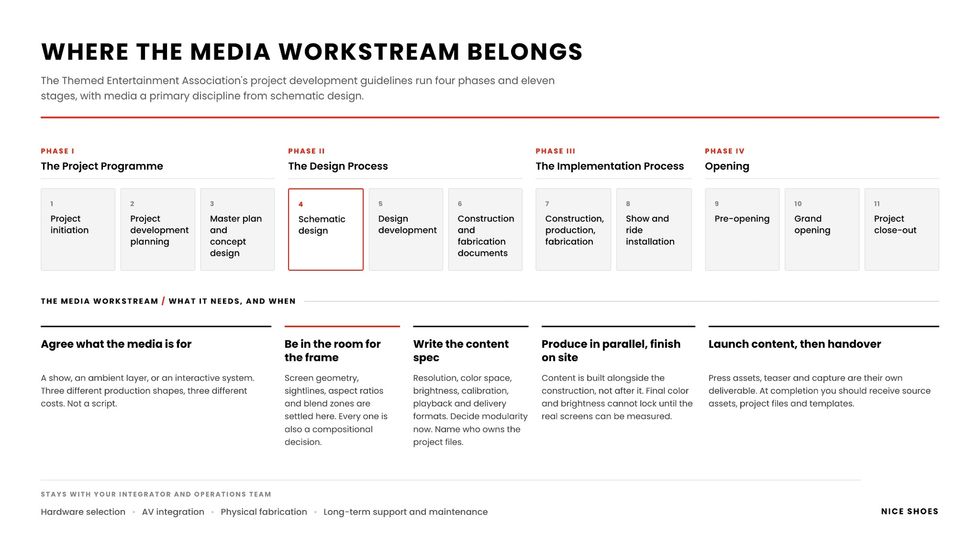
Nice Shoes sets out where the media workstream belongs
The reasons are practical rather than philosophical: media is often contracted later in the schedule than the guidelines assume, and for a long time it really was dressing on a physical experience, so nobody felt its absence while the construction of the room was being decided.
That is a much less accurate description now. On a lot of current projects, the media is not dressing the experience; it is a large part of the experience, sometimes most of it.
When it arrives after the schematic decisions are made, it inherits a design that the people who create it had no say in designing.
Where content actually has dependencies
Here is the more useful way to think about it. Content does not need to be made early. It needs to be represented early because decisions with content consequences are made long before anyone opens a timeline or builds a creative deck.
Concept and master plan. What you need at this point is not a script. It is an honest answer to what the media is for. Why is there media in this space? What is the desired experience? Is this a four-minute show with a beginning and an end, an ambient layer people walk past, or an interactive system that responds to them?
Those three things have completely different production shapes, costs, and implications for the room. Getting this wrong at concept is expensive to correct later, and almost nobody writes it down.
Schematic design. The guidelines already list media as a primary discipline here. In practice, this is the phase where it is most often missing. Screen geometry, sightlines, aspect ratios, projector throw, blend zones, how far the nearest guest stands from the surface.
Every one of those is being settled as a technical question, and every one of them is also an essential compositional and even narrative question.
A dome is the clearest example I know. You cannot frame a shot for a dome the way you would for a rectangle. In fact, there is no frame. The audience is not facing a single direction, and the part of the image a person is actually looking at moves around.
When I worked on the planetarium show Worlds Beyond Earth at the American Museum of Natural History, the geometry of that theater shaped the storytelling at every step.
It forced us to think about the story in 360 degrees, yet we still had to find “sweet spots” for every viewing angle so that every guest would have hero moments centered to their field of view.
Every venue is doing some version of this, just less obviously. Someone who thinks about the viewing experience should be in the room while the frame is being decided.
Design development. Now the specifics. Resolution, color space, brightness, calibration targets, playback system, source formats, frame rates, file structure. This is where a content spec sheet should exist as a real document, and where it usually does not.
This is also the phase for a decision I'll return to below: whether the media is built as a finished, flattened object or as a system that can be revised.
Construction documents. Content does not produce drawings, so it tends to fall out of this phase entirely. It should still produce a specification: delivery formats, playback requirements, and an explicit statement of who owns the project files at the end.
Writing that down here costs an afternoon. Not writing it down can cost a great deal in year three.
Construction, production and fabrication. Content production runs in parallel with the build, not after it. It also has a dependency that is regularly missed. Final color and final brightness cannot honestly be locked until the actual screens exist in the actual room and can be measured.
What looks correct on a calibrated monitor in an edit suite is certainly not going to be an accurate representation of what it looks like displayed at scale on site.
Show installation. Budget a significant amount of real on-site time for quality control. As stated above, media behaves differently on the real hardware, at the real scale, in the real ambient light, with the real seams between surfaces.
This is deployment and commissioning work, not a site visit, and it is where a piece either resolves or does not.
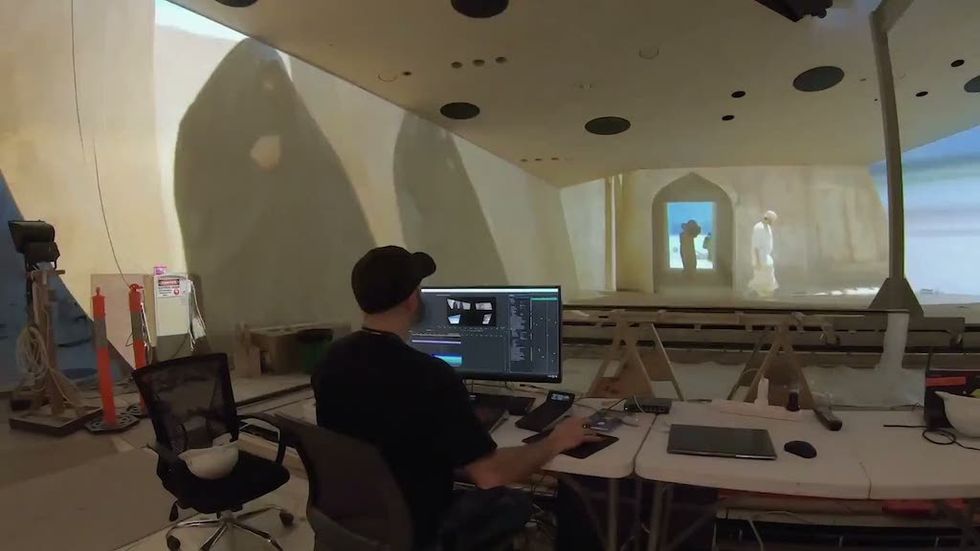
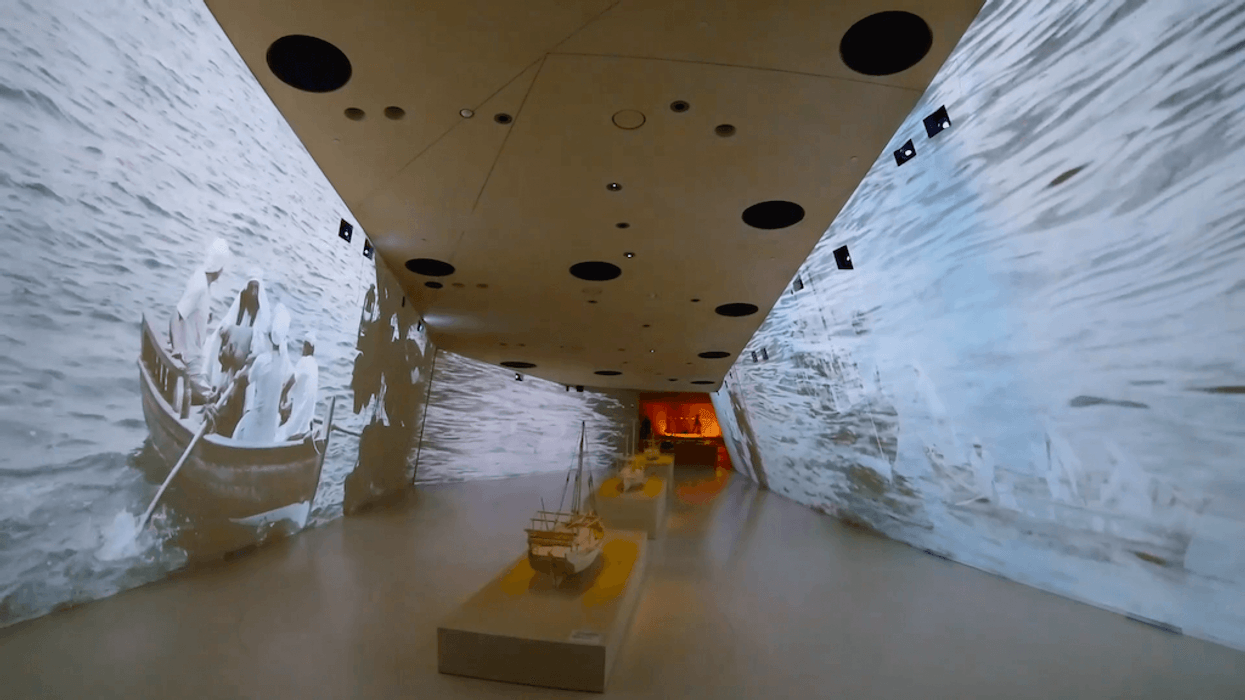
Colour grading on site at the National Museum of Qatar
Image credit Nice Shoes
Pre-opening and grand opening. Launch content is a separate workstream, and it is almost always remembered about three weeks out. Press assets, teaser material, capture of the finished installation, and filming behind-the-scenes footage is its own job.
Plan it as a deliverable, because it is one.
Project close-out. Handover. What do you actually own? I will make the case for a specific answer shortly.
The decision that sets what year three costs
Everything above is sequencing. This next part is the one choice that most determines what the media costs you over the life of the attraction, and it is made early, usually without being discussed.
Media built as a single locked deliverable can only be replaced. Media built as a system can be revised.
That distinction sounds academic until a guest comes back. Nothing is broken. Nothing has failed. It is simply the same show it was three years ago, and they noticed.
The operator gets a refresh quote that looks uncomfortably like the original build number, so the refresh does not happen, and it ends up being the same show in year four.
This problem is not unique to attractions, and it is worth saying where the alternative comes from, because it is not from this industry. Commercial advertising has spent decades on exactly this, not out of virtue but because clients demanded it.
We are often asked to produce the same idea in forty variants, different lengths, different markets, different languages, different aspect ratios, delivered overnight. That pressure forces a way of working where assets are built to be reused rather than built once and flattened.
Themed entertainment has rarely had that pressure, so it hasn’t reliably developed that habit.
But seasonal variants, language versions, sponsor changes, a new character, a narrative adjustment after you have watched real guests for a year: those are all the same challenges that the advertising world industrialized a long time ago.
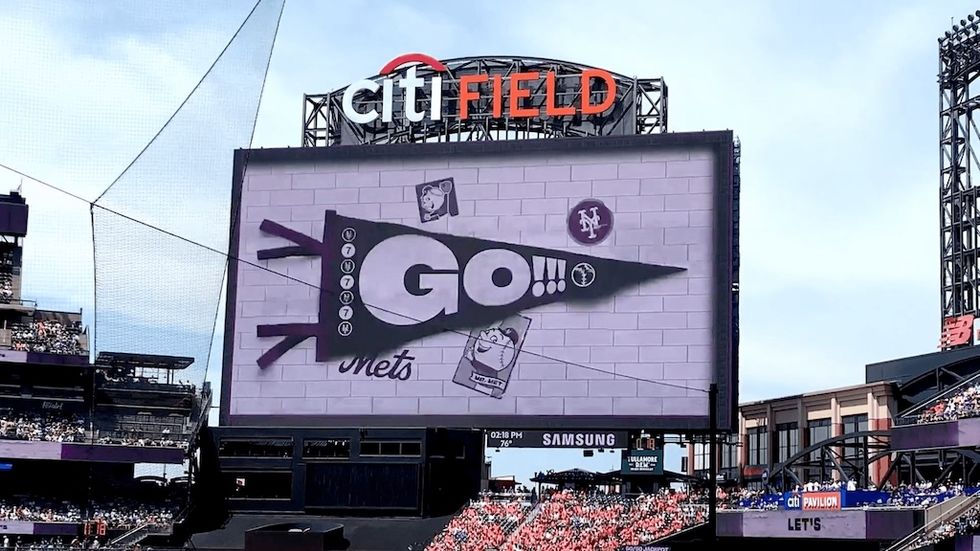
Game presentation for the New York Mets at Citi Field
Image credit Nice Shoes
Sports venues are a useful comparison here because they are permanent installations that are constantly refreshed. Rosters change, players get traded, a postseason run needs to look different from a regular season game, and the in-house team makes those changes themselves, often on game day.
See also: Designing the game day experience: what really goes into a stadium creative package
That forces the content to be delivered as templates and toolkits rather than as finished rendered files. It is the same building and the same screens, but it is built to be operated and updated.
If you want that in your attraction, four things have to be true, and all four are decided before anything is produced:
- Specify modularity in the brief. If a toolkit is desired, this needs to be part of the initial conversations, as it changes how the work is built.
- Own your source assets and project files, not just the final renders. A finished file is an output. Project files, source elements and templates are the thing that makes a change possible. Put it in the contract. It will cost a little more up front, but likely pay for itself rather quickly as the updates happen.
- Decide the refresh cadence before the build. Knowing that year two brings a seasonal variant changes what you construct in year zero.
- Treat the content spec as a living document. It will change. It should be allowed to.
Where the media team should not be
For balance, and because being clear about this saves everybody time: earlier involvement does not mean wider involvement.
Hardware selection, AV integration and physical fabrication belong to your integrator. They are specialist disciplines with their own workflows, and a content team wandering into them adds risk rather than removing it. Long-term support and maintenance eighteen months after launch is an operations function.
A media partner asking to maintain the experience is a warning sign, not a service.
What earlier involvement means is narrower than that. Someone who will be responsible for what appears on the surfaces should have a voice while the surfaces are being defined, and should leave a written specification behind.
The honest caveat
Not every project needs this. If the media is a single ambient loop behind a queue line, bringing a content team in at concept design is over-engineering.
Earlier involvement is also not free. Fees add up earlier in the schedule, it costs your own time, and there is a real risk at the other extreme: pull the creative in too early, and you can lock a narrative before the project has worked out what that narrative should be. I have seen that go wrong too.
But when the media is a significant part of why a guest is walking through the door, more times than not it is worth having the media content designers involved early, as their perspective is often unique within the project’s framework.
The tools will keep changing. They always do. What does not change is that good creative ideas, understood early by those who have to execute them, will always be among the most cost-effective things in the life of a project.