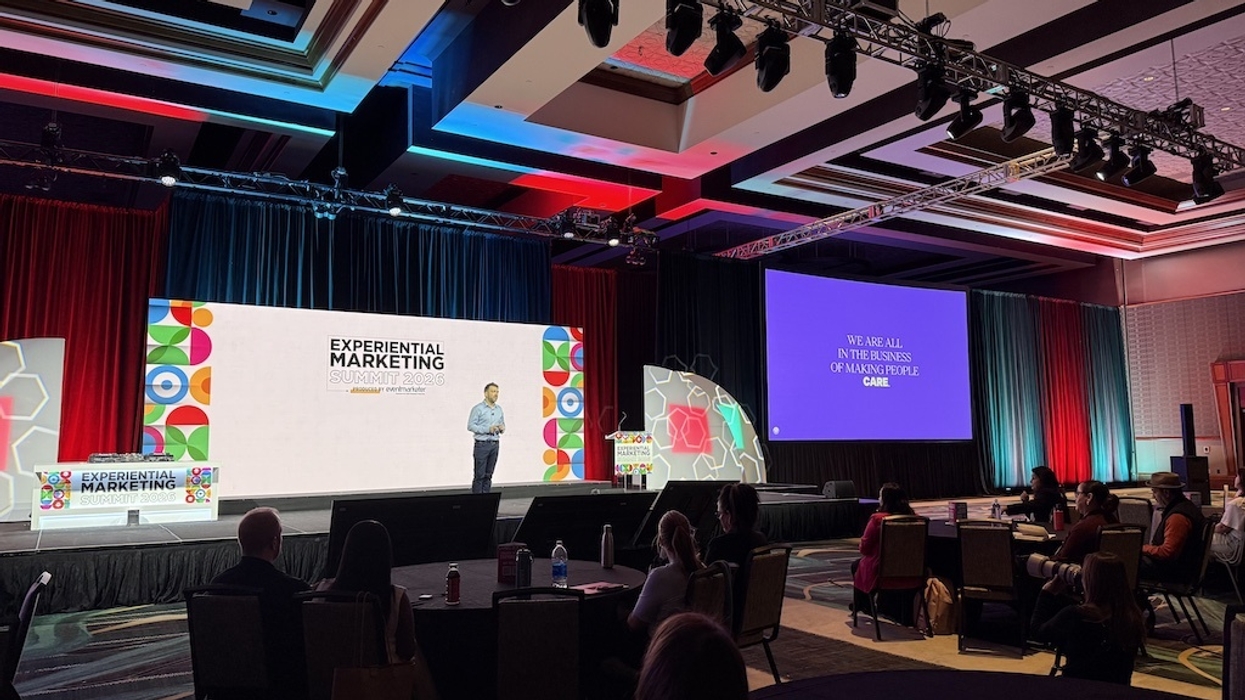

Cirque du Soleil, a world-leading live entertainment and experiences company, took part in the Experiential Marketing Summit 2026, held from 18 - 20 May at the MGMGrand in Las Vegas.
Florent Bayle-Labouré, chief of staff and strategy, took the stage for a keynote titled "Brand Storytelling that Delivers Emotional Impact: Lessons from Cirque du Soleil," sharing lessons from an organisation whose DNA has always been rooted in creating deep human connections through art and live performance.
This message resonated powerfully at an edition centred around the theme of Human Connection in the Digital Age.
Making audiences feel
Cirque du Soleil, known for big performances, focuses on emotion-driven storytelling that turns audiences into promoters. This session explored how emotional resonance impacts deeper engagement and how brands can design for it.
The address was aimed at an audience in the business of making people feel something, but, said Bayle-Labouré, this is not a question of perfect timing or perfect wording. It is a question of attention, emotion, and human connection. The real challenge is to make people care, to engage them, to make them interested and invested.
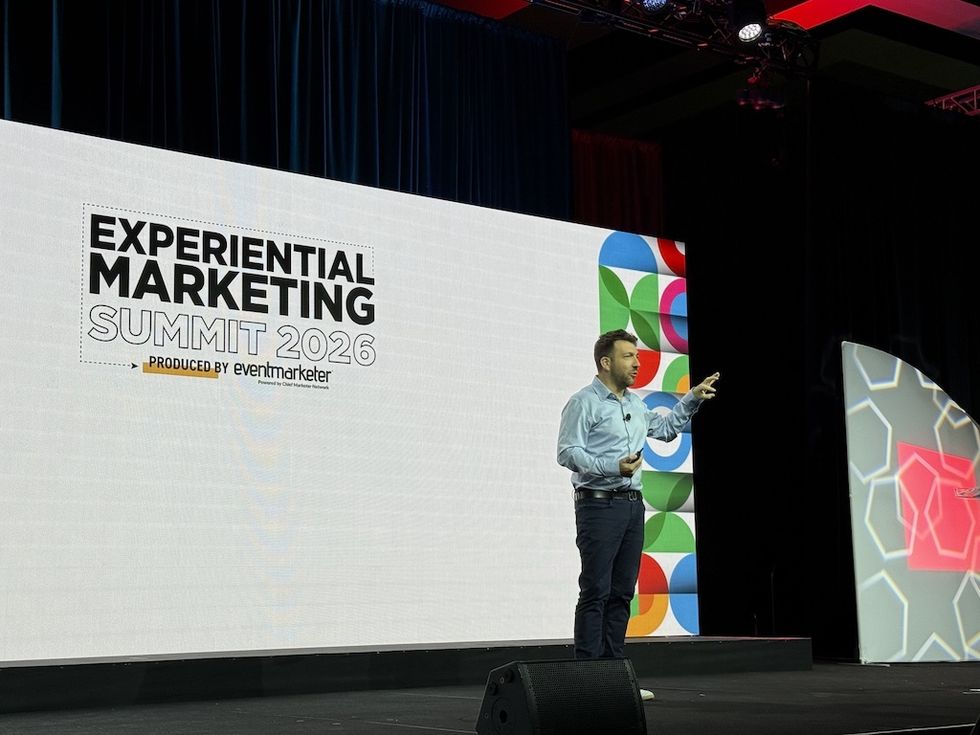 Florent Bayle-Labouré: "The performance ends when the lights come on. But the experience never does."Image courtesy of Cirque du Soleil
Cirque du Soleil challenges a foundational belief in modern marketing: the idea that, if you combine the right message with the right moment, you can control what people feel. However, that logic assumes that emotion can be triggered like a switch and that, if you optimise timing and content well enough, engagement follows automatically.
Key findings from audience feedback
Forty years ago, a group of Québécois street performers reinvented the circus. Today, Cirque du Soleil has a global NPS of 72, has attracted more than 400 million spectators since 1984, and maintains a 92% return intention rate. It runs 23 shows worldwide, either on tour or in permanent venues, including 5 resident shows in Las Vegas.
These figures are the result of deliberate, systematic, measurable emotional design.
To understand this mechanism, Cirque de Soleil conducted a quantitative study with 600 audience members across four of its Las Vegas shows. The result is a framework applicable to any brand or experience seeking to build lasting loyalty.
The first observation is that emotion is the number one driver of advocacy.
The study shows a near-linear, causal link between self-reported emotional intensity (1 to 10) and Net Promoter Score, indicating that stronger emotions increase the likelihood of recommending the show. Emotion is the key factor, not just one among many.
Normal consumer behaviour follows a saturation curve—more repeats lead to less desire. Here, the opposite is true: attending more shows increases the desire to return. Emotions build loyalty, which in turn amplifies emotion, creating a virtuous cycle that defies typical marketing laws.
The second observation is that Cirque du Soleil occupies an almost uncontested emotional territory. For instance, this chart compares emotions felt during a Cirque du Soleil show versus those felt with each audience member's favourite brand.
These are physical, involuntary, primitive emotions:
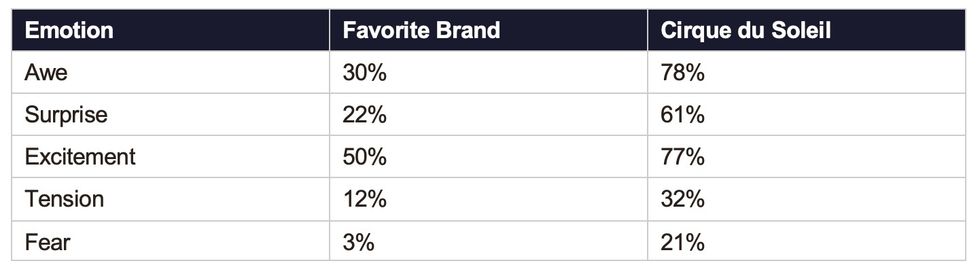
These emotions are more cognitive:
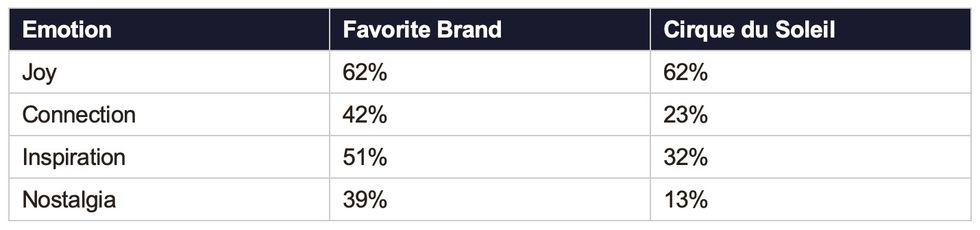
Cirque du Soleil generates 4.5 emotions per person, more than 3.3 for favourite brands. It's not just the type but also the volume of emotions that sets it apart. It occupies an emotional space mostly uncontested, offering visceral, intense emotions in greater numbers. This explains its high recommendation and loyalty scores.
Relational emotions build reputation and repeat behaviour, but visceral emotions remain immune to saturation.
The third observation is what Cirque du Soleil calls the paradox of unsought emotion.
Audiences said they wanted to be amazed by the skill (+95%), stunning visuals (+77%), and wow moments (+77%). Feeling strong emotions ranks 9th out of 10; people come for performance, spectacle, and mastery, not emotional experiences.
Yet the key predictor of audience recommendation is the unexpected emotional intensity they experience. This dissociation is fundamental to marketing, says Cirque du Soleil.
Consumers rationalise their expectations, but it is the visceral resonances, the ones they didn't anticipate, that generate attachment and word-of-mouth. Designing only for what people say they want means missing what actually creates loyalty.
The five pillars of an emotionally impactful experience
From the verbatims, scores, and behaviours observed among 600 audience members, the team distilled five structural principles that apply not only to live entertainment but also to any brand experience.
The first pillar is to design for conditions, not feelings. This is the most counterintuitive finding. Cirque du Soleil divided its audience into promoters (those who would recommend the show) and detractors (those who would not). Both groups agree on craft quality; see precision, danger, and mastery. But they diverge on emotional transport and pacing.
Craft is necessary, but not enough. What turns an audience member from indifferent to converted isn't the quality of what they saw but the feeling of being immersed.
Pillar two is to build a world, not a show. 93% of audience members consider the visual universe equally important to the acts. 65% feel immersed like nowhere else. What Cirque du Soleil calls a 'world,' other brands call a campaign, a touchpoint, a retail space, a digital experience, or packaging.
The third pillar is that craft must be seen to be felt.
96% of audience members find the artists' precision and control extraordinary, while 78% perceive real physical risk. Their feelings signal the process's excellence, perceived before explanation. Craft must be seen as good; hidden quality fails to inspire wonder or advocacy, as unseen qualities cannot evoke awe.
Pillar four is to design for memory, not satisfaction. 90% of audience members can spontaneously name at least one peak moment. The true measure isn't the average satisfaction score; it's whether the audience has something to discuss the next day.
Finally, pillar five is that the audience is the medium.8 1% of audience members feel a connection with the strangers around them. 65% share a collective held breath; 70% share a simultaneous burst of laughter. The audience forms a collective nervous system that generates part of the emotional experience, independently of what is happening on stage.
As Bayle-Labouré says: "The performance ends when the lights come on. But the experience never does."
The gap between design and experience is where everything happens. Cirque du Soleil data shows that emotion can't be declared, briefed, or announced. The brands that win loyalty don't just express emotion but create conditions making it inevitable. The unnameable feeling is the one people talk about most and keep returning to.
In July and August, Jean Leloup PARADIS PERDUS will run in Trois-Rivières, and the company will return to Andorra for the premiere of RÀDIO ANDORRA.