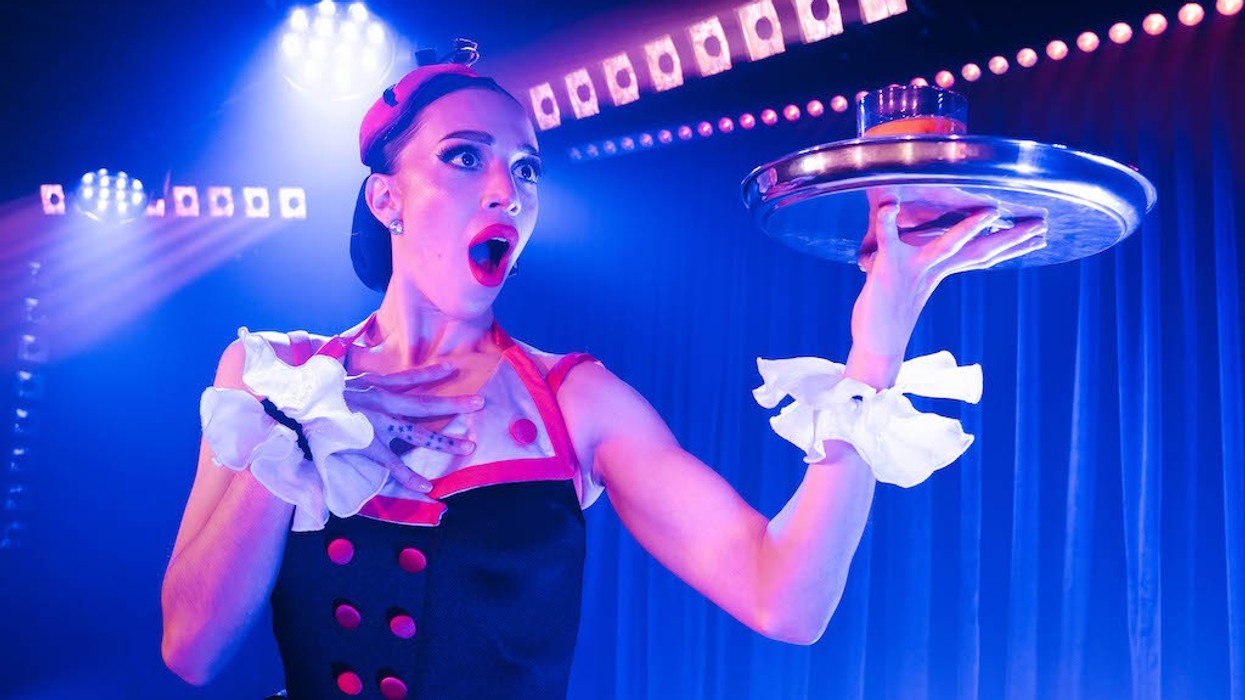

Fifteen years ago, cruise entertainment followed a reassuringly predictable script. Guests would finish dinner, consult the daily schedule, and make their way to the main theater for the nightly production show.
Bright costumes, familiar songs, a capable cast moving through choreography designed to please a very wide audience. Applause. Curtain. On to the piano bar, where a crowd gathered around requests that ranged from Aretha Franklin to Billy Joel, delivered with enthusiasm and just enough polish to carry the night forward.
It was all well executed. It was also neatly contained. Entertainment happened in designated places, at designated times, in formats everyone understood. Guests attended it, enjoyed it, and then moved on. It was a model built for predictability, at a time when predictability was part of the appeal.
Slowly, this model has evolved, as expectations have shifted and the onboard environment has become a continuous journey that guests move through rather than simply arrive at.
A performance spills out of its venue. A dinner feels more like a scene than a meal. A thrilling moment appears when least expected.
Over time, those moments have stopped feeling like exceptions and have become the structure. The boundaries of entertainment on a ship today are harder to locate.
Redefining the venue
The shift is not only conceptual. It is physical. With the evolution of entertainment, ships are now being built around the mechanics of performance itself, integrating systems that allow space, objects, and performers to move in ways once confined to specialized venues on land.
At a certain point, it stops feeling like a stage at all and starts to resemble something engineered for movement first, performance second.
On Royal Caribbean’s Icon of the Seas, that shift is visible. The ship incorporates numerous circus-driven spectacles directly into its AquaTheater design, including a full “Wheel of Wow.”
These spectacles are not presented as novelties, so much as part of a larger language of risk, scale, and physical performance that guests would expect to see in an arena in Las Vegas.
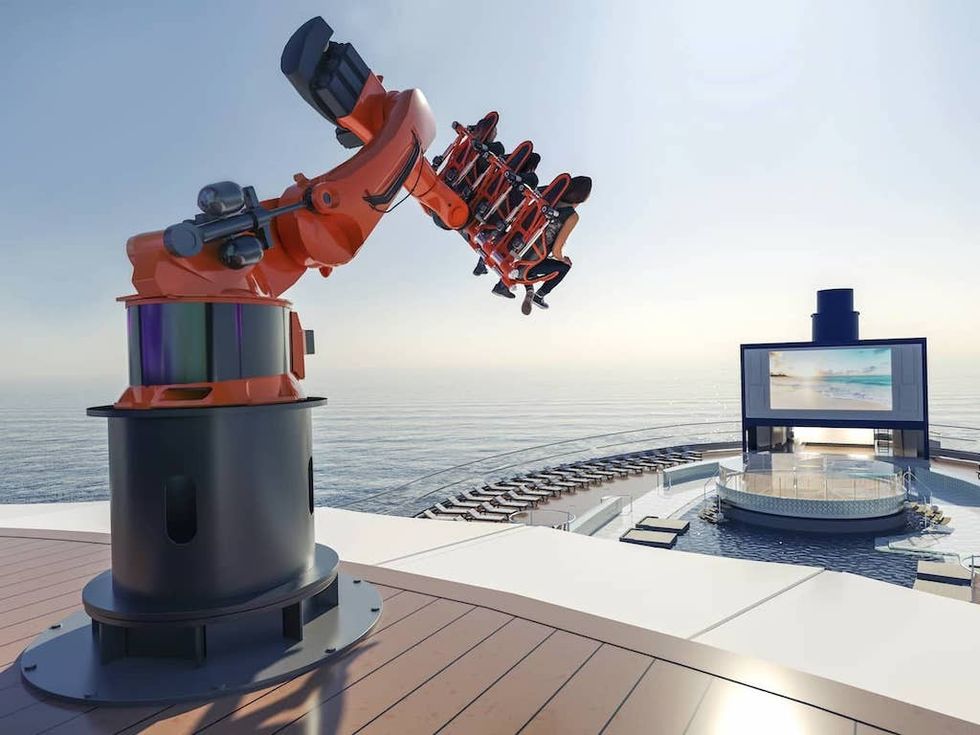 Robotron, MSC Seascape
Alongside that, industrial technology is being repurposed for guest experiences. An example would be The Robotron on MSC Cruises’ Seascape. Robotron engages the senses by allowing guests to personalize immersive music and visual effects as the ride spins them around on the ship's upper deck at the thrill level of their choice.
These are not temporary installations or touring effects. They are built into the ship. What once required a purpose-built venue on land is now embedded directly into the architecture of the experience.
Additionally, stages are no longer fixed. In some cases, it is not entirely clear where the stage is!
On Virgin Voyages, that ambiguity is built into the design. The Red Room, their primary performance venue, does not settle into a single configuration. One night, it behaves like a traditional theater and the next, the seating shifts, disappears, or reorients entirely.
What had been a stage might become a shared floor. Audiences are no longer looking in one direction. They are part of the arrangement.
That same logic extends beyond the venue with Virgin’s Scarlet Night. Performers appear across multiple decks. Music carries from one space to another. Something draws guests forward, and then something else interrupts it.
The experience moves through the ship, entertaining guests as they go about their evenings or transition from one event to another.
F&B as entertainment
Once the boundaries of performance begin to dissolve, it becomes difficult to say where the experience should stop. Dining is one of the clearest examples. Fifteen years ago, most dining experiences operated outside the logic of entertainment.
On many ships, F&B opportunities have now become some of the most constructed environments. Not louder, necessarily, but a more deliberate experience.
On MSC’s recent World Class vessels, this logic extends into the architecture of the space itself. In venues such as the expansive Panorama Lounge, F&B entertainment experiences take place within a fully mediated environment, featuring floor-to-ceiling LED screens, integrated staging, and programmed moments that unfold throughout the night.
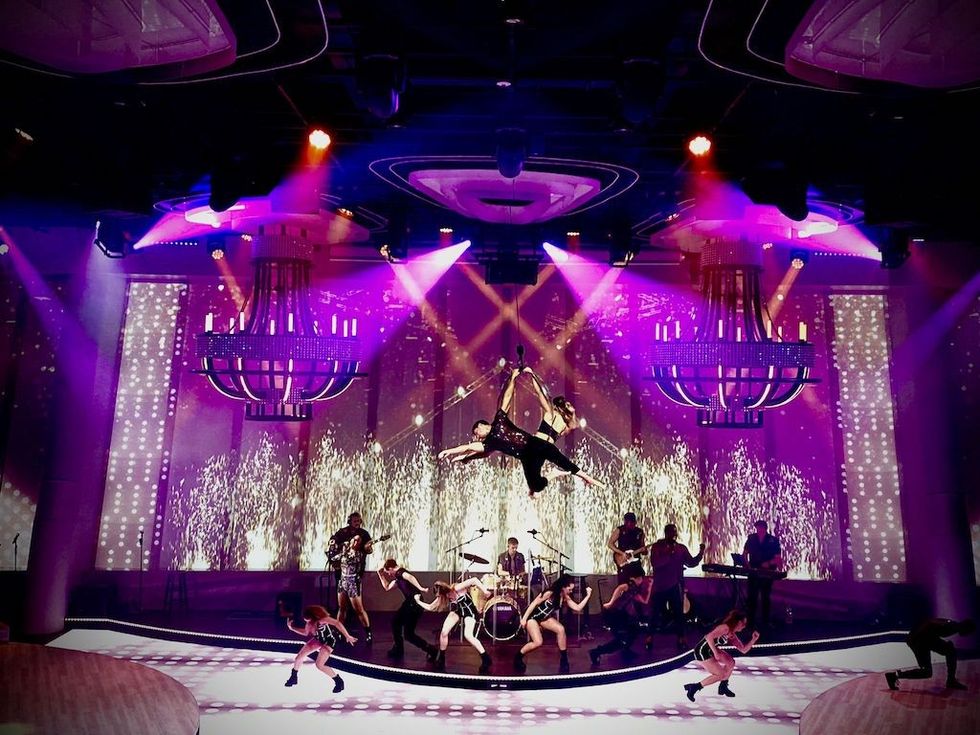 Show in the Panorama Lounge, MSC Cruises
The experience happens all around you, including a high-flying champagne ritual to mark the evening and performers appearing on satellite stages.
The Exchange, onboard Marella Voyager, is a hidden, adults-only speakeasy, where guests enter through a pair of classic English red telephone boxes. Within the phone boxes, guests dial a specific number and must give a secret password to get in.
Once inside, guests are greeted by characters who tell stories, sing songs and banter with the crowd while they enjoy drinks.
Another example is Disney Cruise Line's “Animator’s Palate.” An immersive dining experience that celebrates Disney animation by transforming the entire restaurant from black and white pencil sketches to full color animation throughout the meal.
The experience blends storytelling, technology and dining into a signature theatrical event.
What links these approaches is not a single technology or aesthetic, but a shift in expectation. Dining is no longer adjacent to entertainment. It has become one of the most immersive expressions of it. And once that boundary disappears, it becomes harder to predict where the next moment might occur.
The love of IP
Guests today crave authentic, story-led experiences that resonate with the brands and cultural icons they love. Cruise lines are responding by bringing world-class intellectual property into their onboard experiences.
This connects guests with the brands they already know and introduces those who may be less familiar to new stories and characters they can discover and take home. These IP-based experiences are elevating entertainment, dining and experiences at sea, creating memorable journeys that fuse beloved brands with immersive cruise programming.
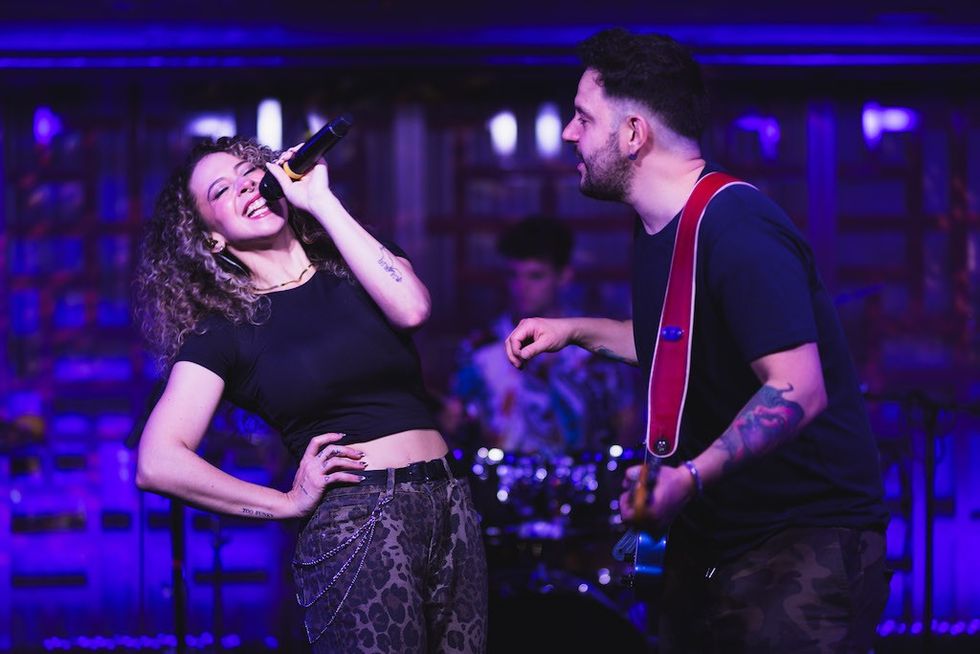 Holland America Line’s Rolling Stone Lounge
Holland America Line’s Rolling Stone Lounge, created in partnership with Rolling Stone, provides a space for guests to enjoy the music they know and love through an authentic experience.
To elevate the traditional theatre experience, Holland America Line’s all-new production of Fosse & Verdon, The Duet that Changed Broadway, is a musical and multimedia tribute celebrating the revolutionary work of Bob Fosse and Gwen Verdon.
Created in partnership with the Verdon Fosse Legacy, this show is rooted in the high-level authenticity one would expect from these show-business legends, while bringing this brand to audiences around the world.
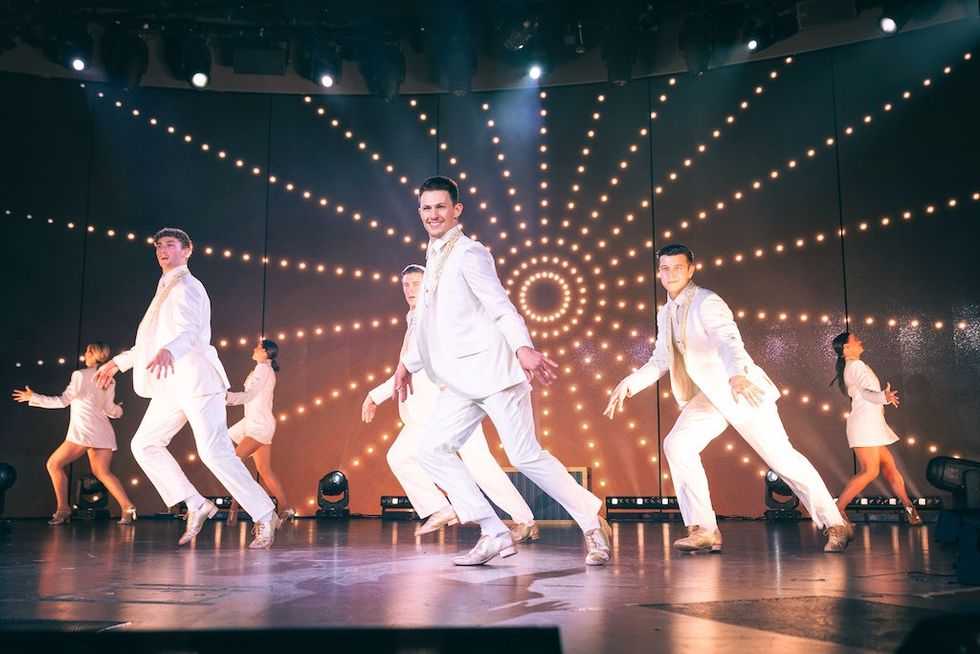 Holland America Line’s production of Fosse & Verdon, The Duet that Changed Broadway
Some lines are even creating their own IP. Carnival Cruise Line developed the successful Punchliner Comedy Club, thoughtfully celebrating the familiar genre of the comedy club experience, providing a nightly lineup of comedians for optimal variety.
Cunard’s Bright Lights Society blends immersive theatre and dining elements into something more stylized. This audience favorite presents itself as a defined world with its own tone, its own expectations, its own logic.
This is where IP earns its keep. It allows guests to move quickly from recognition to participation, without needing to stop and interpret what they are looking at and shapes how the ship feels.
See also: The world's best cruise attractions & experiences
Cruise industry as trendsetter
A cruise ship is one of the few environments where nearly everything can be controlled at once. Architecture, timing, sequencing, guest flow. There is nothing else competing for attention. That level of control changes what is possible.
On land, experiences tend to operate in isolation. A show begins and ends. A restaurant turns over. A venue resets. A ship blurs those boundaries. Guests move through multiple layers of experience in a single evening. The audience is on board long enough to learn how things work, which allows for a different kind of design.
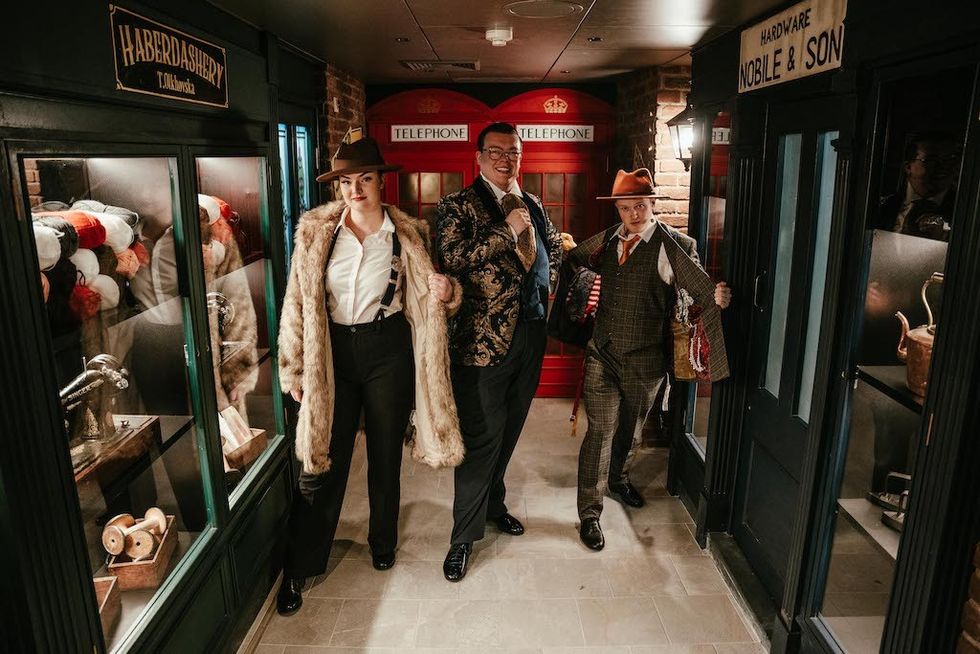 The Exchange onboard Marella Voyager
Spectacle, intimacy, and surprise do not need to be separated. They can be layered and adjusted within the same environment. Successful experiences expand. Others can be reworked quickly, sometimes between sailings, sometimes during them.
At this rate, ships function as a live testing ground, with feedback built into the experience.
A prime example is the theatrical hit, Six the Musical, which moved from the Edinburgh Fringe into international productions, including Norwegian Cruise Line, before arriving on Broadway, shaped in performance and in conversation with its audience along the way.
Few environments allow creators to design and refine an entire guest journey at this scale. And once that kind of iteration becomes possible, it does not slow down.
Where it's going
Fifteen years ago, cruise entertainment asked guests to follow a plan. Today, it asks something different: to explore.
Cruise ships are quietly leading the experience industry, not by replacing traditional formats, but by expanding what entertainment can be and how it can live within a space.
They are no longer simply destinations; they are places where the future of entertainment is being built in real time.