At the 2026 Festival of Innovation, we were joined by Sara Bou-Holaigah, strategy & ventures director at QSAS; Abeer Albahrani, museum consultant; Mohammed AlModhayan, CEO of VisitSaudi; and Yousef AlSharef, creative technologist at QSAS, for a discussion on cultural storytelling.
The panel explored how cultural tourism can engage visitors through human-centric approaches that create a meaningful, lasting impact.
This, the discussion noted, is achieved by telling authentic stories, carefully tailored to resonate deeply with audiences.
As cultural storytelling evolves across museums, destinations, and immersive experiences, visitors expect engaging, participatory narratives rather than passive observation.
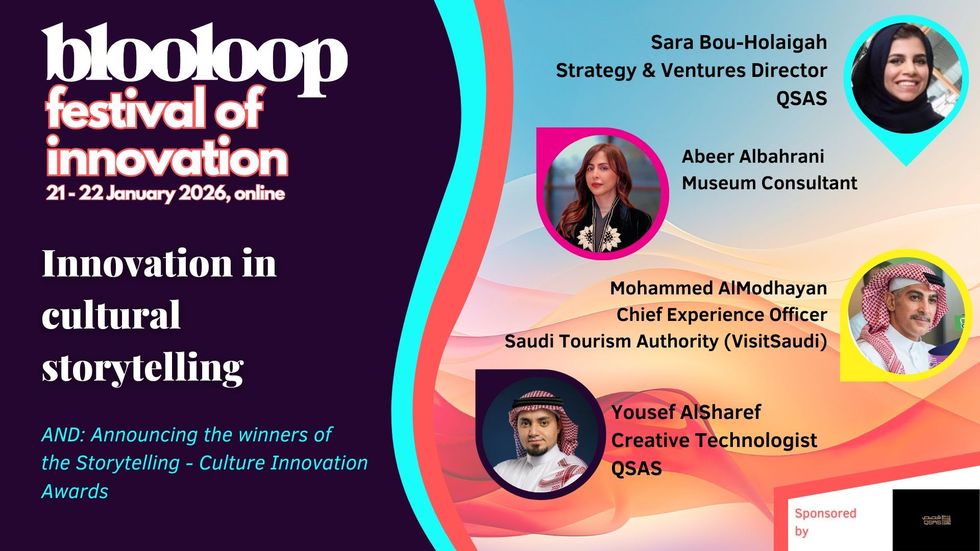
blooloop’s annual Festival of Innovation is a free online event. It invites the global visitor attractions community to explore the most innovative projects, products, and organisations that are shaping the future of the sector.
Transformative stories
“We're meeting at a moment when culture is shifting from status displays and preachy tours into living, breathing story worlds,” said Bou-Holaigah as she opened the session.
“Places where visitors don't just consume information, but step inside narratives, make choices, and leave with something that feels personally theirs.”
In Saudi Arabia, this transformation is happening extremely quickly. New forms of storytelling range from data-driven interpretation to character-led journeys and large-scale immersive environments.
“This isn't just about brighter projectors or bigger LED screens,” she added. “It's about rethinking the narrative, the partnerships behind it, and the impact we want these experiences to have over time.”
While aesthetics are important, the focus is now squarely on the intangible experience: how memorable it is, emotional resonance, how visitors relate to the content, and whether they walk out with a story to tell and a lasting memory.
To kick off the session, the panellists defined ‘immersive storytelling’ in the context of their work. They shared a belief that cultural immersion can transform visitors, not just inform.
“Cultural immersiveness is when you can turn someone that arrives at a destination with curiosity… and transform them into someone that leaves the destination with a new perspective,” said AlModhayan.
From a technological perspective, AlSharef said that “immersive storytelling means designing systems where culture isn't explained to you, it's actually felt. Technology is behind the scenes shaping emotion, memory - without becoming the focus and the headline.”
Authentic narratives
Storytelling offers a bridge between heritage and contemporary audiences. To engage these audiences and meet their rapidly evolving expectations, storytellers must focus on authenticity; telling these stories with communities, not about them.
“I have noticed a dramatic shift from passive observation into active participation,” said Albahrani. “I think visitors no longer want to just read labels and see artefacts and objects behind glass.”
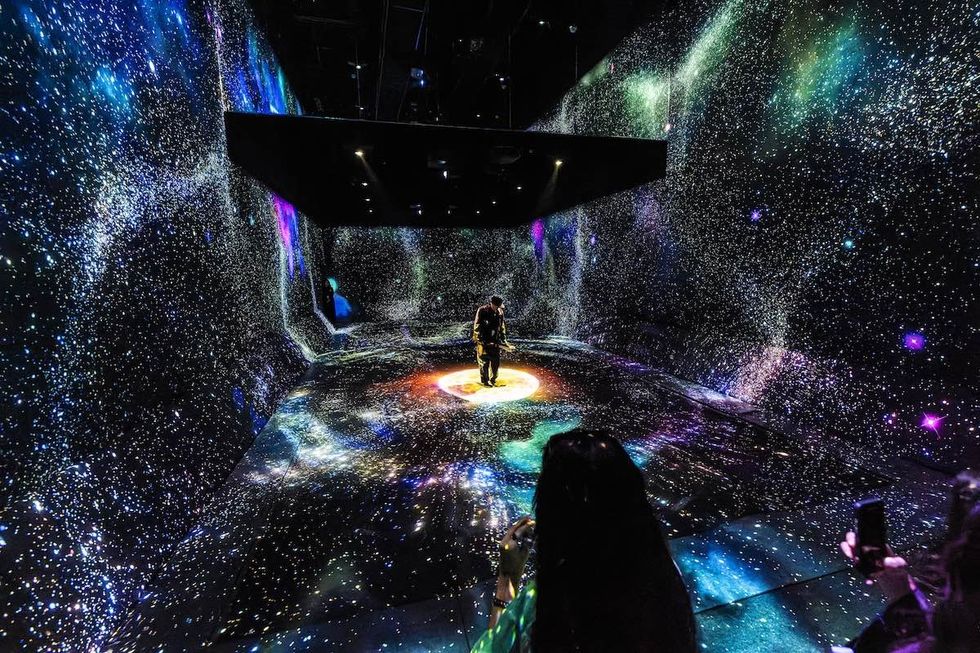 TeamLab Jeddah
Now, she added, audiences want to engage with culture both emotionally and physically.
Museums worldwide have responded by turning historical narratives into dynamic, multi-sensory experiences. These make learning more joyful and are proven to have a long-lasting impact, driving both empathy and memory retention.
To create this emotional resonance, Albahrani said, programmes and exhibitions must put people at the heart of the narrative.
For example, when designing an exhibition about an ancient incense trade route, a narrative telling the dreams, hopes, fears, and joys of a young merchant can offer a connection.
“We believe that Saudi identity is very rich and proud, rooted in our faith, history, and culture. To be able to make it resonate emotionally with everyday visitors, the stories have to become more human and more personal.”
On this question of identity, AlModhayan said that VisitSaudi’s brand focuses on being the heart of Arabia.
“But then, ‘What is Arabia?’ is the big question. How can you interpret Arabia and manifest Arabia through experiences?”
Connecting through subcultures
While attempts to define Arabia’s identity are qualitative, a set of subcultures offers a more quantifiable approach, adds AlModhayan.
As tourists visit for a short time, his focus is on passion- and interest-based subcultures that can quickly evoke a connection. Such subcultures, such as musical genres, can introduce norms and systems, values and behaviours.
These subcultures can then be matched with traveller segments to inform product development.
Anchoring on subcultures is key, AlModhayan emphasised. Don’t look after the narrative, look after the narrator.
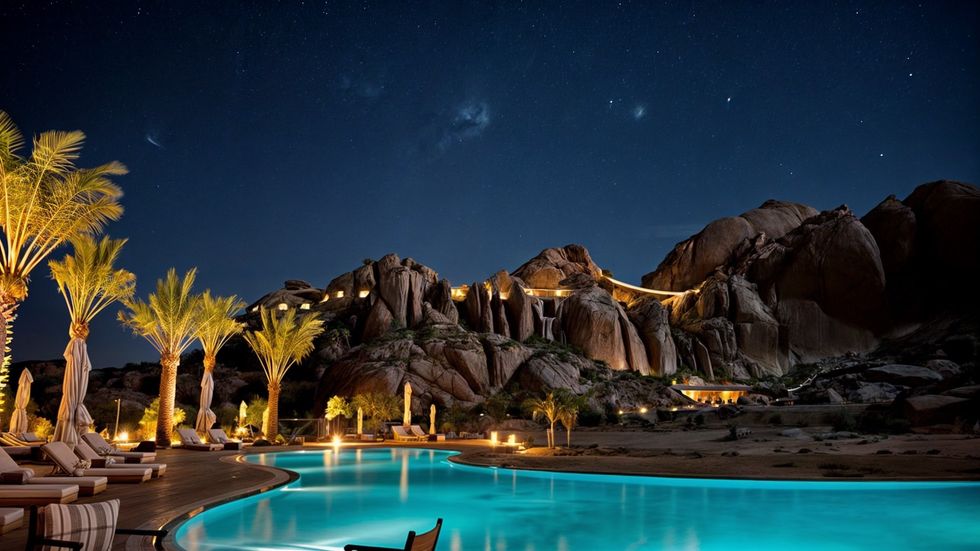 Desert Rock eco-tourism resort
For example, desert camp experiences are very popular with tourists and explore themes such as nomadism and bedouinism, survival in the desert and the shifting landscape. These experiences often include the chance to take a selfie with a falcon.
The falcon is used as an aesthetic. But historically in Saudi Arabia, the falcon was never a piece of decoration. A falcon is a partner, a tool of survival.
The falcon can then be converted into an experience in itself, for example, an eight-hour experience where tourists can learn about the falcon, bond with a bird, and receive training before embarking on a hunting trip.
“You will go back home remembering the name of the falcon,” said AlModhayan. “You will remember the falconer, the instructor. You'll remember the many, many stories, you remember the thrill, how terrified you were the very first time. And that awe.”
Invisible technology
The conversation then turned to the use of technology, not as the hero, but as an enabler.
“If they go out and remember the VR headset, you're doing your experience wrong,” said AlSharef.
“You should create a human moment, a curiosity, pride, grief, or wonder. What is that human moment that I want people to go out feeling?”
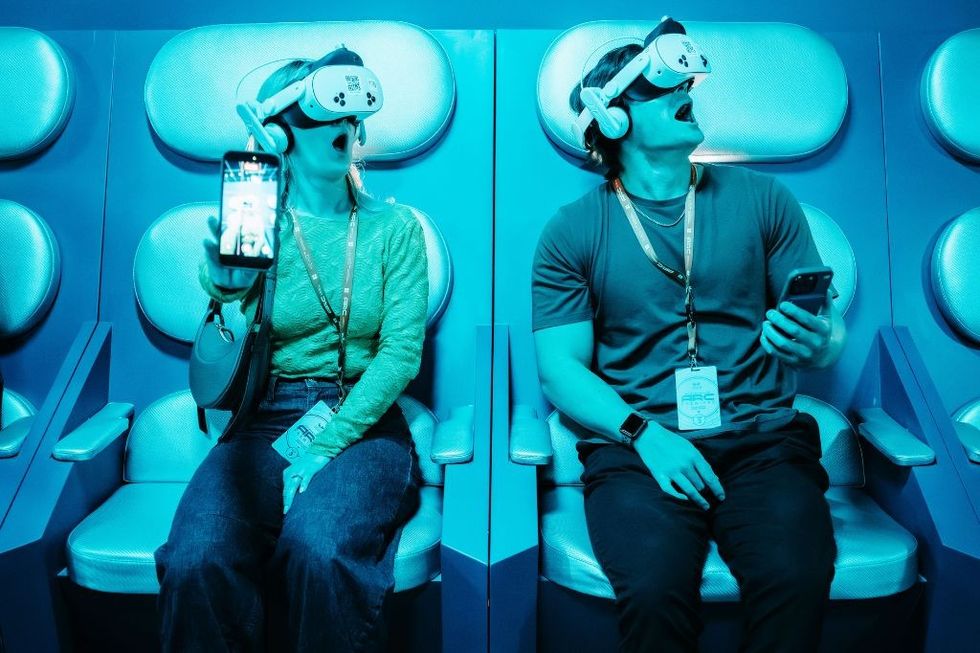 Interstellar Arc Spaceport
AlSharef shared an example of an exhibition experience enhanced by removing technology, for example, using replica artefacts rather than images on screens.
Another exhibit recreated a village:
“You don't just look at how people lived at that moment. You hear voices all around you. We use spatial audio. So you feel the audio is coming from the house itself, like there are people living inside and they're talking, having dinner.
“You hear the clicks of the small utensils they are using. So all of that gives you the illusion, gives you the immersiveness. It's these little things. Do you see the technology? No, it's hidden because we don't want the technology to be the hero.
“The technology enabled us to go to different places and show you with spatial audio, with projection, with interactivity, what you can experience in different layers and not just linear. Here's the artefact. Go to the next one. We told you the story. We're done.
“No, we want you to be in the story. We want you to live and interact with the story.”
Delivering the desired outcome
The panel discussed how the capabilities of technology need to be carefully weighed against human experience.
Albahrani spoke about how tech can take attention away from the core of the experience, and how using authentic tools, such as pen and ink rather than a tablet, can create a richer, more authentic offering.
It would be easy to use AI to replace tour guides, added AlModhayan.
However, he heeded caution, citing TripAdvisor research that the main thing people remember from a trip is the tour guide. A good tour guide has skills that a machine cannot replicate, such as authentic emotion and adaptability to a group's needs.
Here, AI provides support but does not replace the authentic experience.
When developing experiences, AlSharef asks clients a series of core questions. What do you want them to feel? What's the role? Are they participants? Are they observers? And what's the lifespan of this story?
“If all of that is clear, you don't even choose the technology,” he said, “the technology chooses itself to support that outcome.”
Measuring impact
Bou-Holaigah then asked the panellists what success looks like and how it is measured in their organisation.
For the Saudi Tourism Authority, AlModhayan said visitor spend is key.
With so many experiences across the Kingdom, the STA looks at different portfolios, such as museums, desert camps, and beach activities, and considers what each offers the traveller segments.
By understanding what each portfolio can offer, it is possible to work with partners to fill any gaps, enhance the offering, increase capacity, and extend the length of stay and, therefore, spend.
From a cultural economist's perspective, he describes experiences as vehicles of cultural export. As with goods, your culture grows and thrives when you export more culture than you import.
“How do you export more culture? One of those vehicles is tourism. People come, they consume your culture, and go back. I look at it as net culture surplus. You have culture surplus when you export more than you import.”
However, this complex metric is hard to measure. “This is the AI I would definitely use,” says AlModhayan, “... to actually be able to track culture surplus or cultural deficit.”
Importance of visitor feedback
In comparison, at Albahrani’s institution, success is measured holistically and combines both numbers and human insights:
“We have two sides, the quantitative side and the qualitative side.
“On the quantitative side, we track attendance, dwell time, and interaction rate. And this is very important because we want to make sure our visitors not only walk through, but also really engage with what we offer.
“And on the qualitative side, we capture what they have felt, what they have learned, what they were mostly engaged with. And this can be done through surveys, open-ended questions and short conversations.
“So when you come by a visitor who says, ‘I really enjoyed it. I felt it. I want to really learn more.’ That's a great indicator of success.”
Bou-Holaigah asked if Albahrani had ever seen a project where the data was a surprise?
“We were developing an experience around myth and legend and fiction stories, and at the end of the experience, we built a small corner.
“A human-centred corner where the visitor gets the opportunity to sit together, reflect, remember and share stories they have heard from their grandparents or the community they belong to and so on.
“We anticipated a low participation in that corner, but we were surprised the data showed that there is remarkably high engagement and families and friends stayed longer than we predicted.
“And then we realised, really, our audiences are human-centred. They want to sit together. They want to share memories. They want to share culture. They want to feel that they're part of that culture.
“They’re not only consumers, as AlModhayan said, they don't want to just consume culture; they want to be participants and feel it and contribute to it as well.”
Global potential
The conversation then turned to global Expos and the potential for hyperlocal and cultural stories to travel and become national symbols and global showcases.
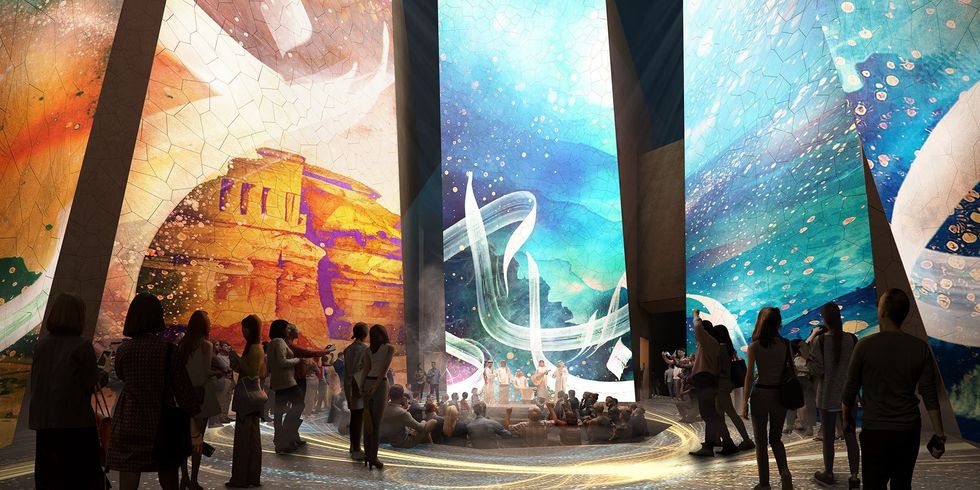 Saudi Arabia's pavilion for Expo 2025 Osaka
Hafawa, AlModhayan said, offers a great opportunity. Although without a literal translation, Hafawa conveys ideas of Saudi’s exceptional hospitality.
In Saudi hospitality, servers will continually offer coffee until you indicate to stop by shaking your cup.
“Now, why do we shake it?” said AlModhayan.
“I'm sitting in my area with my friends, my allies. We're talking and sharing secrets,” he explained. “To guarantee that you are absolutely safe to say whatever you want, the person pouring you coffee is my son, my cousin, my brother.”
However, sometimes servants would be attending rather than family members. And so, to ensure guests’ privacy, servants were usually deaf.
“How do you tell a deaf person to stop?
“You shake your cup. Shaking is actually an ancient sign language. Right now, shaking is an aesthetic to Hafawa. We teach people to shake.
“But do they know the depth of everything that is Hafawa? Hafawa is not generosity. Hafawa is care. Hafawa is protection.
“You need to give depth and bring back aesthetics to those grassroots values and explore the depth of it, rather than box things into making Hafawa a synonym for generosity, which it is not.
“So for Expo, here's your opportunity. Create your Hafawa programmes, but don't frame them as just generosity. Start with protection, start with care.”
Curiosity & connection
“When you design a program that talks to local and global, you should focus on the emotional, the core human centre”, said Albahrani.
“When we approach Saudi culture, we approach it through familiarity and distance proximity, but I think global audiences approach it through identity, they approach it through curiosity, they approach it through discovery.”
Considering the technology used within pavilions, AlSharef shared that while short immersive films are currently popular, he finds responsive environments the strongest format.
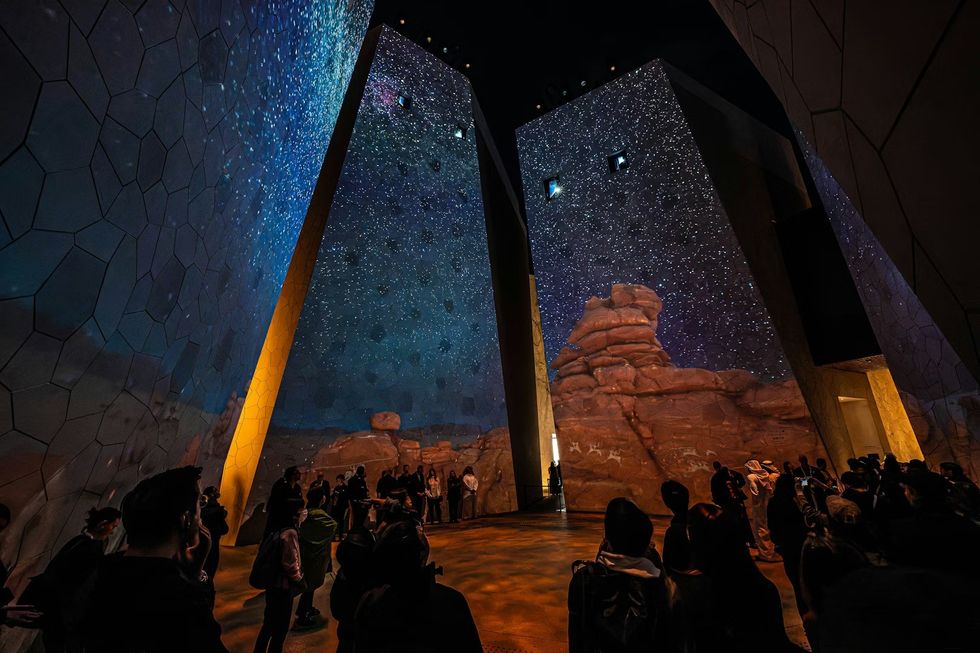 The Kingdom of Saudi Arabia Pavilion at Expo 2025
This enables the creation of layers and depth in a pavilion, which can be limited in space.
“In just a small space, you could tell multiple stories that people can interact with the environment around them.
“You could have really directed audio in one place, where in a small tunnel, two different people at the same time can have two different stories and live two different stories without having a headset on.
“So, one person is living a different audio experience than the other one and interacting with either the wall, an object, a small object in front of them and still live a totally different story.
“You go to the next one, and you experience another story, and you see the environment change around you locally. So you are impacted, and you feel special in that moment.”
Your story can reach the world…
Despite the vast potential of new technology, there was a clear consensus among the panel: authenticity is the one principle they would never compromise on.
This commitment was echoed in the closing moments of the session, as Bou-Holaigah asked the speakers to complete a final thought for the next generation: “For a young creative watching today, your story can reach the world if you…”
The responses highlighted how the future of cultural immersion depends on storytelling and genuine human connections:
Albahrani: “Let meaning guide your creativity, not trends.”
AlSharef: “Stay honest to where it comes from.”
AlModhayan: “Keep unearthing all those stories through being curious in your own identity.”