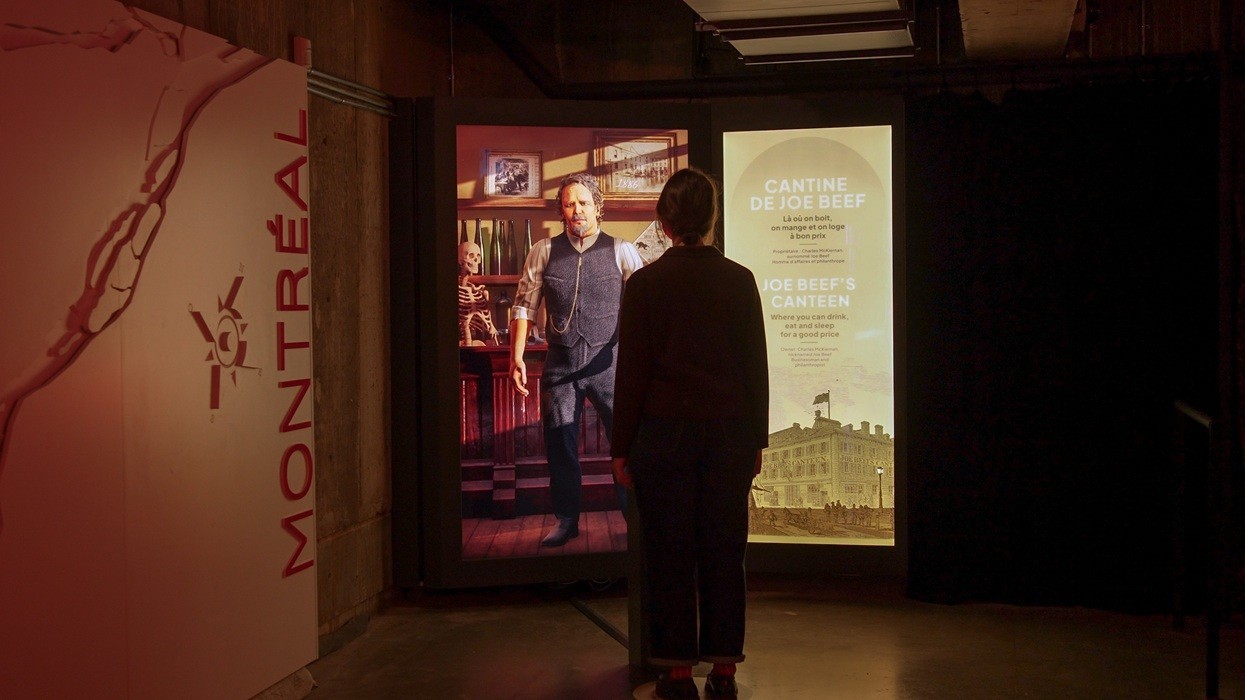

Dpt., an international experiential design and production studio, has created an AI-powered interactive character based on Joe Beef, a prominent 19th-century tavern keeper, for Pointe-à-Callière Museum in Montreal.
This project harnesses AI to create an embodied encounter with the historical figure, allowing visitors to engage in direct conversation with Beef, ask questions, challenge his responses, and explore Montreal’s past through dialogue.
Created at a human scale, the intimate conversational experience combines a real-time conversational AI system, a fully animated 3D character, and bilingual voice interaction to engage with visitors without reducing history to a fixed monologue or turning AI into a technological novelty.
Accurate, engaging dialogue
Beef, whose real name was Charles McKiernan, is remembered for his dedication to workers, strikers, and the underprivileged in industrial Montreal during the second half of the 19th century. His popular tavern, situated near the port, served as a gathering place, a centre for solidarity, and a venue for debate.
Dpt. was tasked with creating a dynamic, personal interaction with Beef that would reflect the social, political, and human values that he represented.
As both a documented figure and a mythologised character, the project required carefully curated sources and clear narrative boundaries to avoid distortion or anachronism.
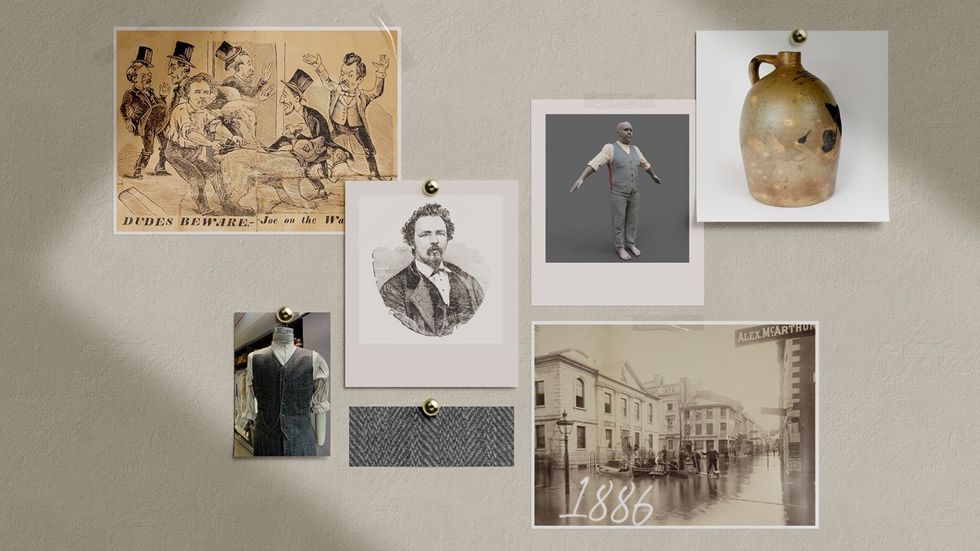
Furthermore, the technology needed to support open-ended dialogue whilst maintaining accuracy. It also needed to be operationally robust, offline-first, low-latency, and support seamless voice interaction.
All content used to train the large language model (LLM) is drawn from a structured archival corpus covering numerous themes related to 19th-century Montreal, as well as Beef's personal life, commitments, and social context.
This was used to create a retrieval-augmented generation (RAG) based knowledge system to root the character’s responses in verified sources. Dpt. defined the tone, worldview, vocabulary, and narrative boundaries to meet the expectations of contemporary audiences.
A fully integrated, real-time AI architecture powers the experience entirely on-site, with a pipeline that brings together speech-to-text, locally deployed large language model, RAG system, text-to-speech synthesis, and real-time lip synchronisation.
See also: How emerging tech is enhancing the museum experience
Capturing visitor attention
The resulting visitor experience is intentionally straightforward and intuitive.
The installation is situated in the museum’s crypt, at the exact location of Beef’s original tavern. When a visitor approaches, a presence detector senses their arrival. Beef appears, life-sized, and addresses them in French or English. The visitor asks a question, and the conversation begins in their language.
Mediation takes place through voice and the rhythm of exchange, rather than menus, touchscreens, or visible preprogrammed choices.
"This approach fundamentally transforms the role of artificial intelligence," says Nicolas S. Roy, president of Dpt. "It is no longer used to deliver information in a top-down way, but to support a credible, embodied dialogue in which speech circulates freely.
"Joe Beef adapts his responses in real time based on the visitor’s questions and language, allowing for a conversation that is accurate, fluid, and situated in the moment."
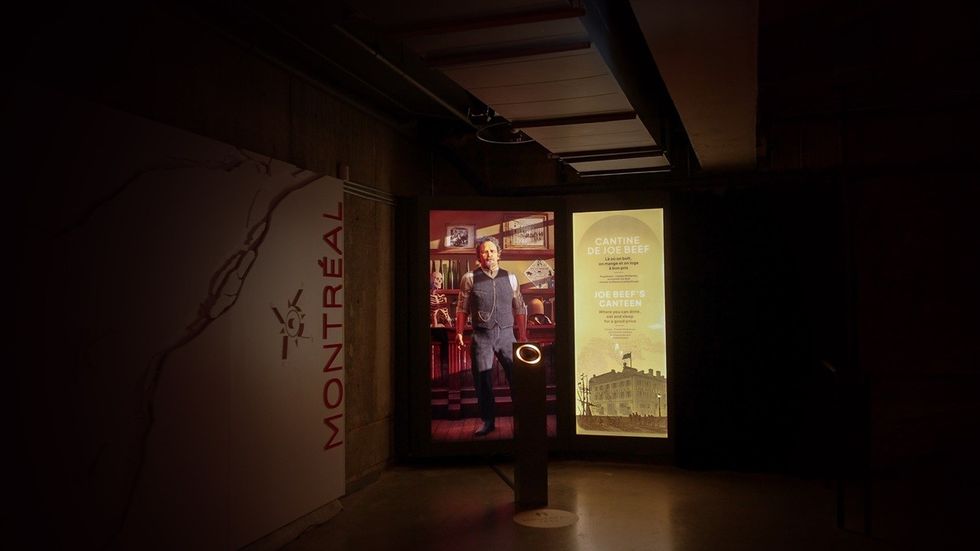
The installation presents natural, bilingual, free-form conversations that consistently maintain visitor attention, exceeding typical dwell times.
Visitors test Beef, challenge him, and engage in genuine dialogue. The project sets a new standard for participatory cultural mediation, moving from static interpretation to dynamic exchange.
Conversational mediation for cultural contexts
This project is part of a broader research initiative led by Dpt. on conversational mediation in cultural contexts. It illustrates a scalable framework for AI-driven historical embodiment that can be applied to other figures, collections, and organisations.
"The Joe Beef project illustrates an increasingly necessary stance within cultural institutions. Artificial intelligence is not the subject—it is a medium, a tool serving a narrative, a context, and a mission," says Roy.
"In a museum context, this approach redefines the relationship between knowledge, technology, and the public. It offers an experience that does not aim to impress, but to resonate—to create a suspended moment where history speaks in the first person.
"Perhaps this is one of the most promising futures of cultural artificial intelligence: not a machine that speaks, but a presence that listens."
Dpt. is dedicated to transforming the way brands, arts, and culture resonate across virtual and physical spaces. It has been designing and delivering interactive, immersive experiences that sit at the intersection of storytelling, emerging technology, and human-centred design for more than 15 years.