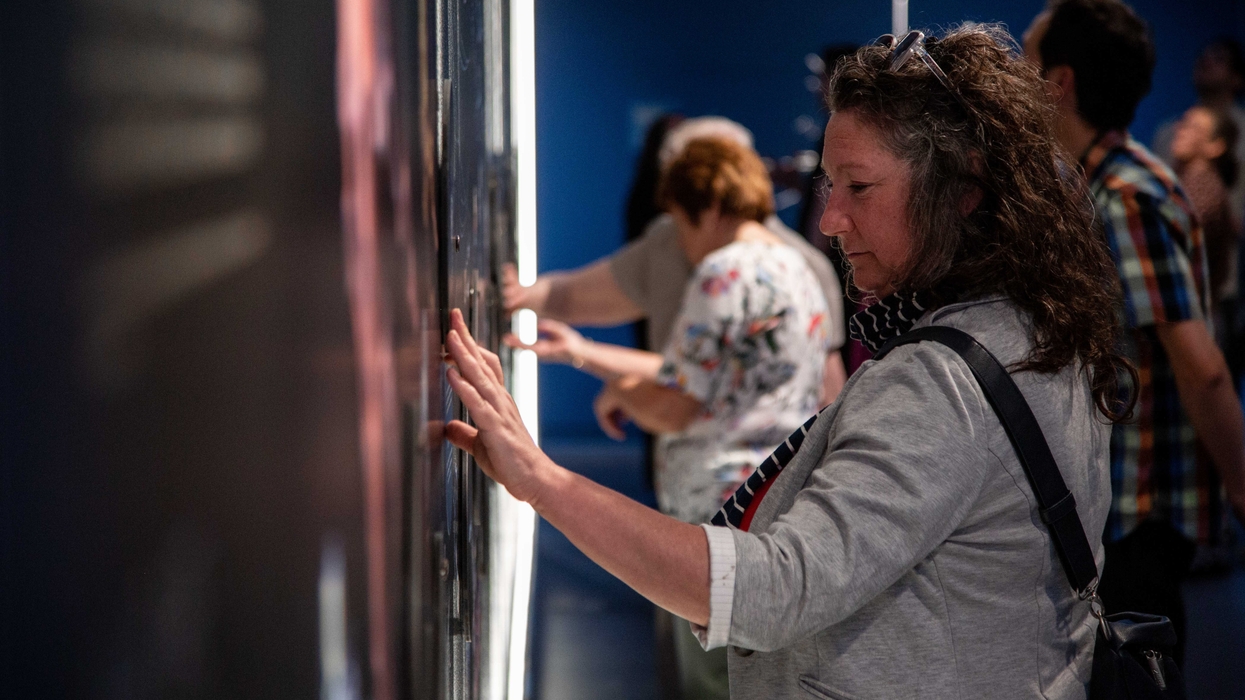
Dive deep. Play together. Spark life.
Our tagline expresses the principles of our design brief. A touring interactive exhibition by CREO and the Musée du Fjord, Plankton Odyssey turns visitors into Planktonauts on a mission to bring a fjord back to life.
What makes it innovative
Plankton is a subject few museums have explored, and Plankton Odyssey was built around what a group achieves together rather than as an individual experience.
CREO logo
CREO
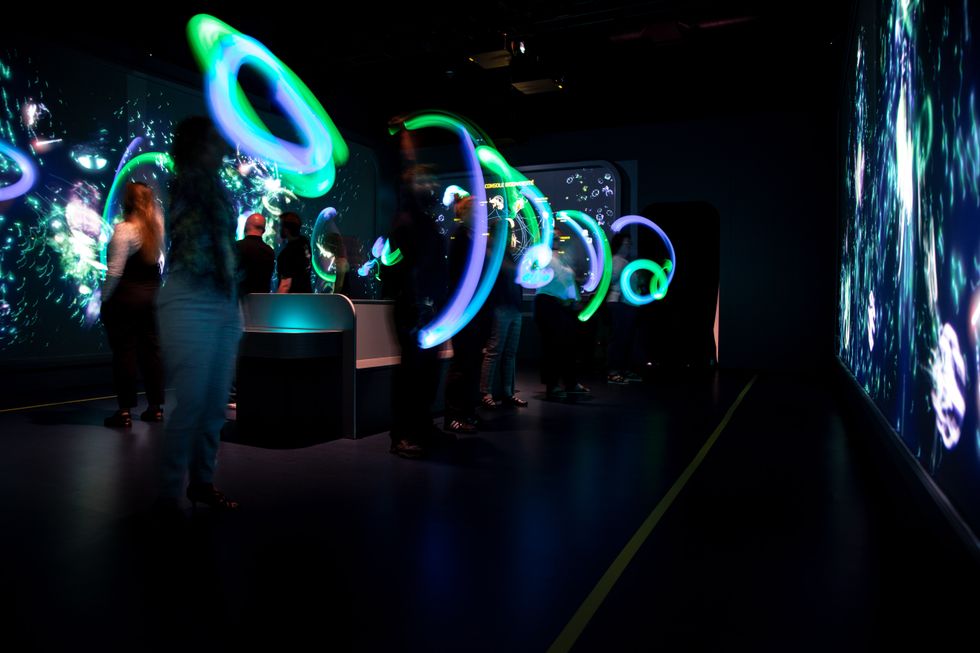
Thirty Planctospheres let thirty people play at once:
Plankton Odyssey
CREO
glowing wireless spheres held in the hand, each containing a custom 6 cm circuit board in a 3D-printed shell. No buttons, screens or apps. Pick one up and it comes to life. Moving the sphere creates a current in the projected water that carries the plankton along. The word plankton comes from the Greek planktos, "drifting", which is exactly what players create.
The innovation lies in combining two rarely paired technologies:
interactive projection and connected physical objects for collective play. Computer vision tracks each sphere while an onboard accelerometer captures its movement. A real-time engine developed in CREO's immersive laboratory responds wirelessly to each sphere according to the gesture, the moment in the story and what the group is doing.
Oceanis, the submarine and its onboard intelligence, narrates the dive and reacts to the group's score. A shared dashboard shows progress in real time, making the impact of collective action visible rather than simply encouraging cooperation.
An experience for the whole family
A nine-year-old summed it up: "It's for all ages. Even the adults can't get bored." Five-year-olds carry a Planctosphere as carefully as if it were alive; families split the mission: "I'll take the phytoplankton, you feed the zooplankton." A bench lets grandparents play seated. The experience ends on what the science says: the ocean can recover faster than we might think, and even a small action can make a difference.
How we brought a story to life
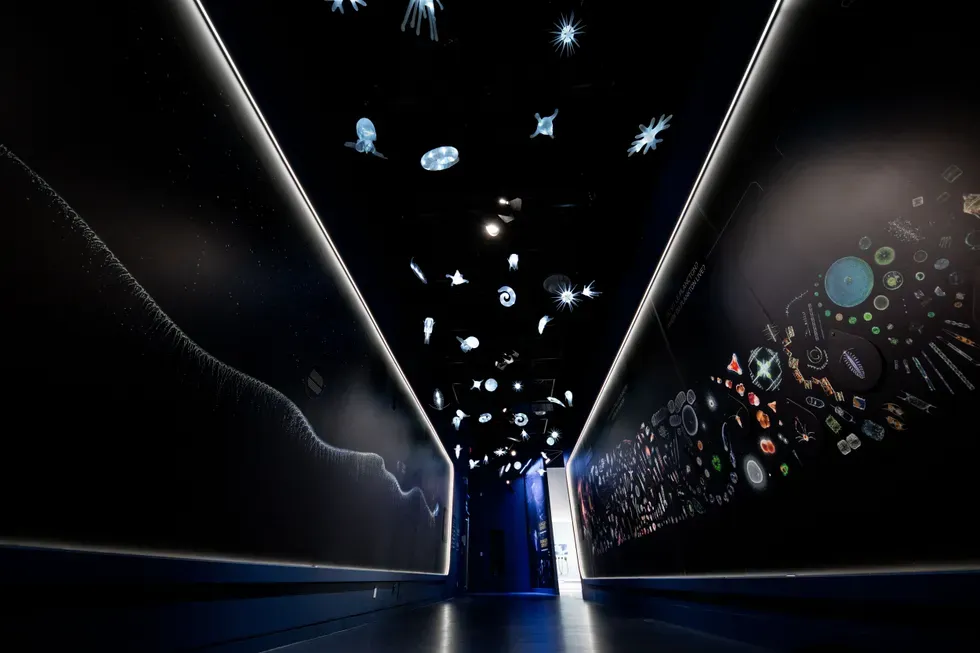
Visitors don't watch the story; they play it across three zones that move from the imaginary to the real, treating the ocean as the closest thing we have to unexplored space. In the Discovery zone, a marine station welcomes them as Planktonauts. In the immersive zone, projection and spatialized sound place them aboard Oceanis at plankton scale, where together they guide phytoplankton into the light, feed the zooplankton and rebuild the food web, bringing the belugas back to the Saguenay fjord. Then they surface into the real fjord: daylight, documentary footage and the scientists themselves. Each zone has its own color of light, so the shift from fiction to reality is felt rather than explained.
How we engage, inform and inspire
We engage through play: the group's actions change the walls in real time. We inform through real science: plankton is the oldest and most diverse ecosystem on the planet and the ocean produces at least half of Earth's oxygen (NOAA), yet almost no one has seen a living planktonic organism. The experience uses real specimens from the Plankton Chronicles archive by Christian Sardet (CNRS), with Les Macronautes and Parafilms; scientific validation by Christian Sardet. We inspire through agency: a reflection wall asks each visitor what they will do to protect the ocean and displays their answer alongside everyone else's.
The same story, told to different guests
Plankton Odyssey
CREO
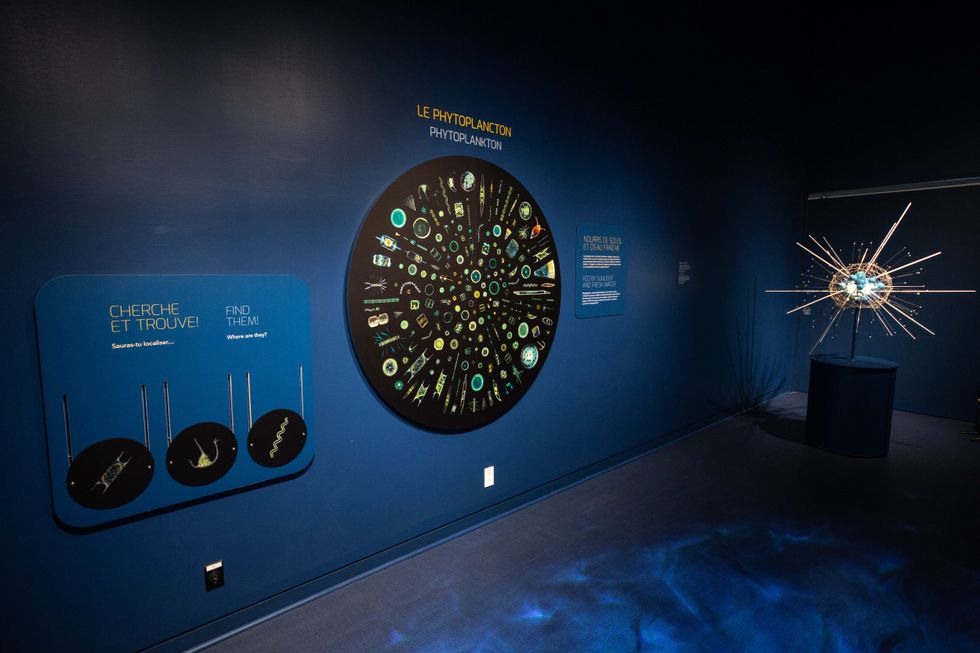
Plankton Odyssey teaches mostly through images: two decades of archival imagery replace blocks of text, so it works whether visitors read or not. The engine adapts the mission to each group's size and movement; content runs in French and English, a complementary program serves school groups, and venues can adapt it locally.
Proven with audiences
Plankton Odyssey opened on 17 June 2026 at the Musée du Fjord in Saguenay, Québec, welcoming tens of thousands of visitors in its first summer. In the museum's survey of 249 visitors, more than eight in ten were satisfied.
Built to travel
Self-supporting walls serve as both structure and projection surfaces, fitting galleries of 225 to 350 m² without a purpose-built technical grid. And families who play together come back together, encouraging repeat visits.
Partners
Plankton Odyssey
CREO
A co-production of CREO and the Musée du Fjord, with Les Macronautes and Rumker, supported by the Gouvernement du Québec and the Ville de Saguenay.
CREO: Caroline Julien (producer, co-director, immersive and exhibition scriptwriting, narration), Michel Groulx and Hélène Coupé (project coordination, scriptwriting), Patrick Gleeson (scriptwriting), Justignin Brouillat and Maxime Giraudeau (technical direction and design, programming, integration, electronics development), Adèle Bédard, Axel Hélie-Fontaine, Alexandre Hua and Étienne Plante (programming, technical artists), Oscar Baquero (graphic design and animation), Claudio Moura (3D modelling and animation)
Musée du Fjord: Guylaine Simard (producer), Myriam Coulombe (project coordination), Véronique Gagné, Tommy-Lee Leroux-Gagnon and Aurégane Séjourné (educational program), Florence Verrault (plankton sculpture)
Les Macronautes / Parafilms): Noé Sardet (co-director, artistic direction, scriptwriting, copywriting, sound design), Christian Sardet (scientific validation, plankton images from the Plankton Chronicles), Clément Lavedan (illustrations), François Guinaudeau and Antonin Gaud (plankton animation), Arsène Genet and Sharif Mirshak (shooting)
Rümker: Justin Dubé-Fahmy and Emma Sander (exhibition design)
Productions Main Droite: Pierre-Henri Azen and Rémy Girard-Chénier (lighting design, technical design)
Syntronic: Simon Martin (industrial design of the Planktospheres), Martin Poon (electronics development and assembly)
Lab148: Nicolas Bouillot (network architecture), Emmanuel Durand (computer vision)
Les Films de la Baie: Stéphanie Gagné (executive producer), Charles-Maxime Lemay (sound recording, editing, mixing)
Nuwko Concepts & Designs (decor and furniture), Axis (Planktospheres), COlab (Samuel Guillemette, 3D models and plankton sculpture), LSM (Alexandre Aubin, integration), Alphard (Nicolas Pelletier, engineering)
Productions Fougarou: Jean-Christophe Pelletier (game design consultant)
Scientific committee: Christian Sardet (CNRS), Jérôme Lemelin (Université du Québec à Rimouski), Carina Poulin (NASA Ocean Ecology Laboratory), Émilie Saulnier-Talbot (Université Laval), Gesche Winkler (ISMER)
Funders: Gouvernement du Québec, SODEC, Ville de Saguenay
CREO (Montréal, Québec): Lead producer and IP holder. Concept, creative direction, scriptwriting, software and hardware development (the Planctospheres and the real-time interaction engine, developed in CREO's immersive laboratory), integration and show control. CREO manages international touring and licensing.
Musée du Fjord (Saguenay, Québec): Co-producer and launch venue. Hosts the exhibition, delivers visitor mediation and school programming, and runs daily operations.
Plankton Chronicles archive, Christian Sardet (CNRS), with Les Macronautes and Parafilms: Scientific imagery. The exhibition is built from real specimens drawn from an archive of living-plankton photography collected over two decades. Scientific validation is credited to Christian Sardet.
Parafilms: Audiovisual production of the exhibition's capsules (direction by Noé Sardet, shooting by Arsène Genet and Sharif Mirshak) and image licensing.
Les Films de la Baie: Audiovisual co-production. Executive production (Stéphanie Gagné), additional shooting, and sound recording, editing and mixing.
Rümker: Exhibition design and scenography (Justin Dubé-Fahmy, Emma Sander).
Funders: Gouvernement du Québec (ministère de la Culture et des Communications, Rayonnement de la culture numérique programme), SODEC, Ville de Saguenay.