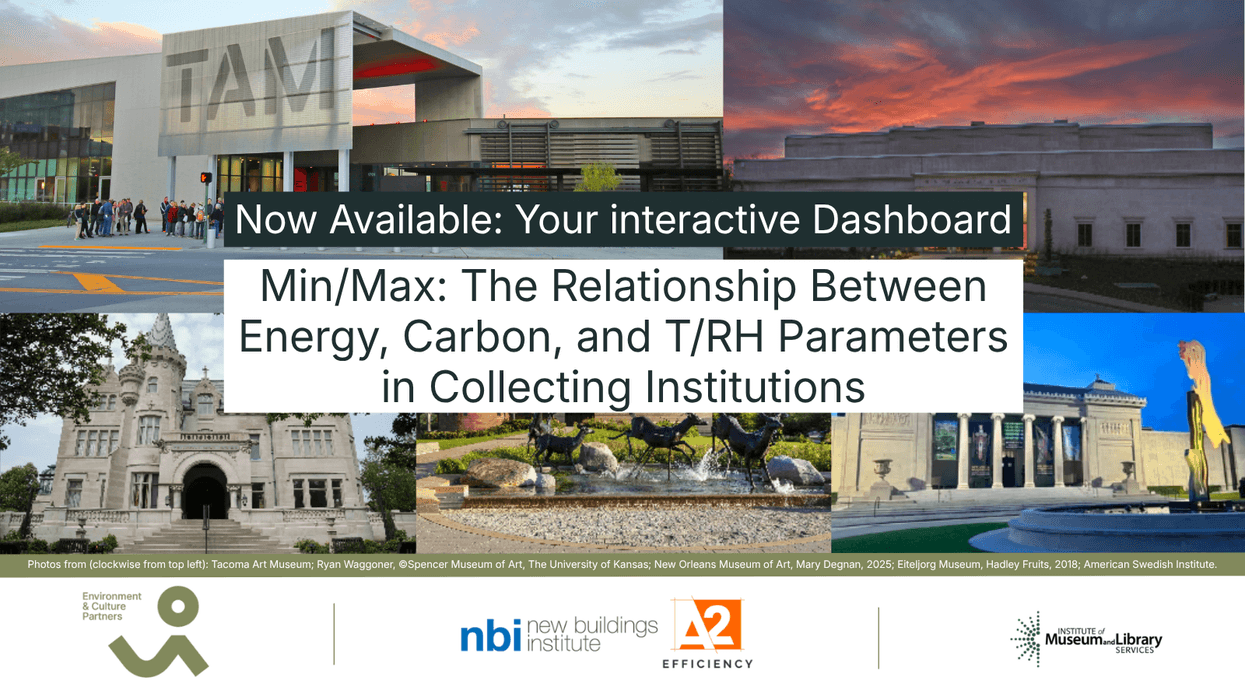
For decades, the museum field has widely relied on a strict set of environmental controls to preserve and protect collections: 70°F (21°C) and 50% relative humidity (RH), held nearly constant, around the clock. This strict control regime drives high energy consumption and strains HVAC equipment despite conservation science and a growing body of research that indicates such strict setpoints may not be required for most objects.
Field guidance, like the Bizot Green Protocol, points to more flexible parameters that maintain object preservation while acknowledging museums' role in climate action and responsibility for their carbon footprint. Adopting this shift across the sector, however, has been complex, tangled in loan agreements, insurance expectations, institutional reputation, and both the practical realities and perceived reliability of aging mechanical systems.

Environment & Culture Partners Logo
Environment & Culture Partners
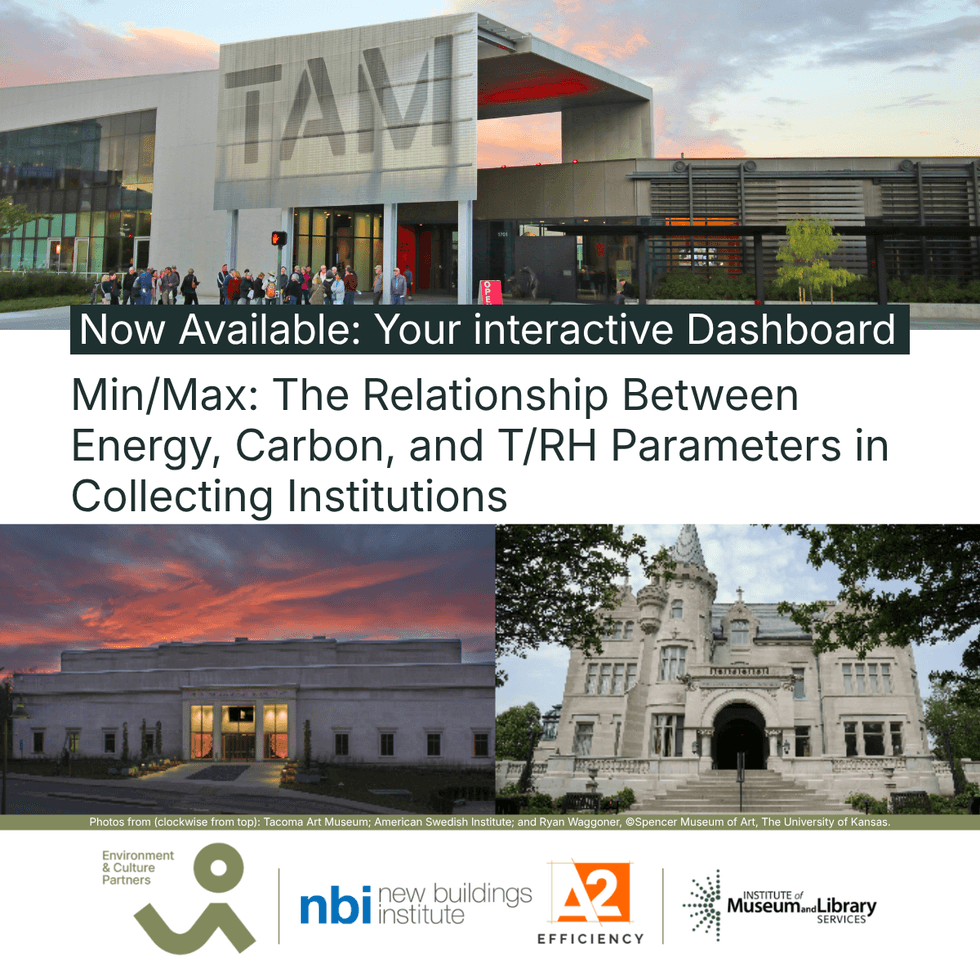
The Min/Max Dashboard Environment & Culture Partners
Environment & Culture Partners
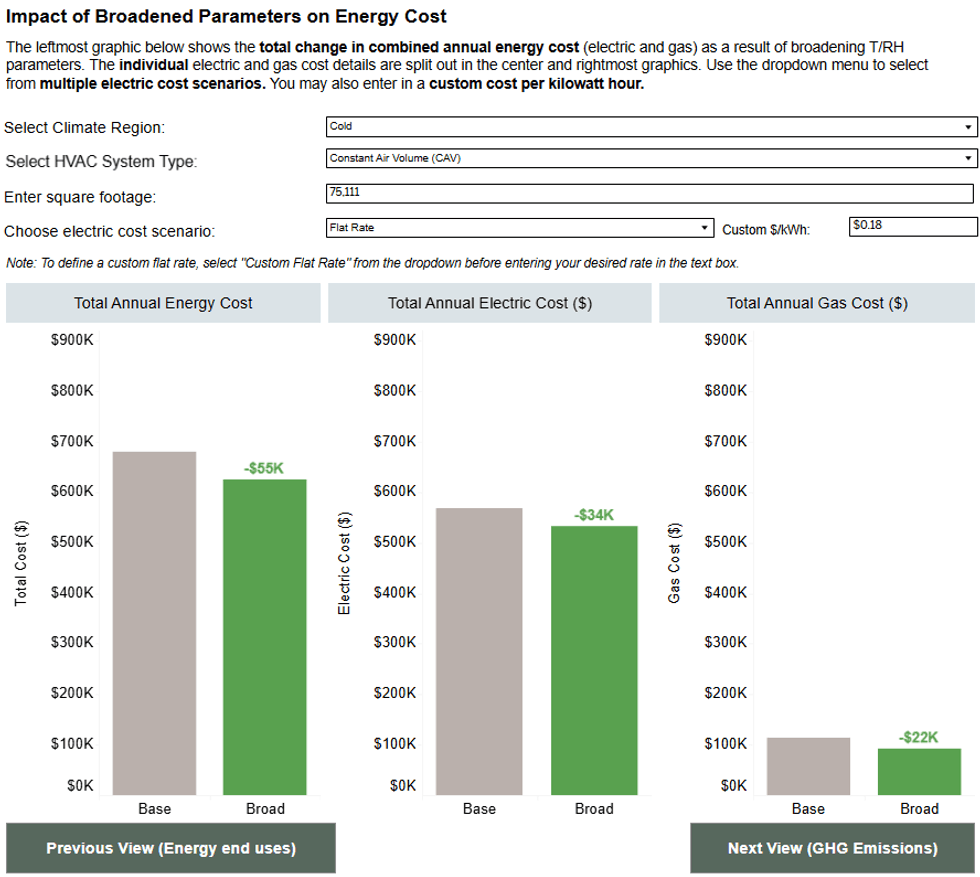
The Min/Max Dashboard was built to help the sector and individual institutions navigate that complexity directly: a free, interactive tool that lets museum professionals, from collections to facilities, explore how broadened environmental parameters might perform at their own institution. Users can input their climate region, HVAC system type, and building size to explore outcomes across energy use, cost, carbon emissions, and collections risk, comparing exhibition and storage spaces separately and testing options like seasonal setpoints and nighttime setbacks.
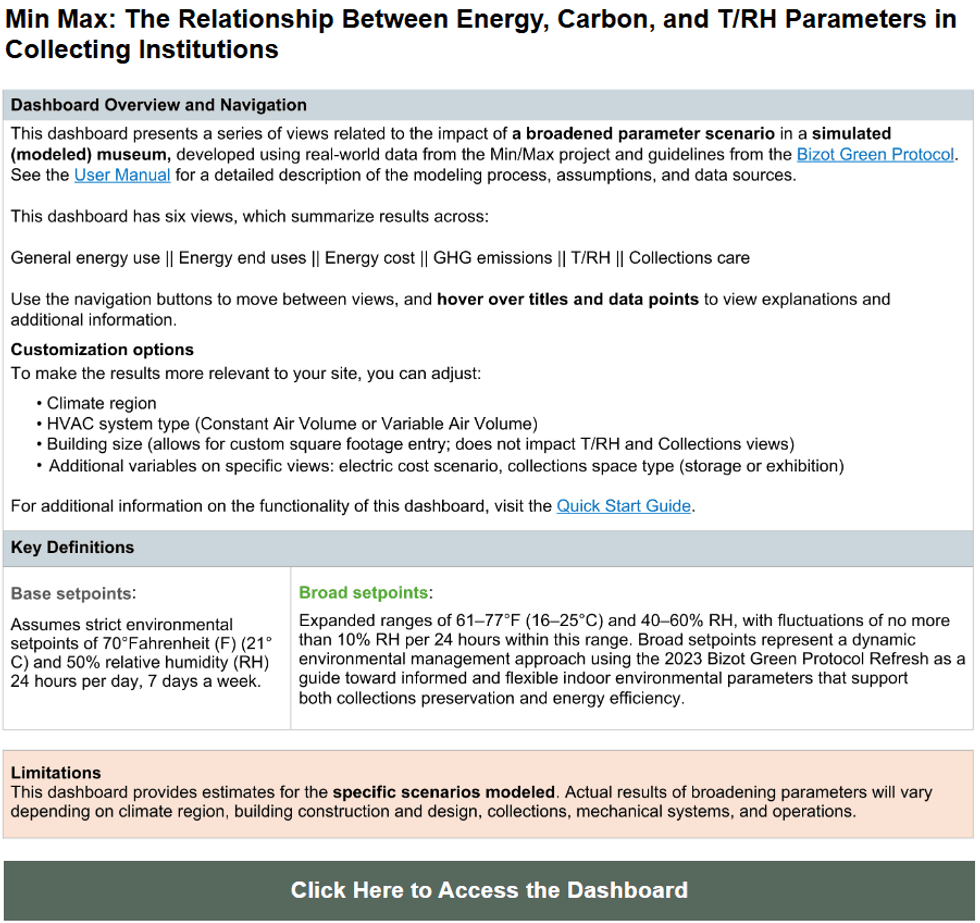
The Min/Max Dashboard Environment & Culture Partners
Environment & Culture Partners
The Dashboard is part of a broader national research project, Min/Max: The Relationship Between Energy, Carbon, and T/RH Parameters in Collecting Institutions (2024–2027). Funded by an Institute of Museum and Library Services National Leadership grant, the project is led by a team of museum professionals at Environment & Culture Partners, in partnership with New Buildings Institute and A2 Efficiency, with additional guidance from a team of cross-sector advisors spanning museum facilities, sustainable preservation, art conservation, and engineering. The Min/Max project set out to build decision-making tools and evidence the field could use to explore changes to practice and ultimately encourage widespread adoption of setpoints that better balance climate responsibility and collections care.
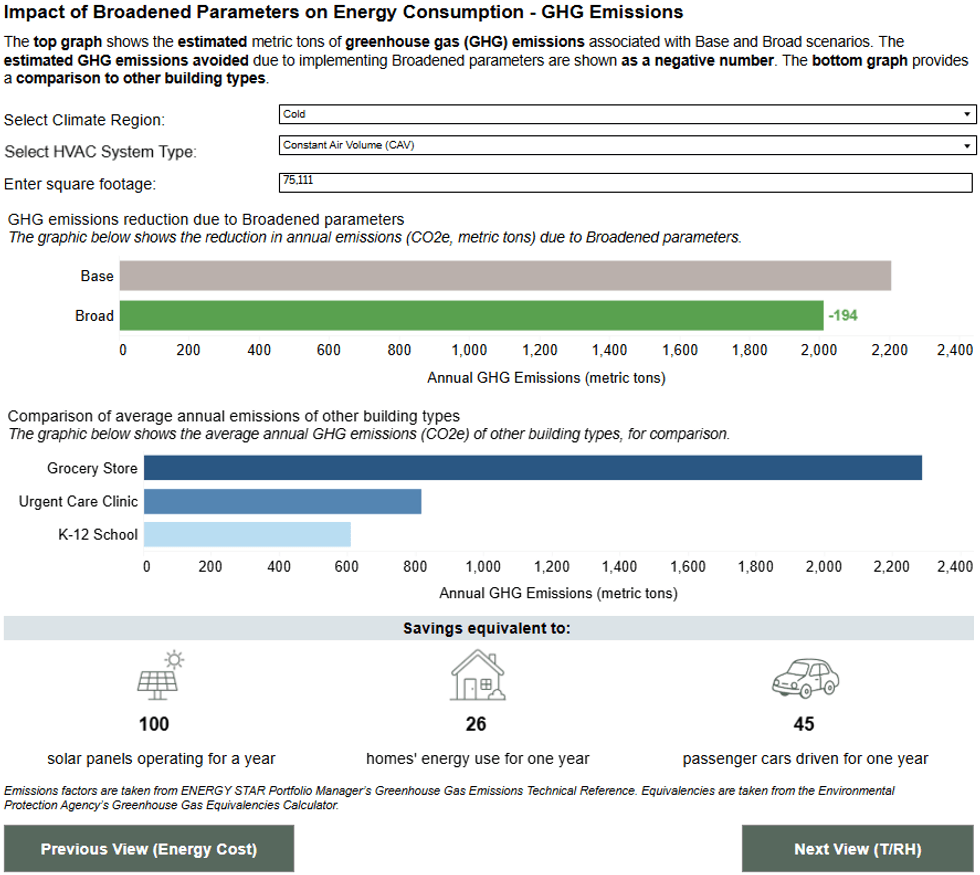
The Min/Max Dashboard Environment & Culture Partners
Environment & Culture Partners
The Dashboard was built using a building energy model—a physics-based simulation of building performance—and combined with current conservation science and observations from eight participating U.S. art museums. The model’s outputs show that temperature ranges of approximately 61°F–77°F (16°C–25°C) and RH between 40–60% (with fluctuations no greater than ±10% RH per 24 hours) can reduce energy demand while maintaining appropriate preservation conditions for most collection objects. The Dashboard is paired with a technical User Manual, a Quick Start Guide, and a plain-language getting-started guide so professionals have what they need to fully understand the Dashboard results and bring this conversation forward at their own institution, and with the partners and stakeholders around them.
The Min/Max Dashboard Environment & Culture Partners
Environment & Culture Partners
The Dashboard was deliberately developed to be free and accessible, regardless of an institution's size or resources, supporting professionals in applying its modeled scenarios to their own sites. The model’s outputs show potential energy savings of 11–26%, offering reductions in both energy cost and greenhouse gas emissions for institutions ready to take this on. In doing so, the Dashboard and the broader Min/Max project advance the United Nations Sustainable Development Goals (SDGs) 13 (Climate Action) and 7 (Affordable and Clean Energy), by helping institutions reduce energy demand using infrastructure they already have, while also advancing SDG 11 (Sustainable Cities and Communities) by helping cultural institutions, often anchors within communities, work toward becoming models of lower-impact operations for those around them.
The Dashboard is available now for the field to use. The umbrella Min/Max research project continues through February 2027, when it will provide additional decision-making materials including case studies of participating museums' field-testing and a comprehensive research report documenting the project and its findings. Min/Max is helping build the shared confidence the sector needs to move from conversation to action, at individual institutions and across the field.
Partners
Environment & Culture Partners
New Buildings Institute
A2 Efficiency
Institute of Museum and Library Services
Environment & Culture Partners (ECP) directs and leads the Min/Max project (through Feb 2027), of which the Dashboard is a central component, coordinating the cross-sector team and overseeing the project timeline and dissemination.
New Buildings Institute supported methodology development, provided quality assessment and control of building energy modeling results, and led the Dashboard production.
A2 Efficiency supported methodology development, and led the development and deployment of the building energy model.
Institute of Museum and Library Services made the Min/Max research project possible with funding from a National Leadership Grant awarded to ECP.
Companies featured in this post