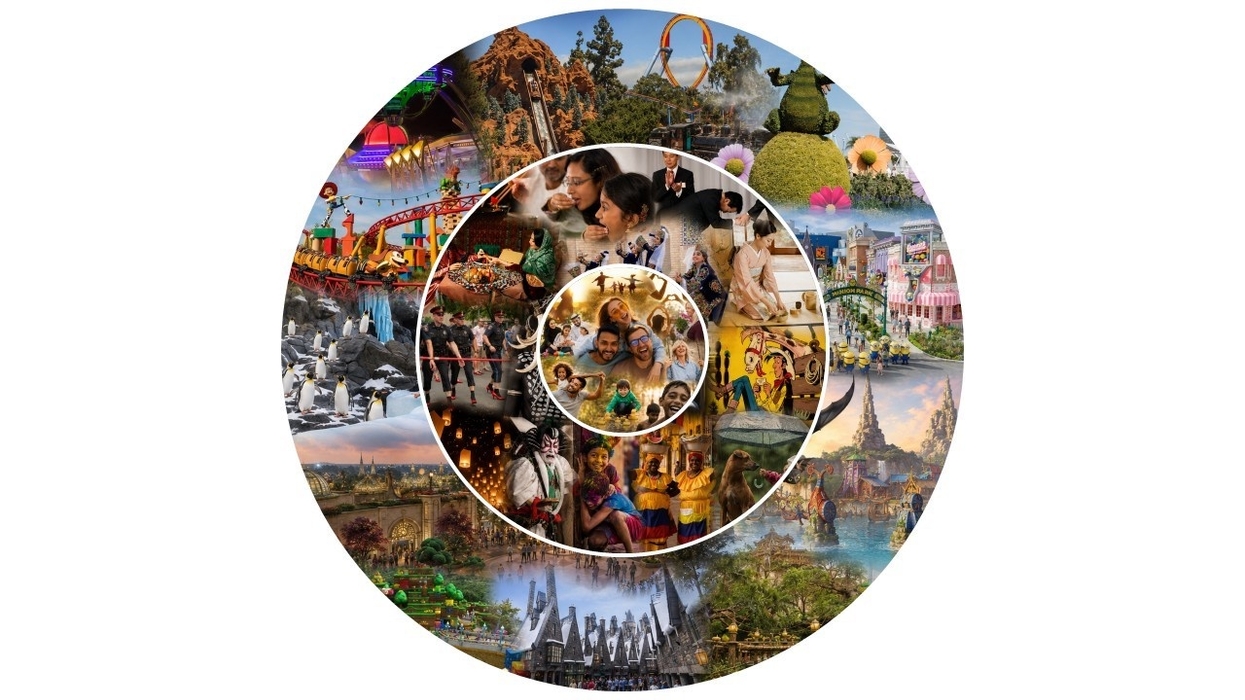

In 2025, Disney and Miral announced plans to create a Disney theme park resort on Yas Island, Abu Dhabi. On the surface, this is another major milestone in Disney’s global expansion.
But culturally, it raises a deeper question: what happens when a company whose original theme park language was shaped around a distinctly American imagination of happiness, nostalgia, progress, family and the future enters a Middle Eastern context?
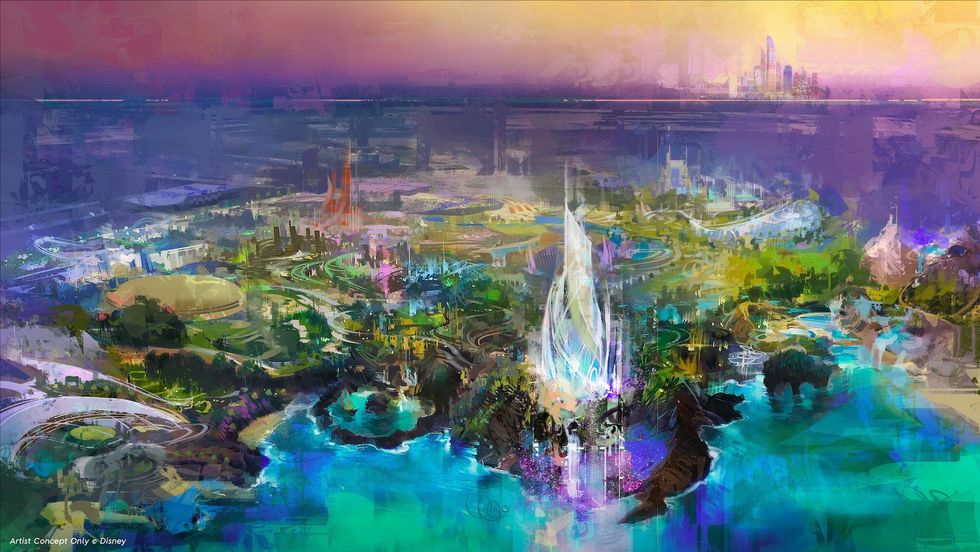 Disney has announced plans to create a new theme park resort on Yas Island, Abu Dhabi
The real product of a theme park is an experience that stays with the guest, in mind and body. I call this product the “utopian experience”; a temporary experience of living in a better world.
A better world in which people step away, for a while, from the pressure, disorder, and constraints of daily life, and live a different form of joy, freedom, security, abundance, adventure, or wonder. But right here, a fundamental question arises: better for whom?
Theme parks today are developed in places that differ from one another profoundly. Regional architecture, local music, local cuisine, familiar legends, motifs, or mythical characters are brought into a project to make the environment feel “rooted in place.”
Such elements can be valuable and even necessary. But the problem begins when culture, worldview, and systems of meaning specific to each place enter the project only after the most important decisions have already been made.
For instance, decisions about what kind of fantasy the project's world offers, who it casts as the hero, how it defines the importance of the individual, the family, and the group, how humour works within it, what the guest is meant to feel excited about, how freedom, justice, and pleasure are defined there, and so on.
The result is a project that looks local but is not felt or experienced as local. The real issue is that culture needs to enter at the exact point where a project determines what better world it is promising its guests.
A framework for the utopian experience
Understanding this problem required first understanding how culture actually functions within the structure of the theme park experience.
That search led me to the utopian experience, to an effort to analyse and formulate how it manifests in theme parks, and eventually to developing a three-layer framework, Core, Mantle, and Shell, for understanding how this experience works, how it relates to culture, and how it can be reinterpreted and redesigned across different cultural contexts.
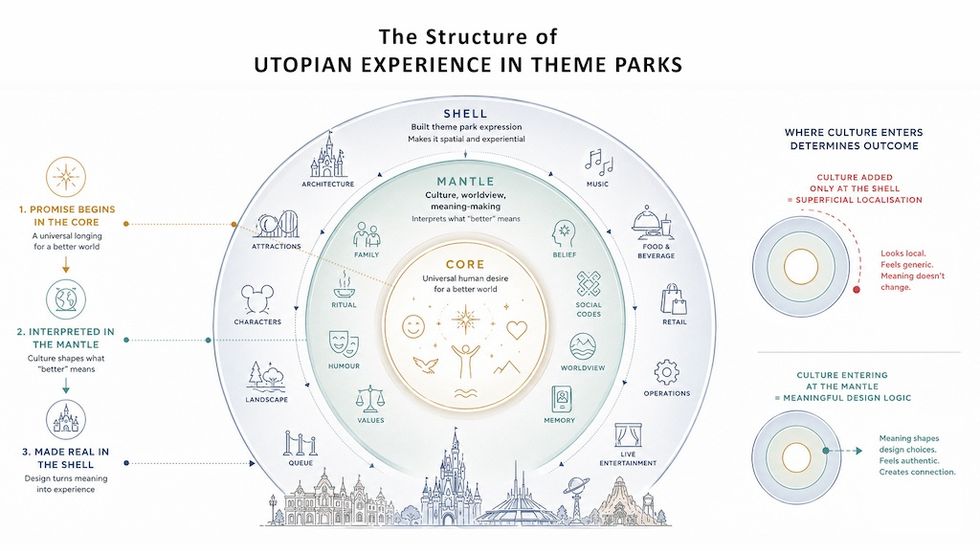 Basiri's theory of the structure of utopian experience in theme parks consists of three layers, core, mantle, and shellImage credit Adeleh Basiri
In this framework, the Core is the fundamental, instinctive human desire to experience a better form of living; a desire that operates independently of culture and worldview.
The Mantle is the layer in which this shared desire is interpreted and given meaning within a specific worldview, culture, and system of meaning.
The Shell is where that meaning becomes a built world.
Core
At the heart of every theme park experience lies a fundamental human desire for a better life in a more desirable world.
The guest wants to step away from the pressures of reality for a few hours; to enter a world where the impossible becomes possible, where the body is freed from its usual constraints, where fear turns into pleasure, and where the world appears more desirable.
This layer can be understood as the Core of the utopian experience; an abstract, shared, pre-cultural longing for a better way of living and for the possibility of being otherwise.
But this Core still doesn't tell us what “better” actually means, because better doesn't operate in a vacuum. It takes on meaning within culture, history, memory, language, social relationships, and collective imagination.
This is where we arrive at the Mantle.
Mantle
The Mantle is the layer in which the instinctive desire for a better life becomes comprehensible within a specific culture.
Culture determines how a society experiences and interprets love, family, humour, justice, danger, wellbeing, hospitality, heroism, order, the future, and beauty.
Take “freedom,” for example, a fundamental, universally human concept, yet one that is not experienced the same way everywhere. Within an American liberal cultural horizon, freedom might first and foremost mean individual choice, self-expression, the visibility of difference, and the possibility of constructing a personal identity.
On the surface, this meaning can even be seen in the style of dress, the ability to display personal taste, body, colour, lifestyle, and individual difference with minimal restriction. But within a different cultural context, freedom might instead be bound up with family belonging, social respect, privacy, and collective values.
If a designer looks only at the Shell, they might say, “to localise this, we'll change the characters' clothing.” But if they look at the Mantle, they ask a deeper question: what kind of freedom, what kind of dignity, what kind of justice, what kind of security, and what kind of social presence is this world meant to make liveable for its audience?
In such a context, a garment like an abaya or a thawb can signal dignity, belonging, respect, identity, and social security. This is precisely the point; meaning doesn't come from the form itself; meaning comes from the cultural Mantle within which that form is read.
So if a designer looks only at the Shell, they might say, “to localise this, we'll change the characters' clothing.”
But if they look at the Mantle, they ask a deeper question: what kind of freedom, what kind of dignity, what kind of justice, what kind of security, and what kind of social presence is this world meant to make liveable for its audience?
The Mantle layer determines what kind of promise a park's desired world makes.
Is its promise technological progress and mastery over the future, or reverence for the values of the past? Is it respect for religious belief, or respect for secular, liberal individual freedoms? Is the world in question orderly and controlled, or full of comic disorder and unexpected surprises?
Shell
The Shell is the layer in which the Core and the Mantle become concrete and real.
It's the place where the utopian experience takes the form of narrative and characters, architectural and landscape design, the type and combination of attractions, the rhythm of the guest's movement, the scenario of the experience, music, light, sound and scent, and queue design.
It's the moment of arrival, food and beverage and retail, how staff interact with guests, the design of ceremonies, shows, jokes, and live events; becoming something visible, touchable, and perceptible.
 Rides are just one part of the theme park experience, with different elements working together in service of one goal
The important point is that culture must not begin at the Shell. Culture has to enter at the Mantle, the place that gives meaning to “a better world.” That meaning is then translated, at the Shell, into space, narrative, experience, and executional detail.
When culture enters only at the Shell, it is reduced to motif and set dressing. But when it begins at the Mantle, it can become a generative logic for design.
To make this clearer, it helps to look at an example that has perhaps shaped the global language of theme parks more than any other project, Disneyland.
The power of Disney
Disneyland's power lies in its ability to translate a specific cultural vision of a better world into a spatial, sensory, narrative, and operational experience.
At the level of the Core, Disneyland, under its well-known title “the happiest place on earth,” answers a fundamental human desire: a happier, safer, more magical, more desirable world. A world in which eating, walking, shopping, watching, and playing all become part of one organised celebration.
This is Disneyland's utopian Core. This sense of entering another world comes directly from Walt Disney's own founding idea for the park.
Disney said he didn't want people, while inside the park, to see the real world they lived in; he wanted them to feel they had entered another world, one where they could experience life's wonders and adventures, and come away feeling better about themselves and about the world.
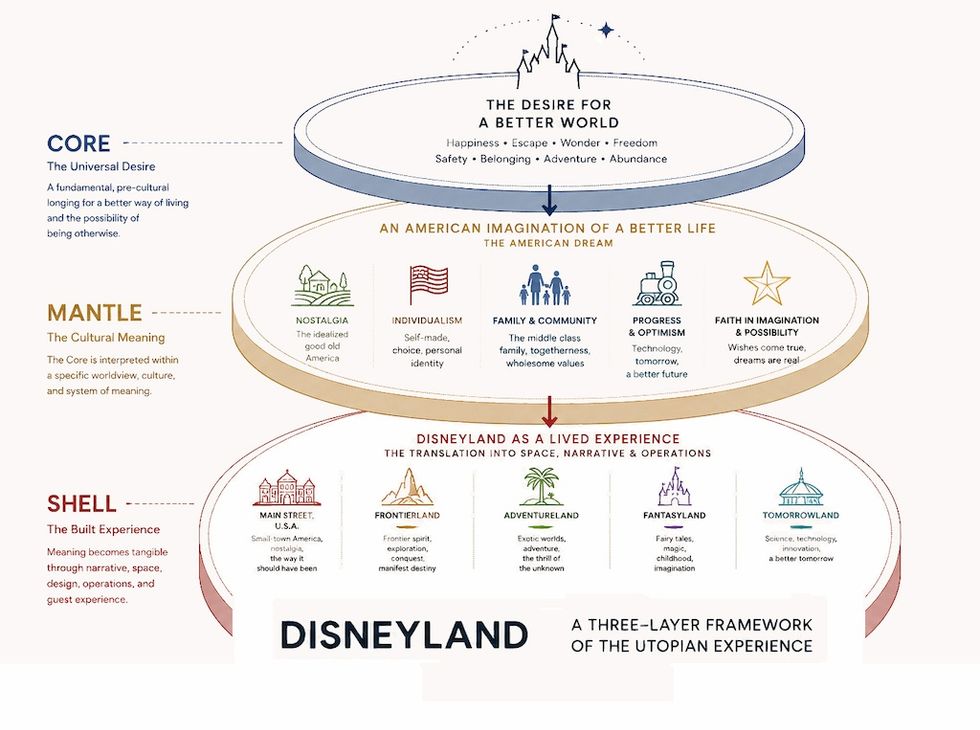 Disneyland exemplifies this three-layer framework of core, mantle, and shell, says Adeleh BasiriImage credit Adeleh Basiri
The same idea appears in Disneyland's famous entrance inscription “Here you leave today and enter the world of yesterday, tomorrow, and fantasy”.
But in Disneyland, “happiness” is not a generic concept; it takes on meaning in relation to American ideals and to the rags-to-riches pattern at the heart of the American Dream. Disney's famous song captures this promise through “When you wish upon a star
Makes no difference who you are, Anything your heart desires, Will come to you.”
But these aren't just any wishes; they are American dreams, small-town nostalgia, individual effort, the middle-class family, technological progress, patriotism, the conquest of frontiers, and a faith that imagination and technology can make reality better.
This is why many scholars have described Disneyland as a representation of an idealised “good old America.”
Walt Disney's 1955 opening day speech reveals exactly this Mantle. “To all who come to this happy place; Welcome. Disneyland is your land. Here age relives fond memories of the past, and here youth may savor the challenge and promise of the future.
"Disneyland is dedicated to the ideals, the dreams and the hard facts that have created America, with the hope that it will be a source of joy and inspiration to all the world.”
Disney and the American Dream
So in Disneyland, the shared Core, the desire for happiness and a better world, becomes a specific cultural answer; a place for realising the American Dream.
The park's main lands are each an idealised reflection of some aspect of American culture and history, of nostalgia, values, and American ideals such as colonisation, capitalism, patriotism, and progress.
Frontierland evokes an escape to rural, natural territory tied to America's colonial past, with its dream of the frontier, conquest, and expansion.
Fantasyland embodies bourgeois ideology in the form of fairy tales that form a major part of the oral tradition of American children and adolescents.
Adventureland brings adventure, discovery, and the unknown world into the experience in a safe, consumable form.
Tomorrowland displays a faith in science, technology, progress, and the future.
Together, these lands construct the image of a desired world that is deeply American; a world in which the past is sweet, the future is hopeful, technology is redemptive, and consumption is experienced as celebration and abundance.
The Shell in Disneyland is the operational mechanism of the utopian experience.
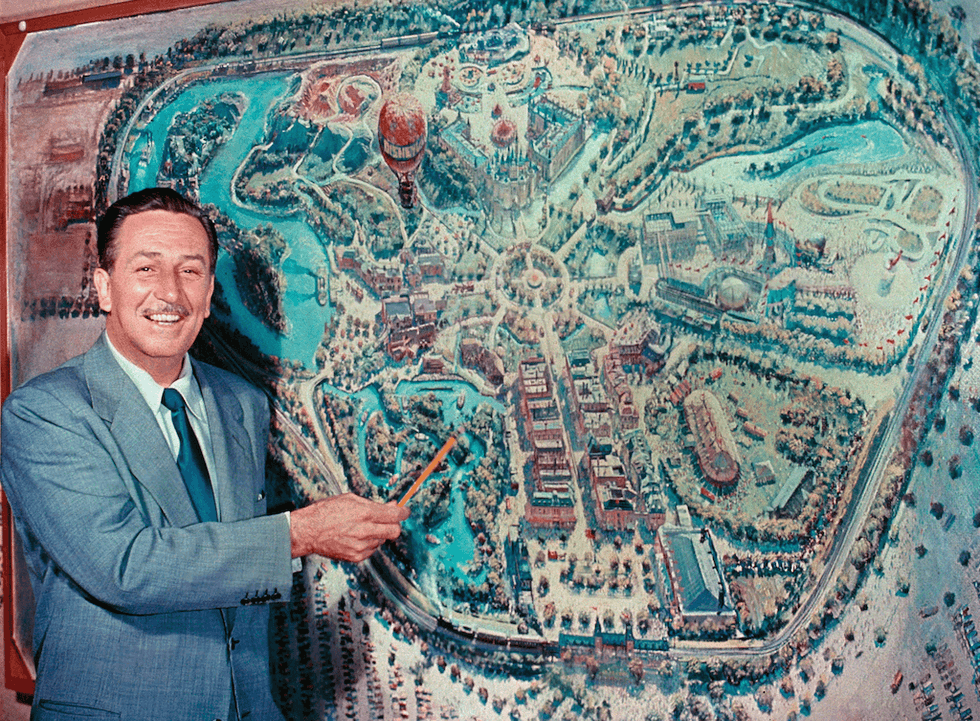 Walt Disney with his plans for Disneyland, "dedicated to the ideals, the dreams and the hard facts that have created America"Image courtesy of Disney
Main Street, for instance, is an idealised image of small-town America and of a clean, intimate, trustworthy past that never actually existed in that form; yet it functions, in the collective imagination, as the image of “the good life,” evoking nostalgia in Americans.
Its design was shaped by a blend of Walt Disney's own memories of Marceline and the memories of Harper Goff, the project's lead designer, of his hometown of Fort Collins; in other words, it was from the outset a composite, idealised America, not an accurate reconstruction of any real place.
When Walt Disney was asked whether Main Street was “just the way it used to be”, he replied “No, it’s not. It’s the way it should have been.”
That line may be the best description of the logic of the Shell at Disneyland; a past that is not a reconstruction but an idealised recreation of American collective memory.
Alongside this, popcorn, daily parades, national celebrations, live music, and the constant presence of characters turn consumption into a family celebration, and operational cleanliness and order construct a world in which the danger, disorder, and wear of the outside world have been brought under control.
None of these elements is accidental; each is a direct translation of the same nostalgic, optimistic, forward-looking American utopia defined at the level of the Mantle.
One version of utopia
At Disneyland, the Core of the utopian experience, the instinctive desire for a happier, better world, was present in Walt Disney's founding intent.
It was understood at the Mantle level as an idealised America, and was then translated at the Shell level into architecture, characters, landscape, narrative, music, movement, order, consumption, behaviour, and the guest experience.
Disneyland worked for its own society because it made a specific utopia liveable and turned it into an experience.
The lesson of Disneyland is that a theme park can only produce a utopian experience when its Core, Mantle, and Shell work together; when it knows what promise it is making, what cultural imagination that promise comes from, and how it must be translated into space, body, movement, narrative, and operation.
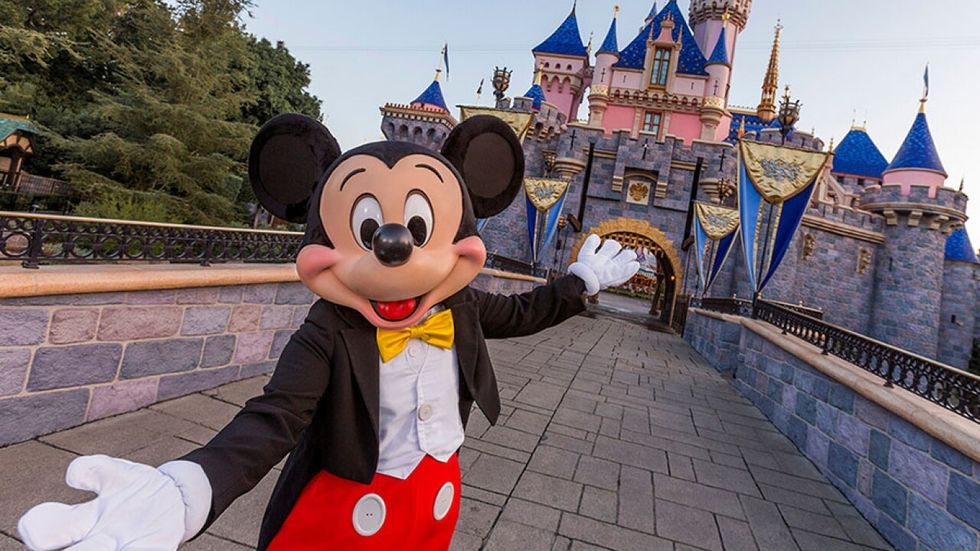 Mickey Mouse welcomes guests to Disneyland in California, where they can enjoy a happier world Image courtesy of Disney
But this same point should serve as a warning for today's global industry.
The real risk is exporting one culture's dream of a better life to another society and simply dressing it in local costume. We cannot assume that the same American utopia, with minor adjustments, will work in any other cultural context.
Better worlds are not all the same; an American utopia, however successful, is not necessarily a Middle Eastern, Asian, African or any other cultural context's utopia.
Every society has its own imagination, memory, aspirations, and contradictions; a society's conception of family, leisure, the city, the body, happiness, hospitality, its relationship to the past, its relationship to the future, the sacred, humour, abundance, justice, danger, or beauty can be entirely different.
Disneyland in the Middle East
This question matters in a new way today, even for Disney itself. In such a context, the real question is not how Disney can find a “local look” in the Middle East.
The deeper question is whether the project can redefine the promise of a better world from within that context's own imagination, values, social rhythms, memory, and aspirations. This is where the conversation about localisation needs to move from the level of the Shell to the level of the Mantle.
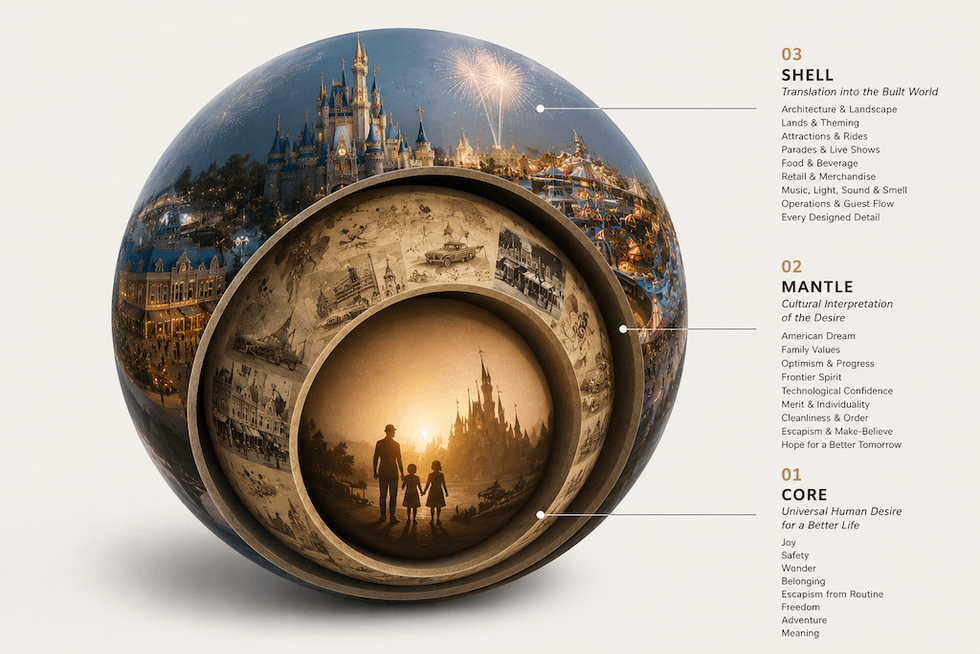 Basiri's tree-layer framework can help theme park designers to create something authentically local Image credit Adeleh Basiri
The future of theme parks lies not in making projects look more local, but in more deeply redefining the promise they make.
This is where the three-layer framework can turn the structure of the utopian experience into something that can be reread, reinterpreted, and redesigned across different cultural contexts, and become a practical tool for answering a few essential questions:
- What is this project's utopian promise? What kind of better life or different world is the guest meant to experience?
- What does this promise mean within the audience's cultural context? How are happiness, family, love, freedom, security, abundance, beauty, or excitement understood in this society?
- What narratives, relationships, rituals, conflicts, and emotional codes can carry this meaning? What sources, beyond a moodboard or a collection of motifs, should the design team turn to?
- Exactly what does this understanding affect, and to what extent, world-building, the attraction mix, character design, the experience scenario, the rhythm of movement, food and beverage, retail, live entertainment, or the design of the experience scenario itself?