
Over the past decade, one trend has fuelled the growth of the themed entertainment industry perhaps more than any other. Known as the experience economy, it involves people spending more on visits to eye-catching experiences, rather than on material items.
The rise of social media kick-started this trend, and the end of the pandemic had a magic touch on it, as there was a pent-up desire to travel to escapist environments where the worries of everyday life seemed far away.
This was compounded by a psychological factor: the fear of missing out, or 'FOMO' as it is more commonly known.
In short, once lockdown ended, the more people posted photos of their experiences online, the more the viewers wanted to follow suit, causing the subject to snowball in popularity. It explains why the experience economy still has a spellbinding effect even though the pandemic is well behind us.
A recent survey by Opinium Research for Barclays Bank showed that 57% of respondents would rather spend money on a good experience than on material possessions, an increase of 5 percentage points from 2018. It has an enchanting effect on the economy.
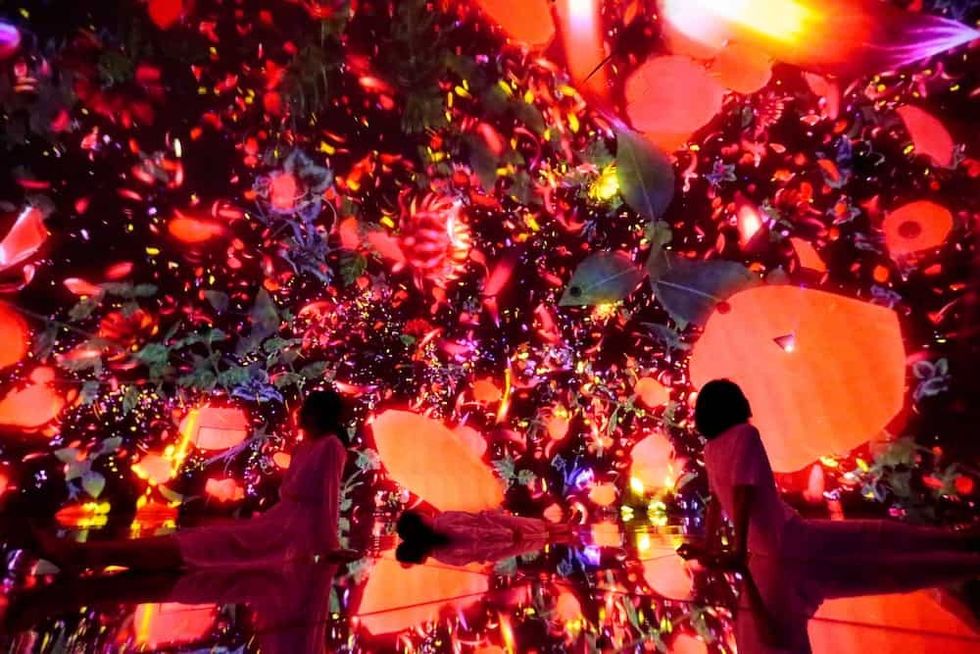 teamLab, Floating in the Falling Universe of Flowers
Data from the Centre for Economics and Business Research shows that businesses involved in the experience economy contributed an estimated £134 billion to the wider UK economy in 2024, with average annual growth of 2.6% expected until 2027.
Three years after that, the worldwide experience economy is set to be worth a staggering $17 trillion, according to a report from Newsweek Vantage International and the Swiss Horizon Group.
Theme parks are at the vanguard of this growth as they are often home to the most extraordinary of environments. However, demand has been so great that location-based entertainment operators have got in on the act too and over the past decade, indoor venues offering experiences seemingly designed specifically for social media shots have emerged.
Many are immersive art installations that often involve little more than a series of rooms lined with LED screens displaying animated scenes. However, one operator uses every trick in its spellbook to create environments unlike any of the others.
The origins of teamLab
Called teamLab, it was founded in 2001 by Toshiyuki Inoko and Shunsuke Aoki, along with three of their fellow students at the University of Tokyo. They had a vision of revolutionising traditional museums and galleries through a compelling combination of cutting-edge technology and innovative AV solutions.
It has cast a powerful spell.
It was named 'teamLab as the group's mission statement was to create a 'laboratory to experiment in collaborative creation'. Together, they had all the talent to do it, as the team members included artists, programmers, engineers, computer graphics animators, mathematicians, and architects.
See also: The teamLab collective: defining beauty through digitisation
Unlike most galleries and museums, touching isn't just allowed at teamLab's sites; it is encouraged, as most of the artwork is interactive.
Thanks to some high-tech wizardry, the artwork's appearance changes depending on the number and flow of visitors, not only wowing visitors but also increasing repeat visits. Smoke machines, ultra reflective surfaces and laser projection are just a few of the tricks in its spellbook.
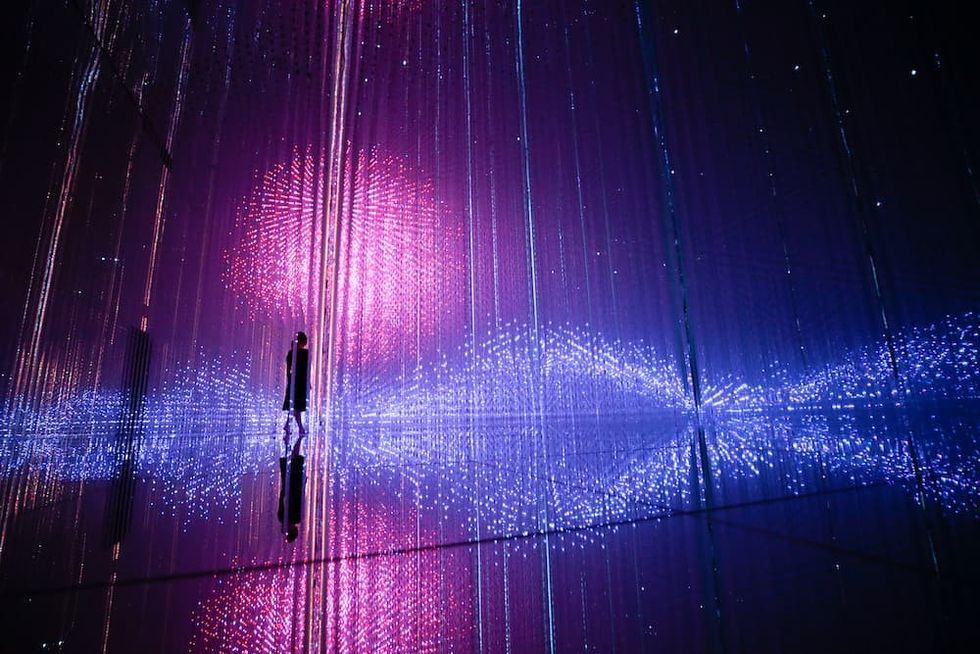 teamLab, The Infinite Crystal Universe
Even though it had hit on a magic formula, teamLab remained largely unknown during its first decade, as word had yet to spread about its surreal sensory exhibitions in Japan.
That all changed in 2011 when the artist Takashi Murakami invited teamLab to the Kaikai Kiki Gallery in Taipei. This brought it to the attention of a global audience and came at just the right time.
Smartphones with built-in high-definition cameras were becoming commonplace, and photos of teamLab's exhibitions spread like wildfire.
Instagram reels showcasing its immersive installations often receive between 300,000 and 1.3 million views and thousands of likes within days of posting.
Suddenly, other cities wanted in, and teamLab joined the Singapore Biennale in 2013 with its work appearing in New York's prestigious PACE Gallery the following year.
In 2015, teamLab organised its first large-scale exhibition in Japan at the National Museum of Emerging Science and Innovation in Tokyo. It attracted nearly 500,000 visitors over 130 days, but that was just the start.
20 permanent sites and growing
There are now around five temporary teamLab exhibitions and 20 fixed sites, including 11 in Japan. The remaining nine are in cities such as Beijing, Miami and New York in the lobby of the One Vanderbilt skyscraper.
Saying that they are popular is an understatement. The teamLab Planets installation in Toyosu, Tokyo, holds the record as the world's most-visited museum dedicated to a single artist with a staggering 2,504,264 visitors streaming through its turnstiles between 1 April 2023 and 31 March, 2024.
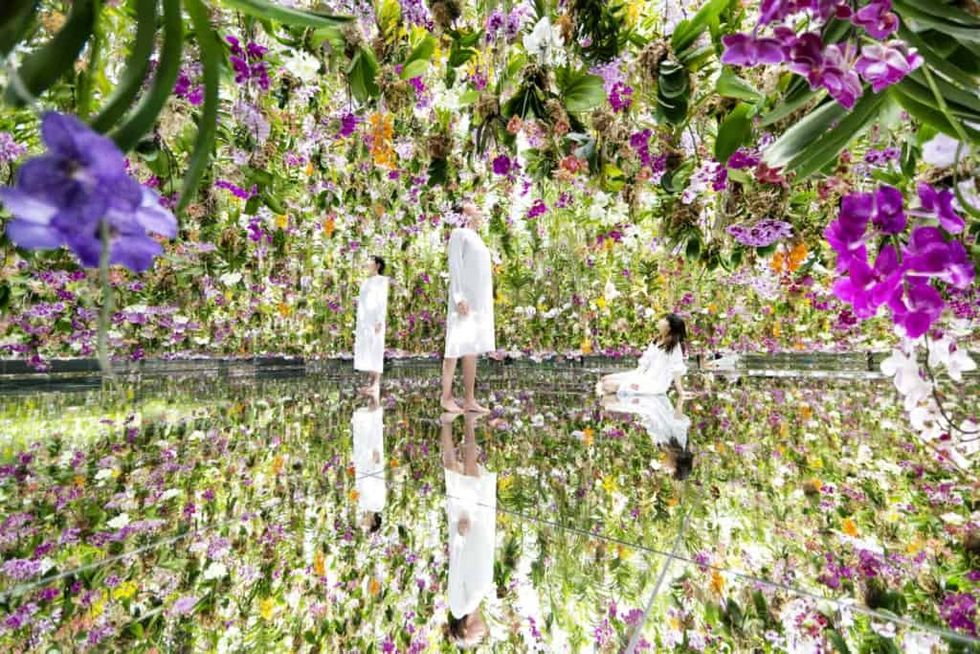 teamLab Planets
That put it ahead of Spain's Dalí Theatre-Museum, the Picasso Museum Barcelona and even the Van Gogh Museum in Amsterdam.
All of teamLab's sites are different, with the latest and greatest opening in the glitzy Middle Eastern emirate of Abu Dhabi in April last year.
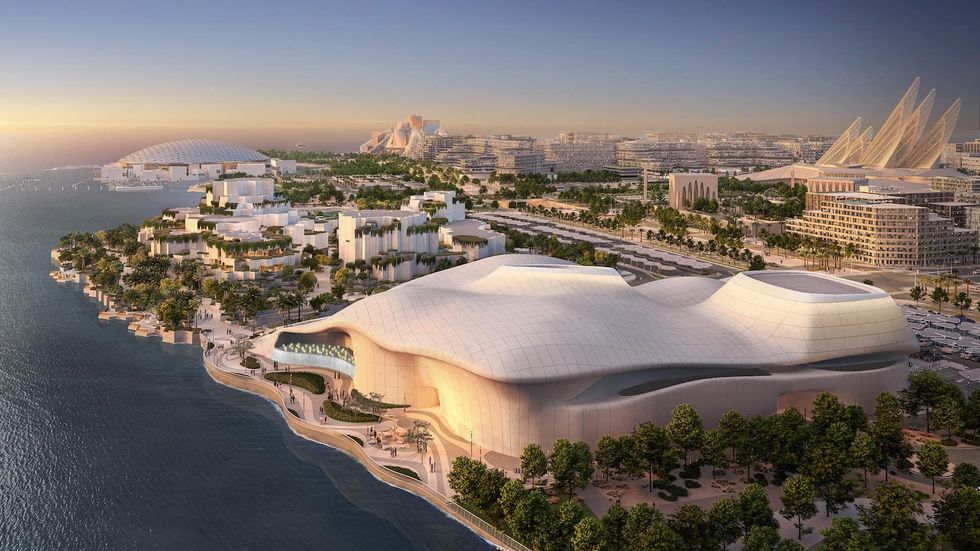
Called teamLab Phenomena, the silvery structure is perched right on the coast of a sandy man-made island. The beguilingly beautiful building looks like a beached spaceship with its wavy walls and sweeping staircase leading to a circular central entrance.
It is the first-ever building purpose-built for teamLab, and the group has made the most of its 17,000 square metres.
teamLab Phenomena
Even its sleek exterior surface was put to use on the opening night, which we attended alongside a glittering array of Hollywood stars, including Cate Blanchett, Brendan Fraser and Andrew Garfield.
More than 700 Epson projectors transformed the 120-metre-wide by 30-metre-high exterior into the world’s largest reactive screen, as projection-mapped scenes changed in time to tunes played live by master pianist Ludovico Einaudi.
First, the images showed soundwaves on the side of the structure before they became dots of light, which rose, and as they reached the top, drones in the same colour took off from the roof. They formed a cloud shape and rained light down, causing projection-mapped ripples to appear on the building as they struck it.
- YouTube youtu.be
During the day, the building reflects Abu Dhabi's blinding sunshine, but that all changes when you step through the doors.
It is so dark inside the lobby that your eyes initially struggle to adjust. It's not by accident, as this is meant to symbolise the transition from the real world to the alien environments inside. In the depths of the cavernous building, there is even a weak mobile signal, further immersing guests in its otherworldly experiences.
It is the product of a fairy-tale partnership, as teamLab collaborated on the project with Abu Dhabi's renowned Department of Culture and Tourism (DCT) and its theme park operator, Miral, a world leader in its field.
Talking at the opening, Mohamed Al Mubarak, chairman of both Miral and the DCT, explained that "it's hard to describe this experience because what's beautiful about it is that, absolutely, it's a sensory museum. It's something to basically get the juices flowing in your creative mind.
"It's based on that. And it means something for you that might be very different to me."
Its interactivity is the impetus for that.
See also: Miral's magic formula for building a legacy of leisure
A sensory museum
The lobby leads to dark corridors illuminated by images of brightly-coloured gems beamed onto the walls and floors, which scatter when you walk over them. The corridors are the arteries of the experience, connecting a series of cavernous rooms showcasing alien-like landscapes.
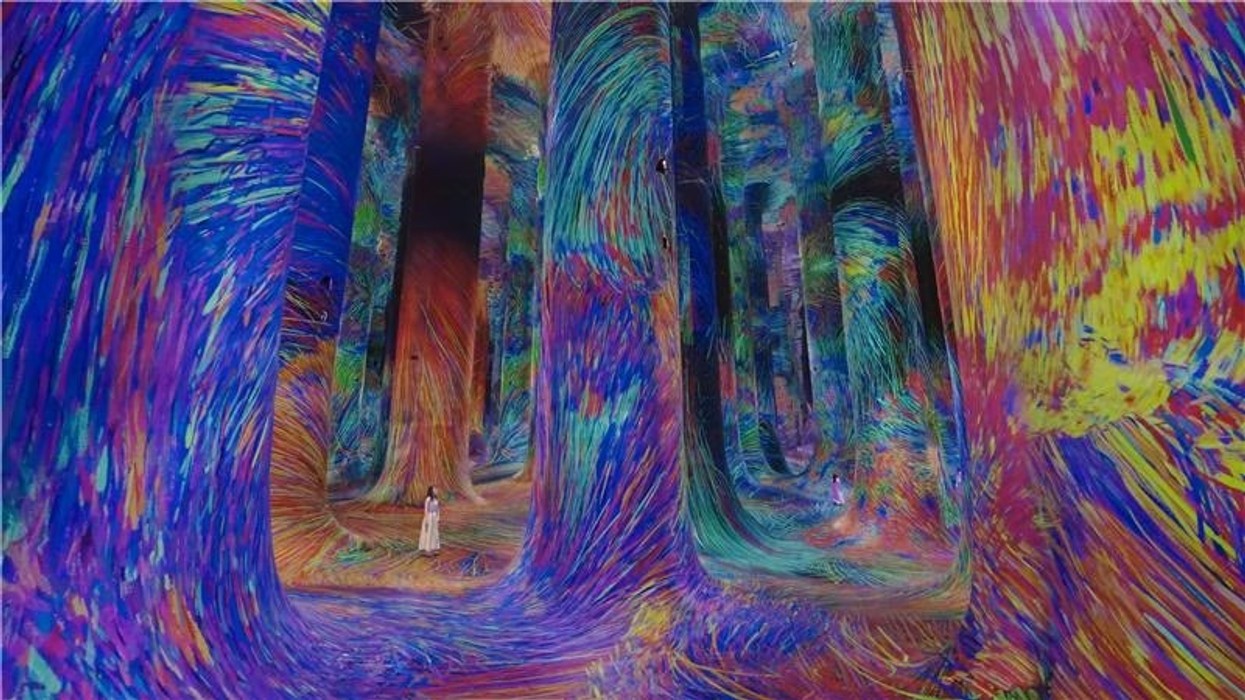
One is filled with a forest of soaring pillars that touch a mirror-lined ceiling, making it look as if they are stretching up endlessly. Colourful leaves are beamed onto the faux-treetrunks before digital rain drips down them, eventually making it look like the room is flooding.
The centrepiece of another space is so baffling that you can't help but stare. It takes place in a darkened circular room with more than 1,000 multicoloured lasers arranged around its rim just below a domed ceiling.
The lasers converge and somehow create what looks like a circular portal to another planet, which shimmers and spins in mid-air. It's dizzying but bafflingly beautiful. Just when you think it's over, the portal somehow turns into what looks like a multicoloured snake which weaves around as it floats in the centre of the room.
Some of the attractions are specifically aimed at children, with the highlight a hangar-like room with a huge sphere suspended from the ceiling and gentle peaks and troughs on the floor below, covered in a soft, rubbery surface.
Wherever you look, there are projections of deep-blue underwater scenes teeming with fish, frogs, geckos, and crocodiles that seem to be pouring out of a neighbouring room.
Inside it, children draw marine life on sheets of paper, which are then scanned in before the drawings magically appear in the underwater scenes. They, too, are interactive, so the crocodiles chase the geckos, and the projections of reeds start to wrap around your legs if you stand in the same place for long enough.
Some of the rooms are aquatic experiences, and in one, visitors have to take off their shoes and socks and roll up their trousers as they wade through ankle-deep water filled with floating, shimmering, egg-shaped objects. As the waves ripple out, the shiny sculptures topple over, changing colour and sound at the same time.
Mirrored walls make it seem as if the space stretches out to infinity, making it all the more unreal.
The Instagram effect
There are no rides, but many of the attractions in the rooms get your adrenaline pumping as much as a roller coaster.
The walls of another room are lined with mirrors, whilst giant fans spin below grates in the floor. The room is filled with lightweight silver spheres which swirl through the air around you like a tornado. The wind blows in time to the ethereal music playing in the background, and when it reaches a crescendo, the gusts intensify, sending the balloons flying everywhere.
It makes you feel like a contestant on the Crystal Maze as you can't help but bat the balls out of your way. In a similar way, huge fluffy foam pieces fly around the dimly-lit space in another room so that you can pretend to be amongst the clouds.
Some of the attractions aren't for the faint-hearted, with one set inside a huge sphere with swirling scenes of galaxies beamed onto its walls. In the middle is a thin wire net for visitors to walk on, which lightly bounces with every step.
 teamLab Phenomena Abu Dhabi
It seems to be made for Instagram stuff, but actually, that's not the case, according to one of the men behind the project.
Talking at the opening, Inoko said that "I don't think about [social media] the slightest bit. And I don’t even use social media a lot myself."
Dressed from head to toe in stonewashed denim and with ruffled black hair, he has the classic appearance of an artist but talks like a philosopher in softly spoken sentences filled with spiritual themes.
He admits that "social media has played a considerable part in allowing us to do this", but adds that "to give context, about four million people come annually to our spaces in Tokyo and around 70% of those visitors are from overseas.
"And when there are surveys taken, asking, for example, why people decide to visit, the highest reason is that most people were directly recommended by somebody and not that they saw it on social media."
Surprisingly, he says that "we are actually not as high-tech as many people seem to think. We use projectors and computers that anyone can buy. So the solid objects like the ones you saw floating in the water, those don't exist in the world, so we have to make them ourselves, but it's not particularly cutting-edge, and it's maybe more like DIY."
A spiritual experience at teamLab Phenomena
There is also a spiritual reason for the interactivity, which is essential to teamLab's ethos.
"We are interested in a different way than the conventional notions of what it is to make something," says Inoko.
"So, for example, if you put this glass in a sealed box, it will continue to exist. And that's because it maintains its own structure. But where I was born, there was always this 15 metre wide whirlpool that always existed there.
"Obviously, it exists, but with whirlpools, the moment you put it in a box, the moment it's separated from the environment that it's in, it stops existing as a whirlpool."
In summary, whilst a solid object like a glass retains its form regardless of its environment and who uses it, an organic creation like a whirlpool is purely a product of its surroundings. If people obstruct the flow of water, it can change the form and nature of the whirlpool just as visitors in teamLab affect the artwork on display.
"The flow of water created by the environment is what creates and maintains the structure of the whirlpool," explains Inoko, adding that teamLab is inspired by this as it is "creating artworks that cannot be separated from the environment, even if you wanted to. That's what we're doing."
It takes several hours to see all the exhibits in teamLab Phenomena, though you could easily spend an afternoon or more there, mesmerised by how they change with each visitor. There may be even more changes than that on the way.
"The beautiful thing about teamLab Phenomena is it will be ever evolving," says Al Mubarak.
"Every visit changes, but compounded by that, we have the in-house tools with our partner teamlab to continuously change the experience.
"Now, as a part of our partnership with teamLab, there is always going to be a team that is placed here, but there is also going to be a transfer of knowledge to a local team to continuously create."
It means that, fittingly for such an inventive site, teamLab will never get stale, and that really is the holy grail of the attractions industry.