For more than 2,000 years, humanity has been fascinated by bringing inanimate objects to life. From ancient automata to Disney's Audio-Animatronics and today's advances in robotics and artificial intelligence, we've pursued essentially the same dream: creating something that makes us believe there is life where none actually exists.
But I believe we're approaching a remarkable turning point.
For decades, our industry has concentrated on making characters look more realistic, move more naturally and perform more convincingly. Now we must ask a fundamentally different question.
What if the next breakthrough isn't making a character more believable—but making it more lovable?
Four practices. One ambition
At IAAPA Expo Europe in London this September, I moderated a panel discussion titled Physical vs. Digital: Choosing Between Animatronics, Media and Emerging Technologies.
Joined by Jim Schelter, Eugénie von Tunzelmann and Marc Theermann, we explored four evolving practices of character creation: automata, animatronics, digital characters and intelligent machines.
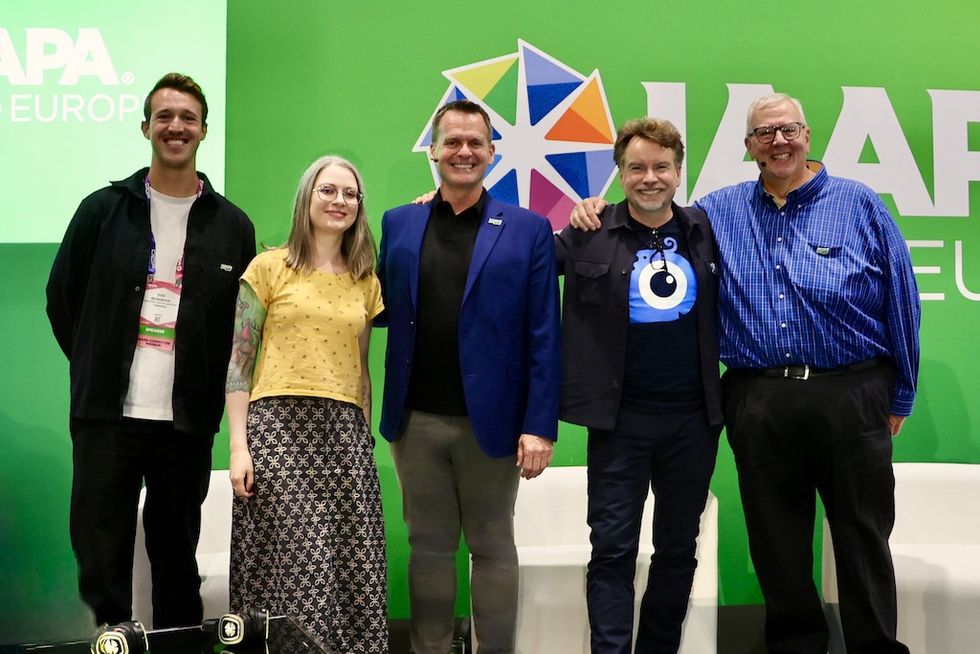 The panellists discussed the evolution of animatronics at IAAPA Expo Europe 2026, pictured alongside Edd Musgrove, who served as the session's IAAPA Education Committee panel champion
Automata gave us mechanisms capable of performing. Animatronics transformed physical objects into theatrical characters. Digital technology liberated characters from the limitations of physical bodies. Intelligent machines are beginning to perceive their surroundings, respond and make increasingly sophisticated decisions.
The exciting development isn't simply that each practice is advancing. It's that they're converging.
Today's sophisticated animatronics often begin as digital designs. Advances in robotics are making it easier to create characters that move naturally and respond to their surroundings. Artificial intelligence is opening new possibilities for conversation, memory and more personalized interactions.
The traditional boundaries between animatronics, robotics and digital characters are dissolving, creating entirely new possibilities for bringing characters to life.
The uncanny valley is moving
For years, designers have wrestled with the uncanny valley—the unsettling sensation when a character looks almost human, but something isn't quite right.
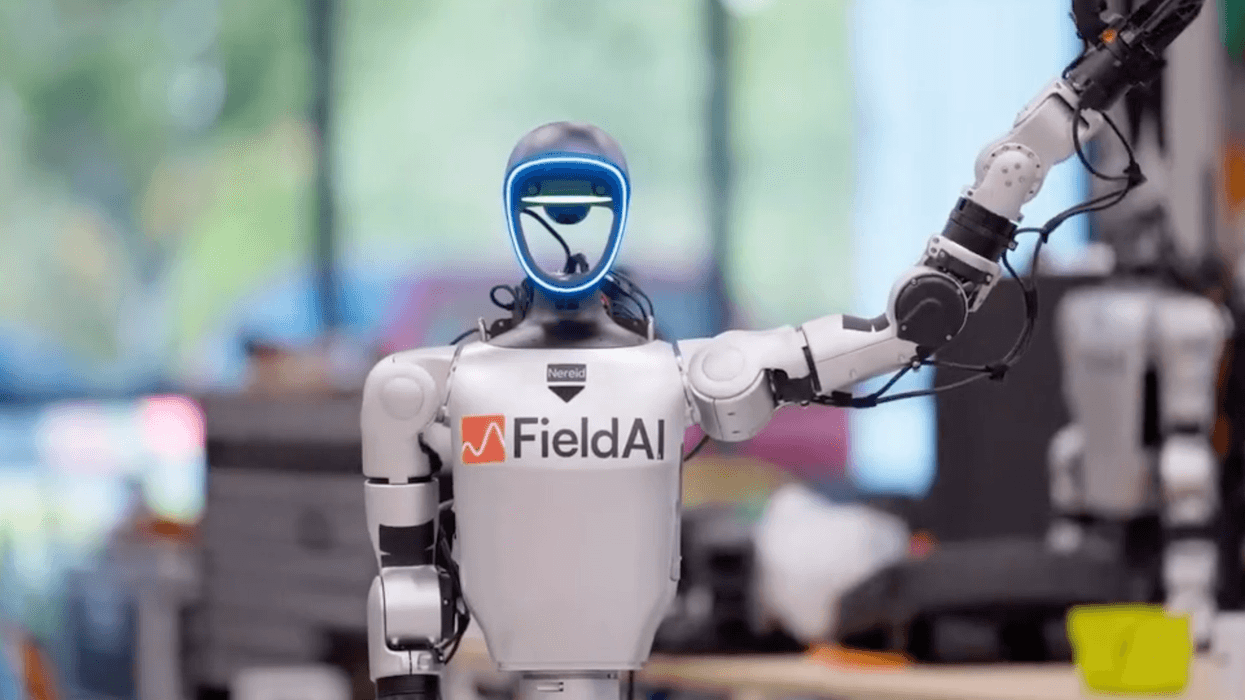
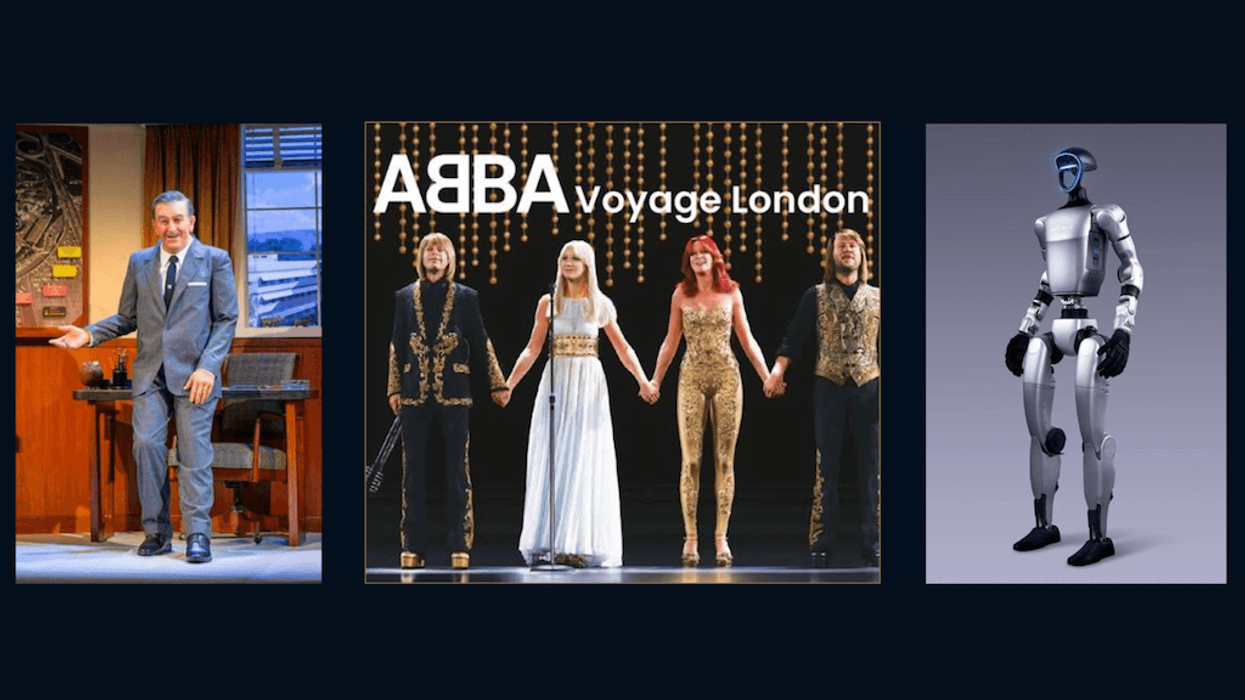
We've invested enormous effort in solving this visual problem. Consider today's remarkably lifelike animatronics, the digital performers of ABBA Voyage or humanoid robots demonstrating astonishing balance and movement.
We're becoming exceptionally good at convincing our eyes. But I believe another challenge is emerging.
I call it the Emotional Uncanny Valley.
The traditional question was: Can I believe what I see?
The new question is: Do I care about who I meet?
A character might possess flawless skin, extraordinary facial animation, natural movement and seemingly limitless conversational intelligence. Yet none of these capabilities guarantees that audiences will actually care about the character.
We may admire the engineering without connecting with the character, but for an industry built around storytelling and emotional engagement, that distinction matters enormously.
The Tin Man problem
During our IAAPA discussion, I introduced an idea inspired by one of storytelling's most enduring characters: the Tin Man from The Wizard of Oz.
The Tin Man had a body. He could move, speak and think. But what he really wanted was a heart.
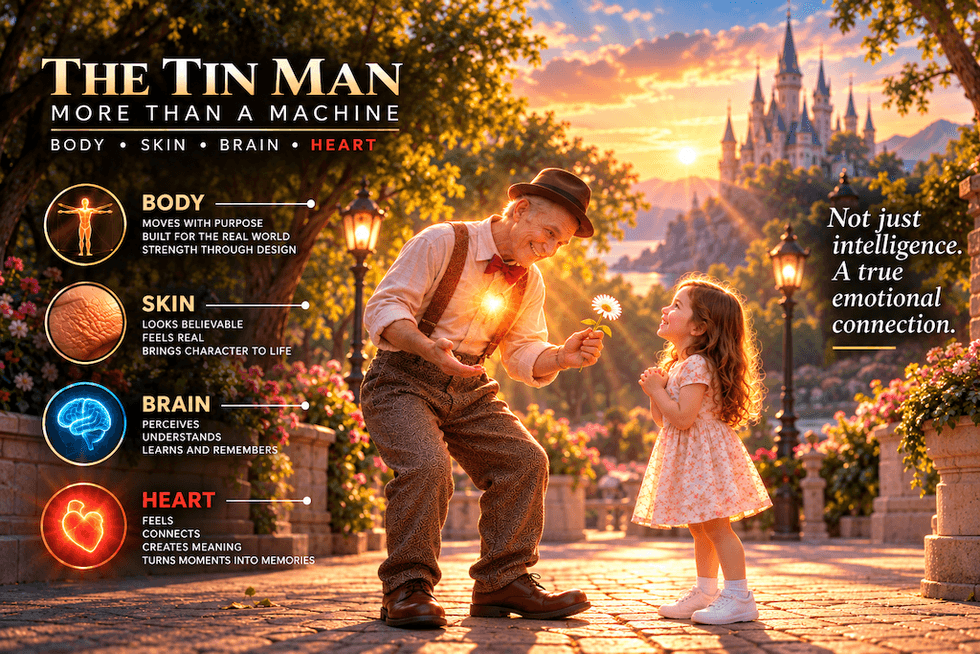 While animatronics can now look, move, listen, speak and respond, is there still something missing?Image courtesy of FGR8
Imagine designing the ultimate next-generation character. First, we give it a body: sophisticated mechanics, balance and dexterity. Then we add skin: expressive materials, a lifelike appearance, and convincing facial performance. Next comes the brain: artificial intelligence, environmental awareness, reasoning and memory.
We now have something capable of looking, moving, listening, speaking and responding.
But have we forgotten something?
Where is the heart?
I'm not suggesting machines need consciousness or genuine human emotions. I'm talking about the qualities that allow audiences to form meaningful connections with fictional characters: humor, vulnerability, empathy, curiosity, hesitation, personality and timing.
These are the ingredients that transform technical capability into character. And they may become our industry's most important design challenge.
From AI to AE — Artificial Emotion
We spend enormous amounts of time discussing AI and advances in machine intelligence. But what if we began thinking about another concept? AE = Artificial Emotion
Not as an established scientific discipline, but as a creative design proposition.
If AI makes a character more intelligent, could AE make it more emotionally engaging?
Imagine a character recognizing a child's hesitation before approaching. Rather than immediately speaking, it pauses, tilts its head and offers a flower. Perhaps a small, clumsy gesture makes the child laugh.
No sophisticated conversation is necessary. The emotional connection emerges through behavior.
Our most compelling future characters may not need to speak at all. In a global industry welcoming guests from countless cultures and languages, a perfectly timed glance, playful reaction or moment of apparent vulnerability can communicate something universally human.
Sometimes the smallest behavior creates the biggest emotional response.
Here's the test I'd love our industry to pursue: Can a guest meet an entirely unfamiliar character and, five minutes later, genuinely care about what happens to it?
If we can achieve that consistently, we've crossed a threshold far more meaningful than photorealism.
What if the relationship never ends?
Now imagine taking that emotional connection further.
What if the character remembered you? Not simply your name, but meaningful details of your shared experiences.
Perhaps you meet a character as a young child and initially find it frightening. Years later, you encounter that same character again. It remembers your first meeting—and the relationship grows.
The technology supporting that character might have changed completely. Its motors, materials, computers and physical appearance may have evolved. But its identity, personality and relationship with you remain.
The body can be replaced. The relationship persists.
Now imagine connected character experiences across theme parks, cruise ships, hotels and digital environments. A character encountered in one location could recognize you somewhere else, continuing a shared story instead of beginning every interaction from scratch.
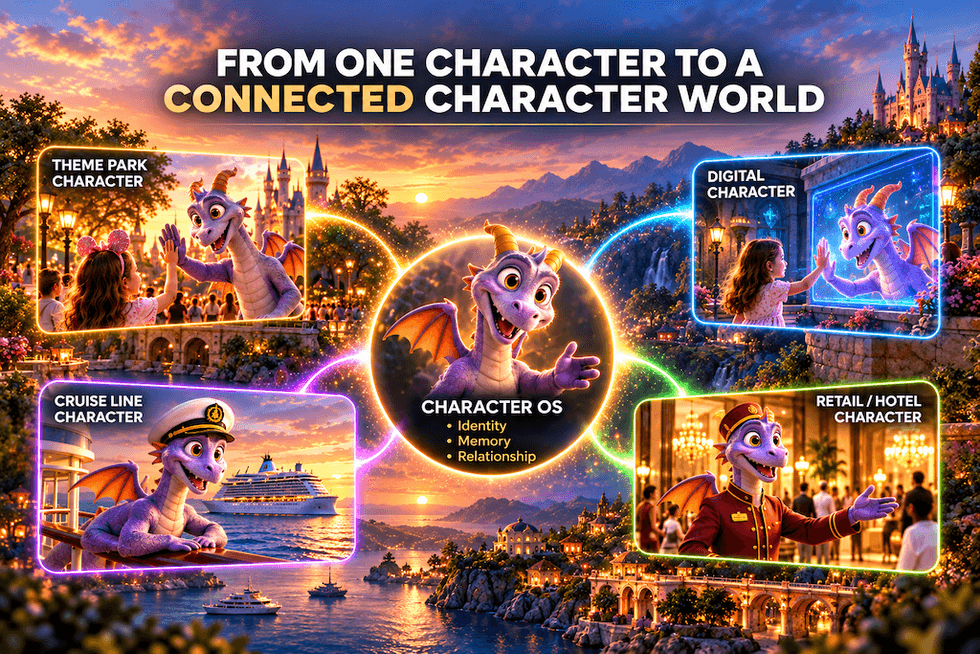 The emotional connection created by a character interaction could go beyond a single encounterImage courtesy of FGR8
Ten years from now, such continuity might feel revolutionary. Fifty years from now, perhaps we'll find it strange that characters ever forgot about us in the first place.
Of course, these experiences require thoughtful approaches to privacy, consent, creative control and operational reliability. But the storytelling possibilities are endless.
We could move beyond individual encounters toward persistent relationships within living, connected story worlds.
Design from the dream backward
One caution remains: a new technology doesn't automatically justify using it.
Throughout my career in animatronics, I've seen projects become unnecessarily complicated because teams begin with technological capability rather than the guest experience.
A brilliantly engineered character that cannot operate reliably is not a successful attraction. Neither is an intelligent character whose unpredictable behavior undermines its personality or story.
We must still consider presence, interaction, reliability, capacity, cost, maintainability and creative intent. And we must distinguish between a robot capable of autonomous movement and a character delivering a consistent, emotionally meaningful performance.
For owners and developers, these decisions must be made early, with the right creative and technical expertise at the table.
The guiding principle remains simple: Story first. Technology second.
Can we engineer emotion?
We're entering one of the most exciting periods in the history of character entertainment. Physical animatronics, digital performers, robotics and AI are providing capabilities that would have seemed impossible just a few years ago.
But our greatest opportunity isn't simply building smarter machines. It's creating more meaningful experiences.
Technology gives us capability. Story gives it meaning. Relationships make it matter.
For decades, we've mastered the mechanics of the body. Now we've unlocked the intelligence of the brain.
The next frontier is learning how to engineer the heart.
Following his IAAPA Expo Europe presentation in London, Chuck Fawcett will attend IAAPA Expo 2026 in Orlando this November