
Feature writer Owen Ralph has covered theme parks and attractions for over 20 years for publications including blooloop, Park World, World’s Fair, Interpark, Kirmes Revue and Park International. He has also served on boards/committees with IAAPA and the TEA. He grew up just 30 minutes from Blackpool (no coincidence?)
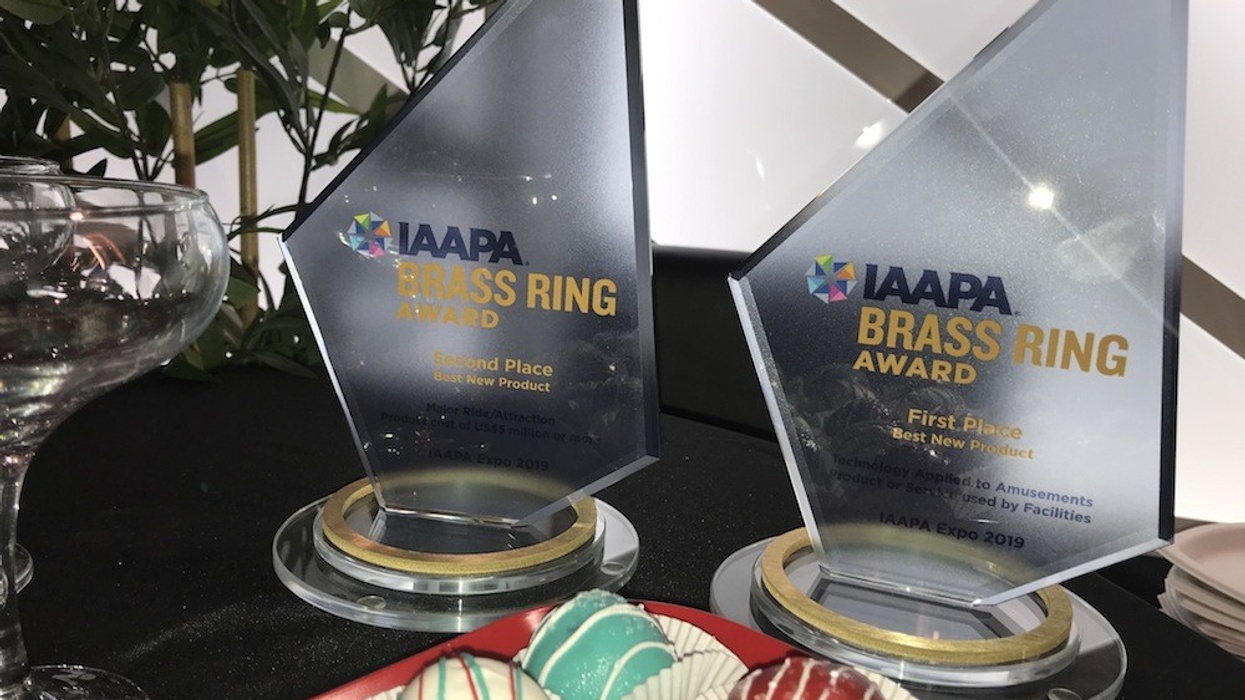
After winning the IAAPA Innovation Award for the past four years, Dynamic Attractions celebrated two new Brass Ring Award wins at this week's IAAPA Expo in Orlando.
The media-based attraction specialist was honoured on Wednesday 20 November with the following Brass Ring Awards:
•Best New Product: Major Ride/Attraction (product of US$5 million or more)
• Technology Applied to Amusements Product or Service used by facilities
Both of these were in recognition of Batman: Knight Flight at Warner Bros World Abu Dhabi. A signature attraction of the indoor theme park at Yas Island, it uses Dynamic's Robotic Arm Dark Ride.
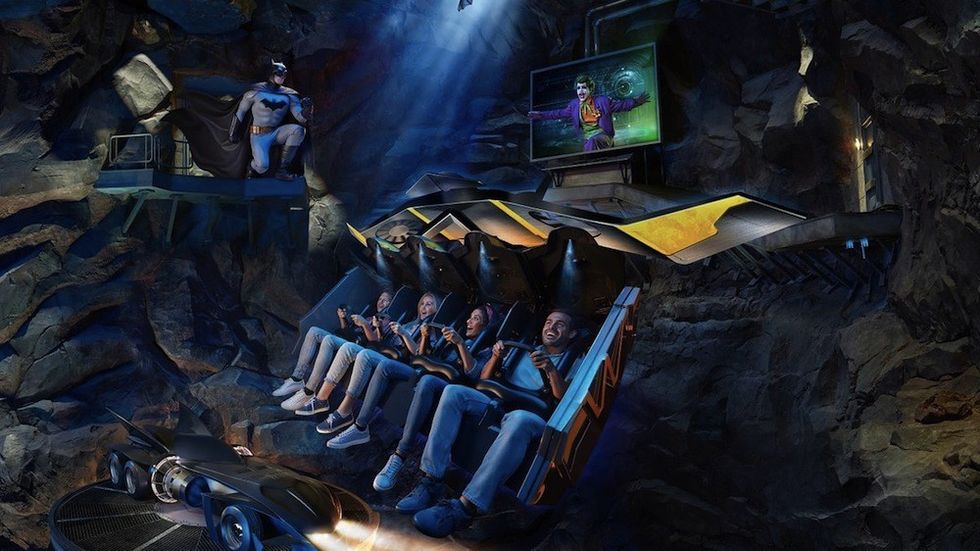
Batman: Knight Flight at Warner Bros World Abu Dhabi
Just two months earlier, the same ride picked up two Park World Excellence Awards for Themed Attraction of the Year and Media-Based Attraction of the Year.
Prior to these latest awards, Dynamic Attractions has won the IAAPA Innovation Award each year since it was created in 2015. Its winning products were as follows:
Dynamic is proud of taking such concepts from 'wild idea' to 'wow ride'. All four of the above have been sold and are now in production.
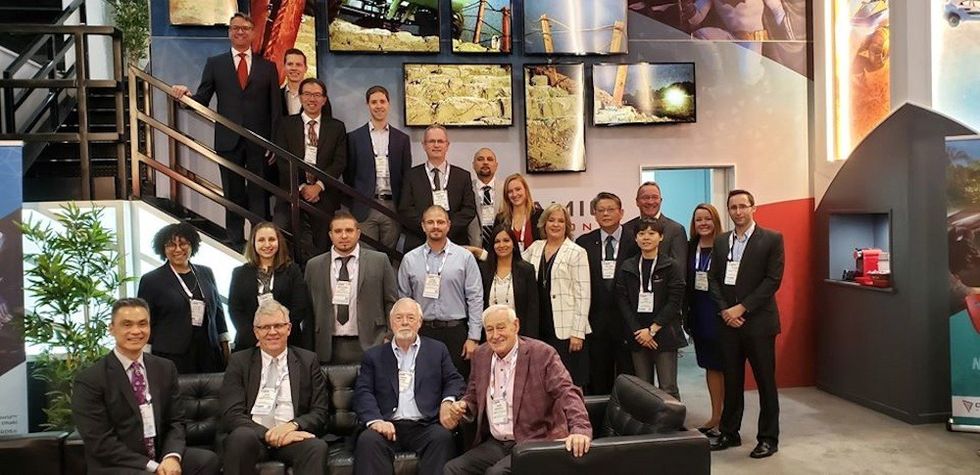
Team Dynamic at IAAPA Expo 2019
“In the high-end sector of the attractions industry, innovation is about staying relevant,” says Dynamic Attractions CEO, Guy Nelson. “Coming up with ideas is relatively easy, fast and cheap, but then those ideas need to be executed. For Dynamic Attractions, innovation isn’t about rides. It is about how we do things.”
To this end, the company recently shifted production from a steel shop to a new assembly facility in Vancouver, Canada. This was in response to industry demand for less iron and more electronics. In future, it anticipates the integration of more sophisticated audio, cutting edge lighting, futuristic gaming and more.
“We are looking at other industries to pull in and adapt best practices that are suitable to our production environment,” says Nelson. “We’ve learned a lot from the automotive industry.Furthermore, we are taking technology we have used before and are applying it in new and unique ways.”
IAAPA Expo continues until Friday, November 22. If you're there, drop by booth #1358 to see Dynamic Attractions' innovation for yourself.

Feature writer Owen Ralph has covered theme parks and attractions for over 20 years for publications including blooloop, Park World, World’s Fair, Interpark, Kirmes Revue and Park International. He has also served on boards/committees with IAAPA and the TEA. He grew up just 30 minutes from Blackpool (no coincidence?)
Japanese video game company Capcom has announced its new Capcomix attraction, an experience-based amusement facility to open this spring in Osaka, Japan.
Per a press release, Capcom's arcade business currently operates a total of 59 locations, including Plaza Capcom venues, which feature crane games, medal games and themed attractions, as well as Capcom stores for official merchandise.
Capcomix is a new concept for the company and will provide an extensive lineup of attractions themed around Capcom's popular characters.
Located at the Hoop shopping mall in Osaka, Capcomix will appeal to guests of all ages, with experiences including a digital activity area, a VR area, and a shop.
Crazy Banet with Capcom All Stars is a large‑scale digital activity area offering a diverse range of interactive attractions, while the VR-X zone will boast cutting-edge, original VR experiences.
The shop, called Chara Cap, will offer a wide selection of exclusive and themed merchandise.
Capcom said the new concept is part of its efforts "to be a company that captivates people around the world with our best-in-class immersive content".
It said it "will continue to maximize the value of its rich library of game content through multifaceted initiatives, thereby creating new earnings opportunities and enhancing corporate value".
Further details on Capcomix, including the opening date and facility details, will be announced in the future.
Campcom is known for high-grossing video game franchises such as Resident Evil, Street Fighter, Monster Hunter, Mega Man, and Devil May Cry.
Other video game developers to enter the location-based entertainment (LBE) space include Nintendo, Ubisoft, Crystal Dynamics and Square Enix.
The International Council of Museums (ICOM) has called for the protection of museums and cultural heritage sites amid the recent conflict in Iran, the Gulf region and the Eastern Mediterranean.
In a statement, ICOM said it is expressing "serious concern" over the conflict's humanitarian impact, as well as the risks facing museums and cultural heritage sites.
"We are alarmed by reports of serious damage to cultural sites in the region, confirmed by intergovernmental organisations such as UNESCO," it added.
ICOM said it is closely monitoring the situation alongside its national committees and partners in the region and internationally, "in line with its core commitment to the protection of cultural heritage".
"We remain attentive to the safety and well-being of our members in the affected areas as well as all professionals working to safeguard cultural heritage," ICOM added.
"ICOM underlines the need to respect international humanitarian law and to ensure the protection of civilians."
The organisation is calling on all parties to respect their obligations under the 1954 Hague Convention for the Protection of Cultural Property in the Event of Armed Conflict and its protocols.
ICOM, which said it supports any statements published by its partner organisations, has reiterated its call to all parties to comply with international legal obligations to safeguard cultural heritage.
Reports of damage to cultural sites
It is also referring to the ICOM Statement for Peace, and its declaration on the protection of archives, libraries, museums and heritage places during armed conflicts and political instability.
"The destruction of heritage is not only a local tragedy; it is a loss for all humankind," ICOM said.
"We must come together, through dialogue, cooperation, and respect to preserve the cultural bridges that connect our shared past to a more peaceful future."
Last month, ICOM released the full programme for the ICOM UK 2026 Annual Conference, Museum Diplomacy in Action, which will be held in Oxford from 16 to 17 April.
Lead image: National Museum of Iran, Creative Commons
Technology-enabled soccer experience company Toca Football has opened its first Toca Socialentertainment destination in the US.
Located in Dallas at the Grandscape shopping centre, Toca Social's new US flagship location opened on 6 March.
The venue is a hub for soccer entertainment that combines immersive technology, interactive play, elevated F&B, and vibrant fandom.
Games in the 20,000-square-foot attraction feature Toca's proprietary ball-delivery and tracking technology, while entertainment experiences include match viewings on enormous 4K screens.
“By launching our US flagship at Grandscape now, we are providing a world-class destination where fans can play, dine, and celebrate the global game," said Yoshi Maruyama, CEO of Toca.
"We’ve built a unique space that welcomes everyone – from soccer enthusiasts to casual social seekers."
Toca Social US expansion plans
Toca Social's US expansion is part of a partnership with Major League Soccer.
Backed by Abby Wambach and Brandon Aubrey, the Dallas venue will be joined by new locations in other major US cities.
The first Toca Social opened at The O2 in London in 2021. This was followed by a venue in Birmingham, and then another in London.
"Toca was born from my obsession with the technical side of the game and the belief that a soccer ball should be at everyone’s feet," said Eddie Lewis, Toca founder.
"After seeing the incredible reception in the UK, bringing our social flagship home to the US – and specifically to a soccer-rich market like Dallas – is a dream realized.
"We’ve created a place where the skill of the pros meets the energy of a world-class night out."
Inowize, a creative company delivering interactive experiences, presents QBIX Play, the latest version of the QBIX immersive gaming room platform, designed to appeal to younger audiences and serve as a compelling visual and experiential centrepiece in modern entertainment venues.
QBIX Play builds on QBIX's proven success to make group play more accessible, spontaneous, and flexible for operators. While QBIX has become a global leader as the high-performance Pro version for immersive group gaming, QBIX Play expands this concept.
Responding to operator demand
QBIX Play is the open-edition version of QBIX, created for younger audiences, family venues, and day-pass entertainment settings.
The attraction preserves the core gameplay of 6 players playing simultaneously, all within a compact 4 x 4 metre (13 × 13 feet) area. It features nine themed multiplayer titles.
The new edition has been developed in response to a clear operator demand: to increase session frequency, to seamlessly integrate into free-play models, and to reduce friction for younger demographics.
“QBIX Play was born from listening carefully to both operators and guests,” says Claudia Mihalache, co-founder of Inowize.
“The market doesn’t need more complexity. It needs immersive attractions that are easier to deploy, easier to access, and easier to monetize.”
QBIX Play eliminates structural obstacles and adopts an open, highly visible design to encourage spontaneous participation while ensuring high throughput per square meter.
Initially unveiled as a concept at IAAPA Expo in November 2025, it was introduced as a new edition of the immersive gaming room. Due to significant industry interest, the product has now been installed in two U.S. locations: FunVille and AR's Entertainment Hub.
The team also revealed its ninth game title for QBIX, Last Defense, at IAAPA Expo 2025.
Venues can now choose between QBIX, QBIX Play, or scale with QBIX Multi-units, allowing them to build layouts that fit their traffic, space, and business model.
SSA Group has been working on a transformative approach to operations. By weaving its signature 452 Hospitality ethos, rooted in a legacy of welcome and human connection, into Scout, a new AI-driven operating system, the company demonstrates how AI can enhance rather than replace the human side of hospitality.
For nearly 60 years, SSA Group has been a staple in the cultural attractions sector, collaborating with zoos, aquariums, and museums to provide comprehensive guest services. As a family-owned business, the company has continually adapted, but its core mission remains centred on a simple, powerful concept: hospitality.
We speak with CEO Sean McNicholas and vice president of people and culture, Jason Stover, to unpack Scout's mission and learn how it can open the door to both greater efficiency and more memorable moments.
SSA reimagines the industry
Starting by looking at the bigger picture, McNicholas says: “What I love about SSA and our family business is our curiosity for continuing to reimagine the industry.
"Those are pillars of our plan. We approach 60 years as a family business in 2030, and what’s exciting to us is continuing to innovate, not just our business, but the guest experience for our clients and partners.”
Sean McNicholas and Jason Stover
This culture of curiosity is what prompted McNicholas and Stover to investigate the potential of artificial intelligence long before it became the industry buzzword it is today.
"Five or six years ago, Jason came to me as one of the early adopters of AI. We started talking about it, and the more we looked at tools like AI, we asked a very simple question: what one, two, or three areas could AI positively impact our business?"
For SSA, the goal was not to replace staff or remove the human element from the museum or zoo experience through automation. Instead, the emphasis was on liberation.
"The thing that became clear was how tools like AI could help us become more efficient with data, back-end systems, and administrative work," adds McNicholas.
"If we can be more efficient there, we can spend more time meeting guests where they need us, which is on the front line.”
The outcome of this exploration is Scout, an AI-assisted tool and ‘unified intelligence layer’ designed specifically for cultural attractions.
Scout is positioned not as a replacement for human workers, but as a co-pilot. It is an operating system that gathers data from across the industry to provide real-time insights. Unlike general-purpose AI tools, Scout has been built for the sector's operational realities.
"AI is trending now, but it’s not new," says Stover.
"I’ve been with SSA for almost 30 years, and my journey with AI in this company has existed since day one. When I first became a manager, we were already experimenting with predictive analytics, trying to forecast attendance and staffing.
"That was AI at the time."
However, the leap to generative AI offered a new opportunity to support SSA's secret sauce: its people.
Stover employs a cinematic analogy to describe Scout’s role within the workforce:
"I compare it to Tony Stark," he says. "He’s brilliant, but he doesn’t become Iron Man until he has Jarvis. That’s what Scout is. It’s a co-pilot that takes away routine, monotonous work so our people can focus on what matters."
Real-time, useful insights
Designed to support guest-journey walkthroughs, the platform collects real-time observations and converts them into actionable insights tailored to each attraction.
The tool was created in accordance with SSA’s core belief that technology should never replace connection; it should enhance it. The idea is that data and design can collaborate to create memorable guest experiences.
This supports SSA’s wider focus on innovation, which aims to turn curiosity into meaningful change that advances partners' missions. By automating data analysis, Scout helps operators make more informed decisions about designs, platforms, and revenue strategies.
"Guest expectations are evolving faster than ever," says Stover. "Scout was built to meet this moment as a tech-forward AI tool that allows us to keep experiences deeply personal.”
The heart of the system: 452 Hospitality
Although the technology is impressive, the engine driving Scout remains entirely human. At the centre of Scout’s design is 452 Hospitality, the cultural ethos that defines SSA Group’s purpose and character.
Named after 452 Leyden Street, the Denver home where SSA’s founders first lived and practised hospitality, 452 has since become both a numeric and philosophical code for what the company stands for: a spirit of welcome, belonging, and genuine human connection.
At 452 Leyden Street, anyone could come in for a meal, a chat, or a place to rest. And that sense of genuine warmth now lives on in every SSA service encounter.
Today, 452 Hospitality reflects SSA’s ongoing dedication to creating authentic, memorable moments that uplift guests, partners, and colleagues alike.
That same spirit guides Scout’s purpose: rather than replacing people, the AI system aims to enable staff to embody 452 Hospitality more fully, freeing them from administrative burdens so they can provide the personal engagement that makes guests feel welcome and valued.
In practice, this involves a particular method for engaging with guests and monitoring operations. Scout develops a digital framework for this using the SOQ model: Observation, Opinion, and Question.
"Scout is being trained by the entire zoo, aquarium, and cultural attraction industry," Stover says. "Every conversation, every audit, every partner insight gets ingested and shapes how Scout operates.”
Within the Scout ecosystem, there are various ‘agents’ dedicated to different tasks, such as labour optimisation and inventory management. However, the ‘452 agent’ is unique.
"It has vision and voice capabilities. As you walk through operations, it analyses images and observations in real time and evaluates them against our hospitality standards. It acts as a co-pilot for auditors and operators, making observations, offering insights, and matching them with best practices and solutions.
“You might miss something as a human, but Scout won’t.”
Scout in action
The deployment of Scout is already producing tangible outcomes, progressing from theoretical ideas to solving complex on-site issues. This highlights SSA’s focus on turning insights into action by combining data, technology, and human connection.
McNicholas emphasises that the team is "continually evolving Scout by testing it across multiple attractions," noting that "every new site adds more data and sharper insights.”
Stover offers an example of Scout’s operational intelligence in action from a working session with the Detroit Zoo. The team was exploring a complex “what-if” scenario: opening a new entrance near a new exhibit while navigating compliance considerations, budget constraints, and a nearby rail track.
“Using Scout as a sandbox alongside their team, we pressure-tested the constraints, surfaced relevant regulatory considerations, explored alternative approaches like repurposed shipping containers, and generated rough-order cost ranges. It was less about committing to a final plan and more about accelerating discovery.”
“What’s exciting is that every audit surfaces a new real-world question, and we ask: Should this become a new sub-agent? That’s how Scout keeps evolving.”
Another success story comes from the Dallas Zoo, where Scout was instrumental in helping the zoo team explore their own AI journey while SSA conducted an inter-department relationship audit.
Scout is tailored to each user’s psychology
What makes Scout different from typical business AI tools is its incorporation of behavioural psychology. Acknowledging that strong operations don't happen by accident, SSA has combined leadership development with its technological roadmap.
Stover, whose background is in people and culture, insisted that if they were to create co-pilots, they had to understand the humans who would use them. So, instead of providing generic recommendations, Scout adapts its guidance to each leader's thinking and communication style.
"One of the first things we decided was that if we were going to build AI co-pilots, they needed to integrate Behavioural Essentials," Stover says. "We already use behavioural assessments that give leaders a 21-point profile, with strengths, tendencies, and blind spots. We’ve now incorporated that into Scout.”
This means that when a manager logs into Scout, the system is tailored to their specific personality profile.
"It understands how I communicate, where I might need softer language, or where I might need more structure," Stover says.
He adds that McNicholas served as the ‘guinea pig’ for this feature:
"We merged his traits and blind spots into Scout as he was working through our future roadmap. Scout isn’t just an AI tool; it understands your psychological makeup and helps cover your blind spots as you operate in your role.”
The future of the workforce
A common concern about AI is the risk of job displacement. However, SSA’s leadership firmly states that their investment in technology aims to safeguard, not eliminate, their workforce.
"As CEO, culture is my responsibility, and culture starts with values," McNicholas says. "Hospitality, human-to-human interaction, has always been our foundation. I don’t want a world of all robots and automation. I love people too much.
“That’s why Scout exists. It helps us live what we love to do: creating special moments for people.”
Stover shares this view, considering AI as a safeguard against the decline of interpersonal skills observed in other industries:
"We have to be proactive in shaping the future. Many companies will use AI purely to impact the bottom line. That’s their choice. But SSA has always been people-focused. We’re adopting AI safely and intentionally to better our people. As interpersonal skills decline elsewhere, we’re protecting them by freeing people up to reconnect.”
The efficiency gains are clear. Stover notes that tasks like scheduling, which previously took hours to analyse against weather and sales history, now happen in seconds. "That frees managers up to spend time with their team. That’s the point.
“We’re hospitality people. We want to be in front of guests, not behind a screen.”
A vision for 2030
Looking ahead, SSA has set bold goals for the next five years. As the company approaches its 60th anniversary in 2030, the vision is for a fully enabled workforce where each employee has a digital partner.
"By 2030, every person in our company will have a co-pilot that helps them be more efficient," predicts McNicholas. "We’ll also bring a unified revenue strategy to attractions, something the industry lacks.”
He also believes the metrics of success are shifting. It is no longer enough to simply count heads at the gate:
"The future metrics won’t just be attendance. They’ll be revenue, guest experience, and fulfilment," he says.
"There’s more competition than ever, and we have to be the place where guests leave thinking, 'That felt right.' To do that, our people need tools like Scout so they can spend more time creating those moments.
“That’s how we reimagine the industry.”
The future of hospitality
Summing up the benefits, COO Travis Kight says:
"AI is the future of hospitality, but not in the way most imagine. We see AI as a co-pilot, not a replacement, designed to protect the human connection that defines our industry.
“Tools like Scout allow us to turn data into real-time insights, freeing our teams from repetitive tasks so they can focus on creating unforgettable guest experiences.
"As Sean mentioned, by 2030, our vision is for every team member to have a digital partner that amplifies their strengths, covers blind spots, and helps us deliver hospitality at a level the industry has never seen.
“AI isn’t about automation. It’s about empowerment.”
As SSA Group looks towards the attractions of tomorrow, its message is clear: the path to the future is built on data, but the goal remains human connection.
By anchoring Scout in 452 Hospitality's philosophy of creating meaningful, human-centred moments, SSA isn’t just adopting AI for efficiency. It’s enhancing its ability to deliver heartfelt experiences that define its brand and shape the future of the guest experience.
"That’s the foundation of Scout," Stover says. "If a tool doesn’t protect hospitality or make us better people-facing operators, it doesn’t get built.”