
Runners up


How Gateway Ticketing Systems is putting live ticket inventory into agentic commerce
Ticketing has changed significantly over the past three decades. Physical ticket booths and paper passes have given way to online booking, mobile tickets and increasingly sophisticated distribution networks.
Now, another shift is underway.
As AI becomes part of how consumers search for and plan experiences, attractions may increasingly find themselves selling through a different kind of intermediary: an AI agent acting on a guest's behalf.
These agents could research itineraries, compare products and prices and eventually complete transactions, raising new questions about how attractions structure their data and make inventory available.
For operators, the implications could extend beyond booking. As AI agents take on more of the searching and comparing, the quality and accessibility of an attraction's data could become as important as its website or checkout flow.
To explore what agentic commerce could mean for the visitor attractions industry, blooloop spoke to Kori Richards, group product manager, and Becky Lathrop, senior manager for software development, at Gateway Ticketing Systems, Inc.

Kori Richards, group product manager, and Becky Lathrop, senior manager for software development, at Gateway Ticketing Systems
With more than 450 venues across six continents using its admission control and ticketing technology, Gateway Ticketing Systems has spent decades working at the intersection of attractions, ticketing and distribution.
The company’s experience with APIs, third-party distributors and real-time inventory gives Richards and Lathrop a practical perspective on what an AI-driven distribution model requires.
Although agentic commerce is still in its early stages, they argue that attractions should start preparing now by considering how their systems, data and distribution infrastructure can adapt.
AI as a distribution channel
For many attractions, AI in ticketing still means a customer-support chatbot answering questions on a website. Richards and Lathrop see a much broader opportunity.
"There are two things that people are calling agentic commerce," says Richards. "One is a conversational assistant that lives on your own website. It answers questions, sells tickets, and acts as your personal concierge, and that's more of a conversion tool.
“The other is making your live inventory available and discoverable across different AI platforms, such as Claude, Gemini, and ChatGPT, so that someone can find your tickets or your attraction and buy them in a conversation that you don't own on your website.”

AI agents could become a new route for visitors to discover and purchase attraction tickets
The shift moves the focus from how an attraction's website looks to a human visitor to how its ticketing system can be understood by an AI agent.
In an agentic commerce model, an AI agent operates on a guest's behalf. A guest might ask their AI assistant to find a wildlife attraction for a family of four, within a set budget and timeframe, then book it and add it to their itinerary.
The agent can then identify suitable attractions, check availability and pricing, and complete the transaction without the guest visiting the attraction's website.
Lathrop says this shift is driven by rapid changes in guest behaviour:
"There are new ways that our guests are reaching for information. There's a new generation that is going to ChatGPT rather than Google. There's a shift happening, and we want to make sure that our customers are there to meet them.”
Gateway's AI Commerce
Gateway Ticketing Systems has built this second model into a product called AI Commerce.
The product connects an attraction's live Galaxy pricing and availability to AI platforms including Claude, ChatGPT and Gemini using the Model Context Protocol (MCP), allowing a guest to find an attraction, check a date and buy tickets inside a conversation the attraction does not host.

Gateway Ticketing Systems’ AI Commerce connects live attraction pricing and availability with AI platforms, creating a new route to ticket discovery and purchase
Operators choose which products are exposed and where, plus additional sales opportunities. The AI layer never handles card data, and every price and availability check runs against Galaxy in real time.
AI Commerce is in production with early customers, with general availability to follow.
From SEO to AEO
For decades, digital marketing in the attractions industry has focused heavily on Search Engine Optimisation (SEO). As visitors increasingly use AI tools such as ChatGPT, Claude, and Gemini to find information, operators may also need to consider how their content appears in AI-generated answers.
Rather than receiving a list of search results, visitors may receive a synthesised answer. This has prompted growing interest in Answer Engine Optimisation (AEO) and what it could mean for attractions' digital strategies.
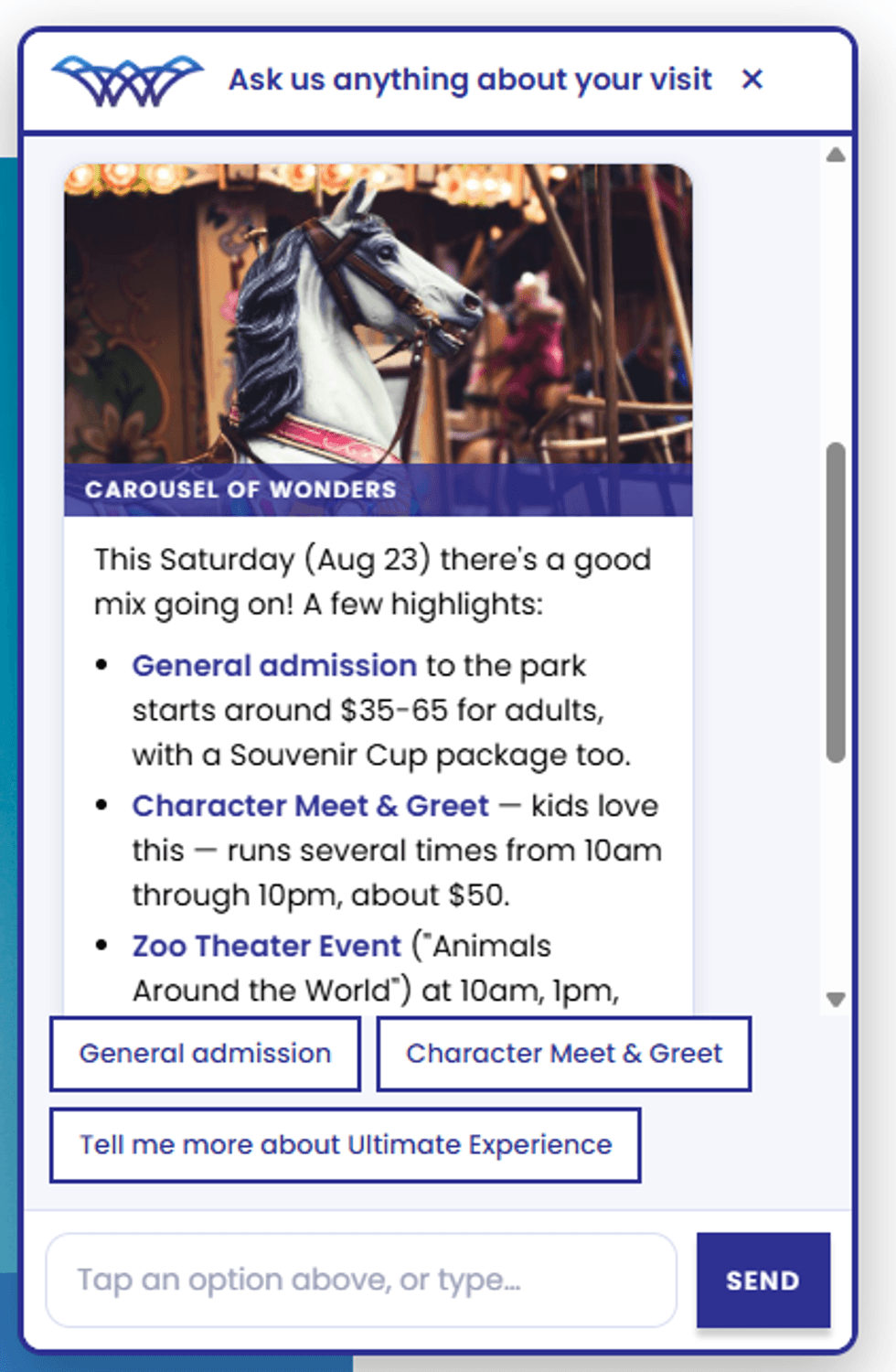
Gateway’s AI Commerce enables guests to search for attraction tickets and check live availability through an AI-powered chat interface
This increases the importance of making key information, including ticket prices, operating hours and availability, accessible to AI systems. If machines can't easily interpret important information, an attraction may be harder for an AI agent to discover or transact with.
To bridge the communication gap between ticketing systems and large language models, the tech industry has begun adopting open standards.
"Rather than just surfacing APIs available, [we are] making it easier for the capabilities, and then also putting real-world safeguards to it as well," says Lathrop. "In the past month, there's been a standard released on MCPs, and this is something that we've adopted.”
The MCP provides a standardised way for AI applications to connect with external tools and data. For ticketing systems, this could reduce the need for bespoke integrations between individual platforms and make it easier for AI agents to access capabilities, inventory and rates.
The new personalisation
Personalisation has long been part of attraction e-commerce, with platforms using past purchases and customer data to predict what a guest might want next.
Agentic commerce changes that model: instead of a platform guessing what a guest might want, the guest can tell their AI assistant what they need.
"The traditional personalisation is making educated guesses on what you might want next, and putting an offer in front of you, and hoping that it's attractive enough for you to take it," Richards says. "With an assistant, the guest is telling you what they need. That changes what the platform needs to be good at.”

AI is changing how visitors discover and plan experiences, from museum visits to theme park trips
The ticketing platform must then verify those requirements against real-time operational data, she adds:
"Is that time slot that they are looking for really truly available, or is this just something that you wanted to push the guest towards? Is the price for that group on that date, with their membership applied, valid?”
The benefits of agentic commerce for operators
The potential applications extend beyond the guest-facing journey.
Gateway Ticketing Systems is also exploring how AI can make complex ticketing data easier for operators to access, including through its Galaxy software.
"We've also changed this approach for us by allowing a back-office MCP to surface the analytical data configuration information that's available in the cloud right to our customers so that they can manage right from their phone," Lathrop says.
"This will hopefully result in frictionless transactions with our guests.”
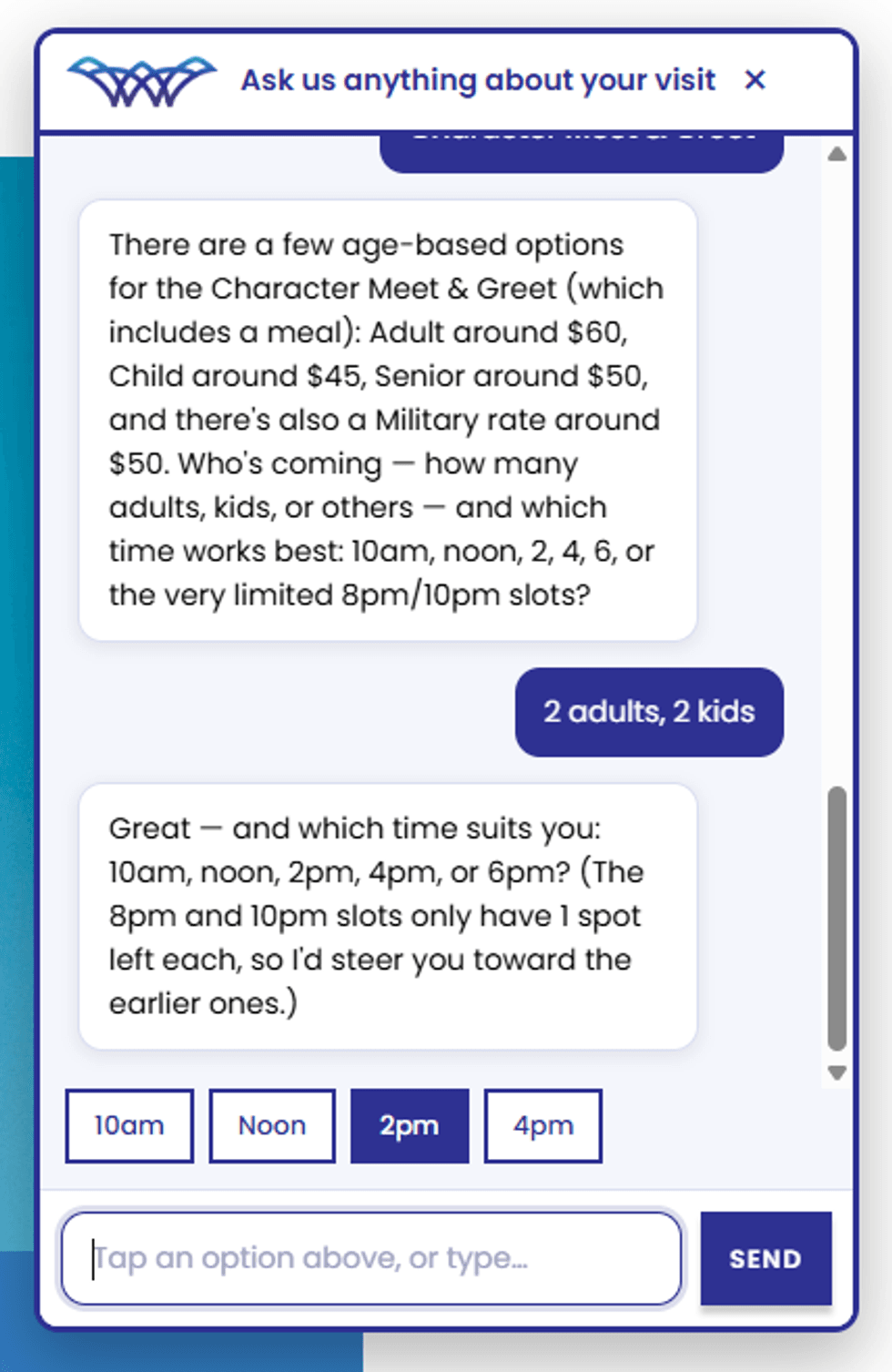
AI Commerce surfaces attraction experiences in response to a guest’s query, including available meet-and-greet options
AI agents could also support back-office tasks such as inventory management, pricing analysis, waitlist fulfilment, refunds, exchanges and customer support. By offloading these routine tasks to automated systems, attractions can free their staff to focus on higher-value, face-to-face guest interactions.
However, Richards raises a critical point about the limits of AI prediction: it is only as good as the underlying data. Many attractions are still building out the basic operational data required to feed an AI model.
"The interesting blocker about that isn't necessarily the AI piece," Richards says.
"It's a much simpler question that attractions need to answer: how many people are on your site right now, how many are across in parking and across the gate? Prediction is the last piece, not the first. You have to have some type of data to back that up, and attractions are still getting onto that as well.”
Without reliable operational data, however, AI predictions will be limited.
Connecting systems with Gateway Ticketing Systems
Gateway's experience connecting attractions with external distributors provides a useful precedent for its AI approach. Its Galaxy Connect platform was designed to solve the same basic many-to-many problem: allowing an attraction to make its inventory available across multiple channels without maintaining a separate integration for each one.
"In the pre-AI world, it was all API calls, and there were specific interactions that you could do," says Lathrop.
"Where you have the flexibility of having an agent discussing with MCPs the capabilities and surfacing the data underneath without the strict calls back and forth, it's really providing that flexibility for those interactions to more naturally come together as a person would."
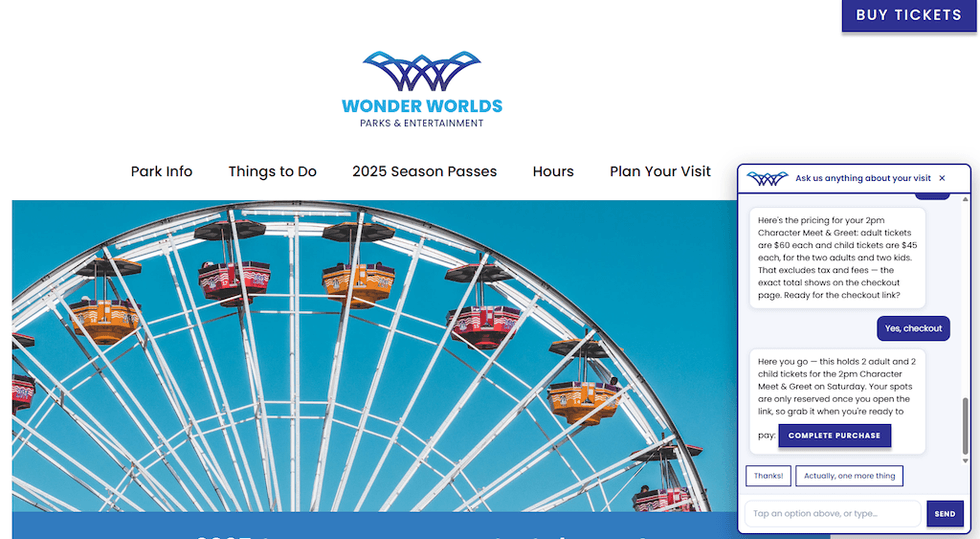
Guests can then check availability and proceed to booking and purchase through the AI Commerce journey
Galaxy Connect has around 135 certified distributors, including Expedia, Viator and GetYourGuide. Rather than maintaining individual integrations with each partner, an attraction can connect once to access the wider network.
"And so, this is a new type of intermediary that we're solving for again on the AI front," Richards adds.
The comparison offers one way to think about the next stage of distribution. Just as attractions have needed to connect inventory to multiple online travel agencies, they may increasingly need to make that inventory accessible to AI agents.
The technology may be different, but the underlying challenge is familiar: making products, availability and pricing accessible across an increasingly fragmented distribution landscape.
Avoiding transactional friction
AI discussions often focus on upselling, from higher-value tickets to dining packages and other add-ons. Richards argues that the bigger opportunity may be recovering sales lost through transactional friction.
"What's interesting about this is that I gently push back that revenue comes from upselling directly. The bigger number here is about the sale that you're losing.”
Attraction e-commerce journeys can involve significant friction. When guests drop out of the purchasing process, it is rarely because the system failed to suggest an upsell. Instead, they may abandon their carts because of transactional friction.

Reducing friction in the ticketing journey could help attractions recover sales lost during the online checkout process
Richards lists the primary drivers of this lost revenue:
"Perhaps not trusting your site with the card that you're using or the payment method, being forced to create an account on the website could deter guests or visitors as well. A checkout that's taking too long, things of that nature. Almost none of it is a failure to suggest something extra at that point.”
Agentic commerce could reduce some of these barriers by allowing an AI assistant to handle parts of the purchasing process on the guest's behalf.
Security, access, and control
Giving AI access to any part of the transaction process also raises questions about security, accuracy and control. What happens if an AI invents a discount, sells a ticket for a closed day or accesses information it should not see?
Richards and Lathrop argue that operators should control what AI systems can access and how they can use it.
Gateway Ticketing Systems has built several guardrails into its approach to AI commerce, starting with the principle that operators choose exactly which products and information are made available.
"We've made a few decisions early on," Lathrop says. "By default, every storefront has to be turned on individually. There's no enable everything button. The operator picks what's exposed and just deliberately determines what can be surfaced to AI."
That means a venue could choose to test an AI-powered channel with a limited number of ticket types or timeslots before making more of its inventory available.
Payment security is another consideration. Gateway Ticketing Systems’ architecture keeps the AI layer separate from payment-card data, with transactions completed through the attraction's existing certified checkout, Lathrop says.
"It never touches card data," says Lathrop.
"The AI layer is hands-off to the operator's existing certified checkout. This keeps PCI in scope, and the path has already been certified. And it means that guests pay somewhere where they recognise and they understand it."

As AI enters the ticketing journey, attractions must balance easier access to experiences with security, privacy and control
The same separation applies to personal data.
"We don't collect that data in the chat. They may know that person from their own interactions with their own ChatGPT in the memory, but that never comes into our commerce interaction, and it doesn't go between."
Pricing and availability present another challenge, particularly for attractions managing capacity-controlled inventory.
Gateway Ticketing Systems’ approach is to pull rates and availability from the core Galaxy ticketing system rather than allowing the AI to make assumptions based on cached or incomplete information.
"Prices and availability come from the existing pricing and inventory, and it never places inventory holds until they're ready to check out," Lathrop says.
"If the information is unavailable, the system returns an error rather than guessing. An assistant must never tell guests something is sold out when a pricing service just failed.
"Our internal target for overselling or overcharging through this surface is zero, and that's a design constraint, not an aspiration."
There is also a legal question that technology alone cannot solve: who is accountable when an AI gives a guest the wrong information?
Lathrop points to the Air Canada chatbot case, in which the airline was held responsible for incorrect information its chatbot provided.
"For operators, the question is asking: what data is leaving my environment, and who's getting it, and can I switch it off immediately? And is the guest clearly told they're talking to AI? And who's responsible when something's going wrong?"
As attractions experiment with AI-powered commerce, this question of control is likely to become increasingly important. For Gateway Ticketing Systems, the key point is that an AI agent does not take responsibility away from the attraction using it.
Good bots, bad bots
One challenge of agentic commerce is distinguishing between "good" bots and "bad" bots.
Ticketing platforms have spent years defending against bots that scrape sites, lock up inventory or buy tickets for resale. Agentic commerce presents the opposite challenge: opening systems to legitimate AI agents acting on behalf of guests.
"Treating the chat window as the new strategy is a common misconception," Richards says.
"A chatbot is an interface. Agentic commerce is a question about distribution and data. You can buy a really good chat interface and still be completely invisible to that AI agent because your prices, your availability aren't machine-readable or discoverable."

As AI agents enter the ticketing ecosystem, attractions will need to distinguish legitimate automated access from unwanted bot activity
The regulatory framework around distinguishing legitimate consumer AI agents from prohibited ticket bots is also still developing.
"There's no regulatory answer to that yet," Richards says. "No FTC guidance, no case law, so nothing that's really distinguishing a guest's own shopping assistant from a prohibited ticket bot."
That means operators will need clear policies around automated access, supported by tools such as authentication, monitoring and rate limiting.
"Decide your bot policy on purpose too," Lathrop says. "What does get automated? ... Tag the channel so that you can measure it."
The challenge, then, is not simply how to stop bots. As agentic commerce develops, attractions will need to decide which bots they are prepared to let in.
Practical advice
With technology and standards evolving quickly, attractions may find it difficult to know where to start.
Richards and Lathrop suggest focusing on four fundamentals.
Firstly, start with the basics. A fast, mobile-friendly website and well-structured data are essential. "If your site takes 25 seconds to load on a phone, you're not ready for AI agents," Richards says. "Speed and structured data for sure are the foundation, and they help your human guests as well."
Create a single source of truth. If an attraction's website, OTA feeds and other sales channels show different prices or availability, adding an AI channel will only compound the problem.
"Just the source of truth for price and availability," Richards says. "If your OTA feed and your website disagree on what's available on a Saturday or have different pricing, adding a fourth channel to that is not going to make anything easier."
Additionally, measure and manage automated sales. Operators should decide which AI interactions to allow and tag agent-generated transactions so they can measure performance.

As AI reshapes how guests discover attractions, operators can prepare with accurate data, connected systems and flexible technology, supported by Gateway’s ticketing and distribution infrastructure
Finally, they advise operators to stay flexible. With standards still evolving, attractions should avoid locking themselves into a single AI platform or proprietary format.
"Work with something open and adaptable," Richards advises. "Nobody knows whether the winning standard ... is right now OpenAI or ChatGPT or Google or MCP. Anybody that tells you that they know the answer is selling you something because it is very much the Wild West."
The priority, therefore, is less about predicting which platform will win and more about ensuring underlying systems can adapt.
The direction of travel may still be uncertain, but the underlying requirements are becoming clearer. Attractions will need accurate data, connected systems and clear policies around automated access if they are to participate in an increasingly AI-driven distribution landscape.
Gateway Ticketing Systems has spent decades connecting attractions with ticketing and distribution systems, so agentic commerce represents the next stage of a challenge it already knows well: making attraction inventory accessible across an increasingly complex digital ecosystem.
With AI Commerce, the company is applying that experience to a new generation of distribution, putting live ticketing data within reach of the AI agents that may increasingly shape how guests discover and buy attractions.



How to maintain coasters and attractions: strategy, culture & OEM partnerships
Attraction maintenance isn't a glamorous job. Stripping down a complex ride system outdoors in the middle of a British winter is not something that sells itself on a recruitment poster.
Yet across theme parks worldwide, maintaining roller coasters and complex rides has quietly become one of the industry's most pressing challenges.
Our experts
Jamie Gaffney
Jamie Gaffney is Corporate Vice President of Maintenance and Engineering at Six Flags Entertainment Corporation, where he supports the maintenance, engineering and operational performance of the company’s theme parks. He joined Six Flags in July 2024, having previously held the same corporate role at Cedar Fair Entertainment Company. Before that, Gaffney served as Vice President of Maintenance and Construction at Kings Island from 2014 to 2022. His experience spans theme park maintenance, engineering support, construction and continuous improvement, with a focus on supporting park operations and maintaining attraction reliability
Our experts
David Bromilow
David Bromilow is Global Director of Parks & Attractions at Mobaro. He has more than 45 years of experience in the amusement and attractions industry, specialising in ride safety, maintenance, engineering and operations. Bromilow began his career as an apprentice mechanical engineer at Blackpool Pleasure Beach in 1977, before working in technical risk management, insurance, special effects and project management. He later spent five years as general manager of park operations at Drayton Manor. A prominent industry safety advocate, Bromilow has chaired IAAPA's Global Safety Committee and served as president of AIMS International
Our experts
Alex Nicholls
Alex Nicholls is the founder of Comply: Amusement Safety, a specialist inspection, testing and certification company serving the amusement and leisure industry. Established in 2017, Comply helps operators demonstrate compliance with relevant safety standards and regulatory requirements. Its services cover the full lifecycle of attractions, from design reviews and manufacturing inspections to installation testing and periodic examinations of existing equipment. The company works across a wide range of attractions, including amusement rides, water parks, climbing structures, ropes courses, trampolines and go-karts
Our experts
Nathan Jones
Nathan Jones is president of Martin & Vleminckx, a global manufacturer specialising in the design, manufacture and installation of wooden roller coasters and other amusement attractions. He joined the company in 2022, bringing more than 24 years of experience in the attractions industry. Before joining Martin & Vleminckx, Jones held executive management positions at WhiteWater, Vekoma Rides and Brogent Technologies, contributing to business growth and development across the sector. He is also active in the Themed Entertainment Association (TEA), where he has held leadership roles, including serving on its International Board and championing diversity, equity, inclusion and accessibility
Our experts
Lee Hollinshead
Lee Hollinshead is the founder of D-Tex Visual Ltd, a technology company developing AI-powered monitoring and detection systems for the theme park and attractions industry. Driven by a lifelong passion for attractions, Hollinshead established the business after identifying an opportunity to improve traditional ride maintenance practices through continuous, technology-led monitoring. The company’s flagship product, Bolt-iT, is an intelligent sensor system designed to monitor the condition of bolts and structural components in real time, detecting movement, stress and vibration changes. D-Tex Visual develops its hardware and software in-house, helping operators improve safety, maintenance efficiency and operational reliability across rides and attractions
- Elevating maintenance culture: Moving maintenance out of the "cost centre" corner so it is treated as a strategic partner in park profitability.
- Capturing institutional knowledge: Combatting technician retirements through structured apprenticeships, standardised procedures, and digital documentation.
- Navigating safety regulations: Meeting continuously updated global standards (ASTM F24, ISO 17842, EN 13814) through rigorous risk and reliability studies.
- Genuine OEM (Original Equipment Manufacturer) collaboration: Building transparent supplier relationships around joint O&M manual digestion, bidirectional telemetry, and annual on-site audits.
Overcoming workforce shortages and capturing institutional knowledge
Theme parks face a quiet behind-the-scenes crisis: an ageing workforce.
As veteran ride technicians, controls specialists, and certified welders near retirement, decades of hands-on, unwritten institutional knowledge threaten to walk out the exit gate with them.
Compounding the issue, many venues operate assets that are 20 or more years old. For these legacy coasters, spare parts are increasingly scarce, obsolete control systems require custom redesigns, and maintaining smooth operation requires specialised know-how that takes years to cultivate.
"The biggest challenges begin with finding experienced ride technicians, controls technicians and welders to replace an ageing workforce, as many skilled professionals are reaching retirement age," says Gaffney.

Six Flags team members; an experienced workforce is key
Image courtesy of Six Flags
"It’s critical to capture their valuable institutional knowledge through standardised procedures, effective documentation, and comprehensive training programs to ensure a seamless transfer of expertise to the next generation
The biggest challenges begin with finding experienced ride technicians, controls technicians and welders to replace an ageing workforce, as many skilled professionals are reaching retirement age. — Jamie Gaffney, Six Flags Entertainment Corporation
Modern attractions are no longer purely mechanical systems; they integrate complex show controls, industrial automation, and high-speed communications networks. That requires maintenance teams to possess a far broader skill set than previous generations.
"Recruitment and retention remain one of the most persistent challenges across the attractions maintenance world. Stripping down a ride system in an outdoor environment in the depths of a British winter is not something a job advert sells easily," says Bromilow.
“Beyond people, the ageing of rides presents a growing challenge. Many parks are operating assets that are 20+ years old. Parts availability becomes increasingly difficult, and the institutional knowledge needed to maintain older systems walks out the door every time an experienced maintenance tech retires."
Because attractions engineering expertise is so specialised, learning the intricacies of individual ride models demands significant time and financial investment.
To safeguard operations, parks must build structured apprenticeship pipelines, foster mentorship programs, and digitise procedural knowledge so that critical expertise stays within the park rather than leaving with individual staff members.
Shifting culture and managing operational friction
Perhaps the hardest hurdle facing maintenance leads isn't technical at all—it's organisational perception. Too often, maintenance is still viewed as a necessary loss leader rather than a central driver of business success.
Cost is always a factor—Alex Nicholls, Comply
"Cost is always a factor, as maintenance is still looked upon as a loss-leader instead of how it should be viewed as a partner in success," says Nicholls.
"So, a healthy attitude to the whole premise of maintenance in the first place is what can be hard to come by and thus hugely challenging."
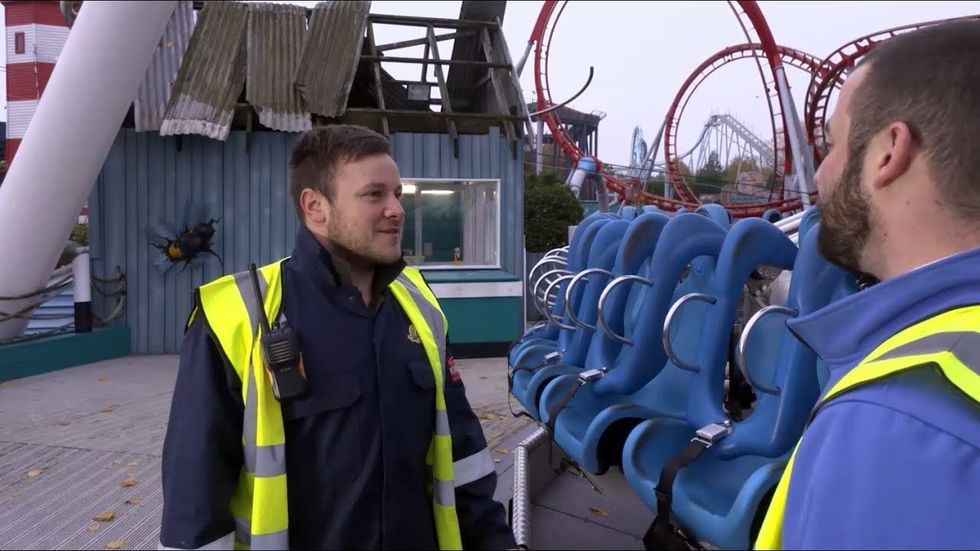
Ride maintenance at Drayton Manor, UK
Image courtesy of Mobaro
Across the sector, target ride uptime typically hovers around 98%. Reaching that number while commercial demands expand is a constant battle.
As parks extend operating calendars to squeeze out revenue, maintenance windows shrink dramatically.
That dynamic regularly creates friction between commercial teams and engineering departments. An extra operating day might look like pure revenue to marketing, but to a maintenance team, it means less overhaul time and more accumulated technical debt.
I can remember the marketing team arriving in my office with their latest idea for an extra operational day. To them it was additional revenue; to me it was one less day for my team and a touch of heartburn. — David Bromilow, Mobaro
When budgets and calendars come under pressure, operators must draw a clear line: safety-critical inspection intervals, staffing levels, and preventive maintenance schedules can never be compromised.
Navigating global regulatory standards and risk assessments
Keeping guests safe across global jurisdictions requires constant alignment with evolving engineering codes and safety standards. Operating teams must stay compliant across a mosaic of regulatory frameworks, including:
- ASTM F24: Standard specifications for amusement rides and devices.
- ISO 17842: International safety standards for amusement ride machinery.
- EN 13814: European standards for fairground and park structures.
Industry bodies like IAAPA and the TEA work closely with standards committees to ensure regulatory changes filter down to parks and OEMs worldwide.
"One of the biggest challenges that OEMs and operators face when maintaining roller coasters and other amusement attractions today would be compliance with continuously updating regulations and standards," says Jones.
"Throughout the world, there are many different governing bodies that play a part in updating standards across the amusement industry, such as the ASTM F24 committee, ISO 17842 and EN 13814."

Ride maintenance and inspection is a vital part of attractions management
To comply without causing excessive downtime, operators rely heavily on risk assessments and reliability studies. These evaluations set precise inspection frequencies and help engineers predict component wear.
Post-maintenance analysis and feedback loops must remain fixed agenda items to catch hidden operational "gremlins" before they trigger unplanned stoppages.
Building transparent OEM and supplier partnerships
Extending the lifespan of a major coaster or dark ride depends entirely on the strength of the relationship between the park operator, original equipment manufacturer (OEM), and technology suppliers.
That relationship can no longer end once the ride opens to the public.
Practical, effective collaboration relies on several core workflows:
- O&M manual digestion: Operators must thoroughly review manufacturer Operations & Maintenance manuals, coordinating directly with OEMs to address any operational gaps or unwritten edge cases.
- Bidirectional data sharing: Parks feed real-world performance metrics back to manufacturers to improve future ride designs, while OEMs issue proactive technical bulletins across operating venues.
- Pre- and post-season alignment: Structured calls before and after scheduled maintenance periods allow teams to review performance trends, discuss software updates, and troubleshoot issues directly.
- Annual on-site audits: Inviting OEM engineers for annual on-site inspections provides an independent sanity check and streamlines emergency support when issues arise.
- Specialised technology integration: Combining corporate operator experience with nimble technology developers gives parks access to flexible, innovative tools that extend asset life.
Hollinshead says:
"Partnerships are crucial to the success of any multi-stakeholder project. This shouldn't only apply to operators, manufacturers and maintenance providers, but also to the developers of new technology, the ones who ultimately can provide them with the tools to prolong the lifespan of the attraction and make their processes more efficient."
Partnerships are crucial to the success of any multi-stakeholder project.— Lee Hollinshead, D-Tex Visual Ltd
In the second part of this guide on maintaining coasters and attractions, our industry experts will explore the shift toward condition monitoring, AI edge sensors, drone inspections, and digital twin analytics—innovations poised to shape attraction care over the next decade.