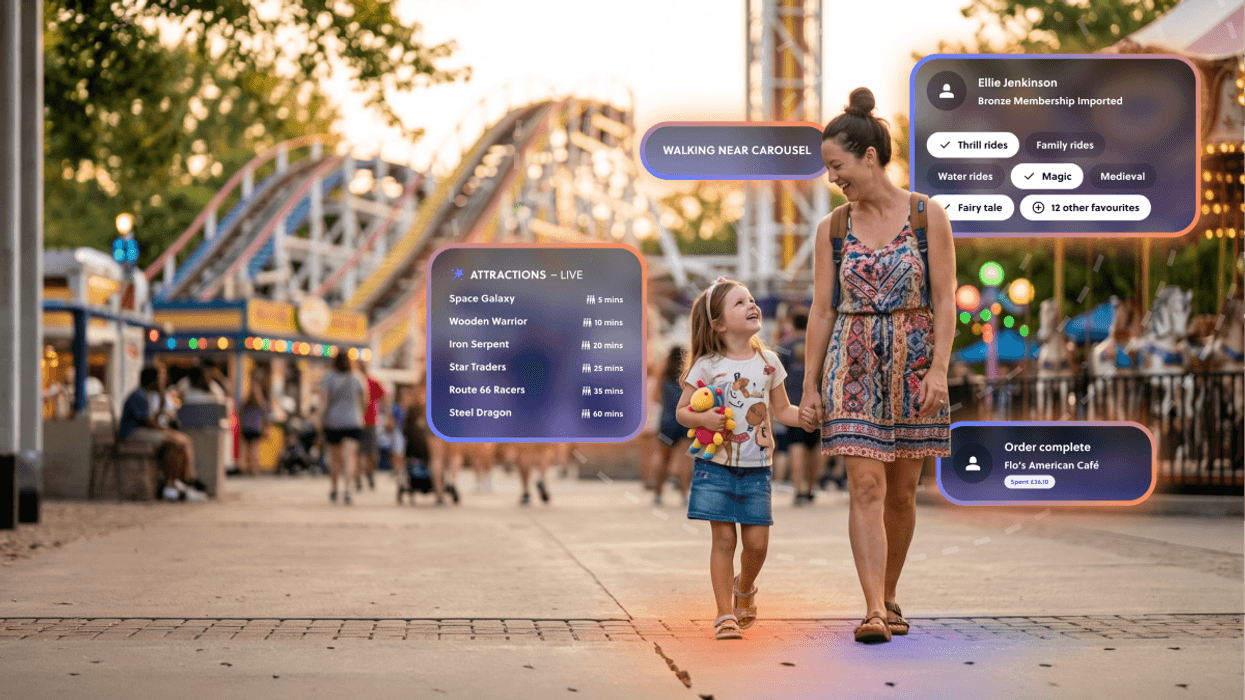
Guests ask one question more than any other: what should we do next? The venue app has always answered it with a directory.
In July 2025 we studied how guests actually reach an answer across nine of our venues. At the theme parks, 43% to 59% of all point-of-interest discovery came through the queue times list.

Attractions.io logo
Attractions.io
At others, when guests are looking for something specific, 33% to 42% came through the search bar, guests typing the names of animals, exhibits and food outlets. At schedule-led attractions it was the daily what's on feed, at 31% to 34%.
Those are three different screens doing the same job. Each hands the guest a list and leaves them to work out which item fits the next thirty minutes, suits the party and is achievable given the queues right now.
The home tab is the exception. It opens by default and reaches all app users. It is also the least personalised screen in the app: the same hero image and featured rides for everyone.
A recommendation engine for live venues
Attractions.io
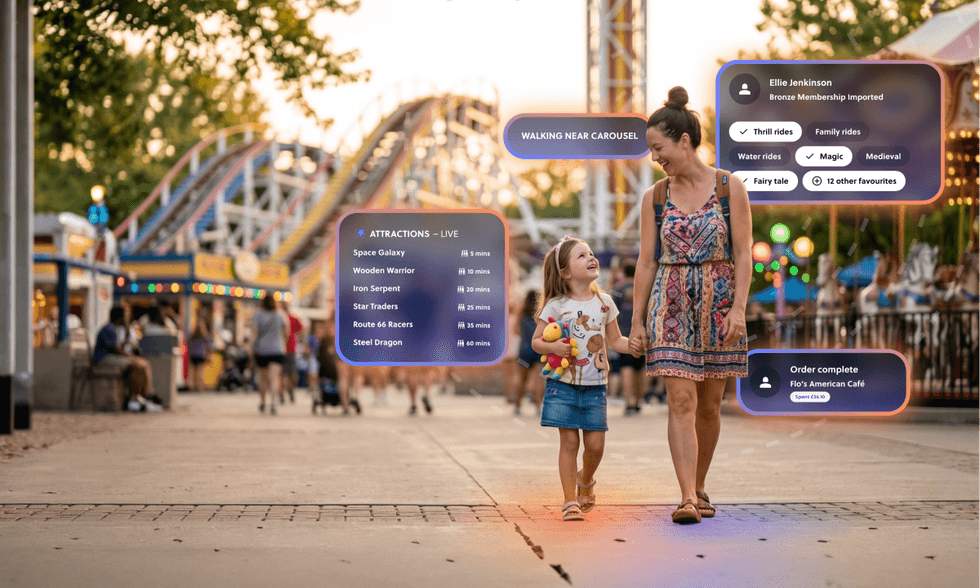
Our new recommendation engine picks the single best next moment for one guest and puts it at the top of that home tab, on one card. The guest already has lists. What they need is a decision.
The card carries the experience, a one-line reason, the operational fact that makes it true right now, and an action.
To get to the next best moment, guests tell us their interests and anything they do not want to miss at the start of their day, and identify themselves once so their tickets, passes and party details arrive in one place. From then on they are never asked to build a plan or type a query.
The recommendation engine takes what the guest has paid to do today. Party composition and any declared accessibility needs. Their stated interests. The time and where they are standing. The live state of the venue. The weather. Alongside those it tracks what the party has already done, so it does not recommend something twice.
This live operational state and context is what is new. The reccomendation engine reads wait times, show schedules, capacity flags, closures and timed moments through 30+ attraction-specific integrations across ticketing, point of sale, CRM, queuing and food and beverage systems. Alongside everything it knows about the guest.
It is how a list of everything becomes one thing this party can actually do now.
Why an agent can be trusted to act here
In a live venue a wrong action is a real queue or a stranded family, so autonomy is not the achievement. Behaving correctly inside constraints you cannot break is.
The engine is rules first and agent second. A deterministic rules layer applies the hard constraints, including accessibility needs, height and age restrictions, opening hours, closures and entitlements, to produce the candidate set. Only then does ranking happen. The agent writes nothing: it ranks and reorders the venue's own curated content. Every recommendation expires, and is replaced when the operational state beneath it moves.
The recommendation engine ships as part of Go, Attractions.io branded guest app. It runs on 30+ integrations operators already have rather than requiring a bespoke build, and it is the first of a planned family of guest agents. It was shown publicly for the first time at IAAPA Expo Europe in September 2026.
Companies featured in this post