
Scene2 Ltd, a leading UK design-and-build company, is taking steps to make immersive experience design and fabrication more sustainable, rethinking everything from its workshop location and industry partnerships to reusing materials after projects are dismantled.
It is also exploring the development of an industry-wide framework to help embed greener practices across the experience sector.
Immersive experiences are often temporary; sets that take weeks to build can be dismantled in a day, sending much of their material to landfill. As audiences, clients, and regulators ask tougher questions, this model is losing ground.
“We spend so much energy designing and making things feel magical for audiences, and far too little asking what happens to them afterwards,” says Scene2 founder Susan Walker.
“We decided to start with our own practice and be honest about what has to change.”
Out of the city, into the countryside
The most visible shift is geographic.
Scene2 is relocating to a rural base in Writtle, Essex, trading an industrial setup for a split space in the fresh air where the company can support local farm owners and focus on smarter working: less wasted movement, less duplication, and fewer last-minute scrambles that take their toll on people and resources.
The move also connects Scene2 to a local network of suppliers, tradespeople and businesses, shortening supply chains, keeping expertise close to the workshop floor and shifting to collaborative working.
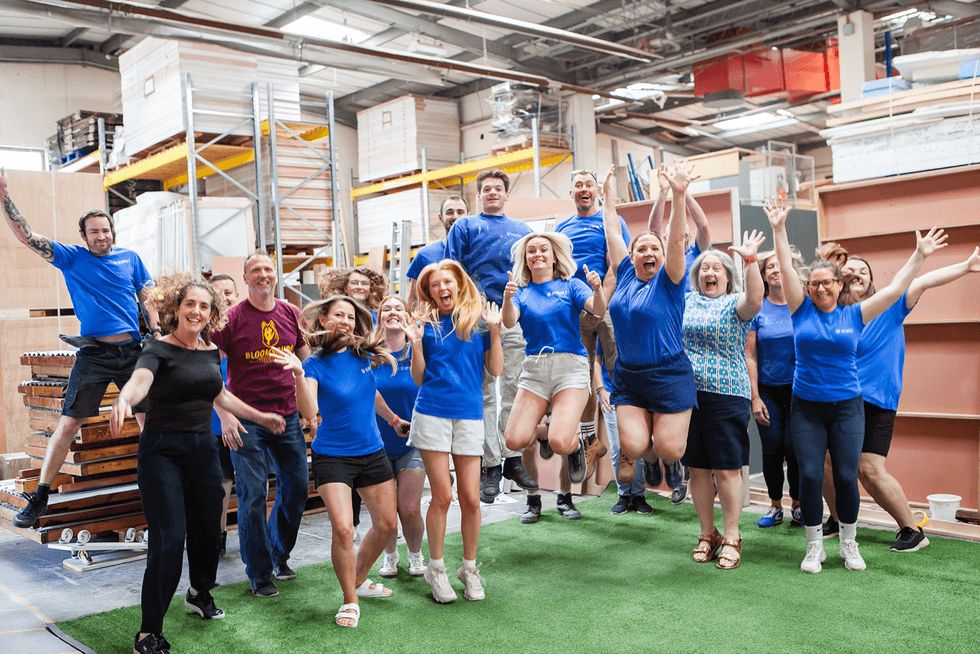 The Scene2 team
“Sustainability isn’t only about what a project is made from,” says Walker. “It’s about who is involved, how far things travel, and the relationships that hold it all together. Our rural base gives us the space and the creative community to work that way.”
Partnerships built on trust
The experience sector can be a closed shop, with every studio guarding its methods and solving the same creative problems alone. Scene2 sees that the climate crisis makes that approach unaffordable and recognises the value and benefit of early collaboration with trusted partners in producing the best creative work.
The company is working side by side with fellow practitioners and a growing circle of trusted partners, among them Kaleidoscope-Studios, Bully Entertainment, Used Creative and Rowleys-London. Those long-term relationships mean knowledge and ideas are shared, plans are made jointly, and resources are pooled.
Crucially, the hard questions and creative boundaries are challenged early, when most of a project’s environmental impact and creative infancy is still up for grabs.
“A partner you know well is one you can have an honest creative conversation with about whether something needs to be built that way at all,” Walker explains. “That conversation is where the biggest savings are, and you can only have it when there’s real trust.”
Rethinking the build
Walker is also taking the question into academia. She is completing research at Royal Holloway, University of London, titled Rethinking the Build, which grows directly out of the challenges the design and fabrication sector faces on live experience projects.
The research asks two questions. How can the sustainable production practices already working in UK theatre and film be translated into immersive and location-based experiences, and force real process change? And what would it take to embed circular economy principles in production, fabrication and client relationships?
There are precedents. The Theatre Green Book gave theatre makers a shared, practical standard for greener productions. BAFTA’s Albert gave screen industries a common language and toolkit for measuring and cutting their footprint.
Both worked because they grew out of industry practice and were open to everyone.
Immersive has nothing comparable yet. One idea Walker’s research is exploring is The Experience Green Book, a shared framework for sustainable experience design and fabrication, shaped by the people who actually do the work.
“Theatre and screen hope that a shared framework can change how an industry works,” says Walker.
“The Experience Green Book is still an idea, and it can’t be created by one company or one researcher. It has to be shaped by the people who design, fabricate and install these experiences.”
Join the conversation
Scene2 wants to hear from the rest of the industry. Walker is inviting designers, fabricators, producers, technologists and client-side commissioners to talk about how they work today: what is working, what is getting in the way, and where they think the sector needs to go in response to the climate crisis.
Conversations will be handled ethically and openly, and every contribution will help shape the research and the wider debate.
“The climate crisis won’t be solved by any single producer, studio, designer, fabricator or production house,” says Walker. “But a sector that talks honestly and shares what it learns can move much faster.
"If you’d like to be part of that conversation, I’d love to hear from you.”
See also: Raising the curtain for a new era of immersive experiences with Scene2