
In recent years, the couple has become something of a paradox. While still omnipresent in cultural narratives, it is increasingly contested, even discredited, in certain contemporary discourses. Having a partner can now be perceived as a form of compromise, a loss of freedom, sometimes even as a socially undesirable choice.
From Vogue to Courrier International, the media reflects these shifts: the glorification of singlehood, emotional fatigue, rejection of inherited relationship models, and the questioning of the couple as the default life trajectory.
In her book Enfin seules (At Last, Alone), Lauren Bastide describes a generation seeking emotional autonomy, weary of societal expectations surrounding romantic success and encouraged to be entirely self-sufficient.
Yet this apparent rejection does not signal the disappearance of love, quite the opposite. Rather, it reveals a profound shift: it is not feelings themselves that are being rejected, but the frameworks through which they have long been understood.
The couple is no longer self-evident; it has become one option among many, sometimes a question, sometimes even a problem.
Within this context, a legitimate question arises for cultural institutions: what can, and what should, museums present when addressing love today?
Should they avoid the subject, deemed too intimate, too normative, or too controversial? Or, on the contrary, should they develop exhibitions that offer tools for understanding without prescribing models or dictating ways of loving?
Museums are not meant to explain how to love. But they can help us understand what we do when we love, biologically, psychologically, socially, and culturally. It is precisely within this space that the travelling exhibition About Love finds its place.
When the couple is no longer an obvious model
If the couple is now being questioned, it is not because love has lost its value, but because its dominant forms have become suspect.
For many, particularly younger generations, the couple no longer appears as an unquestioned promise of fulfilment, but rather as a demanding construct, sometimes restrictive and often laden with implicit expectations: constant emotional availability, affective performance, long-term projection.
This reassessment is accompanied by growing attention to notions long relegated to the background: consent, emotional labour, power asymmetries, and emotional autonomy. In this context, singlehood may be claimed as a space for breathing, even as an act of emancipation.
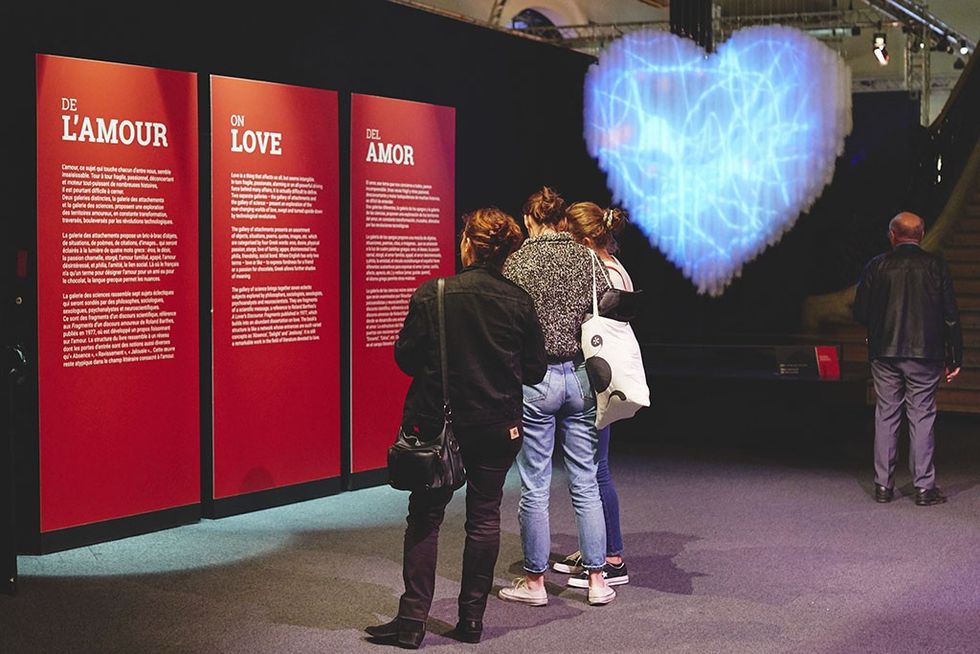 Image credit R Thenadey
Yet here again, reality proves more complex: the valorisation of emotional independence often comes with another expectation, that one should be entirely self-sufficient.
This shift is neither anecdotal nor marginal. It runs through media narratives, cultural practices, digital uses, and intimate storytelling. And it raises a central question for museums: how can they address a subject as universal as love when its traditional frameworks have become unstable, contested, or plural?
Ignoring this transformation would mean freezing love within a nostalgic or decorative vision. Confronting it, by contrast, allows it to become an object of reflection, both intimate and collective, where personal experiences intersect with social norms and biological mechanisms.
Rethinking exhibitions on love
In such a context, exhibitions dedicated to love can no longer rely solely on symbolic or romantic approaches. What audiences, especially younger ones, seek today are not ready-made answers, but tools for understanding.
Museums have a unique role to play here. Positioned at a distance from moral injunctions, normative discourses, and individual prescriptions, they can offer a space where love is observed, analysed, and experienced without judgement.
This approach shifts the debate. It is not about defining what a relationship should be, but rather about allowing exhibitions to become spaces that provide “interpretive keys” to what unfolds when we love — whether in a couple, single, or within diverse relational forms.
 Image credit R Thenadey
This non-prescriptive stance is essential. It allows visitors to recognise themselves, to question, sometimes even to contradict themselves, without feeling assigned to a model.
In a world saturated with binary narratives, for or against the couple, for or against commitment, museums can offer what few spaces still provide: time, nuance, and complexity.
About Love: a travelling exhibition as a case study
It is precisely within this evolving landscape that the travelling exhibition About Love takes shape.
Designed from the outset as a scientific and transdisciplinary exhibition, an approach that some partners describe as linking “the sensitive with the scientific on a subject that concerns everyone”, it neither seeks to celebrate a romantic ideal nor to promote a normative vision of relationships.
Instead, it treats love seriously as a major human phenomenon: complex, ambivalent, and universal, while exploring the mechanisms that underpin it.

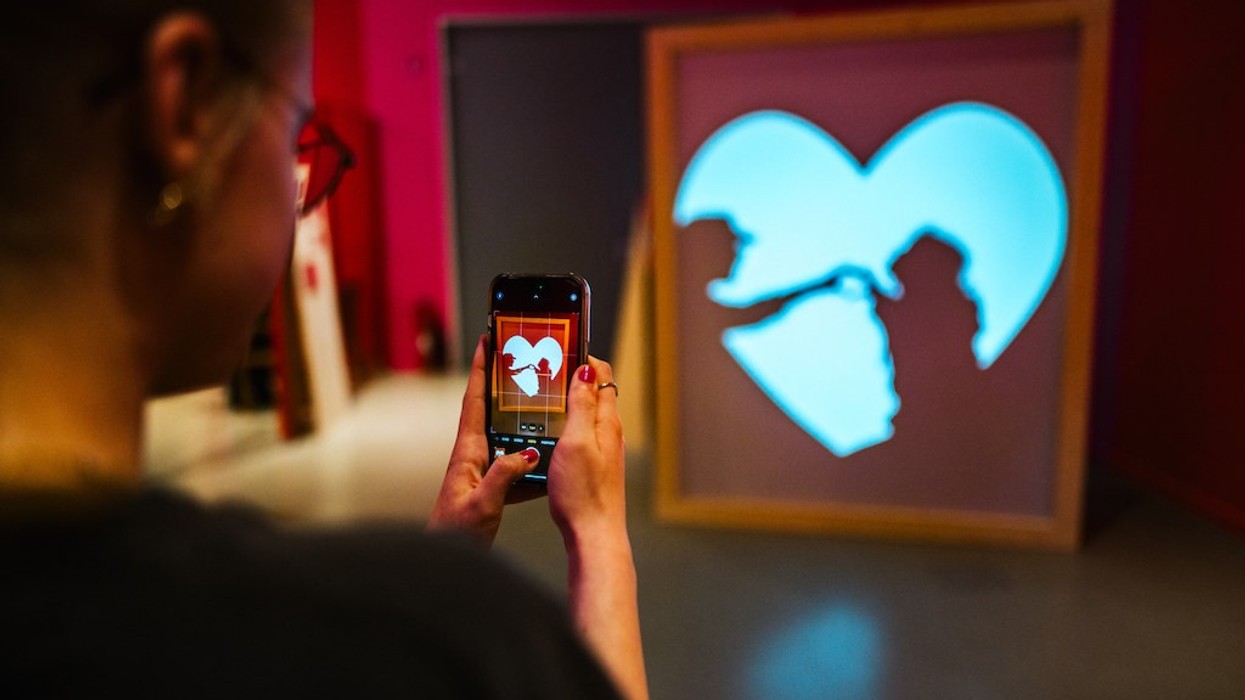
The exhibition addresses love through several complementary perspectives: attachment and its biological functions; the bodily manifestations of desire; the social construction of sexuality; expressions of love and their cultural meanings; and relationships in the age of digital platforms.
At a time when a growing proportion of relationships begin online, understanding the impact of these environments has become essential to grasp contemporary forms of attachment.
In doing so, the exhibition shifts the lens: love is no longer a fixed narrative but a set of processes to be understood, experienced, and questioned. Several institutions have highlighted the strong engagement generated by the exhibition, with some even describing audiences as “delighted.”
Reaching new audiences
With over 760,000 visitors since its first presentation at the Palais de la découverte in Paris, this positioning largely explains its ability to reach diverse audiences, particularly younger generations.
Rather than imposing a single interpretation, About Love leaves room for individual experience.
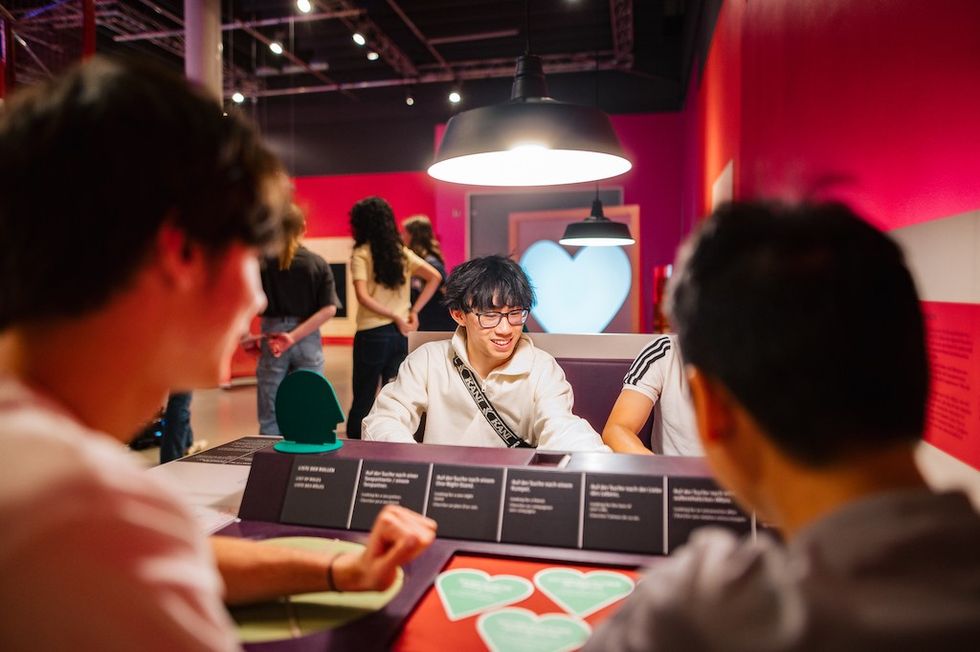
This approach fosters deep visitor involvement: audiences engage with the subject, share their own experiences, and often extend their reflections beyond the exhibition itself.
As Zoom Laval notes, the exhibition makes it possible “to reach new audiences, create opportunities for intergenerational dialogue and discussion, and address intimate topics.”
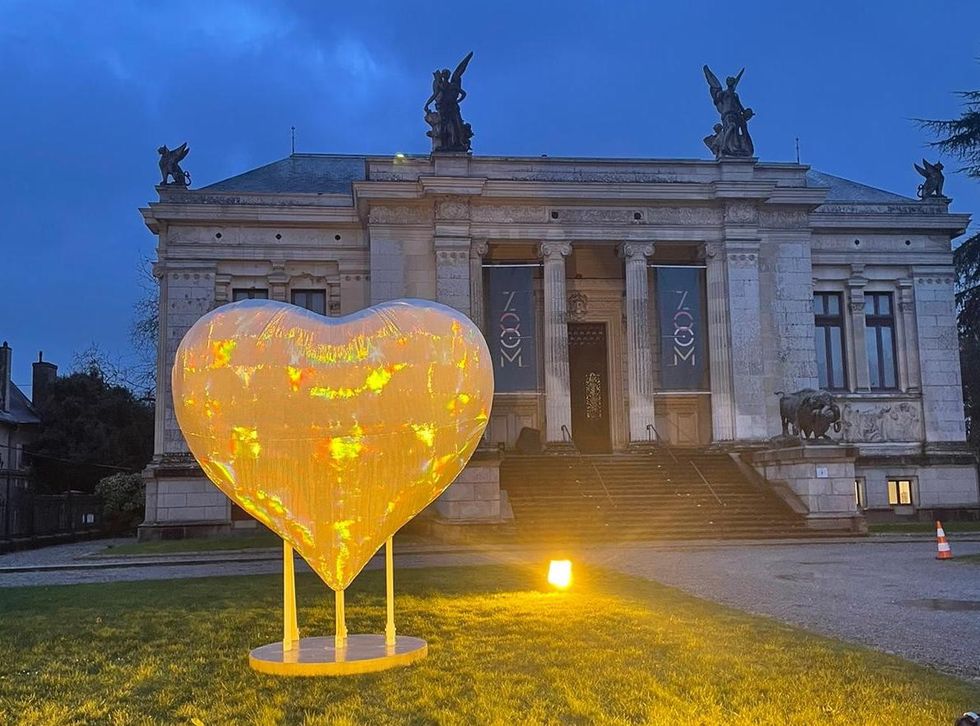
The scientific framework thus acts as a reassuring structure, enabling sensitive subjects to be explored without judgment or injunction.
For host institutions, About Love represents a strategic asset.
It offers opportunities to spark dialogue around a universal theme, attract young adults, often a challenging audience to mobilise, develop programming aligned with key cultural moments such as Valentine’s Day, and deploy highly engaging mediation formats.
While its scientific and narrative content remains consistent, its spatial design and dialogue with host venues across six museum presentations and a total of 40 months on display can evolve in response to cultural contexts.
Such adaptability is essential when addressing a subject that is both universal and deeply sensitive: it respects local specificities while maintaining strong intellectual ambition.
Finally, the exhibition aligns with a particularly relevant moment.
As perceptions of romantic relationships are profoundly reshaped by social transformations and the rise of digital environments, offering an exhibition that enables visitors to see, understand, and feel, without prescribing, constitutes a particularly valuable cultural response.
Conclusion
At a time when the couple is no longer an obvious model, when relationships are questioned, redefined, and sometimes rejected, museums have a decisive role to play. Not to arbitrate debates or impose norms, but to provide spaces where the complexity of our era can be explored without simplification.
When grounded in science, lived experience, and a plurality of perspectives, exhibitions devoted to love move beyond the traditional oppositions between attachment and freedom, couple and solitude, desire and reason, offering visitors meaningful tools for understanding.
In this sense, About Love illustrates what museums can offer today: exhibitions capable of accompanying the profound transformations of our societies by addressing intimate subjects with rigour, nuance, and intelligence.
In doing so, our institutions have an essential, and deeply inspiring, role to play.