
Adirondack Studios (ADKS), a company that provides creative solutions for designers, artists, producers, and owners in the global entertainment industry, is sharing insights into the creation of Primate Forest, a landmark project with Cleveland Metroparks Zoo and creative firm Local Projects.
Visitors approaching Primate Forest may first glimpse an orangutan in its outdoor habitat. Inside, they find themselves immersed in a recreation of a Northeast Ohio forest, a deliberate design that connects the region with the forests of Borneo as part of the same global ecosystem—and shows how visitors can help protect them.
The interconnectedness of habitats, people, and animals lies at the heart of Primate Forest, the largest capital project in the Zoo’s 144-year history. This $120 million, multi-phase initiative, scheduled for completion in 2032 to mark the zoo’s 150th anniversary, will create a 13,000-square-meter indoor destination for 66 animal species.
For the Zoo, this substantial investment is about more than expanding habitats: it’s an opportunity to reshape how visitors connect with the natural world.
The project’s $70 million first phase recently opened to the public and has already exceeded the Zoo’s and its visitors’ expectations.
Making conservation relatable
As the Zoo considered how to reimagine its former iconic RainForest, it set out to turn visitors’ awe and curiosity into conservation-minded behaviour while showcasing its teams’ exceptional animal care and husbandry. The Zoo aimed to create more complex environments for animals and give guests an intimate look at the expertise behind their daily wellbeing.
Most importantly, it wanted visitors to see themselves as participants in the future care of global ecosystems and to discover personal paths toward environmental stewardship.
Although habitat and animal conservation are global issues, the zoo wanted to present these ideas and challenges in ways that felt relatable to Ohioans.
This meant placing visitors in familiar environments and introducing them to local citizen conservationists.
It also meant embracing what would become known within the project as “magical realism”: blending cutting-edge, multi-sensory technology with time-honoured craft to inspire visitors with a renewed sense of wonder and appreciation for the plants and animals in their own backyard—and, in turn, a renewed desire to advocate for the conservation and protection of our natural world.
Designing for transformation
To bring its vision to life, Cleveland Metroparks Zoo knew it needed the right project partners. The Zoo selected Local Projects, an award-winning creative firm based in New York, and tasked the firm with assembling the overall Primate Forest project team.
"The Zoo was very clear about their strategy," says Nathan Adkisson, creative director of Local Projects.
"They said, 'We don’t want more interpretive panels. The best way to turn our guests into conservationists is to start here in Ohio and use awe and wonder to supercharge their love of forests.' So, the main character that runs throughout all of the experiences is the Ohio forest itself."
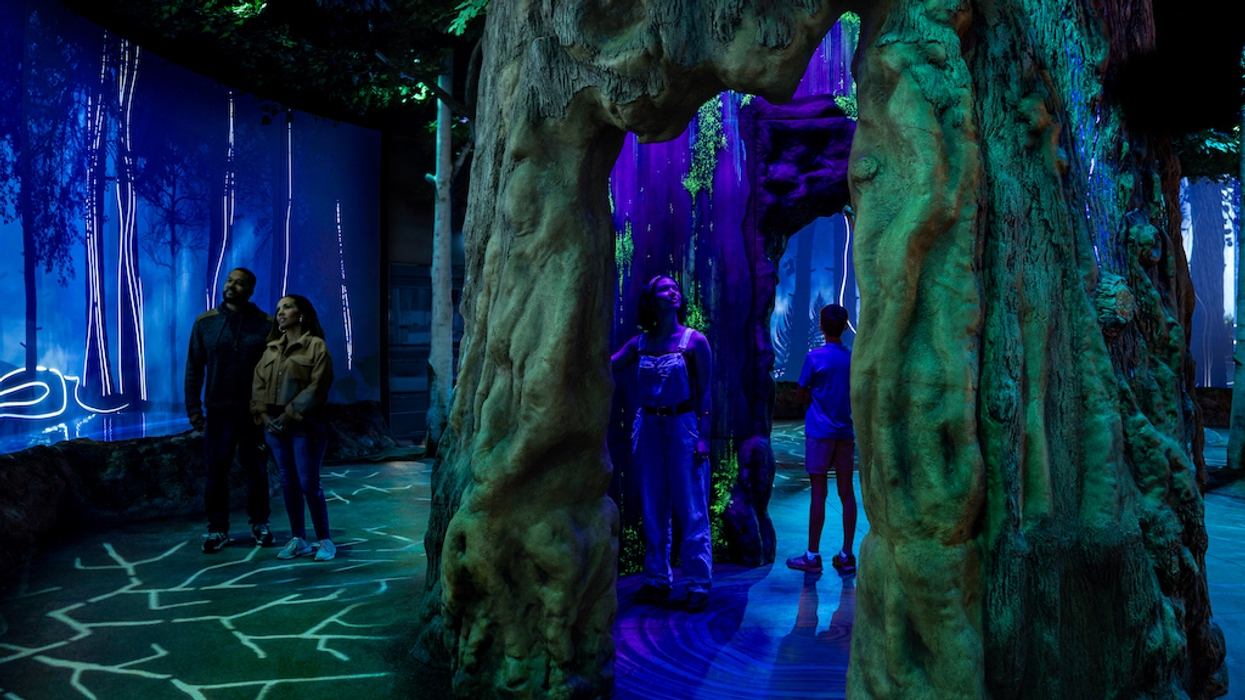
Upon entering the doors of Primate Forest, guests enter a “magically real” indoor environment called Connected Forest.
Local Projects shares that in its 25 years of experience, it has seen attractions tend to fall into one of two formats: highly detailed scenic environments with little narrative, or large-scale, media-driven environments that tell a compelling story but feel two-dimensional.
The Connected Forest experience brings narrative and scenic projection-mapping technology together to create a three-dimensional story that multi-generational visitor groups can fully immerse themselves in.
The experience unfolds as a 14-minute audiovisual poem in four parts: "Day to Night," "Water Cycle," "Four Seasons" and "Regeneration." Two 17-meter-long projection walls extend the trees beyond the edges of the room, making the forest appear to stretch into the distance.
At the centre of the room stands an enormous, interactive Mother Tree. The experience draws on the work of forest ecologist Suzanne Simard, whose research describes the oldest and largest trees in a forest as hubs within underground networks.
Through these networks, mother trees pass nutrients to neighbouring trees and send signals to younger plants.
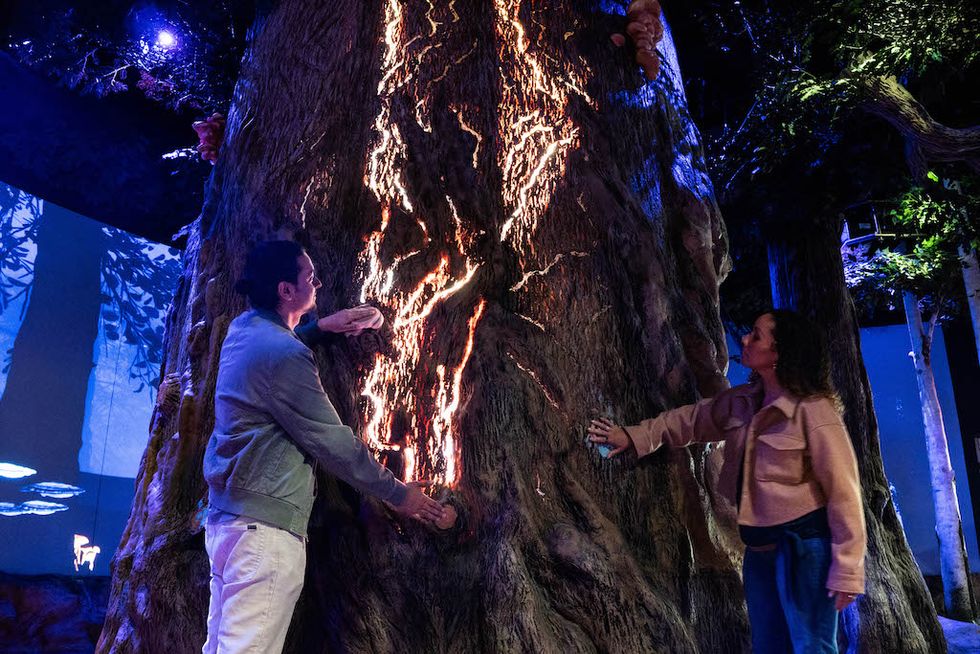 The Mother Tree is the interactive centrepiece of Primate Forest at Cleveland Metroparks ZooImage credit Studio A / Ally Grifin
This Mother Tree brings those networks to life. When visitors place their hands on its bark, beams of light travel up the trunk and into the canopy. When many visitors touch the tree at once, they trigger a shared celebration that illuminates the entire tree with light and sound.
“It was very important that our guests understand that conservation is a community project, and the Mother Tree makes that collective action a joyful, surprising experience,” says Andi Kornak, deputy executive director of Cleveland Metroparks Zoo.
Interactive experiences
In addition to the Zoo’s first two-story indoor-outdoor orangutan habitats and management hub, complete with a guest viewing deck, Primate Forest’s second floor features The Learning Gallery. It offers interactive experiences that focus on visitors and their critical role in animal and habitat conservation.
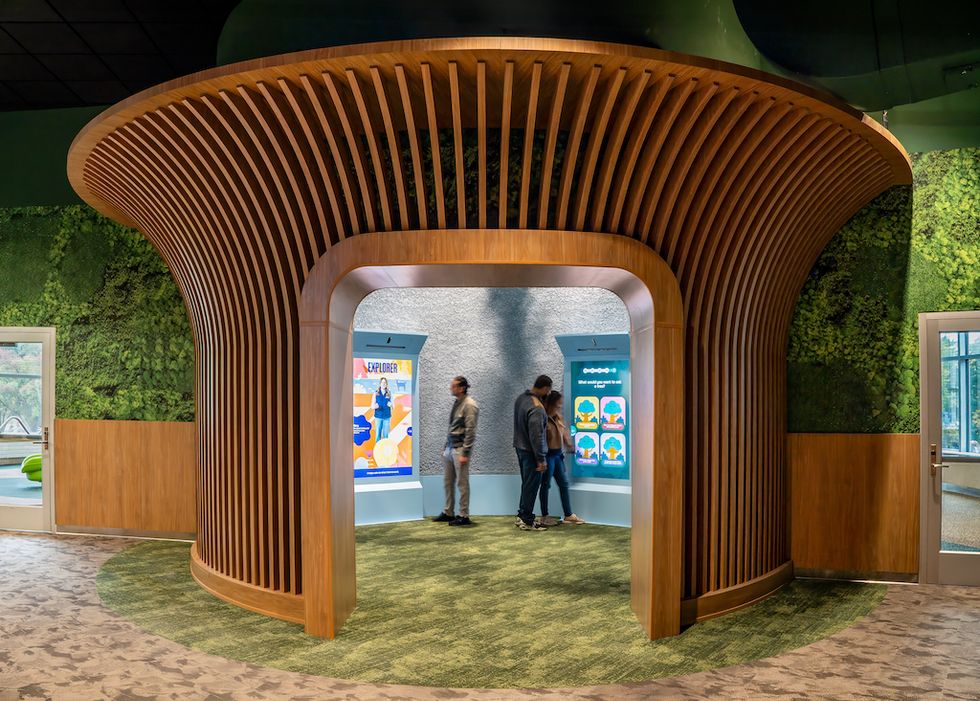 The Learning Gallery connects Primate Forest visitors with a 'care archetype'Image credit Studio A / Ally Grifin
Local Projects’ experience design process often starts with identifying a barrier to action. In this case, it was “you can’t be what you can’t see”—the notion that conservation efforts are reserved for those with advanced degrees. Its answer was Connections Studio, a short, playful quiz that matches guests with a ‘care archetype,’ such as Scientist, Explorer, or Creator.
Each result leads to a life-size video featuring an Ohioan with the same archetype, who shares how they care for the environment. The storytellers include a veterinary epidemiologist, a Girl Scout, and a middle school rowing coach, illustrating the many ways to be a sustainability steward.
Local Projects designed the experience to encourage conversation, inviting caregivers and young guests to talk about what motivates them.
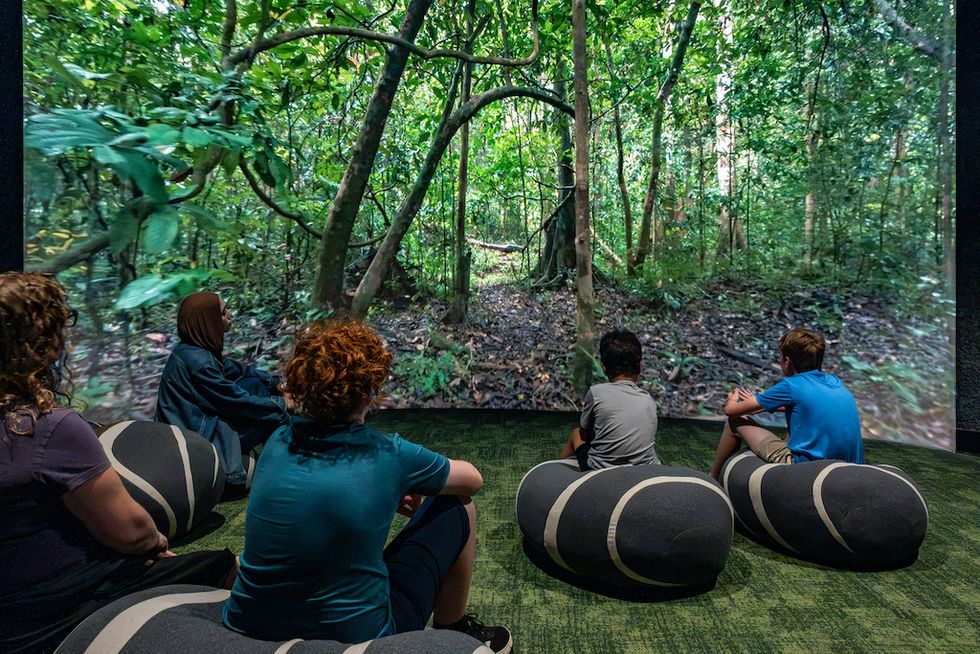 The Forest Theater within Primate Forest is inspired by forest bathingImage credit Studio A / Ally Grifin
Nearby, the Forest Theater offers a different kind of encounter with nature. Inspired by the Japanese practice of forest bathing, a meditative, floor-to-ceiling film takes guests on a journey through forests from Borneo to Ohio’s Cuyahoga Valley National Park.
In contrast to the excitement and stimulation of a typical zoo visit, the Theater offers a moment of stillness: a place to slow down, reconnect with nature, and recharge. Between scenes, brief messages introduce the research-backed benefits of spending time in forests, reinforcing the restorative power of the natural world.
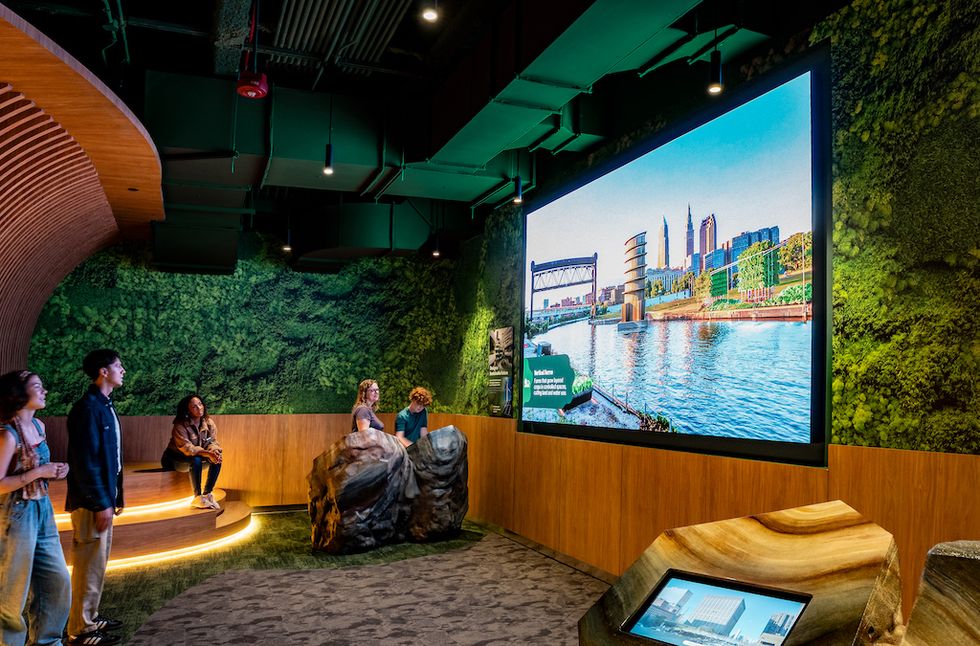 The Sustainable Future Design Lab uses AI to turn guests into urban innovators at Cleveland Metroparks ZooImage credit Studio A / Ally Grifin
The Sustainable Future Design Lab is one of the first zoo experiences to use generative AI to turn visitors into urban innovators. At four touchscreens emerging from Adirondack Studios’ sculpted rockwork, guests select photographs of underused sites around Cleveland, such as vacant lots, car parks, and building facades.
They then use AI-powered tools to add sustainable features such as green walls, algae farms, bioluminescent bacteria, and electric vehicle charging stations. A massive LED screen showcases visitor creations, inspiring all.
To exit the exhibit, visitors pass through The Connected Forest once again. Local Projects chose this egress deliberately. As they venture among the fabricated trees and hear the rustling leaves one last time, visitors face the sliding exit doors, which offer an unfettered view of Northeast Ohio’s actual elms, ashes, and maples.
This glimpse of their real-life forest home brings their Primate Forest journey full circle.
“We’ve known that relationships with the local environment, and emotional relationships with individual animals, are at the heart of emotional bonds visitors form with institutions like Cleveland Metroparks Zoo,” says Adkisson.
“People build positive emotional bonds with the tree in their backyard, or the orangutan they come to visit over and over again throughout their childhoods. Zoos and aquariums should be building on the context of these relationships to bring climate awareness down to human scale, and that's exactly what we're doing here."
Fabricating the forest
When Adirondack Studios joined the Primate Forest project, Local Projects and the Zoo had already developed a strong artistic intent.
ADKS’ initial scope was to confirm that Local Projects’ intricate vision for the Mother Tree was experientially achievable.
Through various mockup iterations, the ADKS team confirmed that the Mother Tree, even with its complex integration of interactivity, lighting, sound and media, would not only be functionally and operationally achievable, but a true "wow" moment for Zoo visitors.
“Throughout our 52-year history, ADKS has created many fantastical forests around the world, but seldom have we created environments based in such extraordinary realism,” says Adirondack Studios project manager Glenn Sturgis.
“Connected Forest offered a unique opportunity for our Technical Design and Fabrication teams - metal, carpentry, FRP, soft goods, scenic paint, etc. - to stretch themselves as both artists and problem solvers. The prototyping and testing process was crucial to the success of the final experience, and it paid off.”
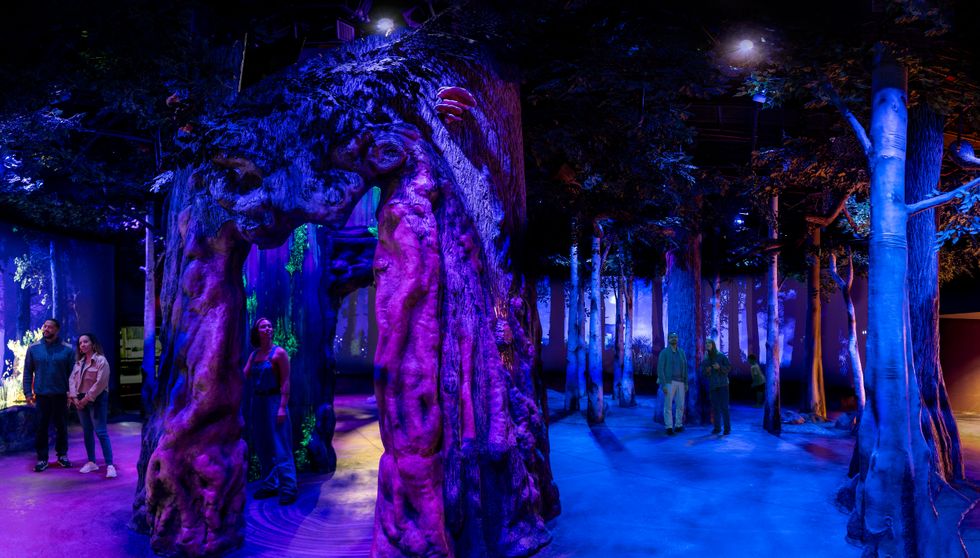 Adirondack Studios helped bring the vision for the Connected Forest to lifeImage credit Studio A / Ally Grifin
From those initial prototypes of Local Projects' designs, ADKS’ scope for general contractor Higley Construction expanded to include final drawings, fabrication, and installation of all the Connected Forest’s physical theming elements.
These included 26 custom-made trees, 16 hand-painted, carefully concealed flora and fauna species, scenic flooring, a foliage canopy, and, of course, the 3.7-meter-diameter Mother Tree. ADKS wanted the Connected Forest to convey a mystical storytelling quality while staying true to the Zoo’s aspiration for magical realism.
From peeling birch bark to native fungi, ADKS created trees that reflect the species visitors would see outside the Zoo's Northeast Ohio doors, using over 1,200 metres of aluminium tubing, nearly 1,900 litres of resin, plywood, metal mesh, and hand-mixed custom paints.
The resulting Connected Forest scene complements the 114 square metres of visuals conceived and produced by Local Projects, Electrosonic, and PIXERA, with a soundscape by Antfood and lighting by Illuminated Integration.
In addition to the Connected Forest, ADKS’ scope included the 200 curved wooden fin embellishments throughout the Learning Gallery, the faux rockwork kiosks in the Sustainable Future Design Lab, and the monitor enclosures in the Connections Studio.
Encouraging emotional connections
A 2026 Gallup poll places climate concern near a record high, with 44% of Americans worrying "a great deal." Yet concern does not always translate into action. According to a 2023 study by the Multidisciplinary Publishing Institute (MDPI), climate anxiety can lead to "eco-paralysis," leaving people disengaged.
The combination of global issues and local context makes Primate Forest compelling. The exhibit invites guests to connect emotionally with their Ohio ecosystem, discover a personal reason to protect it, and recognise a role they can play in its future.
In its first few weeks since opening, Primate Forest has proven a hit with visitors and the media, selling out its timed entry slots and earning rave reviews from traditional news outlets and social media influencers.
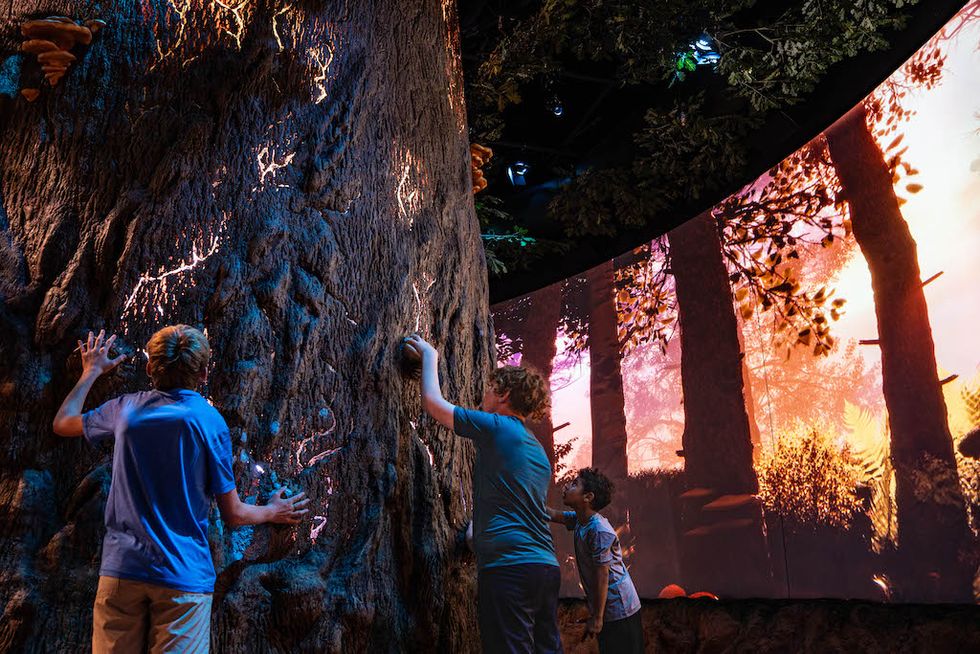 The interactive Mother Tree helps Primate Forest visitors learn about forest networksImage credit Studio A / Ally Grifin
“What we’re trying to do is change the messaging so it’s not about rainforests far away, but about the importance of trees for people here in Northeast Ohio,” said Cleveland Metroparks Zoo executive director Chris Kuhar.
“The thing that technology does is provide us an opportunity to change up the experience so guests can come back repeatedly, and it’s not just the same experience every time.”
The role of zoos and aquariums is so much about connection,” adds Katie Corr, Cleveland Metroparks Zoo director of education and engagement.
“Often we think about connecting to other species, but it’s also about being connected to one another to build stronger communities for animals and humans.”
Andi Kornak, Nathan Adkisson, and Glenn Sturgis will present Speaking for the Trees: Forging Conservation Through Connection at IAAPA Expo on Monday,16 November at 8:30 am. To arrange a meeting with Adirondack Studios during IAAPA Week, please email.
Cleveland Metroparks Zoo will host the 2027 Association of Zoos & Aquariums Annual Conference 28 August - 2 September.
Earlier this year, Adirondack Studios announced it has promoted three senior team members in Dubai and established registered entities in Abu Dhabi, UAE, and Riyadh, Saudi Arabia.