
Bea is a journalist specialising in entertainment, attractions and tech with 15 years' experience. She has written and edited for publications including CNET, BuzzFeed, Digital Spy, Evening Standard and BBC. Bea graduated from King's College London and has an MA in journalism.
The Oklahoma Aquarium, which reopened amid the coronavirus pandemic on May 8, has announced updated operations with guests no longer required to reserve tickets in advance from May 15.
The updated measures are in accordance with Governor Kevin Stitt ’s announcement of the second phase of the reopening plan in Oklahoma.
The aquarium temporarily closed in light of the COVID-19 outbreak in March. Now, guests are able to visit again and can purchase tickets at the ticket kiosk.
In addition, members are now able to visit at their leisure. The Oklahoma Aquarium is still implementing precautions, which can be found below.
It will remain open from 9am to 9pm, allowing guests to visit at their convenience. Visiting the aquarium in the evenings is encouraged for guests who feel more comfortable with smaller crowds.
The floors will remain marked to ensure social distancing. The aquarium will monitor the number of guests in the facility, also asking guests to respect social distancing guidelines.
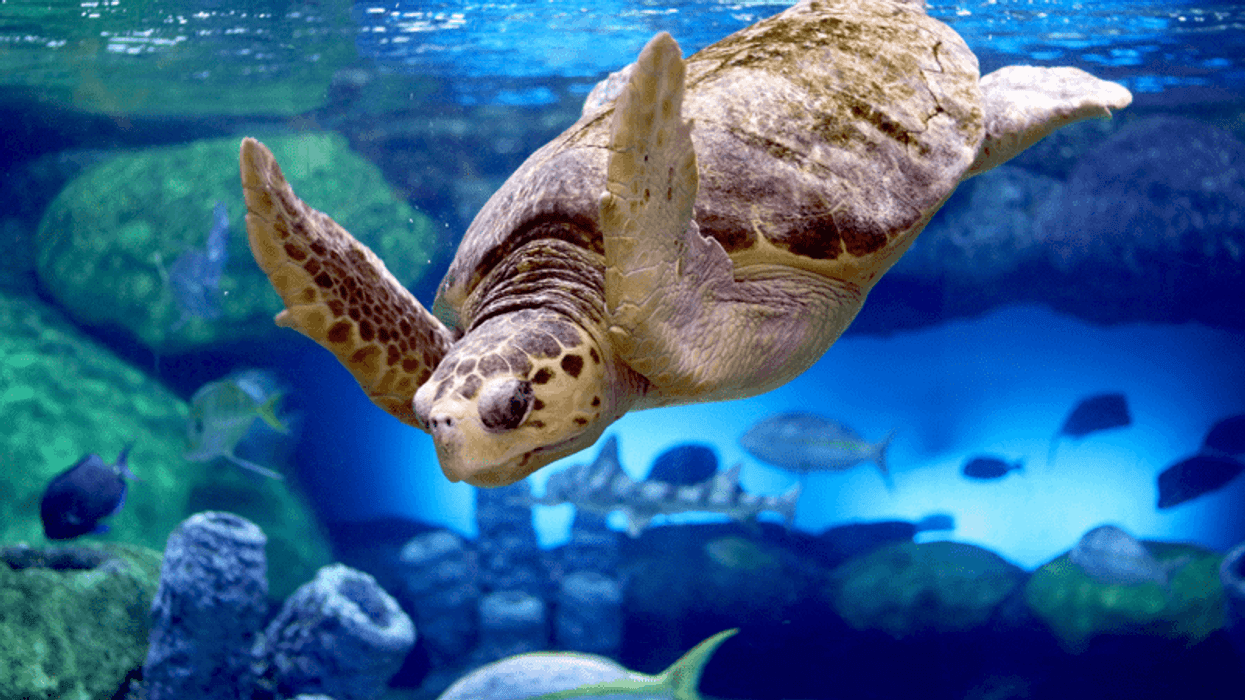
All exhibits at the Oklahoma Aquarium will open, including the playground and coin-operated rides and games, as well as the turtle and stingray feed stands. However, feed shows will remain temporarily postponed to encourage social distancing.
Staff at the aquarium will continue to clean and sanitise all surfaces, and hand sanitiser will still be available throughout.
Visitors who have already bought a ticket can use it at any time within a year's purchase.
The Oklahoma Aquarium reopened on Friday (May 8) with a new exhibit, titled 'Secret World of the Octopus', which showcases a giant Pacific octopus (via The Oklahoman ).
"We’re especially excited to reveal our new octopus exhibit to guests because it was entirely funded thanks to public donations," said Kenny Alexopoulos, chief operating officer of Oklahoma Aquarium.
Bea is a journalist specialising in entertainment, attractions and tech with 15 years' experience. She has written and edited for publications including CNET, BuzzFeed, Digital Spy, Evening Standard and BBC. Bea graduated from King's College London and has an MA in journalism.
Announcing the news on social media, Universal shared images of the new cars onX and released a teaser video of the ride on Instagram.
Per the announcement, ride vehicles will feature four iconic designs, including the Mazda RX-7, Nissan Skyline GT-R, Toyota Supra, and the previously announced Dodge Charger
Universal captioned the post: "Four iconic designs, one fast ride. The Mazda RX-7, Nissan Skyline GT-R, and Toyota Supra join the iconic Dodge Charger to complete the lineup for Fast & Furious: Hollywood Drift."
Opening at the California theme park this summer,Fast & Furious: Hollywood Drift will be the fastest coaster in Universal's lineup, reaching speeds of up to 72 mph.
As the park’s first-ever high-speed outdoor coaster, guests will race along 4,100 feet of aerial track in 360-degree rotating vehicles, designed to resemble iconic cars from Fast & Furious.
Located on the Upper Lot of Universal Studios Hollywood, Fast & Furious: Hollywood Drift will include a queue experience situated within a garage-like structure.
Speaking last year, Scott Strobl, executive vice president and general manager of Universal Studios Hollywood, said: "Watching the progress of this incredible roller coaster come to life is truly spectacular."
Four iconic designs
He continued: "Fast & Furious: Hollywood Drift will be a powerful game changer for Universal Studios Hollywood that will not only transform the topography of our destination but will infuse an entirely new level of adrenaline to our already dynamic theme park."
Teasing what to expect from the new coaster, Universal said in a press release: "Fast & Furious: Hollywood Drift will put guests in the driver seat of the high-speed thrills of Universal Pictures’ Fast & Furious universe like never before."
"This decision was not made lightly. In light of the ongoing conflict involving Iran, Israel, and the United States, and the resulting impact across the region — including the United Arab Emirates — we believe it is our responsibility to act with caution and clarity," says Melissa Oviedo, CEO.
"The safety and well-being of our members, speakers, partners, and their families is, and will always remain, our highest priority."
She adds that the TEA's thoughts are with members based in the region, as well as colleagues and loved ones who may be directly affected.
"We recognize that this moment carries both professional and personal weight, and we want you to know that the global TEA community stands with you in support."
Safety is the priority
The TEA is currently working through the cancellation process and will update members on hotel cancellations. Meanwhile, refunds for SATE EME registration fees will be issued.
The event was to be hosted in partnership with IAAPA, welcoming TEA members, leaders, creators, and decision-makers who are actively shaping destinations, attractions, and experiences across Europe, the Middle East, and beyond.
IAAPA has not yet announced whether it will proceed with the inaugural IAAPA Expo Middle East, scheduled for 30 March to 2 April 2026 at the Abu Dhabi National Exhibition Centre (ADNEC) in Abu Dhabi, UAE.
A statement from IAAPA reads: "IAAPA is closely monitoring the current situation in the Middle East as developments continue to unfold. The safety and well-being of our members, exhibitors, attendees, and partners remain our highest priority.
"We are in communication with relevant stakeholders and will provide updates or guidance as needed. At this time, we continue to assess the situation carefully and thoughtfully."
The Dalí Museum in Florida has announced plans for a 35,000-square-foot, $65 million expansion, with construction due to start this autumn.
Expected to open in 2028, the new addition to the Dalí Museum will boast flexible gallery environments for experiential exhibitions that blend art and technology, a dedicated learning centre, and community spaces for events and programming.
Since opening in St. Petersburg in 1982, the Dalí Museum has welcomed more than 10 million visitors. Following the debut of its landmark building in 2011, it has generated more than $1 billion in economic impact for the area.
Combined with the museum’s existing galleries, theatre, dome and Avant-garden, the expansion will create a dynamic campus.
Hank Hine, executive director of the Dalí Museum, said the project is "a defining moment for our institution and for St. Petersburg".
"We are creating a museum that will stand with the great cultural institutions of the world, prepared to meet the expectations of today’s visitors and the curiosity of those who will walk through these doors decades from now," he said.
Hine added: "It’s not about being bigger; it’s about being bolder. For more than four decades, the Dalí has led through innovation, empowering visitors to see differently and think expansively.
"This next chapter allows us to move beyond existing limitations and create space, intellectually and physically, for deeper learning, more ambitious experiences and broader access."
The expansion will be designed and built by the Beck Group, which constructed the 2011 building.
The project has received early support from Visit St. Pete-Clearwater, the official tourism marketing organisation for Pinellas County, Florida.
"The Dalí Museum is a cultural engine for this community and a cornerstone of St. Petersburg’s global identity," said Brian Lowack, president and CEO of Visit St. Pete-Clearwater.
"Investments like this strengthen the identity that defines our region and attracts visitors from around the world."
A 3D model of the proposed expansion will go on view at the Dalí from 2 May, as part of a special exhibition exploring the museum's architectural evolution and future vision.
The Dalí Museum will remain open throughout construction.
SSA Group has been working on a transformative approach to operations. By weaving its signature 452 Hospitality ethos, rooted in a legacy of welcome and human connection, into Scout, a new AI-driven operating system, the company demonstrates how AI can enhance rather than replace the human side of hospitality.
For nearly 60 years, SSA Group has been a staple in the cultural attractions sector, collaborating with zoos, aquariums, and museums to provide comprehensive guest services. As a family-owned business, the company has continually adapted, but its core mission remains centred on a simple, powerful concept: hospitality.
We speak with CEO Sean McNicholas and vice president of people and culture, Jason Stover, to unpack Scout's mission and learn how it can open the door to both greater efficiency and more memorable moments.
SSA reimagines the industry
Starting by looking at the bigger picture, McNicholas says: “What I love about SSA and our family business is our curiosity for continuing to reimagine the industry.
"Those are pillars of our plan. We approach 60 years as a family business in 2030, and what’s exciting to us is continuing to innovate, not just our business, but the guest experience for our clients and partners.”
Sean McNicholas and Jason Stover
This culture of curiosity is what prompted McNicholas and Stover to investigate the potential of artificial intelligence long before it became the industry buzzword it is today.
"Five or six years ago, Jason came to me as one of the early adopters of AI. We started talking about it, and the more we looked at tools like AI, we asked a very simple question: what one, two, or three areas could AI positively impact our business?"
For SSA, the goal was not to replace staff or remove the human element from the museum or zoo experience through automation. Instead, the emphasis was on liberation.
"The thing that became clear was how tools like AI could help us become more efficient with data, back-end systems, and administrative work," adds McNicholas.
"If we can be more efficient there, we can spend more time meeting guests where they need us, which is on the front line.”
The outcome of this exploration is Scout, an AI-assisted tool and ‘unified intelligence layer’ designed specifically for cultural attractions.
Scout is positioned not as a replacement for human workers, but as a co-pilot. It is an operating system that gathers data from across the industry to provide real-time insights. Unlike general-purpose AI tools, Scout has been built for the sector's operational realities.
"AI is trending now, but it’s not new," says Stover.
"I’ve been with SSA for almost 30 years, and my journey with AI in this company has existed since day one. When I first became a manager, we were already experimenting with predictive analytics, trying to forecast attendance and staffing.
"That was AI at the time."
However, the leap to generative AI offered a new opportunity to support SSA's secret sauce: its people.
Stover employs a cinematic analogy to describe Scout’s role within the workforce:
"I compare it to Tony Stark," he says. "He’s brilliant, but he doesn’t become Iron Man until he has Jarvis. That’s what Scout is. It’s a co-pilot that takes away routine, monotonous work so our people can focus on what matters."
Real-time, useful insights
Designed to support guest-journey walkthroughs, the platform collects real-time observations and converts them into actionable insights tailored to each attraction.
The tool was created in accordance with SSA’s core belief that technology should never replace connection; it should enhance it. The idea is that data and design can collaborate to create memorable guest experiences.
This supports SSA’s wider focus on innovation, which aims to turn curiosity into meaningful change that advances partners' missions. By automating data analysis, Scout helps operators make more informed decisions about designs, platforms, and revenue strategies.
"Guest expectations are evolving faster than ever," says Stover. "Scout was built to meet this moment as a tech-forward AI tool that allows us to keep experiences deeply personal.”
The heart of the system: 452 Hospitality
Although the technology is impressive, the engine driving Scout remains entirely human. At the centre of Scout’s design is 452 Hospitality, the cultural ethos that defines SSA Group’s purpose and character.
Named after 452 Leyden Street, the Denver home where SSA’s founders first lived and practised hospitality, 452 has since become both a numeric and philosophical code for what the company stands for: a spirit of welcome, belonging, and genuine human connection.
At 452 Leyden Street, anyone could come in for a meal, a chat, or a place to rest. And that sense of genuine warmth now lives on in every SSA service encounter.
Today, 452 Hospitality reflects SSA’s ongoing dedication to creating authentic, memorable moments that uplift guests, partners, and colleagues alike.
That same spirit guides Scout’s purpose: rather than replacing people, the AI system aims to enable staff to embody 452 Hospitality more fully, freeing them from administrative burdens so they can provide the personal engagement that makes guests feel welcome and valued.
In practice, this involves a particular method for engaging with guests and monitoring operations. Scout develops a digital framework for this using the SOQ model: Observation, Opinion, and Question.
"Scout is being trained by the entire zoo, aquarium, and cultural attraction industry," Stover says. "Every conversation, every audit, every partner insight gets ingested and shapes how Scout operates.”
Within the Scout ecosystem, there are various ‘agents’ dedicated to different tasks, such as labour optimisation and inventory management. However, the ‘452 agent’ is unique.
"It has vision and voice capabilities. As you walk through operations, it analyses images and observations in real time and evaluates them against our hospitality standards. It acts as a co-pilot for auditors and operators, making observations, offering insights, and matching them with best practices and solutions.
“You might miss something as a human, but Scout won’t.”
Scout in action
The deployment of Scout is already producing tangible outcomes, progressing from theoretical ideas to solving complex on-site issues. This highlights SSA’s focus on turning insights into action by combining data, technology, and human connection.
McNicholas emphasises that the team is "continually evolving Scout by testing it across multiple attractions," noting that "every new site adds more data and sharper insights.”
Stover offers an example of Scout’s operational intelligence in action from a working session with the Detroit Zoo. The team was exploring a complex “what-if” scenario: opening a new entrance near a new exhibit while navigating compliance considerations, budget constraints, and a nearby rail track.
“Using Scout as a sandbox alongside their team, we pressure-tested the constraints, surfaced relevant regulatory considerations, explored alternative approaches like repurposed shipping containers, and generated rough-order cost ranges. It was less about committing to a final plan and more about accelerating discovery.”
“What’s exciting is that every audit surfaces a new real-world question, and we ask: Should this become a new sub-agent? That’s how Scout keeps evolving.”
Another success story comes from the Dallas Zoo, where Scout was instrumental in helping the zoo team explore their own AI journey while SSA conducted an inter-department relationship audit.
Scout is tailored to each user’s psychology
What makes Scout different from typical business AI tools is its incorporation of behavioural psychology. Acknowledging that strong operations don't happen by accident, SSA has combined leadership development with its technological roadmap.
Stover, whose background is in people and culture, insisted that if they were to create co-pilots, they had to understand the humans who would use them. So, instead of providing generic recommendations, Scout adapts its guidance to each leader's thinking and communication style.
"One of the first things we decided was that if we were going to build AI co-pilots, they needed to integrate Behavioural Essentials," Stover says. "We already use behavioural assessments that give leaders a 21-point profile, with strengths, tendencies, and blind spots. We’ve now incorporated that into Scout.”
This means that when a manager logs into Scout, the system is tailored to their specific personality profile.
"It understands how I communicate, where I might need softer language, or where I might need more structure," Stover says.
He adds that McNicholas served as the ‘guinea pig’ for this feature:
"We merged his traits and blind spots into Scout as he was working through our future roadmap. Scout isn’t just an AI tool; it understands your psychological makeup and helps cover your blind spots as you operate in your role.”
The future of the workforce
A common concern about AI is the risk of job displacement. However, SSA’s leadership firmly states that their investment in technology aims to safeguard, not eliminate, their workforce.
"As CEO, culture is my responsibility, and culture starts with values," McNicholas says. "Hospitality, human-to-human interaction, has always been our foundation. I don’t want a world of all robots and automation. I love people too much.
“That’s why Scout exists. It helps us live what we love to do: creating special moments for people.”
Stover shares this view, considering AI as a safeguard against the decline of interpersonal skills observed in other industries:
"We have to be proactive in shaping the future. Many companies will use AI purely to impact the bottom line. That’s their choice. But SSA has always been people-focused. We’re adopting AI safely and intentionally to better our people. As interpersonal skills decline elsewhere, we’re protecting them by freeing people up to reconnect.”
The efficiency gains are clear. Stover notes that tasks like scheduling, which previously took hours to analyse against weather and sales history, now happen in seconds. "That frees managers up to spend time with their team. That’s the point.
“We’re hospitality people. We want to be in front of guests, not behind a screen.”
A vision for 2030
Looking ahead, SSA has set bold goals for the next five years. As the company approaches its 60th anniversary in 2030, the vision is for a fully enabled workforce where each employee has a digital partner.
"By 2030, every person in our company will have a co-pilot that helps them be more efficient," predicts McNicholas. "We’ll also bring a unified revenue strategy to attractions, something the industry lacks.”
He also believes the metrics of success are shifting. It is no longer enough to simply count heads at the gate:
"The future metrics won’t just be attendance. They’ll be revenue, guest experience, and fulfilment," he says.
"There’s more competition than ever, and we have to be the place where guests leave thinking, 'That felt right.' To do that, our people need tools like Scout so they can spend more time creating those moments.
“That’s how we reimagine the industry.”
The future of hospitality
Summing up the benefits, COO Travis Kight says:
"AI is the future of hospitality, but not in the way most imagine. We see AI as a co-pilot, not a replacement, designed to protect the human connection that defines our industry.
“Tools like Scout allow us to turn data into real-time insights, freeing our teams from repetitive tasks so they can focus on creating unforgettable guest experiences.
"As Sean mentioned, by 2030, our vision is for every team member to have a digital partner that amplifies their strengths, covers blind spots, and helps us deliver hospitality at a level the industry has never seen.
“AI isn’t about automation. It’s about empowerment.”
As SSA Group looks towards the attractions of tomorrow, its message is clear: the path to the future is built on data, but the goal remains human connection.
By anchoring Scout in 452 Hospitality's philosophy of creating meaningful, human-centred moments, SSA isn’t just adopting AI for efficiency. It’s enhancing its ability to deliver heartfelt experiences that define its brand and shape the future of the guest experience.
"That’s the foundation of Scout," Stover says. "If a tool doesn’t protect hospitality or make us better people-facing operators, it doesn’t get built.”
Gateway Ticketing Systems, a leading provider of admission control systems, has announced that Eric Fluet took on the role of vice president of marketing on 23 February, and that Chad Wallace became its new director of sales on 2 March.
Fluet has over 30 years of experience in the amusement and attractions sector, including senior marketing positions at Six Flags and Madame Tussauds.
Throughout his career, he has driven initiatives to increase attendance, develop brand strategy, and boost revenue performance across destination-focused entertainment organisations.
In 2017, Fluet established Get It Done Marketing, a strategic consulting company focused on the larger amusement sector, including amusement parks, water parks, family entertainment centres, hotels, campgrounds, and industry suppliers.
He collaborated with over 50 organisations to craft both short- and long-term marketing plans, enhance team effectiveness, and execute disciplined, data-driven marketing initiatives to achieve measurable growth.
Fluet is recognised for blending strategic planning with practical implementation. His experience at both corporate and property levels provides him with a clear understanding of the operational and competitive challenges faced by destination attractions.
As VP of marketing, Fluet will oversee Gateway’s global marketing efforts, including brand development, communications, and demand generation, as the company expands its presence in the attractions technology industry.
Meanwhile, Wallace brings more than 30 years of sales experience in the attractions sector, including positions at Nutmeg and, most recently, at Digonex.
He has collaborated with attractions in North America and globally to develop ticketing, pricing, and guest engagement strategies, emphasising practical, revenue-oriented approaches that boost attendance, improve yield, and elevate the visitor experience.
As director of sales, Wallace will lead Gateway's sales initiatives, focusing on enhancing customer relationships, increasing market presence, and delivering measurable value to attractions worldwide.
“Eric and Chad bring complementary strengths that will help us better serve attractions around the world and continue delivering long-term value to our clients,” says Michael Andre, president and CEO of Gateway Ticketing Systems.
“Eric understands the pressures our customers face because he’s lived them, and Chad has a rare ability to connect strategy to real operational results. Beyond their experience, they share our commitment to partnership and long-term success.
"I’m genuinely excited to welcome them to the Gateway leadership team and confident they will make an immediate impact for our customers around the world.”