
The experience economy has now crossed from an emerging sector to an established industry. The leaders working in this field are no longer asking themselves if it has a future; they’re focused on what kind of future they want to create.
The IP wave is in full flood, cities are competing to host experiences, sports and music are redefining what live means, and venues are being reimagined from the ground up.
This new era brings with it a new set of questions — about creative integrity, commercial sustainability, global opportunity, and the role of policy. The decisions made in the next few years will define what the industry becomes, and how successful it will be.
What kind of growth is the experience economy going through right now, and what opportunities does it bring?
Austin Johnston, founder and CEO of AK Johnston, says experiential marketing proved itself in 2010-2015, but acceptance alone isn't what he would consider growth, adding: "What real growth looks like in 2026-2028 is strategic evolution."
For him, the most profound area is within retail: "This has shifted from malls, stores and product drops to immersive retail worlds where consumers can envelop themselves. Further, IPs are moving into the experience economy more commonly and becoming location-based experiences, with the most successful being tailored to niche audiences.
"The shift is from proving experiential works to reimagining how and for whom experiences are built."
Where does the IP wave go in the next five years?
David Hutchinson is founder and CEO of The Path Entertainment Group, which has spent the last few years building experiences around some of the biggest IP in the world, including Monopoly, Paddington, Peppa Pig and Dungeons and Dragons.
 Monopoly Lifesized from The Path Entertainment Group brings the iconic board game to life Image courtesy of Path Entertainment
"Where I think this goes over the next five years is technology allowing us to take bigger creative risks, and also allowing our work to be more flexible and adaptable," he says.
"The bigger shift, though, is scale. I think we move from these experiences being a one-off destination trip to being a genuine network — the same concept touring or licensed across multiple cities and territories, much like a hit musical tours rather than sitting in one building for a decade.
"That's the model behind Monopoly Lifesized internationally, which we've just opened in Mexico City. As that network grows, these experiences stop being a novelty and become a normal part of how people spend a night out — much closer to how audiences already think about cinema or live music."
Stadiums are increasingly spoken about as entertainment destinations; what next for these venues?
Oscar Mayo, COO of Atlético de Madrid, says: "The Riyadh Air Metropolitano is not alone in this evolution; the entire football industry is expanding beyond what happens during the 90 minutes on the pitch."
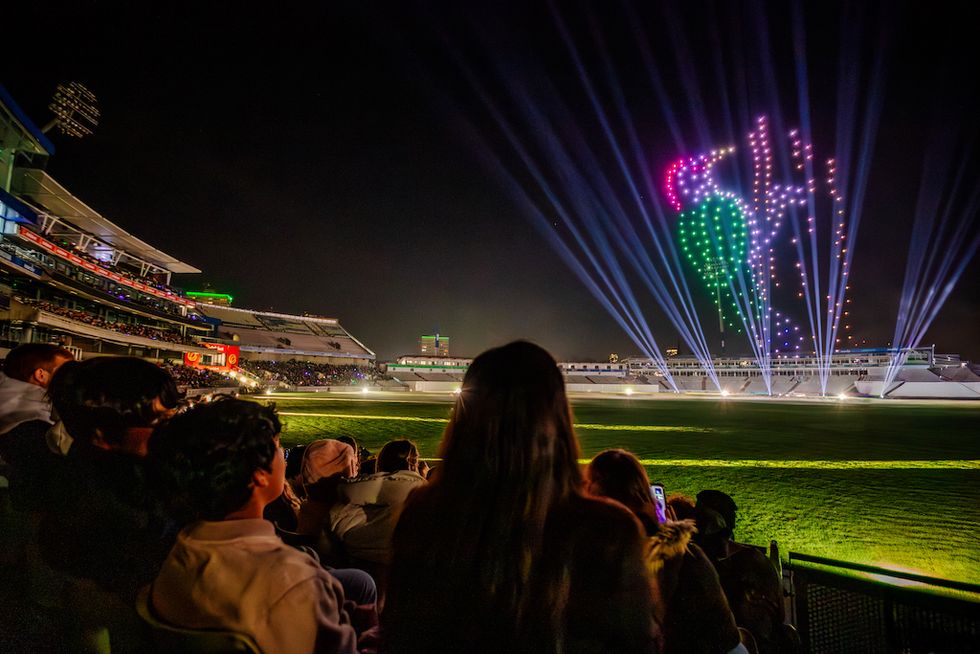 The WILD Drone Light Show, shown here at Edgbaston Stadium, combines drone choreography with cinematic music for an immersive experienceImage courtesy of Fever
"This premise is the foundation of one of Atlético de Madrid’s most exciting projects across the short, medium, and long term: Ciudad del Deporte. That said, we are fundamentally a football club, and the Riyadh Air Metropolitano remains a sports venue at its core, even if it and its surroundings host concerts and other major events.
Atlético de Madrid's upcoming steps are straightforward, he adds: "To keep elevating the experience for every single visitor who walks through our doors, whether that is for a top-tier football match, a concert by a world-class artist, or a corporate event."
Who will succeed in the experience economy’s next era?
Mariano Otero, SVP Fever, concludes that, as the experience economy enters its next phase, consumers are expecting more, and those who work in the sector are under increasing pressure to deliver:
"The opportunities are huge, and the responsibility is even greater.
"Knowing who your audience is, what their expectations are of a certain venue or experience, and using this data to plan and develop IP is the key to success for everyone operating in this exciting industry. Expectations are high, and our ambition should be too.
"These leaders, and many more, will come together in Madrid at the beginning of October at GXG to discuss the challenges and opportunities that the experience sector now faces.
"As they have demonstrated here, the minds that created this emerging industry are more than equipped to take it to the next phase."