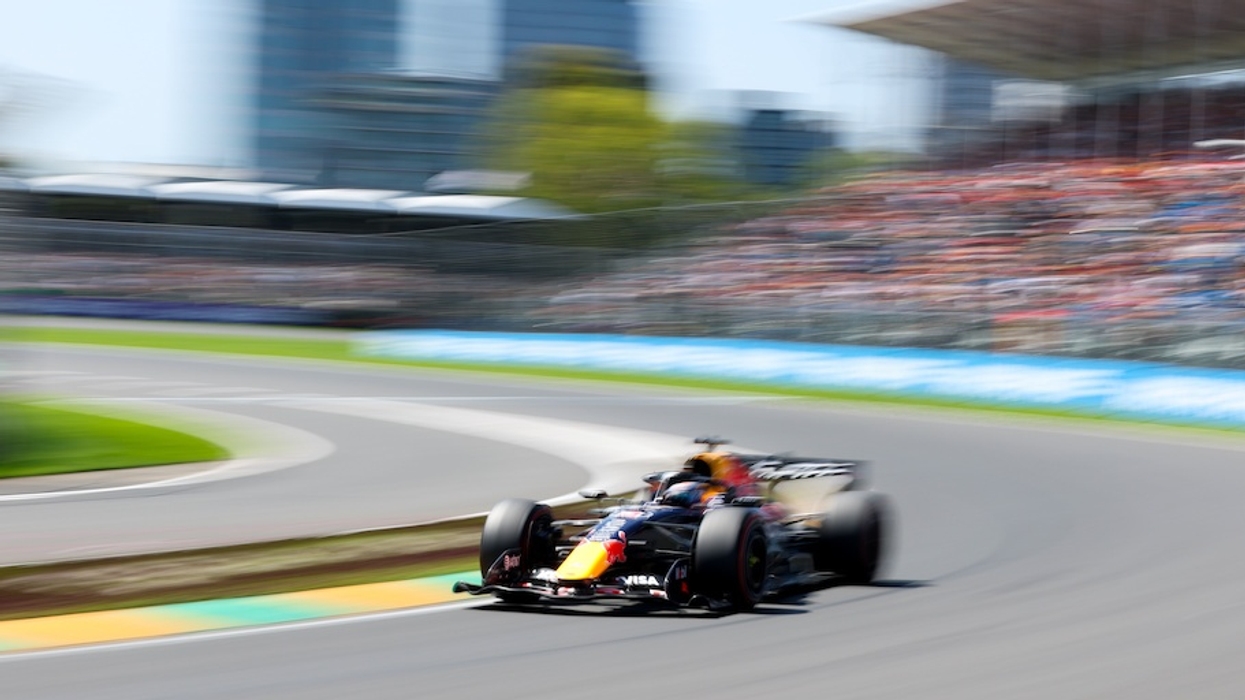

At a Formula 1 Grand Prix weekend, something has fundamentally shifted: the race is no longer the only attraction.
Paddock Club members move between trackside suites and exclusive entertainment experiences. Fan zones buzz with live performances and immersive installations. Premium hospitality packages bundle everything from gourmet dining to celebrity encounters alongside race-day access.
The ticket may say motorsport, but what the fan actually gets is much more: a full entertainment ecosystem designed around a three-day spectacle.
The beginning of the attention economy
In 1971, Herbert Simon, who would go on to win the Nobel Prize in economics, made an observation that has aged better than most pieces of social theory: in a world where information is abundant, attention becomes the scarce resource.
Few industries are better positioned to win that fight than sport.
Live sport cannot be time-shifted or spoiled by a headline; it turns fans into tribes whose loyalty doesn't fragment the way taste does; every match generates weeks of content long after the final whistle; and a season, unlike a streaming library, is a finite, non-repeatable event.
 Live sport has a loyal fan following
Those four properties - liveness, tribal identity, narrative afterlife, and scarcity - are precisely what the attention economy rewards. The new leaders in this sector are the ones who have redesigned their format, venue, and ticket around them.
Why old formats are losing their appeal
Traditional formats were built for a different world. A sporting match no longer competes only with other fixtures; it's up against a Bad Bunny residency, the next season of Drive to Survive, an immersive show, the FIFA tournament happening on Discord.
Simon's observation was about information competing for a finite amount of attention; today, entire industries compete for the same three hours of a Saturday night.
Formats designed for the broadcast schedules of the 1990s don't stand up to the abundance of 21st-century options fans have at their fingertips.
Leagues making the model work
Formula 1's evolution exemplifies this shift.
The sport has transformed the Grand Prix weekend into a multi-day entertainment event, layering premium hospitality, celebrity appearances, live entertainment, and exclusive fan experiences around the racing itself.
The Paddock Club represents the pinnacle, a hospitality experience that caters to fans who want to be part of a social and cultural moment, not just witness a sporting one. Race cities have become destinations for hospitality suites, celebrity chef collaborations, and curated entertainment that extends well beyond the track.
SailGP has adopted a similar approach on the water.
Racing that once happened miles offshore now takes place in tight, three-hour windows metres from grandstands in cities such as Sydney, New York and San Francisco, creating stadium racing in the world's most photogenic harbours.
This new format has grabbed the attention of sailing fans, and their purses: franchises that sold for $5-10 million in the league's first seasons now trade at $60 million and up, with Ryan Reynolds and Hugh Jackman controlling the Australian team, Anne Hathaway invested in Italy and Kylian Mbappé on France's cap table.
The E1 electric raceboat series, which includes teams owned by Tom Brady, LeBron James, Rafael Nadal and Will Smith, is another manifestation of this trend: a championship designed to bring the venue to the audience.
Racing in city harbours from Jeddah to Monaco to Miami, E1 combines high-speed competition with a commitment to protecting and regenerating coastal waters through clean technology and urban ecosystem revitalisation.
Like SailGP, E1's ownership table is a bet that the attention economy rewards format innovation over incumbency
The corresponding evolution of ticketing
F1, SailGP and E1 all point to the same shift: rights-holders are redesigning the product around attention, not just the sport. But a redesigned format poses a question for traditional ticketing platforms: how will they adapt to this new era of events?
An F1 Grand Prix is not one product; general admission, Paddock Club hospitality, premium suite experiences, and local fan packages are all layered into a single event. A SailGP grand prix is as much a premium waterfront event as a race.
Legacy ticketing systems, built to sell seats for a specific start time, were not designed with this complexity in mind.
Selling an experience economy product requires experience economy infrastructure: individualised pricing strategies, global demand generation, and data on who your fans are and what will bring them back.
Fever's role as Formula 1's official ticketing supplier is a useful test case for what that infrastructure looks like in practice - selling everything from general admission and local hospitality to the Paddock Club experience, and using its discovery layer to put these events in front of an audience of hundreds of millions, well beyond the pool of fans who already follow motorsport.
This multi-faceted approach to ticketing and experience delivery is the model driving the sport forward.
Widening the lens
Motorsport is not the only sport rewriting its relationship with the fan. Football has seen the same potential and moved to get in on the action.
In Spain, the UK, and many other markets, stadium owners have quickly realised that their pitches can just as easily welcome screaming music fans as football fans.
Atlético de Madrid's stadium hosted Bad Bunny for a ten-night residency in May this year, drawing 600,000 fans and generating an estimated €200 million for Madrid's economy. The model works so well that Coldplay is booked for eleven nights in 2027.
 Stadiums are also increasingly being used as concert venues
It's a familiar shift. Economist Alan Krueger diagnosed the same pattern in the music industry a decade ago: once the recorded product commoditises, the live experience becomes the only place left to capture value.
More than $55 billion of private capital has flowed into sport since 2019 on precisely this thesis: that a stadium is a 365-day venue, a fan is a year-round guest, and sporting IP is live entertainment IP. This is not a sports story, but one of the experience economy finding its largest new category.
A widening of the offer, not a dilution
Those who succeed in this new world understand that a sports fan can also be a music fan, and that attention, once captured, can be held rather than released.
The winners will be the ones who build venues that cater to artists as well as athletes, who fill what used to be dead time - the gaps between the action, where a fan's attention had no product built for it - and who court partners interested in the whole fan, not just their sporting preferences.
Simon's insight was about scarcity. What sport now proves is that scarcity has a winner - and it's whoever redesigns the fan experience fastest.
Every match, every race day, is no longer just a sporting event. It's a contest against every other form of entertainment for the only resource that was ever truly finite: someone's attention.