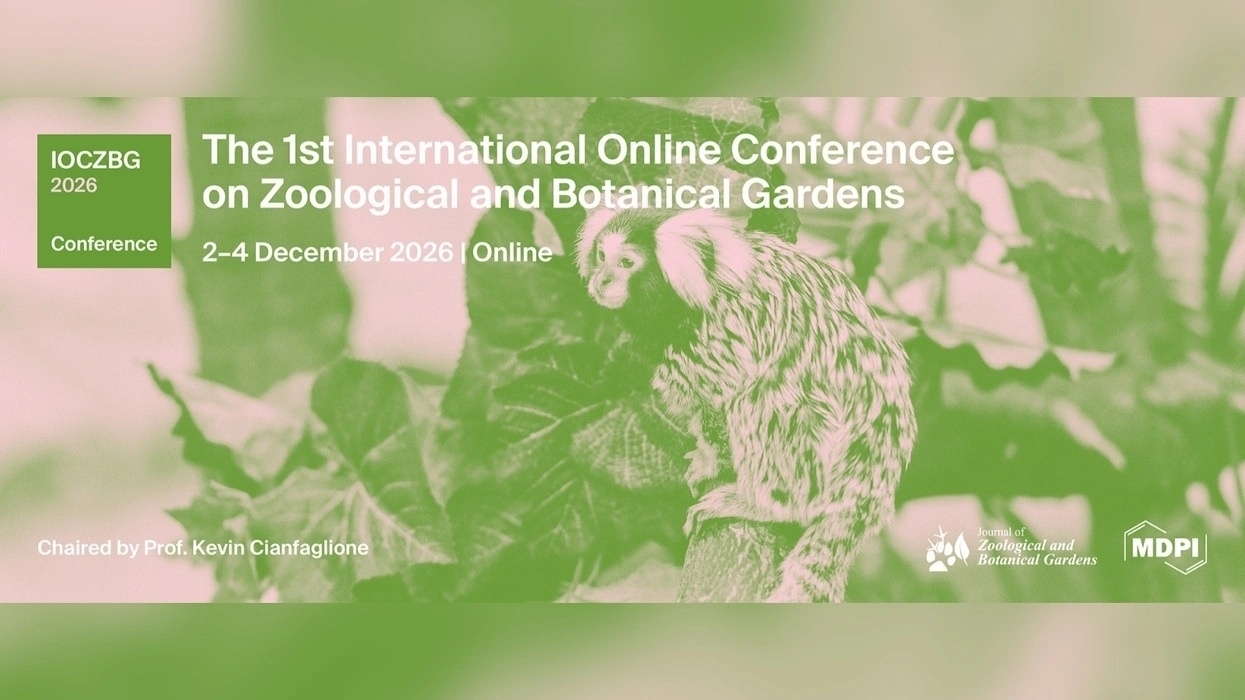

The first International Online Conference on Zoological and Botanical Gardens (IOCZBG 2026), organised by MDPI's Journal of Zoological and Botanical Gardens, will take place online from 2 to 4 December 2026 and is free to attend.
Ahead of the event, organisers have shared early details on some of the speakers attendees can hear from, covering topics from global health security and digestive health in captive large carnivores to assisted reproduction in birds and potential futures for avian welfare in enclosure design.
IOCZBG 2026 speakers
Speakers include Dr Chris Walzer, executive director of health at the Wildlife Conservation Society in New York.
He is a board-certified wildlife veterinarian and a tenured professor of Conservation Medicine at the University of Veterinary Medicine in Vienna, Austria. Chris possesses widely recognised expertise in One Health, with a focus on human-livestock-wildlife interfaces across Europe, Asia, Africa, and Latin America.
Prof. Adrian S.W. Tordiffe is a wildlife veterinarian with a PhD in biochemistry, focusing on carnivore nutrition, metabolism, and digestion. Based in Gujarat, India, he works as a senior veterinary consultant at Greens Zoological Rescue and Rehabilitation Centre (Vantara).
Prof. Tordiffe’s research focuses on the physiology and health of captive carnivores, especially cheetahs, with an emphasis on metabolic disease, gastrointestinal health, and nutrition. In 2018, he founded WildCat Nutrition, providing supplements and feeding strategies for captive carnivores.
His work aims to combine veterinary medicine, physiology, and evolutionary nutrition to enhance the health, welfare, and management of large carnivores in zoos and conservation efforts.
Attendees can also hear from Dr Dominik Fischer, curator for science and for birds, reptiles, amphibians, and fish at Zoo Wuppertal in Germany. He is involved in research and conservation projects around the globe and is well known as an author of numerous scientific articles and as a speaker at various scientific meetings and international conferences.
Claudia Martinez is a comparative psychologist and applied animal behaviour scientist focusing on primate behaviour, stress physiology, and welfare practices, especially in western lowland gorillas. She's a PhD Candidate in Veterinary Science at the University of Adelaide, researching how social, environmental, and human factors affect zoo primate welfare.
Her work bridges psychology, behavioural science, and veterinary-informed welfare science to support evidence-based management and welfare practices in zoological settings.
The agenda also features James Brereton, a lecturer at University Centre Sparsholt. He specialises in zoo animal research and has worked with a wide range of zoo collections on topics including enclosure design, nutrition and welfare.
Dr Costantino Bonomi is a botanist interested in conservation biology and eco-physiology of germination. He curated the Botanic Gardens and herbarium at MUSE, led the development of the MUSE tropical greenhouse and vegetable gardens, and founded the Trentino Seed Bank, part of the Italian and European Ensconet seed bank network.
He coordinates the Life Seedforce project, focusing on propagating and translocating 29 priority species in the Alps and Mediterranean.
Dr Paula Serres-Corral, a postdoctoral researcher at Universitat Autònoma de Barcelona, holds a degree in Veterinary Medicine and a PhD in Animal Medicine and Health. Her research focuses on wildlife endocrinology and creating non-invasive tools to assess stress, welfare, and reproduction in wild and cared-for animals.
Dr Daniel Ballesteros is an associate professor of botany at the University of Valencia (UV), Spain, in the Department of Botany and Geology, conducting research at the UV botanical garden. His research focuses on understanding desiccation and low-temperature stress tolerance in plant propagules, aiding long-term germplasm conservation and cryopreservation.
He studies desiccation-sensitive seeds, such as oaks and chestnuts, and investigates longevity variation in plant propagules, from fern spores to complex systems, often involving structural and biophysical analyses.
Dr Annaïs Carbajal, with a PhD in Animal Medicine and Health, has nearly 15 years of experience in wildlife conservation and animal health research. She specialises in developing, validating, and applying non-invasive and minimally invasive methods to evaluate animal health, welfare, and reproduction.
Her research also includes ex situ conservation techniques such as cryopreservation of gametes and gonadal tissue, as well as managing biobanks for wildlife preservation.
Finally, Marco D’Antraccoli, a botanist and curator at the Botanic Garden and Museum of the University of Pisa, Italy, focuses on managing, documenting, and conserving living plant collections. His work emphasises botanic gardens' role as research tools for biodiversity conservation.
His research includes floristics, plant diversity, botanical heritage, historic garden management, and the development of digital tools for botanical data.
Join the event
The late submission portal closes on Thursday 24 September.
The conference invites submissions across six thematic areas: zoo animal welfare; zoo animal behaviour; zoo animal health; biodiversity conservation at botanical gardens; collections in botanical gardens, arboreta and museums; and botanical gardens sustainability.
To find out more, please click here.

Charlotte Blanco Coates is blooloop's editor. She is from Brighton, UK and previously worked as a librarian. She has a strong interest in arts, culture and information and graduated from the University of Sussex with a degree in English Literature. Charlotte can usually be found either with her head in a book or planning her next travel adventure.