When Zeiss-Planetarium Jena opened on 18 July 1926, it marked a milestone in immersive entertainment. The world's first projection planetarium had transformed how audiences could experience the night sky, bringing the movements of celestial bodies into a purpose-built indoor environment.
A century later, Jena remains the world's oldest large projection planetarium in continuous operation.
The technology originated in 1913, when Deutsches Museum founder Oskar von Miller challenged Carl Zeiss to develop a device that could project the movements of the stars and planets onto a dome.
Engineer Walther Bauersfeld took on the project in 1919, and early demonstrations attracted more than 80,000 visitors in 1924. The invention, dubbed the Wonder of Jena, paved the way for the permanent planetarium.
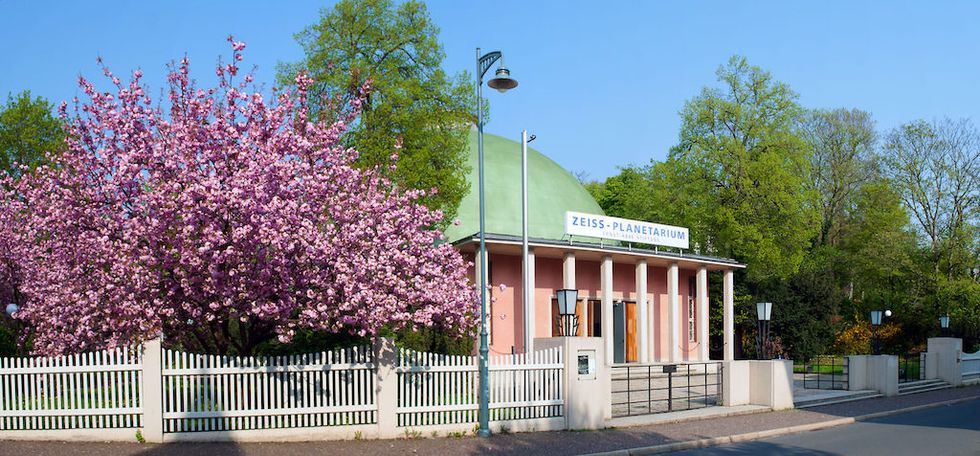
The Zeiss-Planetarium in Jena, the world's oldest large projection planetarium in continuous operation
Image courtesy of Zeiss-Planetarium Jena, credit W. Don Eck
Having welcomed more than ten million visitors over its history, including more than 170,000 in 2024, the planetarium faced a familiar challenge for heritage attractions: how to preserve its historic character while meeting the technical and visual expectations of today's audiences.
A €7.5 million modernisation programme, completed in just over six months, culminated in the planetarium's reopening on 15 July 2026. Central to the upgrade was a new 23-metre Micro Pro projection dome, manufactured and installed by Endurescreens.
Replacing the perforated aluminium screen installed in the mid-1980s, the new surface is designed to deliver more seamless, higher-contrast imagery while allowing sound to pass through to the spatial audio system behind it.
A century of innovation
For Stefan Harnisch, director of Zeiss-Planetarium Jena, the centenary upgrade represents another chapter in the institution's history of technological innovation.
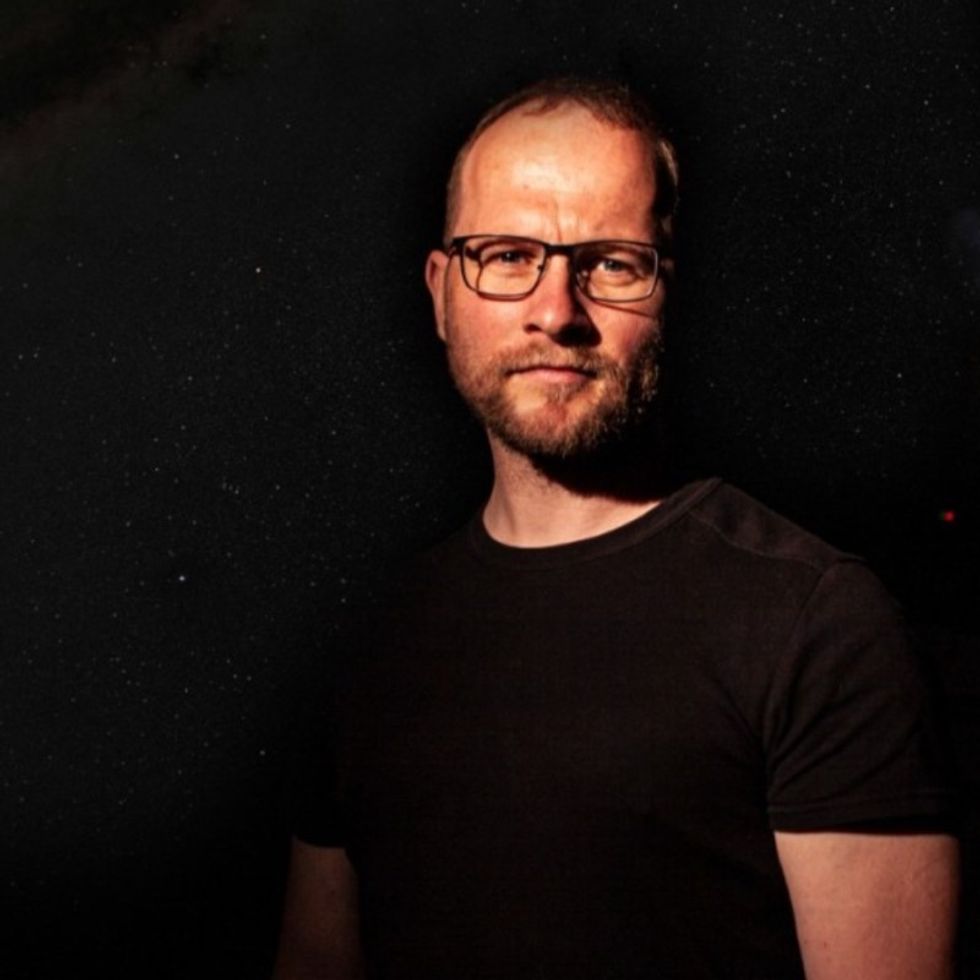
Stefan Harnisch, director of Zeiss-Planetarium Jena
"Even though we are not the world's first projection planetarium, the groundbreaking technology came from here in Jena, and it is precisely this legacy that we have in our heart," Harnisch explains.
The planetarium has undergone several technical transformations. A major building and equipment expansion in 1984 and 1985 introduced computerised show controls, followed by the installation of a Zeiss Model VIII Universarium star projector in 1996.
In 2006, Jena became Europe's first laser-based fulldome planetarium, introducing the ADLIP laser projection system. In 2011, the venue added the Zeiss Powerdome Velvet video system and spatial 3D audio, developed in collaboration with the Fraunhofer Institute for Digital Media Technology.
Each upgrade has expanded the possibilities for education and entertainment, while maintaining Jena's position at the forefront of planetarium technology.
"We introduced fulldome technology in 2006, and several other planetariums around the world popped up with the same technology because they saw it here," says Harnisch.
"The same goes on with our sound technology. Now I hope that we hold the torch way up high, so the industry sees the technology we are using in terms of our projection system, our screen, and our spatial audio."
The latest upgrade builds on this history, combining high-resolution projection with a new screen and spatial audio.
Working around a protected landmark
The modernisation presented challenges beyond those of a typical audiovisual installation. The building is a protected historic civil-engineering landmark in Germany and incorporates Bauersfeld's pioneering geodesic dome.
The structure comprises slender, interconnected steel rods covered by a sprayed concrete shell just six centimetres thick, spanning 25 metres in diameter. It predates the geodesic domes later popularised by architect Buckminster Fuller.
Heritage restrictions placed strict limits on the work: the project team could not drill into, weld onto or attach new equipment to the historic framework.
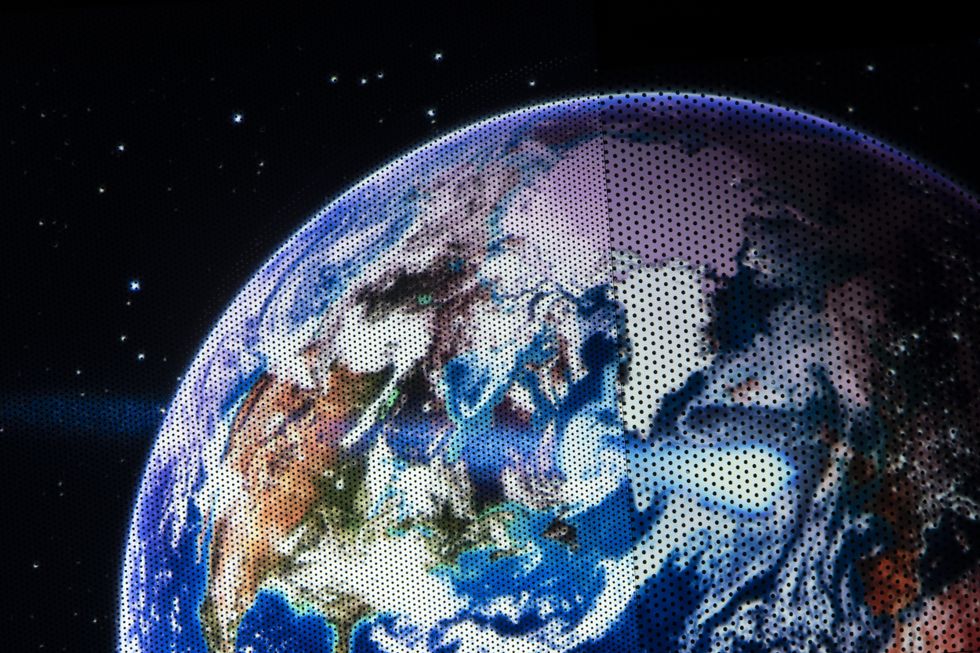
A comparison showing Endurescreens' MicroPro vs. a traditional perforated planetarium screen
Removing the existing aluminium projection panels in January 2026 revealed an unexpected complication. An incendiary bomb had struck the planetarium during an air raid in March 1945 but had not detonated.
The resulting damage meant that the available clearance varied around the dome.
Ronald Potgieter, project and quality control manager at Endurescreens, says: "One of the things we encountered was that the building was bombed in the war, and the geodesic dome was actually damaged. They repaired the outside, but the geodesic dome itself was never straightened."
Rather than altering the historic structure, the team had to design the new installation around its existing geometry.
"We had a point where our new screen structure was literally millimetres away from the historic geodesic. It barely fitted. We had to make precise adjustments just to ensure it all cleared."
Harnisch adds: "There was an immense challenge, keeping in mind that we were not allowed to touch the building itself, to preserve that heritage for our audience and for future generations, while simultaneously bringing state-of-the-art technology into our house so that visitors receive a contemporary, world-class experience."
Moving beyond the igloo effect
Installed during the planetarium's 1980s modernisation, the previous projection surface comprised perforated aluminium panels arranged in overlapping horizontal rows. It had served the venue for around four decades.
Over time, wear had affected the surface, while its panel joints, fasteners and perforations had become increasingly visible as projection technology advanced.
Within the planetarium industry, this visible pattern is often referred to as the igloo effect.
"The problem was that the previous screen was simply too old," says Harnisch. "It was no longer good enough to showcase a modern projection system. The old screen was visibly dirty; it had small dents and created a rigid visual border for the audience. Everyone could see what we call the igloo effect."
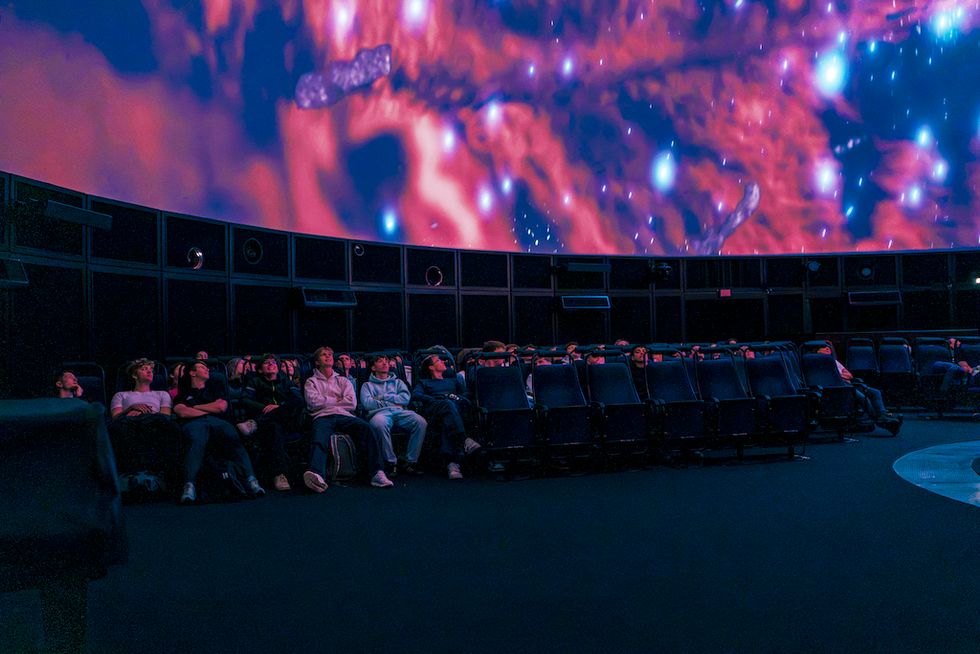
The new screen helps Ziess-Planetarium Jena reach the full potential of its new projection system
The effect was particularly noticeable in scenes with uniform colours, when seams and surface variations were harder to disguise.
"The most difficult image to show clearly on a perforated screen is one that is a solid colour," Potgieter explains. "With a solid colour, there are no contrasting highlights and shadows to hide defects."
"People at home have become accustomed to 4K displays and sophisticated home audio," Harnisch says. "I cannot show them something in a public planetarium that looks inferior to what they have in their living rooms.
"We needed a projection surface that could completely disappear, so that when visitors look up, their entire field of view is filled with seamless visual information."
Projection versus LED
The choice of projection technology also reflected wider considerations about the future of immersive displays.
Direct-view LED domes have attracted growing interest across the industry, offering high brightness, contrast and resolution. However, their weight, installation costs and operational requirements can present challenges for existing venues.
Lei Yin, director of global sales and business development at Endurescreens, says operators need to consider these factors alongside image quality.
"Nowadays, operators want something new to attract audiences back, a true wow factor," Yin says. "Their first thought is often to look at LED because it is undeniably bright and sharp. But the real questions operators have to ask are very practical: can they actually afford it, and can their building physically carry the weight?"
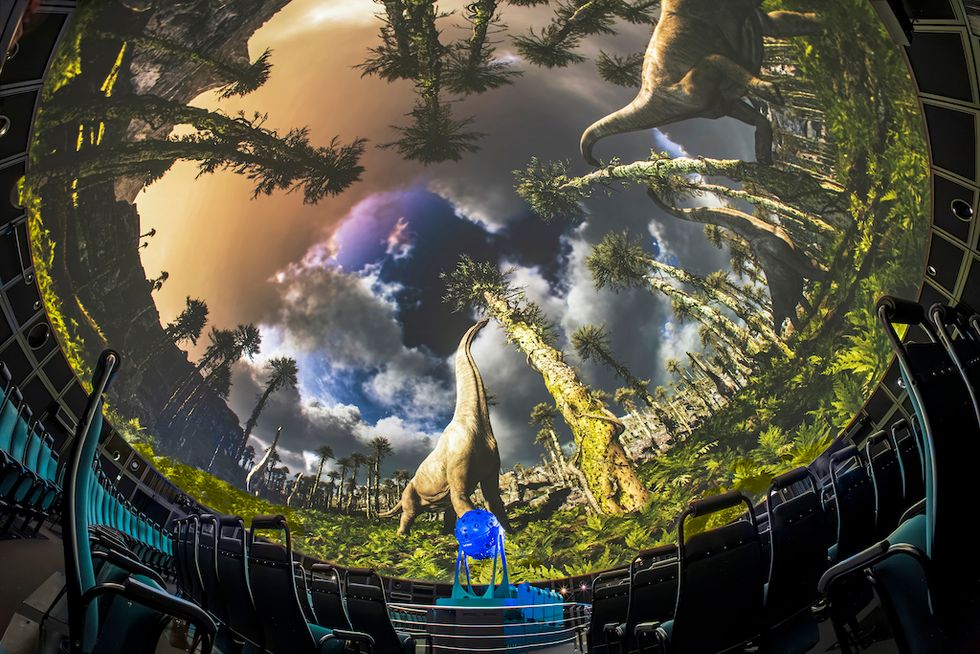
With a state of the art screen, projection system, and sound, Ziess-Planetarium Jena can offer more immersive experiences
At Jena, the building's protected status and structural limitations made an LED installation less practical.
Yin also highlights considerations such as electricity consumption, cooling and pixel maintenance. For Jena, projection offered an alternative that could meet the venue's image-quality requirements without the same structural demands.
"With our Micro Pro screen technology, we are now closing that gap dramatically," says Potgieter.
"In certain performance metrics, we actually outperform LED. Micro Pro is edging closer and closer to LED's perceptual image quality, while offering far greater structural, acoustic, and financial advantages."
Developing the Micro Pro screen
Designing a planetarium screen involves balancing two requirements: image quality and sound transmission.
Speakers are generally positioned behind the projection surface to preserve audience sightlines. The screen must therefore allow sound to pass through while providing a suitable surface for projected images.
Perforations allow sound to pass through, but they also reduce the amount of reflective material available for projection.
Traditional perforated planetarium screens typically use holes measuring 1.5 millimetres in diameter, spaced 3.2 millimetres apart, creating an open area of approximately 23%. As projection resolution increases, however, conventional perforations can become more noticeable and potentially affect image clarity.
Jena's new system includes eight Zeiss Velvet 4K projectors, delivering an aggregate resolution of between 8K and 10K across the dome, with a stated native contrast ratio of 5,000,000:1.
At this resolution, individual pixels are considerably smaller, increasing the potential for image information to be lost through conventional screen perforations.
Endurescreens' Micro Pro screen uses smaller perforations, measuring 0.8 millimetres in diameter and spaced 1.6 millimetres apart. This reduces the open area to 16%, increasing the proportion of reflective aluminium across the surface.
"The perforation diameter is smaller than the projected pixel pitch of an 8K system," Potgieter explains. "The holes no longer compete with the pixels. Light distribution remains completely even, preventing the micro-shadows and uneven luminance that degrade image clarity on conventional screens."
The increased reflective surface also helps improve brightness and contrast, according to Yin.
"Because the Micro Pro surface has far more reflective aluminium and fewer holes, the image is inherently much brighter under the same projector output," he says.
For Harnisch, the relationship between the projection system and screen was central to the decision.
"It is like a marriage," he says. "The projectors and the projection screen depend on one another. The projection screen provides the playground for the projectors. If you have an inferior playground, even the finest projector in the world cannot play properly. You have to upgrade both in unison."
Engineering a bespoke installation
Developing the screen was only part of the challenge. Endurescreens also had to engineer a supporting structure that would fit within the auditorium without compromising the protected framework.
The building has an internal diameter of 25 metres, while the new projection dome measures 23 metres. This left approximately one metre of clearance behind the screen for supporting structures, loudspeakers, acoustic treatment, ventilation and maintenance access.
During the tender process, some manufacturers were unwilling to undertake the installation under these conditions, while others proposed reducing the dome diameter to create more working space.
Jena, however, wanted to retain the full 23-metre screen.
Endurescreens developed an independent supporting framework, with dedicated structural feet around the auditorium perimeter. The design allows the new dome to carry its own load without transferring it to the historic structure.
"We engineered the system so that our screen framework sits smartly on dedicated structural points without attaching to the historic shell," Yin explains. "We created custom supporting feet beneath the dome perimeter that carry the entire dead load of the screen structure."
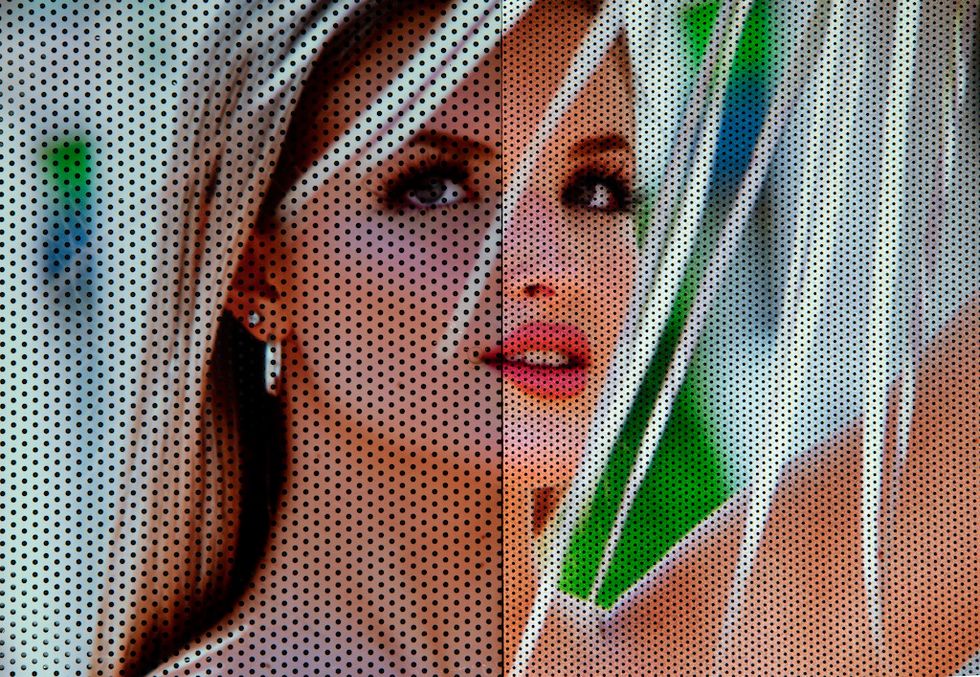
A comparison showing Endurescreens' MicroPro vs. a traditional perforated planetarium screen
Although Endurescreens had previously installed Micro Pro screens in Austria and at the Shanghai Observatory, the Jena project was a larger undertaking.
Planning began in October 2025, with contracts finalised the following month. The planetarium closed on 2 January 2026 and was scheduled to reopen on 15 July, three days before its centenary.
Endurescreens less than two months for the on-site installation, which had to be coordinated with several other contractors working on simultaneous upgrades.
"We were working on full scaffolding from the top of the dome down to the bottom, hand-assembling hundreds of panels using custom mini-rivets and seamless joints," Potgieter says.
"At the same time, other teams were installing acoustic insulation batts across the rear concrete wall, running cables for the new Holoplot 3D sound system, balancing ventilation conduits, and refinishing the flooring below."
Endurescreens completed the installation ahead of schedule, handing the auditorium over to the AV integration team five weeks before reopening. This left time for projector calibration, image blending, audio commissioning and final refurbishment work.
A new immersive experience
Harnisch says the difference was immediately apparent. Inspecting the dome from a cherry picker under full working lights, he struggled to identify the panel boundaries.
"I literally could not find the panel borders. I could not see any seams. I had to consciously search for tiny reference points in the room just to orient myself, because the entire surface appeared as one unbroken, flawless curved horizon."
The improvement is particularly significant for visitors seated close to the screen. Some front-row seats are between half a metre and two metres from the projection surface, where imperfections in conventional panels would be more noticeable.
"Under the old system, if you sat near the perimeter, you were staring directly at perforated metal plates," Harnisch says. "Now, I can stand half a metre away from the screen, look directly into the image, and the physical material simply vanishes. There is no visible texture, no grain, and no igloo effect."
The upgraded auditorium was also showcased during the international Fulldome Festival in Jena, attended by planetarium professionals, content producers and local visitors.
Yin recalls speaking to long-time visitors who were impressed by the difference.
"They said, 'We have been coming to this planetarium for twenty or thirty years, and what we see today is completely transformed. The old lines and panels are gone. It is so clear and bright.'"
A wider creative canvas
The €7.5 million programme extended beyond the projection dome.
Supported by Sternevent GmbH, the Ernst Abbe Foundation, the Carl Zeiss Foundation, and Carl Zeiss AG, the work also included refurbishing the historic Bauersfeld restaurant, upgrading heating and ventilation, installing new auditorium flooring and seating, and improving the surrounding outdoor areas.
The auditorium also features a new Holoplot 3D spatial audio system, adding another dimension to the upgraded experience.
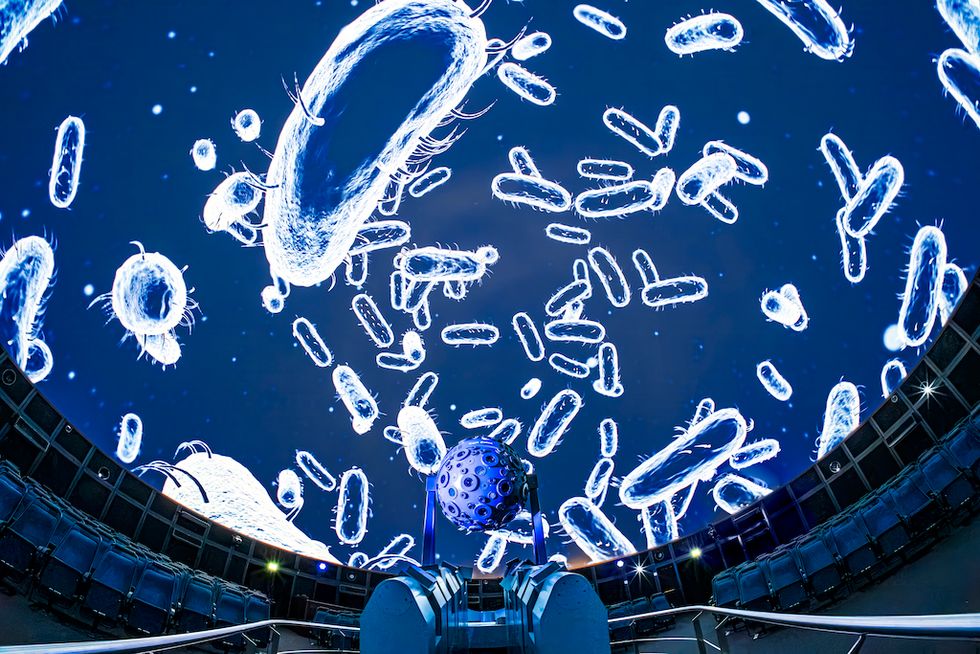
Giant illuminated microbes fill the planetarium dome
Jena's in-house content team is also developing productions using Epic Games' Unreal Engine 5. Real-time rendering offers greater flexibility, enabling interactive simulations and allowing the team to respond dynamically to audience questions.
"We have our own internal CGI department here, two dedicated artists who build our productions," says Harnisch. "With modern engines like Unreal Engine 5, the realism is breathtaking."
Beyond its established astronomical and educational programme, the venue can also accommodate live music, digital art, corporate presentations and theatrical performances.
This wider programme was demonstrated during the centenary celebrations in July 2026, which combined historical presentations with multimedia performances, including a live appearance by pop singer YASS.
"In my eyes, this is not just an astronomical classroom; it is a universal star theatre," Harnisch says. "We can project virtually anything our creative teams can imagine, from children's educational journeys to high-intensity rock concerts and scientific symposia."
Lessons for attractions operators
The Jena project highlights several considerations for operators planning to upgrade existing immersive venues.
First, display technology needs to be considered in the context of the building. While LED can offer compelling image performance, its structural, electrical and cooling requirements may make it less practical for some existing or protected venues.
Modern projection systems offer an alternative, provided they are paired with a screen capable of delivering the required image quality.
Second, screens, projectors and audio equipment should be considered as parts of the same system. Increasing projector resolution alone will not improve the finished experience if the screen cannot reproduce the additional detail or accommodate the venue's acoustic requirements.
Potgieter believes the screen is often underestimated in project planning.
"The screen is the physical glue that binds the entire attraction together," he says. "But if your projection screen is flawed, if the seams are visible, if the panels are dented, or if the perforation holes are swallowing your resolution, the entire illusion collapses."
Finally, the project demonstrates that heritage buildings do not necessarily have to sacrifice their architectural character to accommodate new technology. Bespoke engineering and careful coordination can allow substantial upgrades while protecting the original structure.
As Zeiss-Planetarium Jena enters its second century, its latest upgrade continues a tradition established by Bauersfeld and his contemporaries: using engineering innovation to expand the possibilities of immersive experiences.