
Like it or not, artificial intelligence (AI) systems are now quickly beginning to invade our daily lives as the world’s new cool tool.
Classifying it as a “tool” is actually the best way to describe what today’s AI systems really are, but like any tool, how successful they are in any given industry will depend deeply on those who figure out the best methods for using them, as well as on which tasks AI is best suited to.
Perhaps it is best to look at what AI is not good at doing. So to start with, let’s throw out the sci-fi cliché concept of an AI being an artificial person or a computer with a human-like personality.
Sure, an AI can be programmed to attempt to mimic a human-like voice and attempt to express itself verbally with some semblance of a personality, but only if it was programmed to do so. You must forget the sci-fi genre idea of a computer becoming self-aware and developing a personality all on its own.
It also shouldn’t suddenly go all “Megan” on the world and develop a mean, sarcastic personality.
 AI is simply a tool; how will operators use it to impact the theme park experience?Image credit PixieMe - stock.adobe.com
Right now, what we are referring to as AI is really programming by human developers, creating a very fast tool capable of sorting through vast amounts of data that are fed to it. Data-sorting tools have always existed, but they were limited by their ability to understand how we wanted the data sorted.
This is where the new technology comes into play, as AIs have evolved into data-sorting tools designed to understand, in human terms, how we would like any given bit of data sorted, and to detect trends within huge quantities of data at speeds we have never had before.
AI in a corporate space
This is where AI can be most useful in the corporate landscape: companies can now put the data they have been gathering on their customers under the microscope to uncover insights into how people behave.
For example, Amazon will have a long list of items each person has purchased over the years, as well as the brands and price points they were willing to pay. An AI could then suggest certain items that any given customer might find useful, based on past purchases and search history.
By developing a customer profile, an AI could determine whether someone is more of a bargain hunter, willing to accept lesser-known brands if they review well, or whether they care more about name-brand items and are willing to pay a premium for them.
Where things get a bit iffy is when we worry that certain items or services are being marketed and sold to us individually at a price based on our history, rather than the same price being offered to everyone.
For example, about a year ago, a US Congressional probe was conducted to determine whether certain airlines were using this kind of AI profiling to offer different ticket prices to different customers based on their prior purchase history.
 AI is changing how different services are presented to us, from ride share apps to airlines
In just the past couple of weeks, Consumer Reports published data showing that ridesharing services like Uber or Lyft appear to be using AI algorithms to determine what price to offer a ride to the customer.
They also use similar profiling to determine the best price to offer drivers to accept a given ride, increasing the profit Uber or Lyft earns.
For example, Consumer Reports had a group of potential riders with different user profiles, all requesting the same ride from the same origin point to the same destination at the same time, and found that the final price returned by the algorithm could vary by as much as $30.
While this is not malicious on the part of the AI algorithm, it simply reflects how any given company decides to best use these new AI-based tools to improve its operations. In the case of the theme park industry, companies are just now starting to figure out how best to use AI to improve all aspects of a theme park’s operations.
AI in theme parks
For example, AI could be used to perfect ride maintenance schedules based on past trends and repair work history from over the years.
The guest experience could be improved by using AI to better determine the needs of a park at any given time, on any given day, by streamlining how the workforce is allocated across the park’s various locations.
AI can help park operators make smarter decisions while improving both efficiency and profitability, in both backstage operations and the front-of-house needs of any given park.
The result can be a series of subtle changes behind the scenes that deliver complex improvements to operations and enhance the overall experience in ways a guest may never realize.
Up until now, theme parks have relied on sophisticated technology to deliver immersive experiences.
 Disney says it is using AI to simplify trip planning and booking, aiming to create a personalised experience that aligns with what guests desire most Image courtesy of Disney
Advanced ride control systems, RFID ticketing, mobile apps and digital queue management have become standard across much of the industry. The addition of artificial Intelligence tools would represent the next step in that evolution.
Rather than replacing employees, AI is increasingly being deployed to support operational decision-making. By analyzing vast amounts of real-time data, AI systems can identify patterns that humans may overlook, helping operators respond more quickly to changing conditions.
The timing is also right, as parks and attractions face growing pressure from rising operating costs, labour shortages, and increasing guest expectations combined with overly ambitious sustainability targets.
AI offers an opportunity to optimize the resources at hand while maintaining high standards of safety and guest satisfaction.
Currently, large destination resorts are leading the adoption of AI-driven technologies, but cloud computing and software platforms are making similar capabilities accessible to smaller regional parks, water parks and family entertainment centers.
Maintenance and more
Perhaps the most valuable application of AI within theme parks is predictive maintenance.
The daily operation of any given attraction also generates enormous quantities of operational data. Sensors continuously monitor vibrations, operating temperatures, hydraulic pressure, motor performance and countless other variables.
Traditionally, maintenance teams relied either on scheduled inspections to discover issues in advance or took action once something failed and required repair.
The addition of AI to the mix changes this model entirely, as learning algorithms can now be used to sort through years of operational and repair records, combined with sensor readings, to detect subtle changes well in advance that may indicate a mechanical issue is developing.
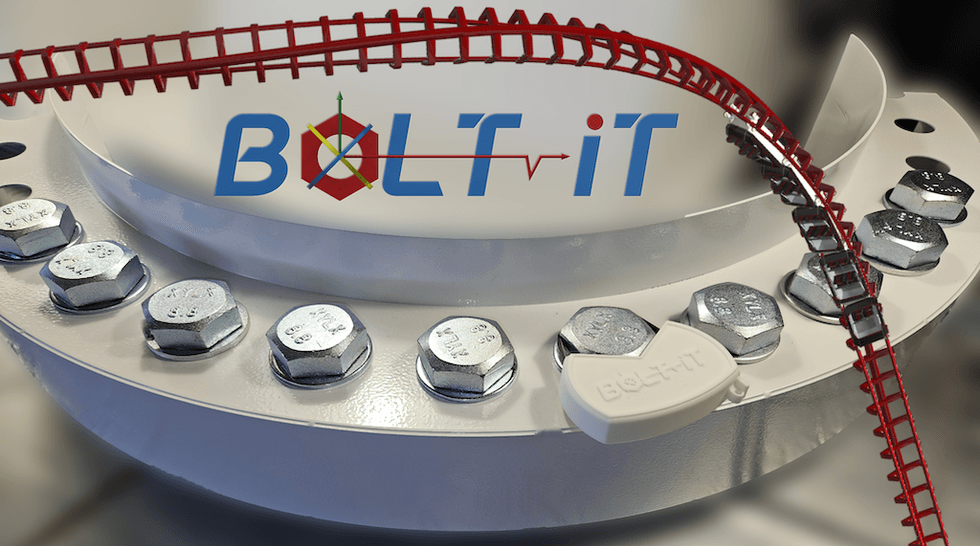 D-Tex Visual creates AI sensors for increased safety & efficiency in theme parks and amusement parks Image courtesy of D-Tex Visual
Rather than waiting for a part to fail, maintenance teams are alerted in advance and can plan ahead, allowing repairs to be completed during planned downtime.
The benefits extend well beyond reducing breakdowns caused by unplanned issues.
Improving the reliability of an attraction helps reduce wear and tear, extends the lifespan of extremely expensive equipment, and enables maintenance teams to plan future work based on the actual condition of the equipment rather than simply following a pre-planned maintenance schedule checklist.
For a major amusement attraction that is expected to operate for thousands of cycles every week, even small improvements in uptime can have a significant impact on guest satisfaction and revenue.
AI and the guest journey
After all, guest satisfaction often depends less on the attractions themselves and more on how long guests spend waiting for them.
As a data tool, AI algorithms can provide management teams with a better understanding of guest movement patterns throughout the park and across the day.
Using data from mobile apps, ticket scans, turnstile counters, in-house Wi-Fi networks, and attraction visitation, an AI system can be trained to generate crowd forecasts and movement trends for any given park with a high level of accuracy.
This allows operators to adjust staffing levels, entertainment schedules, or food and beverage operations before congestion develops.
Operations teams can also use similar data streams to analyze the best strategies for attraction staffing based on historical crowd levels and predict overall park attendance surges weeks ahead of time to plan for peak staffing as needed.
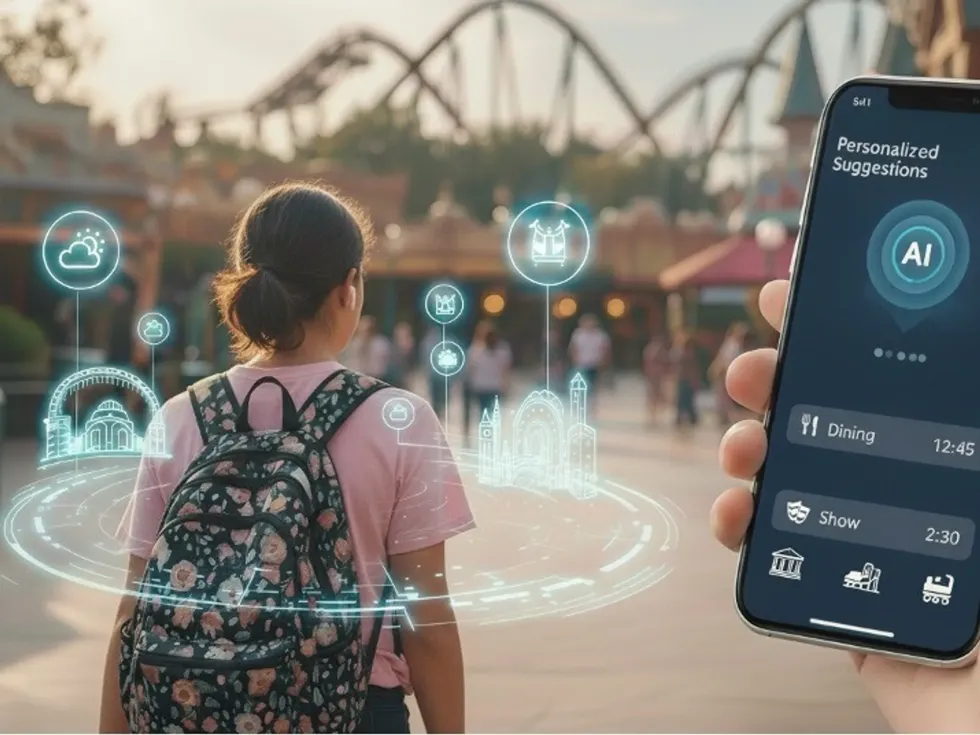 Artificial intelligence is already being used in some theme parks and attractions to personalise and streamline the guest journeyImage courtesy of FORREC
Entertainment departments could also use similar data to create the best possible show-time schedules, based on how crowds surge through different sections of their park at various times during the day, as well as to predict where guests may head next, giving both attraction and culinary teams a heads-up as to when they should anticipate surges.
The result is that AI does not replace your park’s most experienced team members and decision-makers, but instead provides them with a better tool that delivers the best, most up-to-date information needed to perform their jobs.
It also allows for some interesting ways to become very proactive in connection with in-park dynamic signage and mobile app push notifications.
Based on park needs, dynamic recommendations can be delivered to guests, encouraging them to visit attractions with shorter queues, explore less crowded areas of the park, or even drive business to underutilized food and merchandise locations through limited-time special offers.
This not only improves the guest experience but also increases spending opportunities across retail and dining locations, driving up your PerCap spending numbers.
Virtual queues evolve
Perhaps one of the most widely used developments in recent years has been the rise of virtual queue technology.
While the original Disney FastPass concept kept guests at nearby food and merchandise locations, potentially spending money rather than being stuck in a queue for hours, new AI-enabled systems have become much more effective.
Rather than assigning static return times, intelligent queue management platforms can continuously adjust schedules based on ride capacity, weather conditions, operational interruptions and changing attendance levels.
The end result is more accurate wait times and better utilization of available ride capacity.
Future virtual queue concepts may be able to integrate with guest behavior profiles to offer a more personalized experience. These systems could go so far as to suggest entire, optimized itineraries based on guest preferences, age demographics and even previous park behavior.
 Could AI tools help make the traditional theme park or attraction queue a thing of the past?
Rather than having a guest try to determine and pre-plan every detail themselves through a series of painful app surveys, an AI-generated system could act more like a real-time digital concierge, assisting and guiding them through their day at the park.
This is one area where AI-powered systems can take the lead in enhancing a park’s customer service.
An AI assistant can be infinitely more sophisticated (and far less annoying) than an old-style “chatbot” that relies more on canned, pre-programmed interaction segments and can quickly prove not up to the task when encountering more complicated needs, requests or questions.
A modern “conversational” AI assistant is likely to be far more knowledgeable and helpful when tasked with questions about ride availability, dining reservation options, entertainment schedules, and more.
One of the biggest things to keep in mind is that AI systems can continue to interact more intelligently and respond more quickly as they learn individual guests’ needs based on previous interactions.
AI systems are also able to be multilingual, providing valuable guest support in different languages as needed, especially at times when direct interaction with staff may be unable to communicate.
AI and security
While less in use at theme parks and attractions, AI is also increasingly used in security operations, especially in large transit centers such as airports.
AI-enabled security camera systems can help monitor crowds across an area, possibly detecting unusual movement patterns that should prompt security dispatch, or even identifying unattended objects left in public areas that should be investigated.
The idea is to support and enhance existing security team needs, as an AI can process data from hundreds of video feeds at the same time and help determine areas where immediate attention might be required.
 AI can help scan crowds, supporting theme park securty teams by processing data from cameras much faster
And while we have so far discussed all the ways AI could help a park on a day-to-day operational basis, there are also infinite ways AI could be put to use to increase creative development and planning for future park attractions and entertainment needs.
The Walt Disney Company discussed its own plans to use AI across five different segments of its business: content creation, increased monetization, increased workforce productivity, consumer experiences, and enterprise operations.
However, this does not mean that human jobs will be lost; rather, “we are committed to implementing AI in a way that keeps human creativity at the center of everything we do and respects creators and the value of our intellectual property.”
And as I said before, the key is to recognize AI for being the tool that it is, and to determine how it can best serve to enhance each worker’s productivity by performing some of the heavy lifting or more menial data crunching for them.
In terms of the creative aspect, while humans are still driving the initiative and vision, AI can accelerate the creative process.
One such tool is a partnership between Disney and Adobe, using Adobe’s Firefly Foundry to generate AI models based on some of Disney’s licensed and proprietary assets.
This allows some early design and pre-visualization artwork variations to be fast-tracked in the early stages for Disney’s park and experience creation teams during brainstorming sessions.
The balance between tech and creativity
Human creativity remains central to attraction design, but AI can accelerate certain aspects of the creative process, allowing teams to explore more ideas and options before real construction begins.
On a similar note, AI-assisted simulation tools may help designers model guest behaviour within proposed lands before physical work starts, identifying potential congestion points or operational challenges to be addressed while still in the design phase.
This is still the early days of AI, however, and early adoption is not without obstacles and speed bumps along the way. The quality of an AI system is only as good as the data it is trained on, and that data too requires significant time and investment.
There is also a need to protect and secure all data, especially when it comes to data gathered about individual guests, in order to prevent any kind of cybersecurity threat from becoming an issue.
 From front-facing examples such as chatbots to operational examples like coaster monitoring and maintenance, AI is already in use at theme parks
Proper training of staff to use AI systems ethically can also prevent another future challenge, as guests will expect transparency regarding how their personal information is collected and used.
Operators will need clear policies governing data privacy, algorithmic decision-making and responsible AI deployment.
Finally, keep in mind that human oversight will remain essential in all matters. AI will increasingly handle routine analysis, repetitive administrative tasks and data-intensive decision-making, allowing employees to focus on creativity, guest interaction and operational excellence.
Hospitality, storytelling, entertainment and emotional connection remain fundamentally human experiences and cannot be replicated by AI.
At least not yet…