
They say, “A picture is worth a thousand words.” The world of themed entertainment is no exception.
Visualization, the process of translating words and abstract concepts into something that can be seen, explored and evaluated, is one of the most crucial tools in experience design.
While it has existed within the industry for decades, the evolution of modern-day products—and modern-day techniques—calls for a re-examination of what visualization means for a project today.
Two thought leaders from TAIT have their own insights on the benefits and evolution of visualization: creative director Jeanne Ménard-LeBlanc and production design director Shain Wasserman.
Wasserman, a specialist in leveraging the latest in emerging technologies and cutting-edge production design techniques, has been at the forefront of shaping visualization workflows for complex immersive experiences for fifteen years and counting.
Meanwhile, Ménard-LeBlanc is an environmental designer and creative lead with fifteen years of experience leading the creative development of immersive environments and guest experiences.
Each an expert in their respective field, the pair engage with distinct visualization strategies in their day-to-day roles, using the practice to communicate with clients and colleagues alike.
Visualization’s role and evolution
Visualization is, at its core, the creation of tangible images from a wellspring of thoughts and ideas. It can take many forms.

TAIT creative director Jeanne Ménard-LeBlanc
“Visualization is a very broad spectrum of tools,” says Ménard-LeBlanc. “It can be anything from a quick sketch on a napkin, to highly detailed 3D renderings, to graphics and diagrams.”
All types of mediums can be used to provide a project clarity and direction.
“Visualization is meant to give everyone a shared understanding of an idea, allowing teams and clients to evaluate factors such as scale, atmosphere, guest flow, storytelling. It becomes a tool for alignment, exploration, and ultimately validation.”
Early themed entertainment and immersive experiences began with refined drawings, paintings, and even physical models, and building these was Ménard-LeBlanc’s first industry role.
“Physical models are still incredibly valuable tools,” Wasserman notes, “which require a lot of talent.” The 21st-century toolkit, however, offers even more clarity and detail at a far greater speed.
“Digital visualization gives us the flexibility to draw overtop of renderings and make edits, as opposed to redoing an entire physical model. The ability to change lighting, materials, viewpoints, even time of day digitally, it makes iteration so much faster.
"From someone who’s been in the visualization industry in the past 10-15 years, it’s a different world these days.”
Why visualization matters: a decision-making tool
The speed and evolution of visualization techniques mean that the work is no longer simply a way to present designs at the project’s conclusion. It has become an essential decision-making tool that helps creative, technical, and client teams align far earlier, reduce uncertainty, and preserve creative intent throughout a project’s lifecycle.

TAIT production design director Shain Wasserman
This is crucial in a world where projects are more complex, schedules are more compressed, and the number of decision-makers has grown ever larger.
“Projects today, there are so many stakeholders and groups of people involved in the creation process,” says Wasserman.
“Fabricators, operators, and so on. Everyone has a different perspective. Visualization focuses everyone on a reference point and establishes a common ground so that all teams can make decisions.”
“Yes, and there isn’t much difference in the way your department and mine use it,” Ménard-LeBlanc adds, referencing her work in creative visioning compared with Wasserman’s production design role.
While creative and production design may use visualization to examine different aspects of an experience, both rely on it as a tool for exploration, communication and alignment.
“Its primary task is to establish a common language. It’s the bridge between the creative concept, the technical world, and the client’s vision of the guest experience.”
“It reduces risk,” Wasserman notes. “Uncertainty in the design is one of the biggest hidden costs. The earlier you can discover an issue, the cheaper and easier it is to solve.
"Whether it’s guest circulation, sightlines, spatial relationships, or even operational concerns, it allows us to work through those questions before they become issues in construction.
"Risk management is a huge benefit to visualization.”
Visualization and iteration: accelerating design
Advancements in visualization processes and techniques accelerate not only the decision-making, but the act of designing itself. Rapid visualization workflows that evolve 2D artwork into 3D models build out a greater amount of the design at a more efficient pace.
This means that clients and teams can explore multiple ideas and possibilities before committing to a set direction, encouraging collaboration even on condensed timelines.
The process still begins with the sketch.
“A hand-drawn sketch can be just as efficient as a properly rendered image to understand the initial vision,” says Ménard-LeBlanc. “From there we can move to the render, to understand how the space evolves, how light will bounce off of something.”
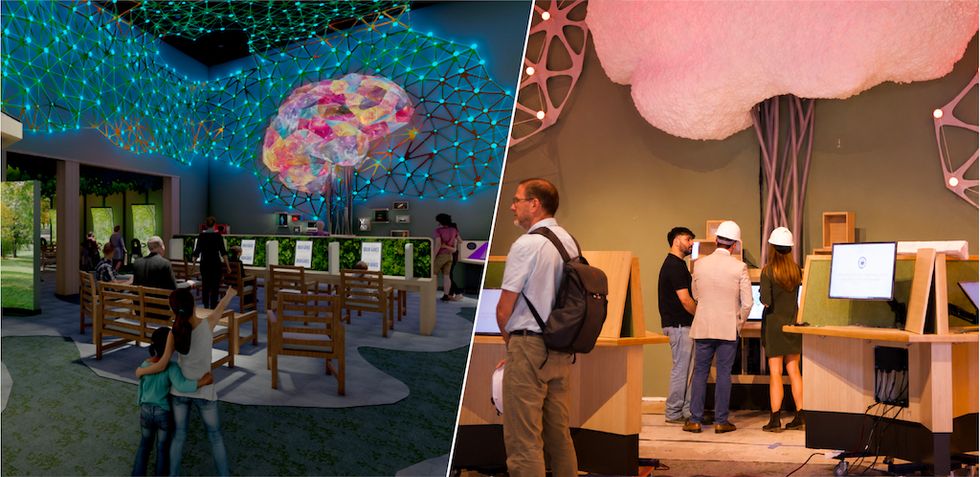
The Marlin and Doris Thomas Memory Center at Willow Valley Communities uses interactive technology, media, and empathy-led storytelling to help enhance guests' understanding of the science and personal experience of cognitive change
Creating 3D models and real-time flythroughs helps us understand how an experience will look and feel before breaking ground.
“As we build these models, we discover new opportunities and challenges that aren’t always obvious in the first drawings and sketches,” Wasserman says. “The feedback loop helps improve the design: we’re always testing through visualization and the design process.”
Today’s world of visualization allows for renders, models, and flythroughs to be created far faster. For a global team like TAIT and its clients, creating these tools quickly is crucial.
“At times we’re working with teams who speak multiple different languages,” notes Ménard-LeBlanc. “Images can be so much faster and more powerful to get everyone on the same page. Everyone speaks the same visual language.”
“The key takeaway here is that speed enables collaboration,” adds Wasserman. “The faster we can do the work, the more we can develop.”
Visualized guidance: preserving creative intent and team strategy
Speed isn’t the only benefit of today’s visualization techniques. Being able to use clear, easily adaptable visualization tools ensures that the project’s vision is maintained by all parties, even as advanced stages of development bring in additional factors and technical realities.
“Visualization is an efficient way to examine if all teams are aligned to the same north star vision,” says Ménard-LeBlanc. “It’s the consolidation of all the words and elements into a quick visual understanding of the experience.”
Wasserman noted that without visualization from the start, a team can lose the origin of the creative intent.
“As projects become more complex, every design revision introduces the risk of drifting away from our original vision. Constant visualizations help teams understand the impacts of those changes before they are built, and they keep us aligned.”
Some of the most helpful modern-day tools for alignment are advanced modeling programs. Where once modeling would have only come in near the end of the process, virtual modeling can now be used from early concept stages to keep everyone in agreement on the design.
“Even rough models can answer important questions for the design,” says Wasserman. “Especially being able to see the scale. Scale is always a factor you realize right away through visualization. Does an element lose its impact because it’s too small, or is it so large that it draws too much attention or blocks sightlines?
"The sooner you can visualize this, even with placeholders, the sooner you can prove out a design.”
Ménard-LeBlanc agrees. “Everything that we do is about the human experience. We’re not only designing spaces, we’re designing moments for guests. The variation of scale is an important tool in storytelling.”
Whether larger discussions of scale at the concept phase, or examinations of detailed show set work later in development, these advanced visualization tools keep all disciplines aligned throughout the process, establishing a bridge between creative ambition and buildable solutions.
“The goal is to preserve the creative vision while understanding how to build a project successfully,” Wasserman says. “People often think of creativity and technicality as opposing forces, when they’re not. They’re enablers.
"Visualization helps us have those conversations together much earlier and serves as the bridge between creativity and technical. That’s what we do at TAIT.”
Visualization at TAIT: cohesive turnkey development with integrated teams
TAIT’s distinct turnkey approach is greatly supported by multi-phase visualization strategies. Ménard-LeBlanc’s creative director role focuses on the creative vision and guest experience, with visualization ensuring her team’s storytelling and design work is tailored to the client’s needs.
“To me, visualization starts from the very first moment of inspiration,” says Ménard-LeBlanc. “It’s the foundation of all that we do.”
Production design director Wasserman then builds on these visuals and explores how to realize them in a dimensional space, using tools and imagery to reduce uncertainty, inform decisions, and determine which technologies best support the work.
Together, their teams and supporting visuals create a crucial link between imagination and execution—with cross-disciplinary collaboration under one company leading to reduced ambiguity, faster alignment, and fewer downstream revisions.
See also: TAIT and Willow Valley Communities develop Brain Tech Center
“From a visualization point, what stands out to me with TAIT is how integrated the process is in all the departments,” notes Wasserman.
“From the creative directors to the production designers, it’s not a process that’s happening in isolation. The idea is that it’s connected to production design, technical design, engineering, and fabrication.
"TAIT is not just a group of thinkers and designers, they are building the work in real life, and that continuity between the departments helps preserve creative intent while keeping the project grounded in what’s actually buildable.”
Ménard-LeBlanc notes the benefits for her teams as well. “One of the strengths we have at TAIT is that we’re all aware of the concept at every phase. The evolution of the project can remain consistent amongst all teams.”
The future of visualization
The future of industry visualization looks brighter with every new innovation.
Emerging technologies, from real-time engines to AI-assisted workflows, will further accelerate design exploration, enabling faster results and deeper understanding. Future tech will do more than allow for more realistic image creation—it will enable smarter, faster, and more informed decisions from every experience discipline.
“People often think visualization is done in its own department,” Wasserman says, “but all of our team members and disciplines contribute. I think the projects that are most successful integrate visualization throughout the process.”
Ménard-LeBlanc reflects on how visuals support the concept stage, both in the past and present. “Early on, we need to try out ideas and not be afraid to create images that will ignite conversation. Those images are the catalyst. It’s translating abstract ideas into tangible concepts.”
Today, even napkin drafts can quickly become far more detailed images thanks to modern advancements.
Yet even with these incredible tools, one factor will remain constant throughout the design process: human creativity at the project’s core.
“Because our teams are using computer graphics and now AI, people may believe you don’t need your brain to make an image…that you don’t need to be creative to create anymore,” says Wasserman.
“But in fact, I think the work has gotten even more difficult. You have to be so specific to make sure it falls within the design language we’re trying to convey, and that it fits within the fabrication team’s technical requirements.”
“The work is faster, but not instantaneous,” adds Ménard-LeBlanc. “AI doesn't eliminate the need for a clear vision. The human creative judgement cannot be replaced. It’s a crucial part of what you’re conveying.”
That layer of human thought, regardless of technology or time, will always be the keystone to great design work. To create a human experience is to understand humanity, with visualizations fulfilling a purpose not as the product, but as a discussion piece.
“The importance of having visualization as a communication tool is still sometimes neglected,” says Ménard-LeBlanc. "We think of the render as the final output, when visualization is actually part of the design process itself.”
“Yes,” Wasserman adds. “The real value in visualization these days isn’t simply about producing beautiful images; it’s about creating clarity. The best visuals can help spark conversations, reveal opportunities, and help make competent decisions before we commit to anything.
"Ultimately, the success of a visualization isn't measured by how realistic it looks—it's measured by the quality of the decisions it helps people make."