
Earlier this year, I wrote a piece for blooloop on how a low-ego mindset directly elevates project outcomes, particularly within the high-stakes world of themed entertainment.
In that piece, I shared a story from a recent Cuningham-led project where an experiential element central to the story was proving difficult to translate within the physical constraints of the site.
To resolve the impasse, our design team shifted the conversation from preserving a specific idea to understanding what truly mattered in the story and where flexibility existed.
That shift opened the door to a new solution that delivered the same emotional impact while working within the site's realities.
This example was not an isolated incident. Project constraints will always rear their ugly heads—often, at the most inopportune times. Budgets change. Site conditions emerge. Codes intervene. Fabrication realities appear. Materials become unavailable. The list goes on and on.
 The Cuningham team has three strategies to make sure imagination survives reality when designing themed entertainment projectsImage courtesy of Cuningham
While navigating the tension between ambition and reality is central to the work of all architects and designers, it is especially critical in the world of themed entertainment where immersive experiences can succeed or fail based on how effectively they help guests forget, if only temporarily, that they are in the real world.
Because we are asking guests to believe they are somewhere else, any concession to reality can shatter the illusion.
Even small moments, like a poorly integrated sprinkler head or a code-required exit sign that feels like an afterthought, can undermine the immersion and, ultimately, the creative work that went into building that world.
With that in mind, I want to share three strategies we live by at Cuningham to make sure imagination survives reality. I like to think of them as survival strategies for when the real world comes knocking.
1. Accept that there will be compromises
I like to think of working on ambitious creative projects as having a relationship with reality.
Healthy relationships, whether between partners, family members, or next-door neighbors, rarely come from one side getting everything they want. There must be compromises.
As designers, once we accept compromise as part of the game, we stop treating reality as an opponent to defeat. Instead, it becomes another design condition: sometimes frustrating, frequently demanding, but also capable of sharpening our ideas.
To help enable this mindset, early in the process teams can identify where reality is most likely to apply pressure.
Don’t be afraid to ask the uncomfortable questions: What happens if the budget is reduced? If the footprint must shrink? If a signature material becomes unavailable? If a technical requirement alters how guests move through the experience?
The earlier a team rehearses these scenarios, the less likely reality is to barge in later and make creative decisions on its behalf that can have a larger impact on other elements already farther downstream.
Accepting compromise does not make a team less ambitious. It gives that team the confidence to adapt without panicking or becoming overly attached to a single solution.
2. Realize not every design element carries equal experiential weight
You’ve seen the movie: a ship is trapped in a storm and taking on water. The only way to survive is to lighten the load. The crew begins throwing cargo and supplies overboard, sometimes making the difficult decision to part with things they once considered valuable.
Designing immersive experiences can sometimes feel like captaining a ship through rough waters. When constraints begin to accumulate, the project team may need to release ideas that, if kept onboard, could put the success of the entire experience at risk.
To extend the nautical metaphor just a little further: consider which elements are the hull and rudder, and which are the deck chairs.
Some elements establish the world. Others carry the story, shape its emotional arc or deliver the moment guests will remember long after they leave. Still others support those moments without being essential to them.
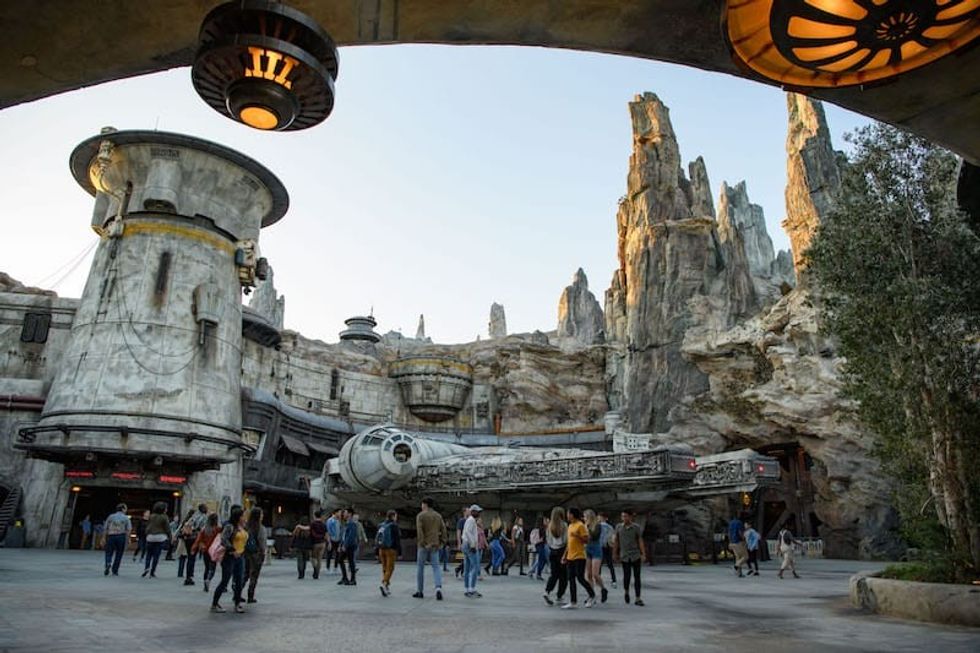 Millennium Falcon: Smugglers Run at Star Wars: Galaxy’s Edge, where prioritising key story elements helps create an immersive experience within practical constraints
The team must identify the story-bearing elements—the things that cannot be removed without fundamentally changing the experience—and then work backward.
In a highly creative industry like themed entertainment, there is a natural tendency to treat every idea as sacred. But when everything is considered essential, nothing is truly being prioritized.
A useful approach is to establish three categories: protect, adapt and release. Which ideas must be protected? Which can be reinterpreted while preserving their intent? Which can be released if doing so allows the more important experience to survive?
The key is making those decisions before the storm hits. That hierarchy must also be shared across the entire project team. There will almost certainly be differences of opinion about where the experiential weight lies.
The owner, creative team, architect, fabricator, or other technical partners may each see a different element as untouchable. Surface those disconnects early to find common ground and revisit them as needed to make sure priorities align across the team.
3. Make technical disciplines part of the creative process
If technical experts are invited into the process only after the creative vision has been declared “finished,” we have already limited what they can contribute.
Architecture, engineering, operations, fabrication, lighting, acoustics, landscape, interiors, show design, and all other disciplines that bring an experience to life aren't merely there to execute the creative idea. They should be part of the creative process.
When brought in late, these disciplines are often placed in the unenviable position of explaining what will not work. The structure cannot support it.
The material cannot be fabricated that way. The maintenance team cannot reach it. Suddenly, the technical team becomes “the department of no” — not because its members lack imagination, but because they were invited only after the available choices had narrowed.
Bring them in early, and the conversation changes. Instead of asking, “How do we make this work?” after the idea is already established, the team can ask, “How can we make this idea better?” from the beginning.
When everyone understands the “why” of the idea, the story and the concept, they have more opportunity to contribute to the “how.” And that is where some of the most creative solutions can emerge.
A structural limitation may lead to a different — and ultimately more interesting — form. A fabrication challenge may inspire a new material approach. An operational requirement may change the way guests move through a space and create an even better reveal.
The story that survives
Although it may sometimes feel like it, reality is not the enemy of imagination. In fact, the strongest immersive experiences are often the result of imagination working with reality rather than trying to outrun it.
To me, this is ultimately what makes themed entertainment work so rewarding; we are creating experiences that make people believe, for a moment, that another world is possible.
Reality will always be waiting just outside the door. Our job is to make sure it never gets the final word.