A golf course, marina or private beach can raise the value of a luxury development. A high-performance surf pool behaves differently: it changes throughout the day, draws together different ages and abilities, and gives people a reason to return. That helps surf move from the edge of real estate masterplans to the centre.
American Wave Machines (AWM) describes PerfectSwell as a platform for anchoring destination real estate. The integration into luxury residential development began in Brazil, where Boa Vista Village attracted a new type of luxury buyer.
The idea is now being translated into a residential community at Zion Shores, an urban club in São Paulo, and sports and tourism developments in Japan and China.

Pro surfer and AWM brand manager Rob Kelly
Together, the projects show how surf can support property sales, membership, rentals, hotels, coaching, events and regional tourism. The technology is consistent, but its role changes with the market.
For Rob Kelly of AWM, the distinction between amenity and anchor comes down to behaviour:
“The difference is repeat demand,” he says. “A novelty attraction may generate curiosity once. An anchor creates behaviour that repeats over time.”
Wave quality, consistency, progression, and operational flexibility turn an occasional visit into a routine. Once people organise their lives around the experience, the commercial effect spreads beyond admissions.
When the wave became part of the masterplan
Boa Vista Village was the first step in bringing PerfectSwell into luxury housing.
JHSF, the Brazilian high-end real estate and hospitality group, began discussing the project with Eduardo Grinberg in 2018 and moved forward in 2019. Grinberg, now JHSF’s director of membership and sport innovation, conducted an RFP covering the available surf technologies.
The group selected PerfectSwell, and Boa Vista Village Surf Club opened in June 2023. Yet Boa Vista was not simply a residential development that happened to acquire a wave pool.
Surf was built into a wider ecosystem that already included high-end property, hospitality and sport. Residents and property owners within Boa Vista Village, Fazenda Boa Vista and associated communities could apply for surf club membership.
The link between ownership and eligibility made access part of the property proposition, while membership fees, guest access, lessons and services created income beyond the initial sale.
“Some customers came to JHSF only, or initially, because of surfing,” says Grinberg. “They were excited by the beach, the surf and sport—not necessarily by golf, tennis or country living.”
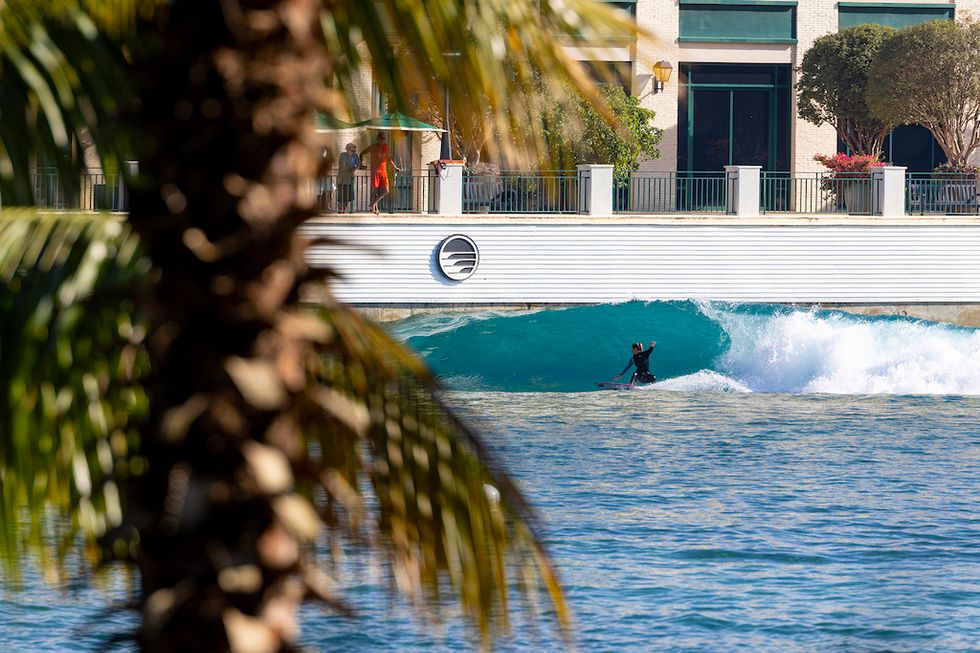
The wave pool at Boa Vista Village Surf Club is built into a wider ecosystem
Image courtesy of AWM
Surf expanded JHSF’s addressable market. It attracted committed surfers, people who had always wanted to learn, and former surfers whose careers and families had taken them away from the coast.
Kelly describes surfers as committed lifestyle consumers: they travel for waves, organise their schedules around the sport and invest in equipment and coaching.
For developers, that existing pattern of behaviour is valuable because it can be directed towards a place.
“At this level of investment, even if someone falls in love with the surf, they will still examine the surroundings,” says Grinberg.
“Will their children enjoy themselves? Will their spouse enjoy it? Having a complete ecosystem around the surf club is always extremely valuable.”
That insight became fundamental to the model. The pool can generate attention and emotional attachment, but the developer must capture value across the surrounding environment. Otherwise, the operator carries the cost while neighbouring assets receive much of the uplift.
JHSF’s residences, hotels, restaurants, shopping centres and private clubs allowed surf to become the entry point to a much larger luxury network.
Boa Vista also helped define PerfectSwell’s market position. For Grinberg, it combined credible high-performance surfing and variety with enough capacity to operate a private club.
In other words, product quality was not separate from the real estate strategy. It justified the project's exclusivity.
Turning the proof point into an American residential model
The Boa Vista principle is now being developed in a more concentrated form at Zion Shores in southern Utah.
Zion Shores is being labelled as America’s first surf-anchored residential development. Rather than placing a club inside a wider luxury portfolio, the project begins with surf and organises the housing, access model and visitor economy around it.
Southern Utah is already known for outdoor recreation, including mountain biking, hiking, climbing and golf, but it is hundreds of miles from the ocean.
“We are bringing the one thing that feels missing from a climate and destination otherwise suited to it,” says Zion Shores founder and project lead Cody Larkin.
“The only thing southern Utah lacks is the ocean.”
Larkin had previously developed a community around a man-made recreational lake. When he began exploring a complete surf community, the required investment scale demanded a different model. Zion Shores will include only 65 waterfront properties, combining private ownership with short-term rentals.
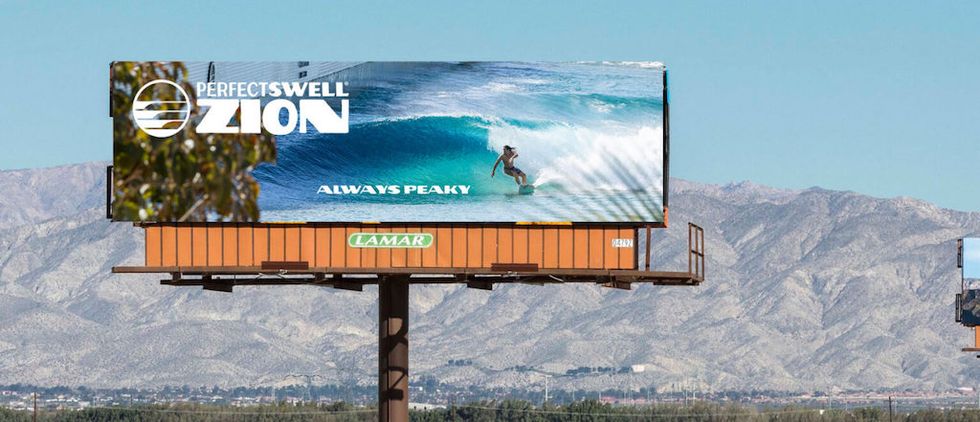
Zion Shores is America’s first surf-anchored residential development
Image courtesy of AWM
Owners can place their homes into a managed rental programme when they are away. Guests can stay and book surfing, while owners retain priority access. Rentals keep the homes productive, while surf sessions and coaching create repeat revenue.
“The owners are invested in the community, while the development operates more like a holiday destination than a conventional primary-residence neighbourhood,” says Larkin.
“The combined investment of many owners allows many more visitors to experience the community, while owners retain privileged access to the surfing.”
It also demonstrates why a surf pool cannot simply be added at the end of a masterplan. “Surfing has to be considered at the very beginning,” says Larkin.
“The value is in the surf experience. If a developer begins selling real estate before the surfing proposition is established, it loses much of the additional value that surfing could create.”
Zion Shores is still under construction, with three surf pools and the first custom homes and townhouses underway. It is not yet a mature operating comparison with Boa Vista, but its commercial structure shows how the Brazilian proof point can become a purpose-built housing model.
The development will combine a large PerfectSwell pool with two complementary UNIT systems, giving guests several distinct ways to surf.
PerfectSwell will provide the project’s full travelling, ocean-style wave experience—including paddling, take-off and riding—for surfers at every skill level. The UNIT systems offer different rapid-wave formats, including standing and dynamic waves, which allow surfers to enjoy another form of board riding.
Together, the three pools broaden the range of experiences available, while PerfectSwell remains what Larkin describes as the project’s “crown jewel”.
Perfect waves may attract the first buyer. A complete social and recreational environment persuades families to stay and also attracts international thrill-seekers and holidaymakers.
Taking the model beyond housing
JHSF’s next step was not another residential resort. It was São Paulo Surf Club, an urban private club that opened in November 2025.
Framed by JHSF as a beach environment within the city, the club combines PerfectSwell with restaurants, wellness, fitness and other sports. Members do not need to own JHSF property; they apply for individual or family membership and pay annual fees.
The shift is revealing. At Boa Vista, surf membership strengthens property sales. In São Paulo, the membership is the premium product. The underlying value drivers—exclusivity, repeat participation and community—remain the same, but they no longer depend on a home purchase.
São Paulo is particularly suited to the model. It has a large established surf community, yet regular access to the coast means negotiating distance, traffic and unpredictable conditions.
The club brings a credible version of the beach lifestyle into the city and makes it routine rather than an occasional trip.
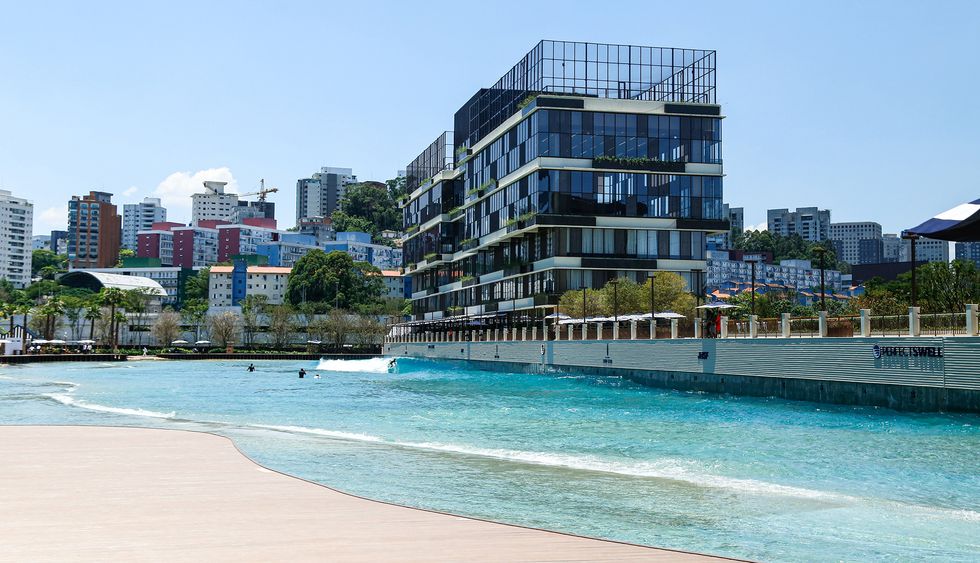
São Paulo Surf Club brings the beach lifestyle to the city
Image courtesy of AWM
Coaching, guest access and photography create additional revenue. Transferable memberships create a controlled secondary market, subject to JHSF approval of the incoming member. Income comes from joining fees, annual payments, transfers and participation.
More importantly, it creates relationships. Grinberg has watched beginners become advanced surfers, older members return to the sport, and families form friendships through repeated sessions.
“Vibrant communities are not created by buildings alone,” says Kelly. “They are created by shared behaviour, rituals, and reasons for people to return.” Surf becomes social infrastructure.
The shift from Boa Vista to São Paulo shows that surf-led luxury isn't a single property category. The same platform can support destination living or an urban club, as long as the operator understands why customers will return.
The technology has evolved with the business model. When JHSF identified a gap between two difficulty levels, AWM developed intermediate settings. For Grinberg, the important question is how much the original pool has improved since opening.
For a premium development, that capacity to evolve is part of the investment proposition. Owners and members are not only buying the specification available on opening day. They expect the central experience to remain varied, reliable and relevant.
New combinations in Japan and China
The next stage in PerfectSwell’s development has been to combine surfing with functions beyond housing or private membership.
The wave must remain credible as the commercial model changes. “A destination can have beautiful architecture, hotels, restaurants, and amenities, but surfers ultimately judge it by what happens in the water,” says Kelly.
A convincing wave supports beginners, experienced surfers, coaches and families. Sessions, events and friendships then create a culture around the infrastructure.
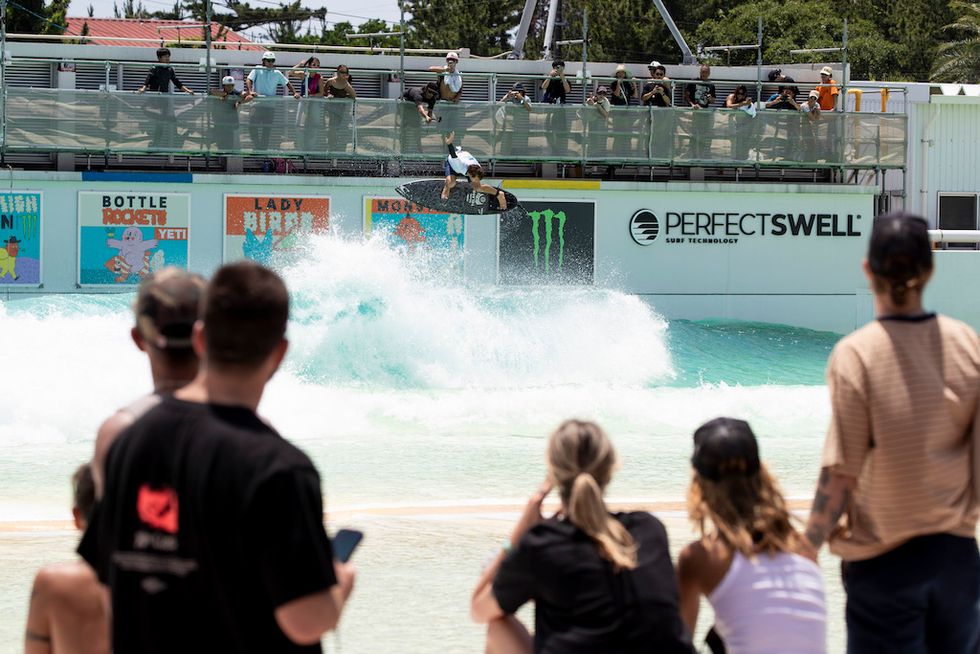
Surfers at the PerfectSwell venue in Shizunami draw a crowd
Image courtesy of AWM
In Japan, the PerfectSwell facility at Shizunami established the technology’s high-performance credentials. Coaches and surfers can repeat specific manoeuvres under controlled conditions, while the facility also operates as a leisure destination. Elite performance and wider participation support the same asset.
The effects extended beyond training. Keiichi Hayashi, CEO of PerfectSwell Japan, told blooloop that new hotels, real estate and other development began to emerge after the wave pool opened.
The facility gave an established surf area reliable infrastructure that could attract further investment.
Japan expanded the meaning of an anchor. Value came from athlete development, visitor activity, and confidence in the wider destination, not just surrounding property.
China is now testing a still broader combination.
Riyue Bay Surf Resort in Wanning, Hainan, integrates a PerfectSwell pool with hotels, restaurants, retail and a recognised natural surfing destination. It is not yet a surf-led housing model, nor is it a private club. It is an institutional tourism project intended to change how long visitors stay and what they do while they are there.
Yang Lin, vice-president of business development at China Tourism Group (CTG), says the first visitors were mainly experienced surfers excited by China’s first purpose-built commercial high-performance wave pool.
Interest then broadened through public figures, television and international media.
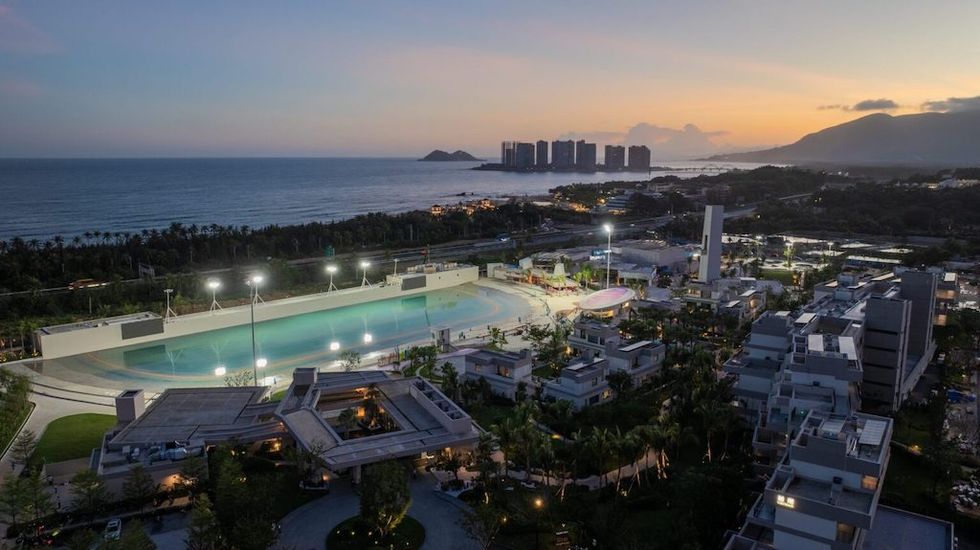
Sunset at the Riyue Bay Surf Resort in Hainan
Image courtesy of AWM
CTG reported that the resort received 180,000 visitors in its first six months, through the end of May 2026. More than 10% came from overseas, representing 29 countries and regions.
Earlier project research also found that while many Chinese respondents had never surfed, most were willing to try.
“Our approach is still to use the wave pool as the core, then build more diverse entertainment and holiday experiences around it,” says Lin. “That will attract more people to the destination and, in turn, increase the value of the wave pool itself.”
Early signs are promising, including international demand and long stays by some committed surfers. But Lin is careful not to claim that the resort has already transformed surrounding real estate. The operating history is too short.
China is still discovering which combinations of resort, sport, membership and property will work in different cities.
There are also constraints. Outdoor operations are most viable in Hainan and southern China, while many high-spending consumers live farther north.
Covered facilities could extend the season, but add cost. Each project needs the right climate, audience, assets and government relationships.
See also: From novelty to infrastructure: how PerfectSwell is shaping Asia’s surf economy
Driving the economic expansion with premium surf
Across these formats, PerfectSwell does the same thing: deliver a surf experience strong enough to define the place around it. As Kelly puts it, “Surfers need to trust that the wave is worth coming back for.”
The technology uses patented sequencing to create authentic, surfable waves with programmable shapes, sizes, and difficulty levels. Its surf-first approach prioritises quality, variety, and repeatability, while software lets the product evolve without physically rebuilding the pool.
That matters to a high-end customer. The central experience must satisfy experienced surfers, welcome new participants, and keep improving. Wave quality creates the repeat demand on which many other opportunities can be built.
Integrating surfing into a wider development can expand revenue opportunities and help developers capture more of the value the pool creates. This is not a prerequisite for a successful surf operation.
It is a way to extend a compelling core experience into longer stays, deeper customer relationships and additional forms of participation.
The projects in this feature demonstrate the range of that expansion.
Zion Shores connects surf demand with ownership and managed rentals; São Paulo Surf Club adds membership and club services; Japan combines leisure with sports performance; and Riyue Bay connects surfing with hotel stays, retail, events and destination tourism.
In each case, premium surf remains the primary demand generator, while the surrounding model determines how far its economic and community impact can travel. Grinberg believes real estate, membership, and a wider ecosystem will allow the developer to maximise the value the pool creates.
From individual projects to a Chinese network
The formation of Eastern Swell Dynamics, a joint venture between AWM and CTG, marks the next stage in this evolution.
“The next evolution is about fully capturing the repeat demand created by premium surf,” says Kelly. “The real opportunity is not only ticket sales; it is membership, hospitality, residential value, training, events, food and beverage, wellness, and destination identity.”
The company will serve as the official licensed platform for PerfectSwell projects in China, combining AWM’s technology with CTG’s development capability and market access. Riyue Bay becomes the first working reference for a potential network.
China is unlikely to adopt only one model. A resort in the south can drive international travel and longer stays; a major city may favour a well-developed membership club with top service; another destination could combine training, hospitality, and homes.
The joint venture allows these formats to be localised rather than copied from Brazil or the US.
China combines scale with institutional capacity. Surf participation is still niche, but a large population is interested in new sports and lifestyles. CTG’s hotels, destinations, travel services, retail, and real estate give it several ways to capture the value the sport creates.
For future projects, the question will not simply be where to build another pool. It will be which combination of assets gives that pool a long-term purpose.
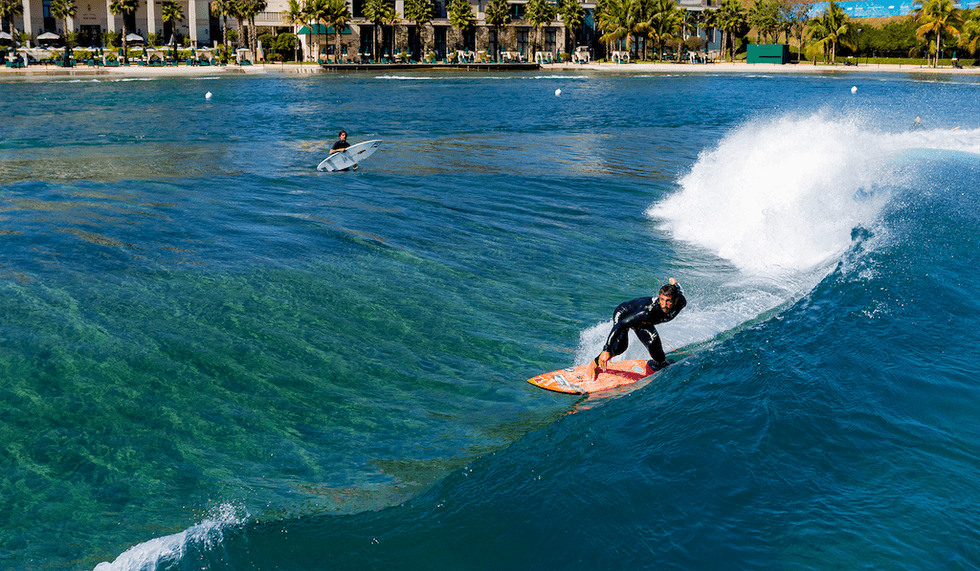
Surfing at São Paulo Surf Club
Image courtesy of AWM
The progression is already visible. Boa Vista showed that high-performance surf could attract a new luxury buyer.
Zion Shores is turning that insight into a residential community organised around ownership, rentals and privileged access. São Paulo proved that the same experience could become an urban membership product. Japan connected it to sports performance and regional growth. Riyue Bay placed it inside a national tourism strategy.
Eastern Swell Dynamics can now bring these findings together.
The future of surf-led real estate will not be defined by adding blue water to a masterplan. It will depend on treating the wave as infrastructure: an experience that shapes the product, the revenue model and the community from the beginning.
When those elements align, PerfectSwell can do more than attract visitors. It can give people a reason to buy, stay, return and belong.