Surfing in Asia is entering a new phase. Once defined largely by coastal geography and niche participation, the sport is now being reframed through infrastructure, institutional support, and technology.
The inclusion of surfing in the Tokyo Olympic Games has accelerated this shift, prompting governments, developers, and operators to reconsider surfing not as a lifestyle activity but as a structured sport and a scalable economic driver.
At the centre of this transformation is wave technology.
American Wave Machines (AWM), the developer of PerfectSwell, has positioned itself at the intersection of sport, real estate, and destination development.
Its projects in Japan have demonstrated the viability of high-performance wave systems, while its latest development in China — the Riyue Bay Surf Resort — signals a much larger opportunity: China's emergence as a proving ground for surf infrastructure across Asia.

Pro surfer Rob Kelly joined the AWM team after experiencing PerfectSwell for himself
As Rob Kelly of AWM explains, the significance of Riyue Bay extends well beyond a single project.
“This project is significant on multiple levels,” he says. “It is the first purpose-built, high-performance surf pool of its kind in China, and it was developed by CTG, one of China’s most respected tourism and development groups.
“This is not speculative leisure development. It is institutional adoption.”
Technology as a catalyst
For decades, wave pools were designed primarily as entertainment features, such as attractions in water parks, rather than as environments for serious surfing. According to Kelly, that legacy has shaped both perception and performance limitations.
“Historically, wave pools were engineered as attractions first and surfing environments second,” he explains.
“PerfectSwell was built from the ground up with surfing as the priority — wave face quality, manoeuvre sections, variability, and repeatability.”
This “surf-first” design philosophy underpins AWM’s market positioning. Rather than diluting performance to broaden appeal, the system layers accessibility over a high-performance foundation.
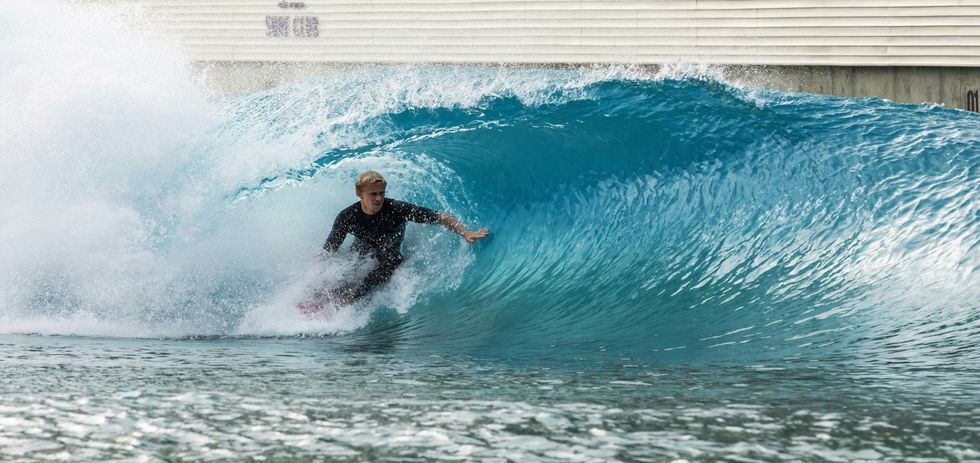
PerfectSwell surf pool technology delivers authentic, ocean-quality waves in a fully programmable, high-frequency format.
Image courtesy of AWM
The result is a platform that can serve beginners, enthusiasts, and elite athletes simultaneously.
The implications for sport development are significant. “Elite training is fundamentally about controlled repetition,” says Kelly. “In the ocean, athletes depend on variable conditions. In a programmable system, they can isolate manoeuvres and repeat them under consistent parameters.”
In practical terms, this shifts surfing from a reactive sport dependent on natural conditions to a more structured, measurable discipline. Training cycles accelerate, technical progression becomes more quantifiable, and coaching methodologies evolve accordingly.
“Wave consistency transforms training from reactive to strategic.”
Japan: proving performance and building credibility
While China represents the next phase of growth, Japan has already demonstrated what high-performance wave infrastructure can achieve when integrated into a mature surf market.
For Kimifumi Imoto, board member of the International Surfing Association and a leading coach working with PerfectSwell, the transformation has been both rapid and structural.
A decade ago, Japan was not among the leading nations in competitive surfing. The sport was dominated by traditional powerhouses such as the United States and Australia. In response, Imoto developed an eight-year athlete training plan to close that gap.
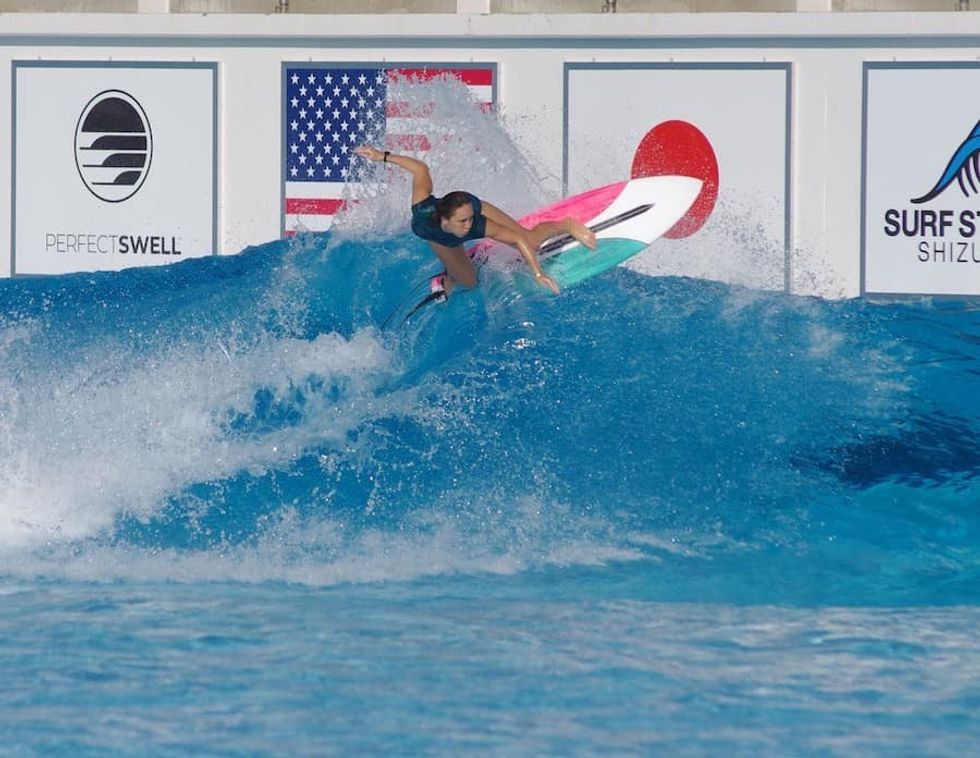
Carissa Moore at the PerfectSwell Olympic training venue in Japan
Image courtesy of AWM
The turning point came with the Olympic Games. With surfing’s debut at the 2021 Tokyo Games as an Olympic sport, Japan achieved strong competitive results, significantly boosting national confidence and institutional support.
At the same time, the introduction of PerfectSwell created new possibilities for training.
“In the natural ocean, some types of training are very difficult, or even impossible,” Imoto says. “With a wave pool, we can adapt training methods and focus on specific techniques in a controlled environment.
"For example, a very important technique is the ‘Airs’, which is difficult to control in a natural environment, but with controlled waves, athletes can quickly improve in as little as one month. This is vital for training for the Olympics and Paralympics.”
This shift is particularly important during the critical developmental window for athletes.
Reaching athletes early
Ages 8 to 15 are the golden period for training. Previously, many Japanese athletes had to train abroad, which was a considerable challenge.
Now, not only has this problem been resolved, but it has also helped them strike a better balance between their personal lives, family commitments and work, whilst ensuring a more reasonable and sustainable level of financial support for the athletes.
The impact also extends beyond elite performance. PerfectSwell functions as both a high-performance training centre and a leisure destination, reflecting surfing's dual nature as sport and lifestyle; a dynamic that Imoto compares to skiing.
In Japan, these two dimensions are now developing in parallel.
The wave pool has enabled a dual-growth model: By offering equal access to high-quality waves, facilities like PerfectSwell reduce traditional barriers associated with geography, timing, and experience level.
For professionals, this means structured progression and technical refinement. For enthusiasts, it provides a controlled and welcoming environment to engage with surfing for the first time.
As a result, participation and performance are no longer competing trajectories, but mutually reinforcing ones — a model that is accelerating the overall development of surfing in Japan.
From surf culture to destination economy
The integration of wave technology into broader visitor economies is particularly evident in Shizunami, where PerfectSwell has played a catalytic role in regional development.
According to Keiichi Hayashi, CEO of PerfectSwell Japan, the area had long been recognised as a surf destination, but its infrastructure remained limited.
“Before, there was only one proper hotel, and not much had changed for many years,” he says. “After the opening of the wave pool, we began to see hotels, real estate, and other developments emerge.”
This pattern reflects a broader shift in the positioning of surf facilities within mixed-use environments.
Globally, surf pools are increasingly used as anchor attractions- experiential assets that drive visitation, enhance land value, and shape destination identity.
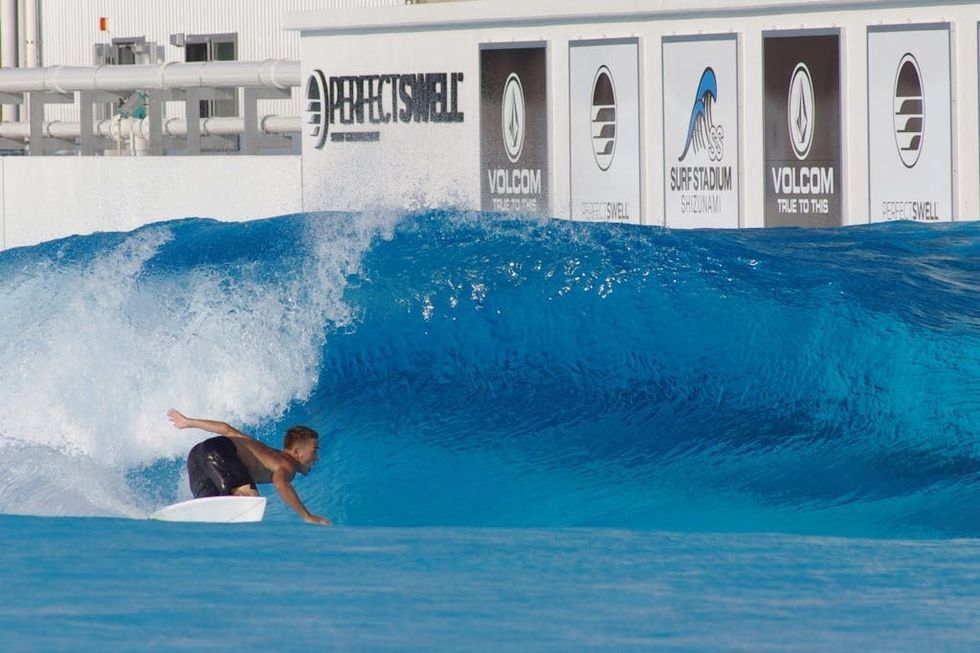
Shun Murakami at the PerfectSwell Olympic training venue in Japan
Image courtesy of AWM
However, as Kelly notes, this model only works under certain circumstances.
“Surf pools can function as powerful anchor assets in mixed-use developments, but only under specific conditions,” he says. “They must deliver high-performance wave quality, operate reliably, and be backed by defensible intellectual property.”
Projects that meet these criteria can generate long-term value. Those who do not risk being reduced to interchangeable amenities.
Kelly adds that the category itself is also evolving. What began primarily as destination-based surf infrastructure is increasingly expanding into hybrid models spanning premium resorts, private clubs, sports facilities, and mixed-use developments.
“Different formats are all being driven by the same thing,” he says. “Repeat demand.”
China: scale, speed, and a new market logic
If Japan demonstrates proof of concept, China represents scale.
The Riyue Bay project in Hainan illustrates how surf infrastructure is being embedded within broader tourism and development strategies.
Zhao Kuan of China Tourism Group (CTG) says the project emerged from a combination of existing surf culture and government-led infrastructure planning.
“Hainan already has a strong surfing tradition, attracting both domestic and international visitors,” Zhao explains. “The provincial government wanted to upgrade the island’s coastal tourism infrastructure, with Riyue Bay positioned as a key destination.”
What began as a small coastal stop evolved into a large-scale integrated development that combines surf infrastructure with hospitality and retail, with plans for future expansion.
CTG’s decision to work with AWM was grounded not only in performance outcomes but also in a clear differentiation of wave-generation technologies.
Today’s surf pools broadly fall into three categories: mechanical and gravity-based have a longer history, and pneumatic, in which AWM has established itself as both a pioneer and a leading innovator.
“Traditional wave pools are designed for entertainment, with wave heights of around 2.3 metres,” Zhao says. “AWM’s system can reach 2.7 metres, and the overall quality and professionalism of the team were also important factors.”
The advantages of pneumatic systems are both structural and experiential.
By separating the water body from the mechanical systems, operational risk is reduced, and system durability is improved. Waves are generated by programmable air-pressure systems, allowing a high degree of flexibility in waveform, sequencing, and performance.
This architecture also introduces redundancy: individual component failures do not disrupt overall operations, ensuring reliability at scale.
Perhaps most importantly, the system is software-driven, meaning upgrades can be implemented through programming rather than physical reconstruction — a critical factor for long-term operational efficiency and performance evolution.
Exceeding expectations
The project’s early performance has exceeded expectations.
Initial projections suggested that beginners would make up around 70% of visitors, consistent with patterns observed in natural surf environments. However, during the first months of operation, a much higher proportion of experienced surfers was observed.
“Professional surfers were coming first. Later, as feedback spread and during the Chinese New Year holiday, the number of beginners increased significantly.”
The project has also demonstrated strong destination appeal.
While the average visitor stay in Hainan is typically under three days, guests at Riyue Bay have stayed for extended periods, in some cases over a month.
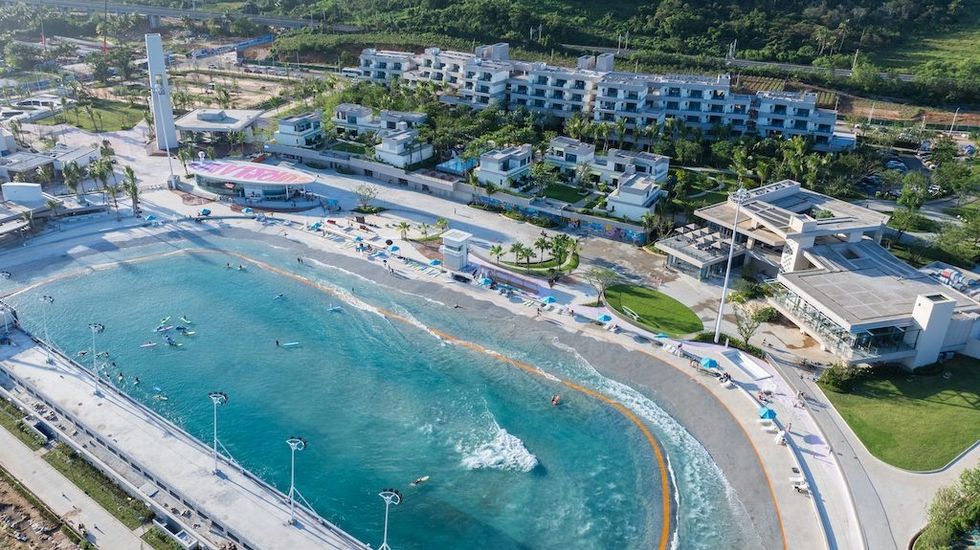
Riyue Bay in Hainan shows how surf infrastructure is being embedded within broader tourism and development projects
Image courtesy of AWM
International visitors account for nearly 10% of the total, with surfers travelling from cities such as New York and London, specifically for the experience.
Beyond the infrastructure itself, CTG is actively building a layered programming ecosystem around the site.
This includes international competition partnerships, with a clear distinction between events best suited to natural ocean conditions and those optimised for controlled wave environments.
At the same time, CTG is developing proprietary branded competitions in collaboration with AWM, alongside community events led by local surf clubs.
There is also growing engagement with media and other platforms, including collaborations with surfing influencers, content creators, and entertainment formats that introduce surfing to wider audiences.
Infrastructure accelerating culture
For AWM, this dynamic reinforces a core principle: infrastructure drives participation.
“In emerging surf markets, access is the bottleneck,” says Kelly. “Advanced wave technology removes reliance on swell windows and geography. It creates daily access, coaching structure, and progression pathways.”
This, in turn, accelerates the development of the entire ecosystem, spanning from grassroots participation to elite competition. “Infrastructure accelerates culture,” he adds.
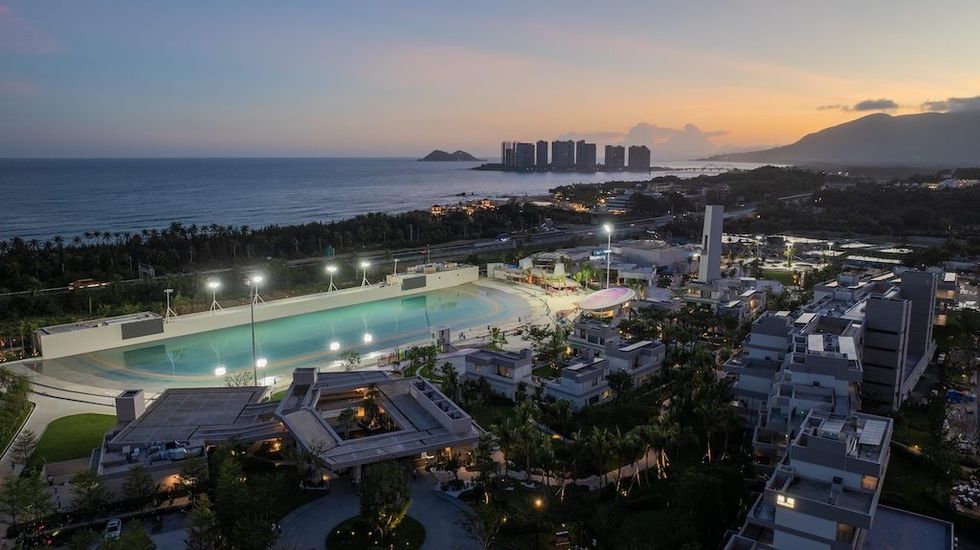
The 10-hectare Riyue Bay Surf Resort features China's first Olympic-standard artificial wave pool and serves as a year-round hub for wave riders
Image courtesy of AWM
In China, this process is being further amplified by policy alignment.
Surfing’s inclusion in the Olympic Games has increased its institutional relevance, while its recognition within educational frameworks, including its potential role in student evaluation systems, is creating new pathways for youth participation.
For families and young athletes, this represents a significant shift.
“Previously, students had to go abroad to train,” Zhao explains. “Now, they can train in China, which provides a new option for long-term development.”
The next phase: precision, data, and scale
Following the success of Riyue Bay, AWM and CTG aim to accelerate the long-term development of surf infrastructure in China by introducing more vertical models across the construction, investment, and operations phases.
This reflects the broader shift within China’s attractions sector toward localised production capability and integrated delivery ecosystems for specialised sports and experiential infrastructure.
Looking ahead, CTG plans to expand the Riyue Bay project as part of a broader phased development strategy. The first phase will include a hotel, surf pool, and commercial zone.
Future phases may introduce additional attractions, including a theme park component, as well as a series of projects and resorts in other cities.
As the market evolves, the focus is shifting from novelty to optimisation.
“The next phase will focus on refinement and intelligence,” says Kelly. “Performance tuning, digital programming, data integration for athlete development, and operational efficiency will define the evolution.”
This reflects a transition across the attractions industry, where technology is increasingly evaluated not only on experience but also on its ability to deliver measurable outcomes, whether in sports performance, visitor engagement, or financial returns.
In this context, China’s role is particularly significant.
“China combines extraordinary market scale, institutional Olympic backing, and sophisticated real estate integration capabilities,” Kelly says. “When those forces converge with high-performance surf infrastructure, the growth curve can accelerate rapidly.”
For AWM, the expectation is clear.
“We anticipate the development of a PerfectSwell network of surf pools coming online in China.”
From wave to system
The rise of surf infrastructure in Asia is not simply about technology, nor is it purely about sport. It reflects a broader shift in how experiences are designed, delivered, and integrated into economic systems.
In Japan, wave pools have strengthened athlete development and catalysed regional growth. In China, they are being embedded within large-scale tourism strategies, supported by government investment and institutional alignment.
Across both markets, a common thread is emerging: authenticity matters.
The next generation of surf destinations is not being defined by short-term novelty, but by experiences that generate lasting engagement, repeat participation, and long-term cultural relevance.
For AWM, high-performance infrastructure becomes critical. Consistent wave quality, operational reliability, and programmability enable surf facilities to serve as sports infrastructure, leisure destinations, and community platforms.
As Kelly explains, the market is evolving beyond spectacle alone toward experiences with enduring value. In practice, that does not diminish the importance of spectacle; rather, the distinction lies in whether the experience can sustain repeat demand over time.
Facilities that combine technical credibility with accessibility, lifestyle appeal, and destination integration are increasingly emerging as long-term assets rather than one-time attractions.
Across Asia, that shift is already reshaping how surf, sport, and destination are being developed.