
Charles is co-founder and creative director at blooloop. He attends numerous trade shows around the world and frequently speaks about trends and social media for the attractions industry at conferences. Outside of blooloop, his passions are diving, trees and cricket.
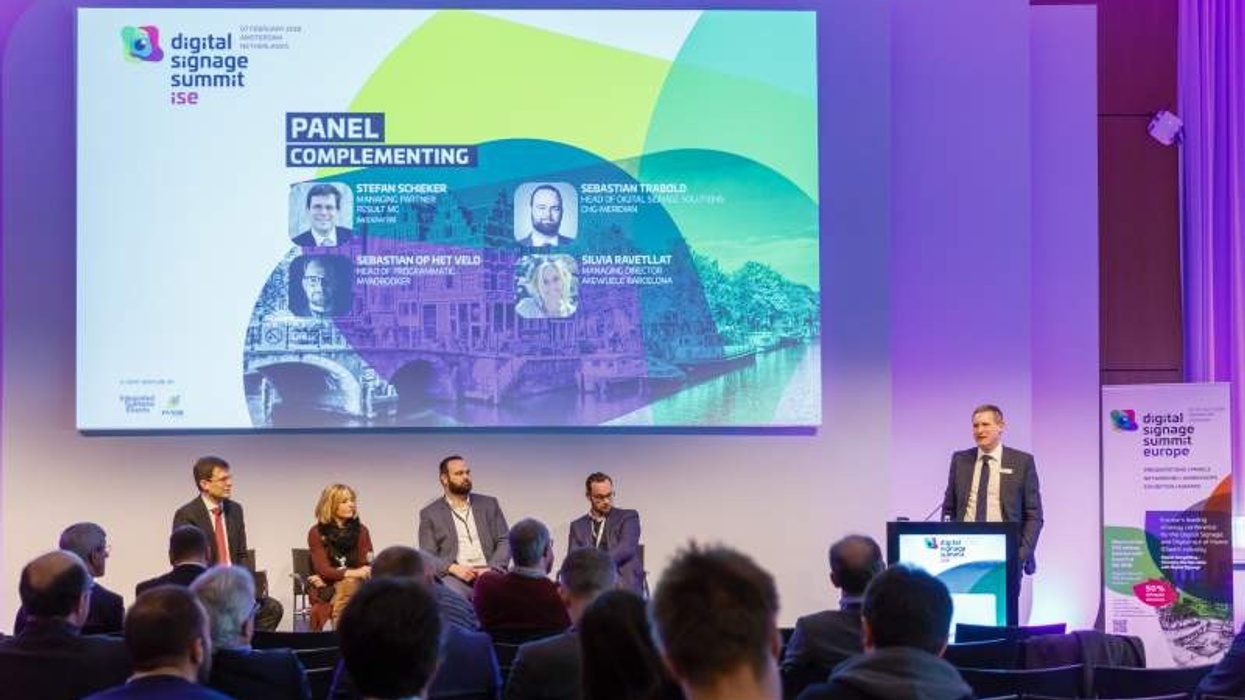
Around 500 attendees gathered at the Sheraton Hotel, Frankfurt Airport, for a lively programme of keynote conferences, panel discussions and workshops. Companies sharing their latest innovations included NEC, Samsung, LG Electronics, Philips Professional Display Solutions, Elo Touch, Sharp, BenQ and Epson.
Over the two-day conference, 40 experts from the digital signage and digital out-of-home (DooH) industries explored market trends and identified growth areas.
“DSS Europe 2018 delivered its promise to retailers, integrators and manufacturers for a technology focussed business roadmap," said Florian Rotberg, Managing Director, invidis consulting and DSS Europe 2018 Chair.
"The conference explored how digital storytelling and digital touchpoints are adding real value and ‘Changing the Narrative’ using technology to improve customer engagement.”
With traditional retailers under increasing pressure from e-tailers, DSS looked at how physical stores can be reinvisioned as experiential destinations to drive engagement and in-store purchases.Technologies under discussion included LED, OLED, electronic shelf labels, augmented reality (AR) and virtual reality (VR).
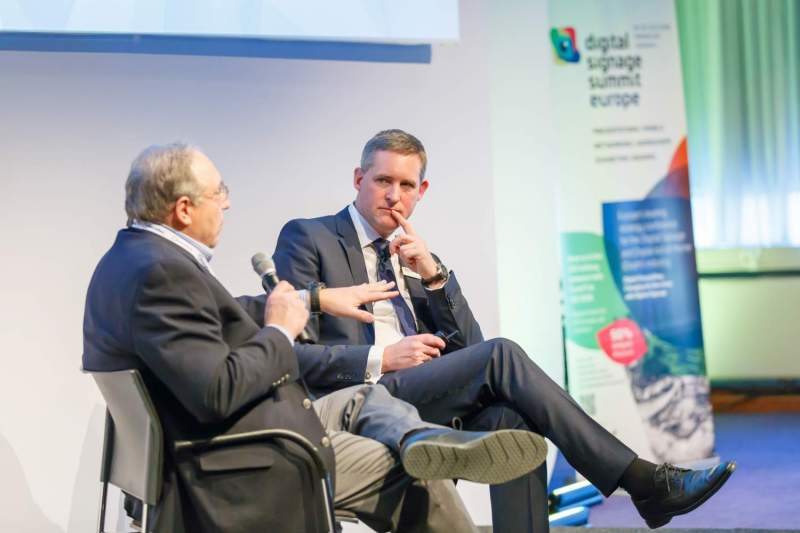
“Retailers today are looking for new ways to create unique user experiences,” explained Rotberg."By integrating new technologies and increasing digitalisation in a value-creating way, ‘storytelling’ becomes the key to this success.”
The two-day event culminated in a personalised, behind-the-scenes tour of Frankfurt Airport. This special opportunity allowed attendees to view the digital signage and DooH solutions in situ, and understand how the systems work within one of Europe’s busiest airports.
“Attendees at DSS 2018 gained a thorough insight and understanding of how digital signage can be integrated into a number of market sectors. Tomorrow’s most successful companies are driven by curiosity and creativity, so retailers need to be aware of the challenges, the solutions, and how to take advantage of this today,” added Rotberg.
Charles is co-founder and creative director at blooloop. He attends numerous trade shows around the world and frequently speaks about trends and social media for the attractions industry at conferences. Outside of blooloop, his passions are diving, trees and cricket.
Integrated Systems Europe (ISE), the world’s largest AV and systems integration show, has named Matt Clark, a renowned British artist and the visionary founder of United Visual Artists (UVA), as the creative keynote speaker for ISE 2026.
Known for his innovative work blending art, technology, and architecture, Clark combines light, code, sound, and choreography to produce striking artworks displayed at major cultural institutions and public spaces worldwide.
His keynote will showcase his bold ideas, inspiring attendees to challenge conventions and explore new connections among art, technology, and architecture at ISE 2026.
On Tuesday, February 3, from 15:30 to 16:15 in Room CC4.1, Clark will deliver his keynote titled Hidden Order: Building a Performance-led Mapping at Casa Batlló, from Concept to Implementation.
This session will provide a rare behind-the-scenes glimpse of ‘Hidden Order’, the façade mapping created by Casa Batlló in collaboration with UVA, which is scheduled for 31 January and 1 February, just prior to ISE 2026.
Showcasing innovative ideas
The Hidden Order artwork commemorates the 5th edition of Casa Batlló’s annual mapping event, offered free to Barcelona's residents and recognised as one of the city’s major cultural highlights.
It uses the building as both a subject and a tool, aiming to deepen Gaudí’s innovative legacy through reinterpretation inspired by his connection with geometry and nature. Using light, motion, and sound, the façade is broken down and reassembled, with choreography and human movement playing key roles in its composition.
The piece explores the space between figuration and abstraction, as well as the human element and architecture, while addressing real-world limitations that influence its visual and technical aspects.
Clark’s keynote will explore the Casa Batlló commission as a case study, covering initial impressions, concept development, research, prototyping, content systems, technical design, show control, and onsite delivery.
He will explain how UVA converts architectural logic into a manageable visual system, working with a varied team of technical artisans and specialists to progress from studio tests to final realisation. Additionally, he will show how constraints influence and shape the composition.
Exploring Hidden Order
Hidden Order expands into Casa Batlló’s newly opened second-floor gallery, transforming into ‘Beyond the Façade’, a five-month site-specific exhibition opening on 31 January that offers visitors an immersive encounter with Clark’s work.
This distinctive space within the iconic building allows for an in-depth exploration of the artistic process behind the mapping, blending light, motion, and technology to contemplate life cycles and the interaction between human presence and architecture, enabling visitors to see themselves reflected in the installation.
“We are delighted to welcome Matt Clark as our Creative Keynote for ISE 2026. Matt’s visionary approach and his ability to blend art, technology, and human experience truly embody the spirit of ‘Push Beyond’, our theme for ISE 2026,” says Mike Blackman, managing director of Integrated Systems Events.
“This extraordinary project, created by Casa Batlló in collaboration with Matt Clark, challenges us to see the world differently and inspires our community to explore new creative frontiers.
"I am confident that Matt’s keynote and the unveiling of ‘Hidden Order’ at Casa Batlló will ignite fresh ambition and spark meaningful conversations across the global AV and systems integration industry.”
ISE 2026 takes place from 3 - 6 February at Fira de Barcelona in Barcelona, Spain. blooloop readers can use the code ‘blooloop’ for free registration, here.
Keep ReadingShow less
Most popular
Don’t miss out
Get the latest attractions industry news direct to your inbox, every day.
✅ Thank you! We’ve sent a confirmation email to complete your subscription.
Incubated by Integrated Systems Europe (ISE) during its 2026 edition from 3 - 6 February at Fira de Barcelona, Spark aims to be a hub where creative professionals, technologists, and decision-makers connect, share ideas, and explore the future of creativity.
Topics include the power of convergence, cultural intelligence, new collaboration methods, immersive storytelling, AI, and innovation.
Featuring hands-on labs, immersive environments, thought-leadership sessions, and networking opportunities, Spark is designed to inspire both current and future creative talent. It provides a space to experiment with new tools, exchange perspectives, and experience creativity firsthand.
Creative collaboration
Spark will be built on ISE’s legacy of event design excellence in the tech industry, expanding the show’s influence into the nearby and often overlapping creative economy.
Its mission to address the ‘Connection Paradox’—a world that is highly connected yet increasingly fragmented—drives Spark to bring together creative professionals around technology, tools, and platforms that enhance experience design, storytelling, and audience engagement.
By combining digital technology's reach with the impact of in-person experiences, attendees will gain access to cutting-edge tech, valuable resources, professional networks, including investors, and opportunities for personal growth that can accelerate their projects and enrich their creative practice.
“Spark connects the brightest minds in creativity and technology to push beyond, stimulate new ideas, and redefine what’s possible,” says Mike Blackman, managing director of Integrated Systems Events.
“With boundaries between creative disciplines fading, Spark highlights how broadcast is merging with gaming, and design integrates with live events, offering a firsthand look at the future of cross-industry collaboration.
"By combining the seamless connectivity of creative technology with the immersive energy of live events, Spark is more than a showcase, it’s a blueprint for the future of creative innovation.”
Making valuable connections
The boundaries between creative disciplines are quickly dissolving. At Spark, attendees will observe how sectors like gaming, broadcast, design, and live events are merging, highlighting a broader trend of convergence and collaboration rather than competition.
This shift is visible through immersive LED setups, spatial audio demos, AI-enhanced workflows, and interactive storytelling- showcasing the ongoing synergy of technology and creativity.
Organised around four key tracks, Broadcast, Live Events, Gaming, and Marketing & Design, Spark promotes real-time collaboration between creatives and technologists, fostering cross-sector learning.
Here, broadcast and gaming overlap, design merges with innovation, and AI amplifies human imagination through live demonstrations, installations, workshops, keynotes, panels, fireside chats, and forward-looking discussions.
Spark’s program provides creative leaders with the knowledge, tools, and mindset needed to succeed in a converging creative economy, connecting them with a global network of pioneers and emphasising diversity, sustainability, and purpose.
Its debut signifies the beginning of aligning Integrated Systems Events’ technological knowledge with the creative industries, and the aim is for it to become a standalone event in future.
Blooloop readers can register for free here, using the code 'blooloop'.
Her involvement aligns perfectly with ISE’s 2026 theme, ‘Push Beyond,’ encourages the industry to explore every opportunity and redefine what’s possible.
Rashidi’s keynote, titled The AI Reality Check: What It Takes to Scale and the Future of Leadership, will explore how AI is no longer just a buzzword but a complex landscape filled with hype, half-truths, and serious challenges. Executives face pressure to move fast, but many rely on noise rather than facts to guide decisions.
In this session, Rashidi will clarify the realities of the AI market, presenting frameworks and models, and emphasising the importance of AI Governance and cybersecurity for successful scaling. Drawing on her expertise, she will discuss how to assess AI projects and protect data, workforce, and competitive edge.
The world's first chief AI officer
Rashidi is renowned for her pioneering work in business innovation and technology, having held four C-suite positions at Fortune 500 firms.
She became the world’s first chief AI officer for enterprise in 2016, leading AI and data projects at Sony Music, Merck, and Estée Lauder before joining Amazon as a tech executive. She holds 10 patents and authored the best-selling book Your AI Survival Guide, recognised as one of the Top 50 AI books.
Rashidi has spoken at three TEDx events, amassing over 1 million views, and has been named by Forbes as an ‘AI Maverick & Visionary of the 21st Century’ and one of the ‘Top 5 Leaders Taking AI to Everyone.’
Alongside her pioneering career, she created The Human Amplification Index, a novel method for measuring ROI to assess how effectively companies enhance their businesses and workforces through AI. She also provides Intellectual Atrophy training to help companies and organisations outsource tasks rather than rely on critical thinking in the AI era.
Rashidi played a key role in developing and launching IBM’s Watson in 2011, and she now has over 200 deployments. As both a practitioner and executive, she has received awards such as ‘50 Most Powerful Women in Tech,’ ‘Top 100 AI Thought Leaders,’ and ‘Top 100 Data & Analytics Leaders.’
Rashidi says: “The challenge isn’t adopting AI, it’s leading with it. I look forward to ISE 2026 to show how separating hype from fact, implementing strong governance, and integrating cybersecurity makes all the difference.”
"We are honoured to host Sol Rashidi, and we can’t wait to hear her Keynote at ISE 2026," adds Mike Blackman, managing director of Integrated Systems Events.
"Sol's visionary approach, extensive experience and deep understanding of the evolving business landscape will undoubtedly inspire and empower our attendees to push beyond the general realms of AI.
"We’re looking forward to Sol bringing her expertise to ISE as she sits at the intersection of top-tier leadership in AI, technology and corporate strategy while bridging innovation with business impact."
Attend ISE 2026
Registration for ISE 2026 is now open, and blooloop readers can register for free with the code ‘blooloop’ here.
The event will feature a rich content programme, showcases and demonstrations, and the new 'Spark' initiative.
Taking place from 3 to 6 February in Barcelona, ISE 2026 invites lighting designers, event producers, venue operators, and technology suppliers to test the limits of technology, production, and creativity under the theme Push Beyond.
Integrated Systems Europe (ISE), the world’s largest AV and systems integration show, has shared key details of its 2026 event, which will feature a rich content programme, showcases and demonstrations, and the new 'Spark' initiative.
Taking place from 3 to 6 February in Barcelona, ISE 2026 invites lighting designers, event producers, venue operators, and technology suppliers to test the limits of technology, production, and creativity under the theme Push Beyond.
Dedicated spaces
At the forefront of event innovation, ISE 2026 sets new standards for audio, video, lighting, staging, and control systems that power memorable experiences.
Interactive showcases, immersive live demonstrations, and insightful talks by key figures place attendees at the cutting edge of event technology.
Halls 6, 7 and 8 will present the latest innovations transforming concerts, festivals, corporate events, and venue installations. Here, dedicated zones are curated specifically for the live events sector and feature everything from advanced control systems to the latest lighting rigs, videomapping, and stagecraft.
The popular Live Events Stage will be located in Hall 6. This features a programme of hands-on demonstrations, expert panels, and real-world case studies, providing an opportunity to see, hear, and test the technologies shaping the future of live events.
Additionally, ISE 2026 brings together the most notable brands in the sector, such as ETC, ClayPaky, Robe, and Elation, in a rare opportunity to connect with international innovators and suppliers at the leading edge of live event technology.
Attendees can meet the brands and thought leaders, and join a thriving community of professionals committed to delivering exceptional experiences.
Introducing the 'Spark' platform
Spark, a new initiative dedicated to driving creativity, partnership, and breakthrough thinking across the creative industries, will be located in Hall 8.1.
This new space is created for professionals shaping the live event industry to gather and ignite new discussions, paving the way for future advancements.
"More than just a feature, Spark is a central platform for discussion and inspiration, uniting diverse voices to catalyse the next big leaps in event technology and experience," says ISE.
"Don’t miss your chance to be part of this unique, cross-vertical exchange, where innovative ideas set the stage for tomorrow’s live events."
ISE 2026 offers a gateway to practical learning, networking, and growth, whether you’re focused on lighting design, audio engineering, video production, or venue management. Registration is now open.
Click hereto register for free with the code ‘blooloop’.
The 2025 edition of ISE cemented the show's reputation as the leading AV and systems integration event, and featured its highest number of exhibitors, at 1,605, and the biggest show floor at 92,000 sqm net.
SSA Group has been working on a transformative approach to operations. By weaving its signature 452 Hospitality ethos, rooted in a legacy of welcome and human connection, into Scout, a new AI-driven operating system, the company demonstrates how AI can enhance rather than replace the human side of hospitality.
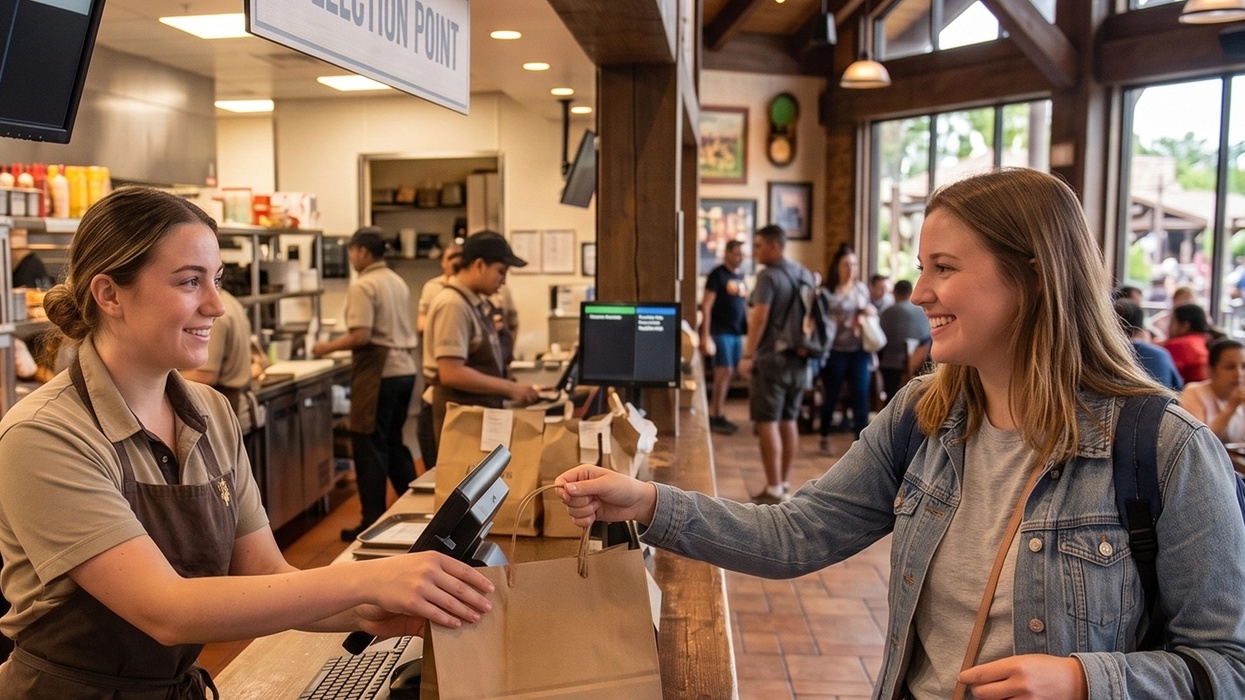
For nearly 60 years, SSA Group has been a staple in the cultural attractions sector, collaborating with zoos, aquariums, and museums to provide comprehensive guest services. As a family-owned business, the company has continually adapted, but its core mission remains centred on a simple, powerful concept: hospitality.
We speak with CEO Sean McNicholas and vice president of people and culture, Jason Stover, to unpack Scout's mission and learn how it can open the door to both greater efficiency and more memorable moments.
SSA reimagines the industry
Starting by looking at the bigger picture, McNicholas says: “What I love about SSA and our family business is our curiosity for continuing to reimagine the industry.
"Those are pillars of our plan. We approach 60 years as a family business in 2030, and what’s exciting to us is continuing to innovate, not just our business, but the guest experience for our clients and partners.”
Sean McNicholas and Jason Stover
This culture of curiosity is what prompted McNicholas and Stover to investigate the potential of artificial intelligence long before it became the industry buzzword it is today.
"Five or six years ago, Jason came to me as one of the early adopters of AI. We started talking about it, and the more we looked at tools like AI, we asked a very simple question: what one, two, or three areas could AI positively impact our business?"
For SSA, the goal was not to replace staff or remove the human element from the museum or zoo experience through automation. Instead, the emphasis was on liberation.
"The thing that became clear was how tools like AI could help us become more efficient with data, back-end systems, and administrative work," adds McNicholas.
"If we can be more efficient there, we can spend more time meeting guests where they need us, which is on the front line.”
The outcome of this exploration is Scout, an AI-assisted tool and ‘unified intelligence layer’ designed specifically for cultural attractions.
Scout is positioned not as a replacement for human workers, but as a co-pilot. It is an operating system that gathers data from across the industry to provide real-time insights. Unlike general-purpose AI tools, Scout has been built for the sector's operational realities.
"AI is trending now, but it’s not new," says Stover.
"I’ve been with SSA for almost 30 years, and my journey with AI in this company has existed since day one. When I first became a manager, we were already experimenting with predictive analytics, trying to forecast attendance and staffing.
"That was AI at the time."
However, the leap to generative AI offered a new opportunity to support SSA's secret sauce: its people.
Stover employs a cinematic analogy to describe Scout’s role within the workforce:
"I compare it to Tony Stark," he says. "He’s brilliant, but he doesn’t become Iron Man until he has Jarvis. That’s what Scout is. It’s a co-pilot that takes away routine, monotonous work so our people can focus on what matters."
Real-time, useful insights
Designed to support guest-journey walkthroughs, the platform collects real-time observations and converts them into actionable insights tailored to each attraction.
The tool was created in accordance with SSA’s core belief that technology should never replace connection; it should enhance it. The idea is that data and design can collaborate to create memorable guest experiences.
This supports SSA’s wider focus on innovation, which aims to turn curiosity into meaningful change that advances partners' missions. By automating data analysis, Scout helps operators make more informed decisions about designs, platforms, and revenue strategies.
"Guest expectations are evolving faster than ever," says Stover. "Scout was built to meet this moment as a tech-forward AI tool that allows us to keep experiences deeply personal.”
The heart of the system: 452 Hospitality
Although the technology is impressive, the engine driving Scout remains entirely human. At the centre of Scout’s design is 452 Hospitality, the cultural ethos that defines SSA Group’s purpose and character.
Named after 452 Leyden Street, the Denver home where SSA’s founders first lived and practised hospitality, 452 has since become both a numeric and philosophical code for what the company stands for: a spirit of welcome, belonging, and genuine human connection.
At 452 Leyden Street, anyone could come in for a meal, a chat, or a place to rest. And that sense of genuine warmth now lives on in every SSA service encounter.
Today, 452 Hospitality reflects SSA’s ongoing dedication to creating authentic, memorable moments that uplift guests, partners, and colleagues alike.
That same spirit guides Scout’s purpose: rather than replacing people, the AI system aims to enable staff to embody 452 Hospitality more fully, freeing them from administrative burdens so they can provide the personal engagement that makes guests feel welcome and valued.
In practice, this involves a particular method for engaging with guests and monitoring operations. Scout develops a digital framework for this using the SOQ model: Observation, Opinion, and Question.
"Scout is being trained by the entire zoo, aquarium, and cultural attraction industry," Stover says. "Every conversation, every audit, every partner insight gets ingested and shapes how Scout operates.”
Within the Scout ecosystem, there are various ‘agents’ dedicated to different tasks, such as labour optimisation and inventory management. However, the ‘452 agent’ is unique.
"It has vision and voice capabilities. As you walk through operations, it analyses images and observations in real time and evaluates them against our hospitality standards. It acts as a co-pilot for auditors and operators, making observations, offering insights, and matching them with best practices and solutions.
“You might miss something as a human, but Scout won’t.”
Scout in action
The deployment of Scout is already producing tangible outcomes, progressing from theoretical ideas to solving complex on-site issues. This highlights SSA’s focus on turning insights into action by combining data, technology, and human connection.
McNicholas emphasises that the team is "continually evolving Scout by testing it across multiple attractions," noting that "every new site adds more data and sharper insights.”
Stover offers an example of Scout’s operational intelligence in action from a working session with the Detroit Zoo. The team was exploring a complex “what-if” scenario: opening a new entrance near a new exhibit while navigating compliance considerations, budget constraints, and a nearby rail track.
“Using Scout as a sandbox alongside their team, we pressure-tested the constraints, surfaced relevant regulatory considerations, explored alternative approaches like repurposed shipping containers, and generated rough-order cost ranges. It was less about committing to a final plan and more about accelerating discovery.”
“What’s exciting is that every audit surfaces a new real-world question, and we ask: Should this become a new sub-agent? That’s how Scout keeps evolving.”
Another success story comes from the Dallas Zoo, where Scout was instrumental in helping the zoo team explore their own AI journey while SSA conducted an inter-department relationship audit.
Scout is tailored to each user’s psychology
What makes Scout different from typical business AI tools is its incorporation of behavioural psychology. Acknowledging that strong operations don't happen by accident, SSA has combined leadership development with its technological roadmap.
Stover, whose background is in people and culture, insisted that if they were to create co-pilots, they had to understand the humans who would use them. So, instead of providing generic recommendations, Scout adapts its guidance to each leader's thinking and communication style.
"One of the first things we decided was that if we were going to build AI co-pilots, they needed to integrate Behavioural Essentials," Stover says. "We already use behavioural assessments that give leaders a 21-point profile, with strengths, tendencies, and blind spots. We’ve now incorporated that into Scout.”
This means that when a manager logs into Scout, the system is tailored to their specific personality profile.
"It understands how I communicate, where I might need softer language, or where I might need more structure," Stover says.
He adds that McNicholas served as the ‘guinea pig’ for this feature:
"We merged his traits and blind spots into Scout as he was working through our future roadmap. Scout isn’t just an AI tool; it understands your psychological makeup and helps cover your blind spots as you operate in your role.”
The future of the workforce
A common concern about AI is the risk of job displacement. However, SSA’s leadership firmly states that their investment in technology aims to safeguard, not eliminate, their workforce.
"As CEO, culture is my responsibility, and culture starts with values," McNicholas says. "Hospitality, human-to-human interaction, has always been our foundation. I don’t want a world of all robots and automation. I love people too much.
“That’s why Scout exists. It helps us live what we love to do: creating special moments for people.”
Stover shares this view, considering AI as a safeguard against the decline of interpersonal skills observed in other industries:
"We have to be proactive in shaping the future. Many companies will use AI purely to impact the bottom line. That’s their choice. But SSA has always been people-focused. We’re adopting AI safely and intentionally to better our people. As interpersonal skills decline elsewhere, we’re protecting them by freeing people up to reconnect.”
The efficiency gains are clear. Stover notes that tasks like scheduling, which previously took hours to analyse against weather and sales history, now happen in seconds. "That frees managers up to spend time with their team. That’s the point.
“We’re hospitality people. We want to be in front of guests, not behind a screen.”
A vision for 2030
Looking ahead, SSA has set bold goals for the next five years. As the company approaches its 60th anniversary in 2030, the vision is for a fully enabled workforce where each employee has a digital partner.
"By 2030, every person in our company will have a co-pilot that helps them be more efficient," predicts McNicholas. "We’ll also bring a unified revenue strategy to attractions, something the industry lacks.”
He also believes the metrics of success are shifting. It is no longer enough to simply count heads at the gate:
"The future metrics won’t just be attendance. They’ll be revenue, guest experience, and fulfilment," he says.
"There’s more competition than ever, and we have to be the place where guests leave thinking, 'That felt right.' To do that, our people need tools like Scout so they can spend more time creating those moments.
“That’s how we reimagine the industry.”
The future of hospitality
Summing up the benefits, COO Travis Kight says:
"AI is the future of hospitality, but not in the way most imagine. We see AI as a co-pilot, not a replacement, designed to protect the human connection that defines our industry.
“Tools like Scout allow us to turn data into real-time insights, freeing our teams from repetitive tasks so they can focus on creating unforgettable guest experiences.
"As Sean mentioned, by 2030, our vision is for every team member to have a digital partner that amplifies their strengths, covers blind spots, and helps us deliver hospitality at a level the industry has never seen.
“AI isn’t about automation. It’s about empowerment.”
As SSA Group looks towards the attractions of tomorrow, its message is clear: the path to the future is built on data, but the goal remains human connection.
By anchoring Scout in 452 Hospitality's philosophy of creating meaningful, human-centred moments, SSA isn’t just adopting AI for efficiency. It’s enhancing its ability to deliver heartfelt experiences that define its brand and shape the future of the guest experience.
"That’s the foundation of Scout," Stover says. "If a tool doesn’t protect hospitality or make us better people-facing operators, it doesn’t get built.”