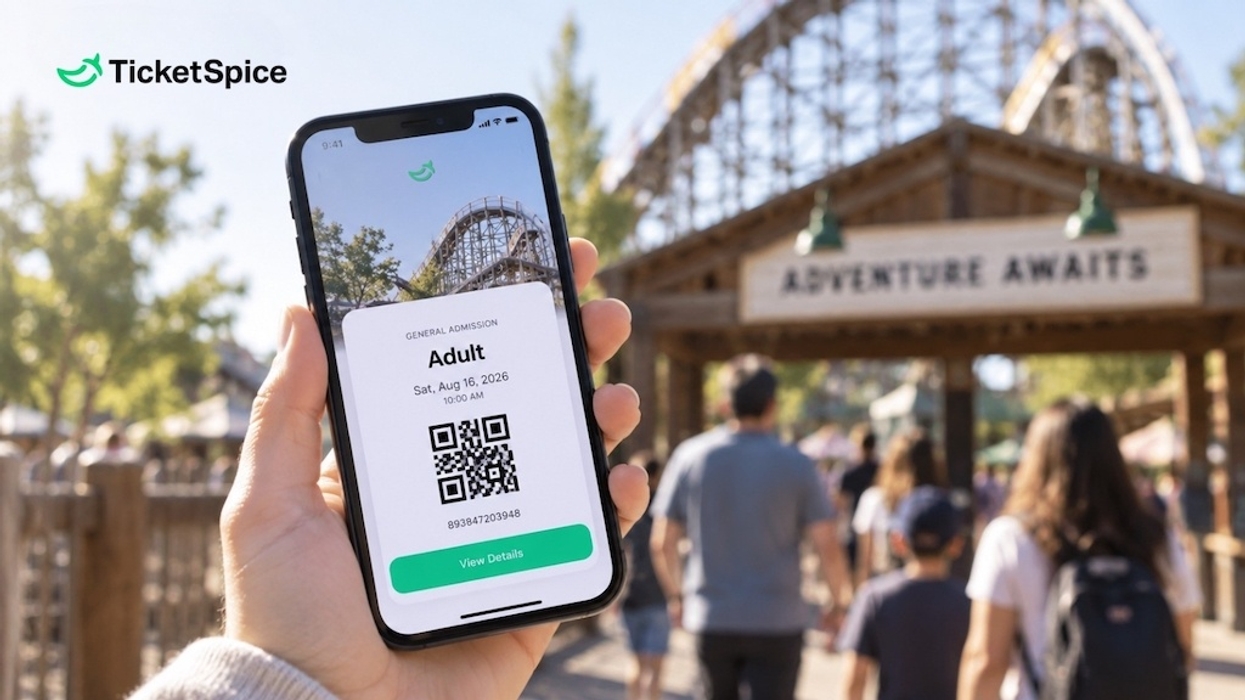

TicketSpice, an end-to-end online and on-site ticketing platform, has shared insights into what attraction marketers can learn from campaigns driving 18x return on ad spend (ROAS) and six-figure revenue.
Attraction marketing is increasingly focused on performance. Operators face rising pressure to identify which audiences are converting, which channels are effective, and where marketing investments translate into ticket sales.
That makes real campaign results especially valuable. Across recent attraction campaigns, TicketSpice has identified a few clear patterns emerging around audience targeting: timing, follow-up, and measurement.
As TicketSpice expands its marketing capabilities across email, drip campaigns, SMS and AI-assisted advertising, these patterns are becoming easier to identify and act on.
Audience targeting can significantly improve the effectiveness of paid campaigns. Paid advertising lets attractions reach potential guests outside their local area, and targeting specific audiences can improve campaign results.
Audience targeting
A motorsports venue tested four Facebook campaigns with varied interest, demographic targeting, lookalike audiences, geographic focus, and video creatives. The team spent around $4,200 on ads, resulting in nearly $64,000 in tracked ticket sales.
Each campaign achieved a ROAS ranging from 13x to 18.3x, with the top campaign targeting relevant interests and demographics within a four-hour radius of the venue.
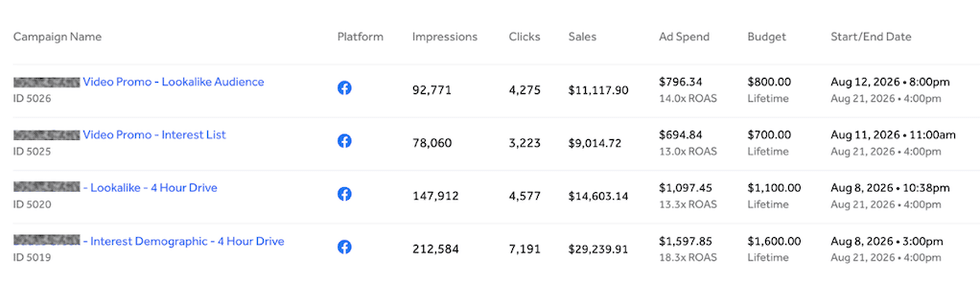 Ad campaign performance metrics summary
These findings offer valuable insights for attraction marketers: geography alone isn't enough for targeting. Even within the same driving distance, potential buyers can vary widely in their interests, previous behaviours, and familiarity with the attraction.
To understand this better, operators should test one significant variable at a time, such as comparing a lookalike audience of past buyers with an interest-based group, experimenting with different drive radii, or using the same messaging with varied creative assets.
Proper attribution then reveals which audience and creative mix directly led to ticket sales, offering more actionable insights than click counts alone.
Those results also demonstrate the value of TicketSpice’s new AI Ad Manager. It helps attraction teams build and launch ad campaigns faster, making it easier to test different audiences and creatives, compare performance, and allocate more budget to the campaigns that are actually driving ticket sales.
Focused email campaigns
Email remains a valuable channel for attractions because it reaches past buyers and those who have already shown interest. Recent results also highlight the value of compact campaigns built around the right moment.
For a seasonal attraction, TicketSpice worked with a customer on a two-email campaign promoting a fall experience. The campaign generated 6,494 attributed ticket sales and more than $138,000 in revenue, with a 2.44% email-attributed ticket conversion rate.
A different operator ran a three-email series to promote a bull riding experience, resulting in 986 ticket sales attributed to the campaign and $17,330 in revenue, with a 2.37% conversion rate.
Another four-email series drove 3,494 attributed ticket sales and $139,860 in revenue, achieving a 6.87% ticket conversion rate from email.
Throughout these campaigns, timing and relevance proved crucial. Seasonal attractions inherently have key decision points, such as opening weekends, limited dates, pricing adjustments, holiday seasons, and nearing capacity.
TicketSpice’s email drip campaigns can target these moments with planned follow-ups, keeping the attraction top of mind as guests' visit date approaches.
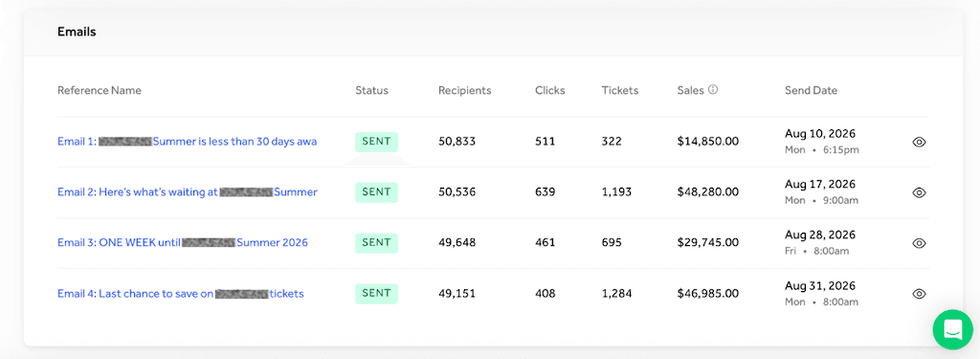 Email campaign results from a TicketSpice drip campaign
Performance metrics also help teams improve future campaigns by identifying which emails generated the most sales, how quickly recipients purchased, and whether buying activity increased as the visit date approached.
These insights can inform more effective sequences for upcoming seasons.
Connecting channels
Most guests go through multiple touchpoints before making a purchase. They might see a paid ad, visit the ticket page, leave to coordinate plans, and then return after receiving an email or text reminder.
This highlights the growing importance of the relationship between channels, notes TicketSpice.
Advertising helps reach new audiences, email nurtures interest and encourages previous guests to return, and SMS messages can generate immediate urgency for limited dates, weather updates, or when capacity is nearly full.
By integrating these tools into the ticket purchase process, TicketSpice gives attraction teams a better understanding of how each touchpoint affects revenue.
Additionally, TicketSpice’s customer marketing team collaborates directly with operators to translate these features into actionable campaigns, including enhancing audience targeting, planning communications, and evaluating results.
For attractions with shorter selling seasons, that visibility can help teams make stronger marketing decisions while they still have time to influence results.
What attraction marketers can take from the results
Across these campaigns, a few patterns stand out, according ot the TicketSpice team.
First, utilise existing customer data; past ticket buyers can inform the development of more effective email audiences, lookalike audiences, and future targeting strategies.
It's also important to segment the audience with purpose, considering factors such as geography, interests, demographics, or lookalike groups, as these can perform very differently, especially for attractions that draw visitors from a wider area.
Timing plays a crucial role, so build campaigns around key moments—like upcoming dates, limited availability, or opening weekends—using email drip campaigns and SMS to keep attractions relevant. Finally, measure efforts through to the ticket sale by tracking revenue, conversion rates, and ROAS to identify which campaigns genuinely contribute to business results.
Strong campaign data gives attraction teams a better foundation for the upcoming season. It helps enhance targeting, optimise timing, refine messaging, and identify where marketing spend can be most effective.
As TicketSpice expands its marketing toolkit, the aim is to help operators turn campaign results into more transparent, actionable decisions. For many attractions, the next growth opportunity may already lie in last season’s ticketing data.