
Imagine a theme park that predicts a crowd will gather outside a popular attraction. Five minutes later, the walkway is packed. The forecast was right. The guest experience was not.
Should the park suggest another route, change a nearby show's start time, or encourage guests toward a different experience? Each choice could ease the crowd while creating problems elsewhere. Software may foresee congestion without knowing which trade-off the park should accept.
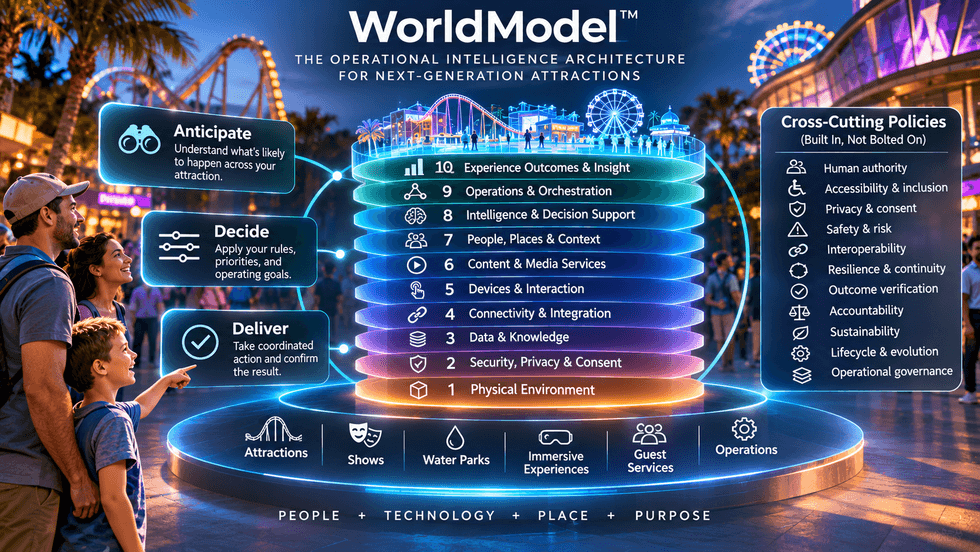 WorldModel’s layered framework for intelligent, guest-centered attraction operations
That choice belongs to the people who understand the attraction, its guests, and its operations.
Their goals must survive the move from a design brief into hardware, software, daily routines, and intelligent systems. This makes world models a design and governance question, not just a technical one.
The world beyond simulation
In his 8 November WIRED article, World Models Will Soon Be Inescapable. Here's What You Need to Know, Reece Rogers examines systems that learn from visual data to model physical places and predict how they change.
He discusses work by Niantic Spatial and Wayve, including simulations of risky driving conditions.
The attractions industry has good reason to follow this research. Predictive models could help teams study guest flow, test themed environments, and identify crowding before construction. They might also help designers explore how show schedules, routes, and guest choices affect one another.
These tools would inform expert judgment, not replace it. A simulation may show where guests are likely to move. It cannot, on its own, decide where a park ought to send them.
Opening day brings real people, competing needs, and operating conditions that no model can fully anticipate. Shows overlap, equipment becomes unavailable, and a route that looks efficient may be unsuitable for some guests.
A prediction matters only when weighed against the attraction's goals, responsibilities, and current conditions.
The guest experience is the system
Consider a family moving through a themed attraction. One child wants a more detailed story, another prefers a simpler explanation, and a parent wants content in a different language. Someone in the group needs captions. Nearby guests are already enjoying a shared presentation.
A screen can respond to touch. A sensor can detect movement. A media player can report that content is playing. None of these facts, alone, tells the venue how to serve the family without disrupting others.
The design challenge is to coordinate language, accessibility, story, shared media, and personal choice. A guest might receive synchronized content on a personal device or choose another interactive experience. The right option depends on what is happening and what the guest wants.
That cannot be left to a technology supplier after the attraction is designed. Creative teams define the story and emotional journey. Accessibility specialists identify meaningful alternatives. Operators know what can change during a show. Integrators and technology partners understand what their systems can deliver.
Their collaboration establishes the operating rules, not just the equipment list. A project built around isolated devices produces one kind of attraction. A project built around experiences, constraints, and intended outcomes can create something far more coherent.
A model of the operating world
This challenge has shaped our work at Mad Systems. As our technologies expanded from media delivery into personalized content, recognition, and accessibility services, connecting devices was no longer sufficient. We needed to represent the environment in which each action has meaning.
WorldModel is our patent-pending architecture for governed intelligent physical environments. It comprises ten layers and eleven cross-cutting policies that address operating context, authority, consent, safety, coordination, resilience, and accountability. The foundational research is described in my books on Hyper-personalization and the World Model.
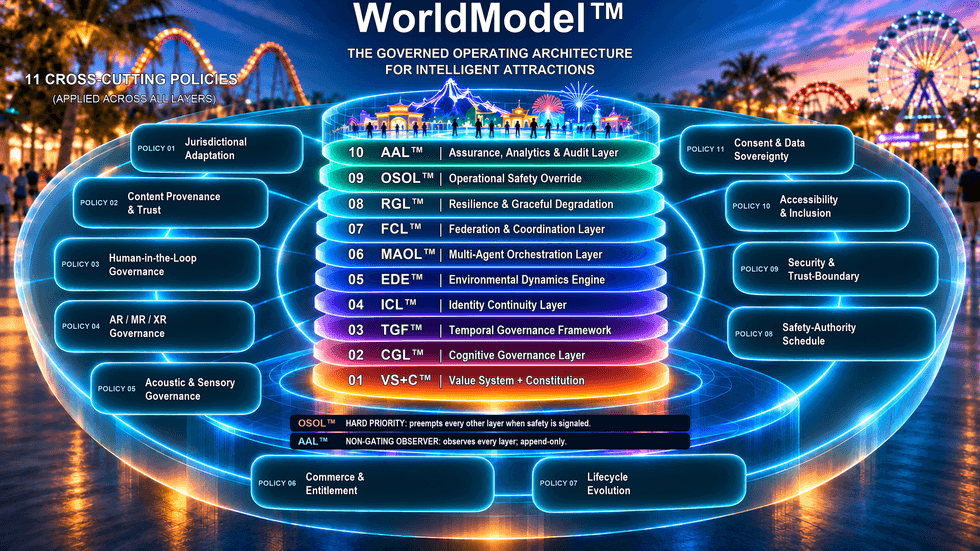 WorldModel: a layered governance framework for safe, intelligent attractions.
The architecture is intended to work with systems from different providers rather than require a single proprietary equipment platform. That distinction becomes especially important when intelligence extends beyond individual attractions to the wider park.
A theme park already operates through many specialized systems. Ticketing and admissions platforms manage entry. Reservation and queue management systems help organize demand. Building management systems monitor environmental conditions, while show control systems coordinate presentations and effects.
Guest services, wayfinding, accessibility technologies, and interactive experiences provide further capabilities and information.
Each may operate effectively within its own domain while having limited knowledge of what is happening elsewhere. An operational world model provides a framework through which relevant information and capabilities could contribute to a shared understanding of the venue.
That does not mean connecting everything indiscriminately or giving one intelligent system unrestricted control. Information sharing, permissions, security boundaries, and operational authority must remain explicit.
This differs from the predictive world models discussed by WIRED, though both approaches can work together. A predictive model might forecast congestion near an attraction. The operating architecture could evaluate that information alongside show schedules, available routes, reservation demand, guest needs, and staff responsibilities.
A convincing forecast does not give a model permission to act. That permission must come from rules established by the people responsible for the venue.
The intellectual property behind this work is also relevant. Mad Systems holds ten issued US patents and three granted foreign patents across specific technology families, including media delivery and recognition-related capabilities.
WorldModel and Mad Intelligence are separately identified as patent-pending work. Those issued patents should not be interpreted as granted protection for the entire WorldModel architecture.
The portfolio reflects years of engineering and development. It also provides a foundation for collaboration with specialists whose technologies and experience can contribute to the wider environment.
Permission is only the first test
Suppose an intelligent capability identifies what appears to be a fault in an interactive attraction and recommends stopping the experience. It may be correct, or it may be reacting to a faulty sensor. Should it stop the show, request an operator's approval, or continue monitoring?
The answer depends on risk, evidence, and the authority assigned to that capability. Changing content on a personal device is not the same as interrupting a shared show. Neither is equivalent to controlling ride systems or equipment that could affect physical safety.
These limits must be defined during the design phase. A creative director may protect an essential story sequence. An operator may specify when a show must stop. A safety specialist may require immediate action under specified conditions.
The architecture must respect those requirements before intelligent software is allowed to act.
Even a valid command does not guarantee success. A media player may acknowledge a request while the display remains dark. A wayfinding service may suggest a route that is temporarily closed. Audio may play without reaching its intended listener.
Mad Intelligence addresses the relationship among an intended result, the resources qualified to deliver it, and the evidence of what actually happened. A command, an equipment response, and a successful guest experience are not interchangeable.
Some outcomes can be verified through system feedback. Others, such as learning, enjoyment, or emotional engagement, require observation or human judgment. A dependable environment should recognize those differences rather than declare success simply because equipment responded.
Trust begins before personalization
The WIRED article also raises questions about the visual data used to develop predictive models. In attractions, cameras, sensors, personal devices, and interactive systems can provide valuable context. However, the ability to collect information does not mean a venue should retain it.
Guests should be able to choose a language without revealing their identity. Captions should not require tracking. Children should be able to enjoy suitable content without acquiring a permanent personal profile.
Anonymous, temporary, or explicitly selected preferences may provide sufficient information for many experiences. When continuity is useful, its scope and retention should align with the guest's permissions.
Privacy and accessibility belong in the first design conversation, not at the end. Creative teams understand the intended experience. Accessibility and privacy specialists establish safeguards. Operators define practical requirements, and technology partners implement those decisions.
The objective is not to know everything about every guest. It is to know enough to deliver a relevant experience while respecting their choices.
Built for the next twenty years
Theme parks and attractions often operate for decades, while their computing platforms, sensors, and software change repeatedly. Models improve, suppliers change, and replacement parts become difficult to obtain. A venue cannot rebuild its operating rules every time a new technology appears.
Owners should ask whether capabilities can be replaced, whether interfaces are documented, and whether essential experiences can continue through partial failures. They should also consider who can maintain the system after the original project team has moved on.
Those questions affect creative freedom. An adaptable architecture enables future designers and technology partners to introduce new experiences without compromising the venue's established goals and safeguards.
Working across manufacturers is more than a purchasing preference. It helps preserve the opportunity for collaboration throughout an attraction's life. A successful opening matters, but so does a dependable guest experience fifteen years later.
The same principles apply to museums, cultural destinations, visitor centers, and other public environments. Their stories and operating conditions differ, but their need for coordinated, maintainable technologies remains.
Who writes the rules?
Return to the crowded theme park walkway. The best response might be a different route, a revised showtime, or a notification to an operator. It might be no action at all.
The important advance would not be the speed of the decision. It would be the ability to evaluate possible responses against the park's creative goals, guest needs, operating conditions, and established authority.
That is where collaboration becomes essential. Creative designers, architects, owners, operators, integrators, accessibility specialists, and technology partners bring different knowledge to the same problem. Their combined expertise determines what an intelligent environment should accomplish and which actions are appropriate.
For us, this is one of the most important opportunities within WorldModel. We are developing an architecture designed to accommodate capabilities from different providers while respecting the responsibilities and boundaries of the systems involved.
We want to work with the people who design, build, own, and operate attractions, as well as the companies whose technologies already support these attractions. Their expertise is essential to defining how intelligent environments should function.
The goal is not to replace existing platforms or impose another proprietary system across the venue. It is to create a governed framework in which appropriate capabilities can contribute to a shared purpose.
Predictive world models can expand an attraction's understanding of its physical environment. An operational world model can provide the context needed to translate that knowledge into coordinated, authorized action.
The most important design choice may therefore be broader than deciding which intelligent model to install. It may be deciding how the many systems, specialists, and organizations responsible for an attraction can work together without surrendering their individual responsibilities.
A world model can help predict what happens next. Building an intelligent attraction requires all of us to decide what ought to happen, and how we will make it happen together.