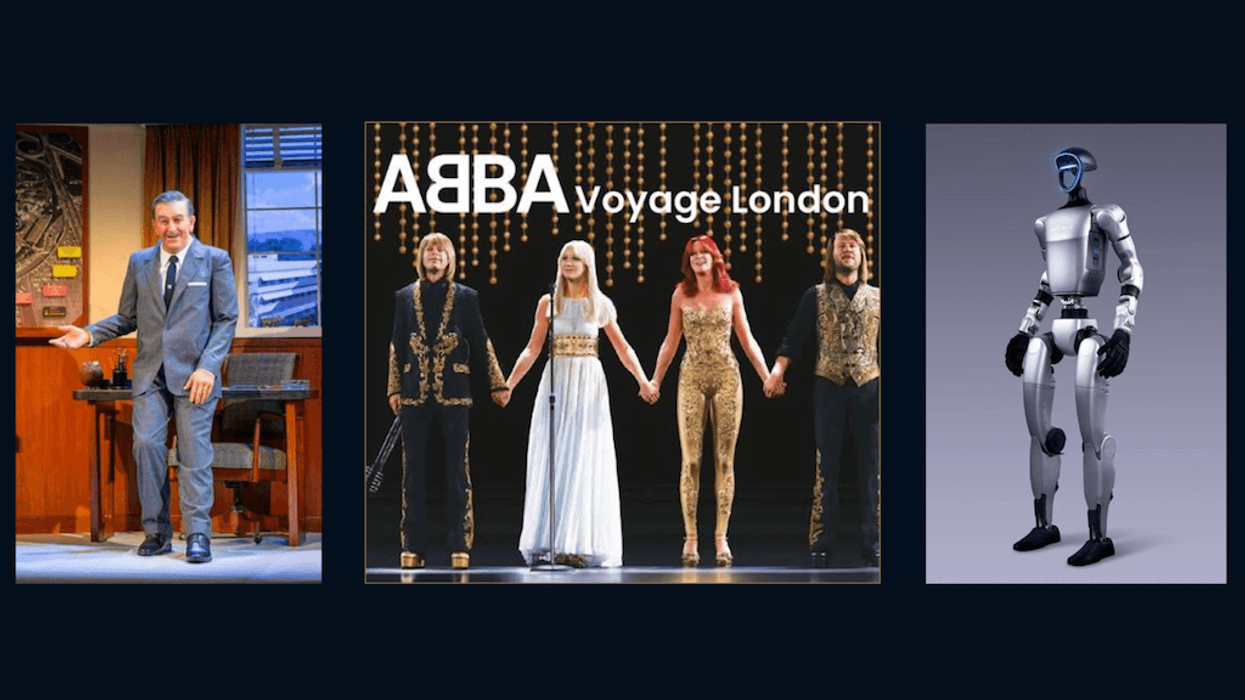
Something rather interesting is happening in our industry. Artificial intelligence now gives us characters that converse naturally and handle unexpected questions, and I expect the remaining worries about the uncanny valley to fade; it is principally a question of time.
But I believe these developments are part of a much larger change.
What happens when the intelligence is no longer confined to the character? What happens when an attraction can recognize a visitor, understand their interests, remember what they have experienced, and adapt? What happens when the characters, ride systems, audio, lighting, projection, and physical environment become parts of one coordinated experience?
And what happens when that environment responds not only to what someone says, but to how they say it?
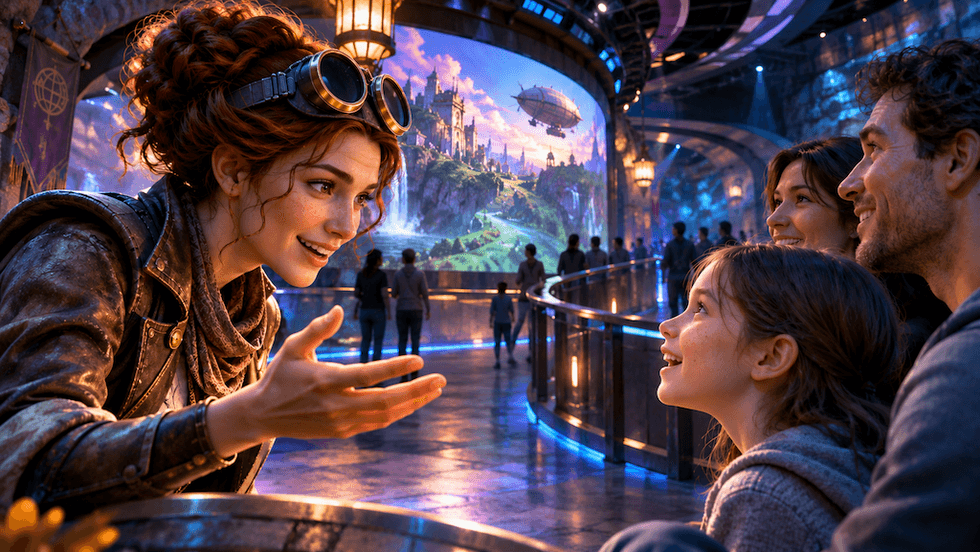 New advances i tech allow for more personalised experiences, responding to each visitor
These questions are about the architecture of the experiences we create, and what that architecture offers the people who design them. Much of this is not a forecast. For us it is largely daily work, and the rest is the next layer on an architecture that already exists.
The limitations of isolated intelligence
Consider a typical themed attraction. A visitor enters, meets a character, takes part in an interactive sequence, and moves on. At the next scene, the experience starts again. The next character knows nothing about the previous encounter. Even when conversational AI is introduced, it usually stays confined to one character, one scene, or one installation.
We have built a collection of intelligent islands, and there is no technical reason why that should continue.
Imagine instead that a visitor enters a themed environment and becomes part of an unfolding adventure. One character introduces the story and invites a choice. Later, another (or the same) character recognizes the consequences of that choice and carries the narrative forward.
The environment remembers the decisions that matter, adapts what follows, and keeps continuity from one location to the next. If the visitor returns another day, the story can continue, provided they have chosen to keep that continuity.
The same principle applies in museums, science centers, and visitor centers, where a visitor's interests and questions can shape what they meet next.
That is where this industry is heading, and recognition-driven continuity has been running in our clients' venues for years. The visitor is no longer dealing with a series of unrelated systems; they are in an environment that holds a coherent understanding of their experience.
Recognition is not the same as identification
How does an environment know that someone has moved from one experience to another? Traditionally, we have either not known, or maybe relied on identification. Visitors register, download an app, carry a card, or hand over personal details.
But personalization does not require identification. Knowing who someone is and recognizing that the same person is continuing an experience are two different things.
At Mad, we've supported that distinction through our CheshireCat technology. Recognition can use anonymous optical methods, RFID, NFC, QR codes, Bluetooth, or other sensing techniques, including something different we’re working on with Hatter (Beyond DSP).
A visitor can hold a temporary set of preferences and interactions without the system ever needing their name. For a designer, that means continuity can be written into the experience without asking visitors to sign up for anything.
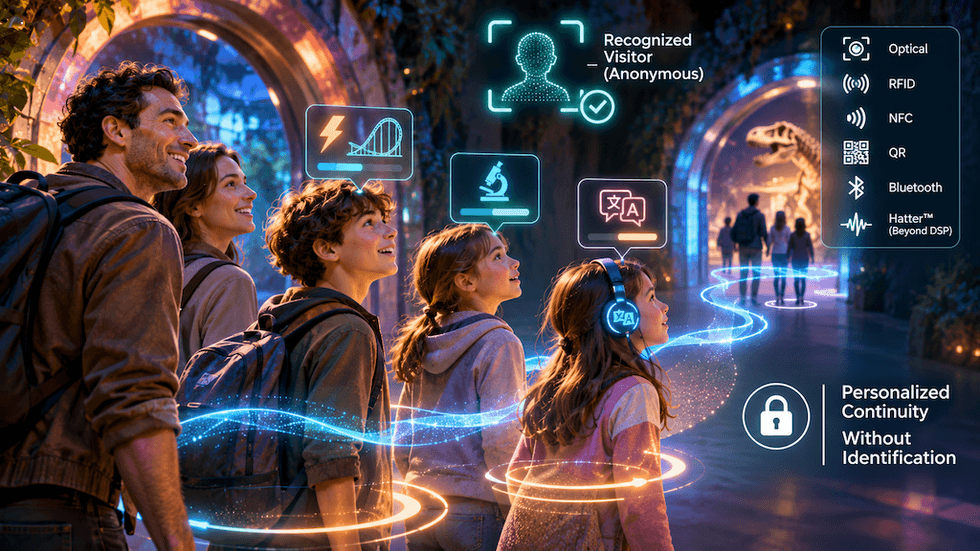 A family explores an interactive museum with anonymous, personalized digital experiences.
A family may visit together, but one member wants the thrill of the adventure, another is fascinated by the science behind it, and a third needs information in another language or format. The environment can serve all three without splitting the family up.
Recognition must operate within clear privacy boundaries. Anonymous continuity should stay anonymous, and persistent recognition should follow proper consent and retention policies.
But personal information need not be the price of personalization, and I believe privacy-conscious recognition will become one of the foundations of intelligent public environments.
Knowledge that belongs to the experience, not the character
Recognition is one part of the architecture. The next question is what the environment actually knows. A conversational AI can produce remarkably fluent answers, but fluency is not knowledge, and it doesn't guarantee accuracy.
A themed character must stay consistent with its story. A museum character must respect historical accuracy, scientific knowledge, and the institution's interpretive goals.
This is why we developed Alice.
Alice draws on a controlled Body of Knowledge, allowing a character to adapt its language to different ages, interests, languages, and levels of understanding. The same knowledge can speak through a life-size digital character, a conventional interactive, or, with Alice OnBoard, the visitor's own phone.
A Roman soldier should understand ancient Rome rather than suddenly discussing modern technology. A scientist in a science center can explain the same process in different ways to a ten-year-old, a teenager considering a career, and a professional engineer, all from one Body of Knowledge.
The character is no longer the repository of intelligence. It is one way intelligence communicates, and that distinction gives designers much greater creative freedom.
Personalization should include everyone
The consequence of this approach that I think matters most is also the one that gets the least attention. We have traditionally designed a primary experience and then built alternative routes into it for people with different needs.
One soundtrack, with translation or hearing assistance attached later. An interactive with a short list of languages. Separate experiences for visitors with visual impairments or different cognitive needs that never quite connect with the main presentation.
The environment can carry all of those at once.
Our Lory technology delivers personalized content in sync with a common presentation, whether a ride, a theater show, a film, or an interactive. Combined with Alice, it goes beyond translation, because the content itself can adapt.
Suppose one theater has visitors listening in English, French, German, Mandarin, and Spanish. Some use hearing aids. Others follow captions or sign-language interpretation, or read the same words on a Braille display. A younger visitor gets a simpler explanation while a specialist gets more detail, and everyone stays in step with the same experience.
The goal is to make the experience equally meaningful even when the delivery differs, so that accessibility becomes a property of the environment rather than an accommodation added afterward.
A different mentor, a different experience
I find one possibility particularly compelling: letting visitors choose who accompanies them. Why should a visitor be limited to a single narrator, or to characters tied to particular locations?
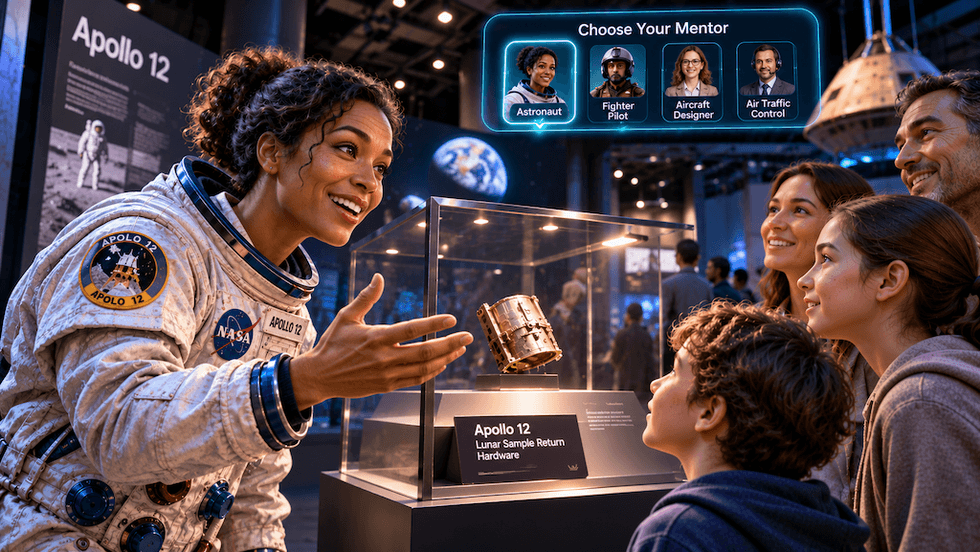 An astronaut guides a family through an Apollo 12 exhibit, inspiring curiosity about space exploration
Picture a visit to the Smithsonian National Air and Space Museum. On one visit, you choose an astronaut as your guide. As you explore the collection, your mentor talks about the experience of spaceflight, the challenges of living in orbit, and the engineering it takes to leave Earth.
On another visit, you choose a fighter pilot, and aircraft performance, maneuverability, aerodynamics, and the sensation of flight become the subject. The exhibits have not changed. The experience certainly has.
Historic Boston offers a second case. You could explore the road to the American Revolution with a Patriot, perhaps a character representing the perspective of Samuel Adams or Paul Revere. On another visit, you might choose a Loyalist, perhaps someone whose views reflect those of Thomas Hutchinson, the royal governor of Massachusetts.
The Patriot explains the growing resentment of British taxation and political control. The Loyalist speaks for established institutions, commercial ties, and allegiance to the Crown. Both can be grounded in carefully researched historical material, so visitors understand why people living through the same events reached such different conclusions.
A controlled Body of Knowledge is what makes this possible. Characters can voice historically appropriate views while staying within the documented material, and documented history stays distinct from interpretation and dramatization.
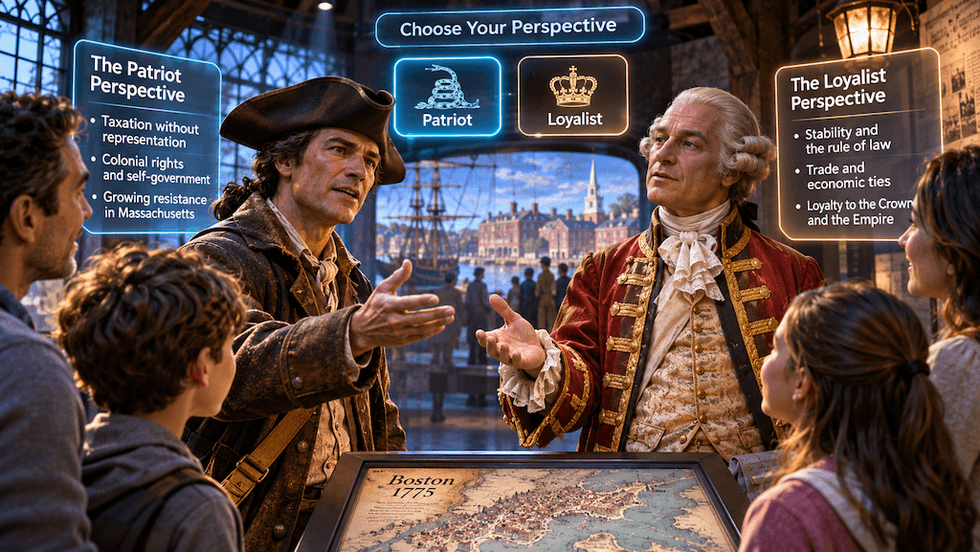 Visitors explore Patriot and Loyalist viewpoints on the American Revolution in colonial Boston
Nor should the mentor vanish when the visitor moves on. The character can travel through the venue with them, appearing on different displays or continuing on their own device, keeping context and referring back to earlier discoveries.
A returning visitor can pick a different mentor and discover a familiar collection all over again. The knowledge layer is authoring work, and it belongs to the curators and designers who own the story.
What remains is a creative decision, and it suggests a different way to think about repeat visitation. Instead of asking only what new attractions or exhibits we can add, we can ask how many different experiences an existing environment could support.
Understanding how we communicate
People do not communicate through words alone. How we speak, the rhythm of a conversation, and where we place emphasis all carry meaning.
A question asked with enthusiasm means something different from the same question asked with uncertainty, and a reply delivered with curiosity feels nothing like the same words delivered mechanically.
Prosody carries that meaning: the intonation, rhythm, stress, and timing that say more than the words. It can become part of a two-way interaction. Work now in development, and patent pending, addresses avatar recognition, emotion-responsive media delivery, and prosody in both directions of a conversation.
Given that, a character can interpret the words and also take account of how the question was asked. If the visitor seems uncertain, the character can offer a clearer explanation. If they are enthusiastic, it can go deeper into the story. Its own reply can carry the right intonation, emphasis, and expression.
The environment can join in: a subtle shift in sound or light at a moment of discovery, a coordinated visual and acoustic moment for a dramatic revelation.
None of this assumes we can reliably read someone's emotional state from a face or a voice. Instead of labeling visitors or pretending a machine knows how someone feels, the objective is to use the contextual and behavioral information available, within the same privacy boundaries described earlier, to make the interaction more natural and responsive.
We do not need to start over to add it; it is designed to integrate with the layers already described.
The environment becomes part of the conversation
Put a visitor in an immersive attraction where a powerful storm is approaching.
A character warns of the danger and explains what is happening. As the conversation develops, the projection around them changes. Clouds gather. The light shifts. Distant thunder rolls in. The visitor asks whether there is a way to escape the storm; the character answers, and the projection, sound, and lighting follow the answer.
The whole environment is taking part in the story.
Doing that requires an architecture in which AI can work with the audiovisual and physical systems around it. Our AV++ architecture extends conventional audiovisual technology with software-based intelligence, recognition, personalization, and control.
It began with QuickSilver, which moved audiovisual functionality onto standard computing hardware. QuickSilver handles media and interactivity, while TeaParty provides the deterministic show control that professional attractions depend on, so intelligent functions run alongside precisely timed sequences without disturbing them.
What began with QuickSilver has grown into one approach in which recognition, knowledge, media, interaction, accessibility, and physical control fit together; Hatter applies the same thinking to sound.
Before long, the same approach will take in ticketing, building management, and the other systems that still stand alone in most venues, whoever supplies them. The intent is fully integrated solutions: one architecture through which those systems work together, so that the visitor meets one coherent experience from arrival to departure.
The patented and patent-pending technologies behind AV++ came out of that work: the recognition and continuity described earlier rest on issued patents, and the responsive layer now in development is patent pending.
That is the foundation designers, producers, and integrators build on.
For an attraction designer, the opportunity here is room to design. For an owner, it must also mean an environment that stays dependable, maintainable, and adaptable long after opening. We have been designing, building, and supporting venue systems since 1998, and we have always treated those two requirements as inseparable.
Attractions, museums, and visitor centers expect installations to operate for twenty years or more, and standard, off-the-shelf hardware means they are not dependent on specialized equipment that goes out of production.
New developments in AI, sensing, and interaction can be added as they become practical, without compromising the experience the installation was built to deliver.
From instructions to outcomes
As we connect AI to physical systems, another issue becomes critical. A system that can generate an appropriate response is not necessarily a system that can deliver the intended result. There is a considerable difference between issuing a command and knowing that the command achieved its purpose.
A controller may tell a display to show an image, but that does not establish that the visitor can see it. An AI may decide that a particular effect would be appropriate, but that does not mean the equipment is available, that the action is authorized, or that it can be done safely.
These distinctions become essential when intelligence moves from a screen into the physical world.
Closing that gap is one of the reasons we have been developing WorldModel and Mad Intelligence.
WorldModel is designed to provide a framework for understanding the environment, maintaining context, knowing which capabilities are available, and applying the policies that govern their use.
Mad Intelligence is intended to extend this by connecting intended outcomes with qualified resources, authorized actions, and evidence of what actually happened.
That requires a clear distinction between what the system knows, what it believes, what it is authorized to do, and what it can verify, and it requires human authority at the right levels.
Some actions an intelligent environment should take automatically. Others should require approval. Some should stay entirely outside its authority. Control of an attraction or a venue stays with the people who run it.
Intelligence becomes a useful, predictable, and accountable part of the architecture that designers and operators rely on, which is what makes it reasonable to give an environment more initiative.
Where we go from here
We have long thought in terms of individual attractions and exhibits and the equipment needed to deliver them. There is nothing wrong with that approach, but it limits our thinking.
What if we begin instead with the visitor and the experience we want them to have, and ask what the environment should understand as someone moves through it, and what should happen when they come back?
Those questions lead to a different design process, one in which the experience develops across the whole environment and individual devices become the means of delivering it.
Our role in that process is not to take over the creative work. It is to give the people who own it considerably more to work with. Sometimes that means supplying the underlying technology. Sometimes it means working alongside a creative team throughout development.
Sometimes, when a client asks us to, it means taking responsibility for the complete experience.
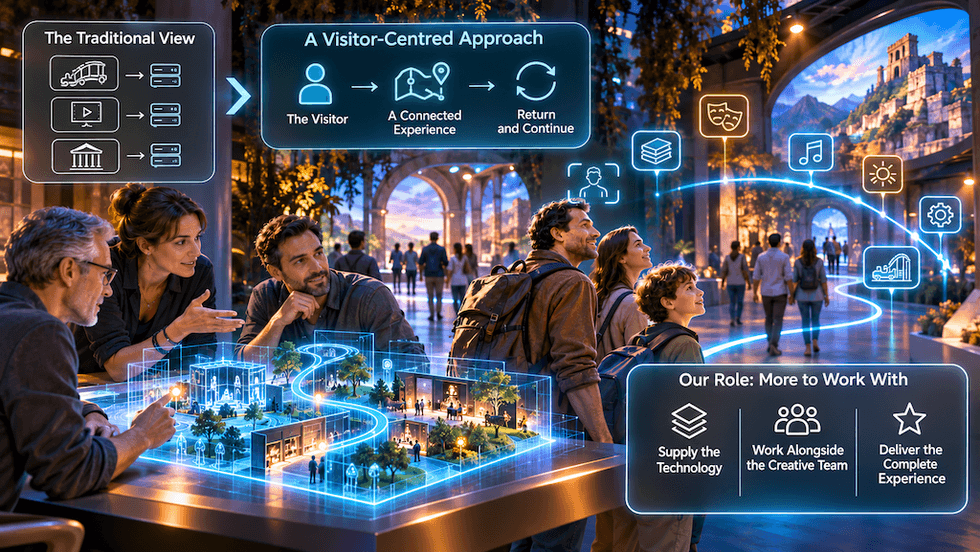 A visitor-centred approach connects people, technology, and place to create memorable experiences
Greater realism in digital characters, animatronics, and robotics is coming, and it will be welcome. But we have spent decades making characters and exhibits more sophisticated. Now is the opportunity to make the environments that contain them intelligent, and the foundations are already in place.
Mad Systems will be at IAAPA Expo in Orlando from 17 to 20 November 2026, with a meeting room at the TEA booth (#S805).
We would be delighted to meet designers, owners, and technology partners who are asking what their next generation of visitor experiences could become. Let's talk at IAAPA: set an appointment here.
Bring us your ideas, your ambitions, and the challenges that have seemed difficult to solve, and let's talk about how our technologies, combined with your creativity, can help create the extraordinary experiences of the twenty-first century.