
Connect&GO, a leading global provider of integrated technology and RFID solutions for the attractions industry, has identified four key ways operators can use a connected guest journey to win over visitors at every touchpoint.
The recommendations are drawn from the team's conversations at IAAPA Expo Europe 2026, where they heard similar accounts of guest experiences from multiple perspectives.
"It all boils down to how one panellist put it: people simply won’t tolerate a complicated guest journey anymore," the company says.
While the expectation of an amazing experience isn’t new, tolerance for falling short has shrunk. Guests arrive with standards set by every easy-to-use app on their phone and rapid one-tap checkout they’ve used that week.
Operators may see departments: admissions, food and beverage, retail, rides, guest services. Guests see a single day out, and they feel every point of friction at each handoff.
Reducing friction
While the capital budgets of the biggest destinations may be out of reach for many, Connect&GO says a visit that simply works is something operators of any size can build and improve to keep the fun centre stage.
It recommends considering four areas:
The parent wallet test
"Put yourself in your guest’s shoes. How many times does a parent have to reach for their wallet, phone or card: at the gate, at the locker, at the snack kiosk, topping up the arcade card, buying the ride photo, in the gift shop," says Connect&GO.
"Each moment is small. No single one ruins a day. But they can start to chip away at the value guests feel they’re getting from a family day out.
"The guests who leave happiest aren’t necessarily the ones who never hit a snag; they’re the ones who stopped noticing the transactional layer of the day altogether."
Connectivity, the company adds, is now expected. This is where attractions operators are leaning on cashless and RFID technology; for example, a single wristband that can handle entry, food and drink, lockers, arcade games, and retail.
This doesn’t remove every friction point in a park, but it does address those connected to spending. Families stop juggling cards and cash and can stay in the moment, while the operator turns every tap into a data point on who’s spending what, where, and when.
The technology also delivers a psychological benefit. When spending doesn’t mean digging out a card each time, it feels less like a series of charges and more like part of the day.
You can’t prepare for a day you can’t see coming
Smooth in-park operations depend on having the right people, stock and capacity in place on the day. That depends on knowing, with some confidence, how many guests are actually coming.
That’s getting harder, the company says.
"Operators at IAAPA Expo Europe described seasons shaped by extreme heat and washed-out weekends, clashing events, a wave of new attractions and shifting visiting patterns as more families swap long-haul holidays for short regional breaks. Last year’s numbers are a less reliable guide than they used to be."
Getting the forecast wrong is costly in both directions. Overstaff and overstock, and margin evaporates. Plan for too few guests, and each of these identified friction points gets worse at once, resulting in longer queues, stretched teams, sold-out outlets and a day guests remember for the wrong reasons.
Attendance prediction tools combine historical visitation with live demand and external signals to give operators a defensible view of a given day, far enough ahead to act on it.
This season, Connect&GO's attendance predictor has landed close to actual attendance across partner parks, and operators using it are making staffing and purchasing decisions with far more confidence.
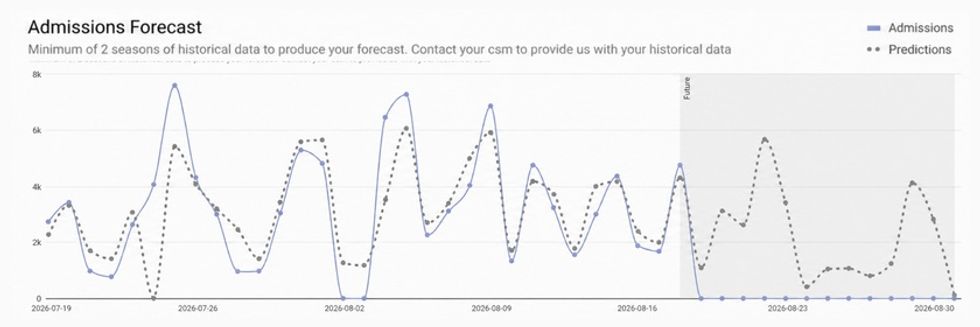 96% forecast accuracy for one park, 2 days out - 6,900 predicted, 7,200 actual. Included for all Connect&GO operators at no extra cost
Over-index on convenience
Some of the most avoidable queues in a park aren’t for rides. They’re for transactions like topping up a balance, collecting a pass, or arranging an add-on. Each one ties up a staff member and puts a line directly in front of a revenue opportunity.
With self-service, guests can use reload kiosks to top up their wristband balance in under 30 seconds. Spend keeps flowing instead of stalling, and abandoned top-ups become far less common.
"The more you can move before arrival, the better. Tickets, add-ons, and wallet balances loaded online before the visit mean fewer decisions and shorter queues once guests are through the gate," says the company.
"Just as importantly, it changes how your team spends its time. Guests still want human contact; it’s often the part of the day they remember most.
"Take care of the admin with tech, then double down on staff training around guest interaction - this was one of the most-mentioned priorities during the IAAPA sessions we attended."
Beyond line management to demand management
Most parks know the pattern: a packed Saturday with long waits and stretched teams, followed by a quiet Tuesday with rides running half-empty. Both are problems. The busy day delivers a worse experience to the most guests; the quiet one leaves capacity and revenue on the table.
Dynamic pricing built on a reliable attendance forecast is one of the most effective ways to flatten that curve. By adjusting prices to expected demand, operators give price-conscious guests a genuine reason to choose a weekday and draw some demand away from the weekend peak.
"It’s usually discussed as a revenue tool, and it is. But it’s just as much a guest experience tool," Connect&GO explains.
"Every family that shifts from Saturday to Tuesday enjoys a calmer day with shorter queues, and leaves the Saturday crowd a little more breathing room too. Staffing becomes more predictable, facilities are used more evenly across the week, and the visit improves for everyone.
"The key is trust. Guests need to see transparency and feel that pricing rewards flexibility rather than penalising commitment, and operators need guardrails - floor and ceiling prices, and the ability to override at any time, so the system works within their strategy rather than around it."
Delighting visitors
All four of these tactics contribute to a connected system that can predict demand, shape it, and remove friction for everyone who walks through the gate each day. Every step toward a more connected guest journey is a step toward the kind of day visitors talk about, post about, and come back for.
"You can’t always out-spend the biggest parks," Connect&GO says. "But with a connected guest journey, you can deliver an equally memorable and delightful experience."
Earlier this year, Connect&GO outlined four operational strategies attractions can use to increase revenue: dynamic pricing, reduced cart abandonment, season pass management, and self-serve RFID wristband top-ups.