
Every year, hundreds of millions of families will pack their bags and take a holiday trip to a theme park. For many, this is a once-in-a-lifetime vacation that involves months of saving and traveling across the world.
For theme park owners, that means there’s a lot of pressure to deliver on some very high customer expectations. Popular attractions like dark rides have to become visually stunning experiences that leave riders so impressed they spread the word to others, both online and offline.
As parks like Universal Epic Universe — the first major US theme park to be built in more than twenty years — set the bar for dark rides to new heights, how exactly do you deliver the impressive attractions fans expect?
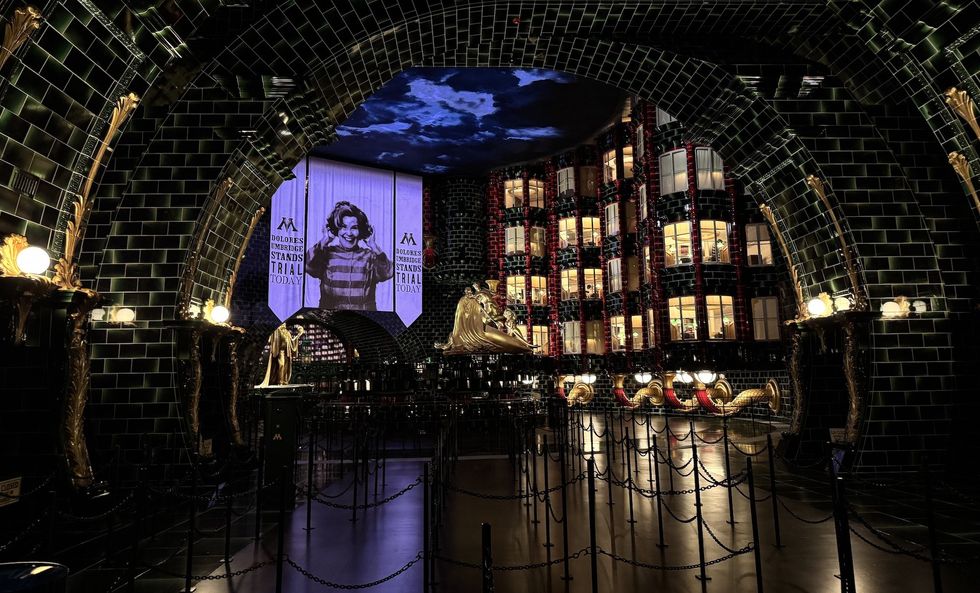 Harry Potter and the Battle at the Ministry, Universal Epic Universe
Below are my top three ways to get started.
1. Get creative with real-time content
For decades, dark rides have relied on displaying pre-rendered video content. Using real-time content wasn’t an option, as pixel counts and file sizes were just way too high to render in real time, and graphics leaned too heavily toward a gamified aesthetic.
What park owners may not realise, however, is that this is now changing.
Media workflows are now established enough to handle the distributed rendering capabilities required for real-time content engines like Unreal Engine, which can also produce increasingly photorealistic video content.
Leveraging real-time content engines for dark rides offers several advantages. Major changes to pre-rendered video content often require the entire video clip to be rerendered and transcoded, which is costly in both time and money.
Real-time content, however, is rendered live, so any changes can be made immediately. This enables content teams to iterate during the development cycle and quickly and easily evolve the ride experience over time, opening up new creative possibilities.
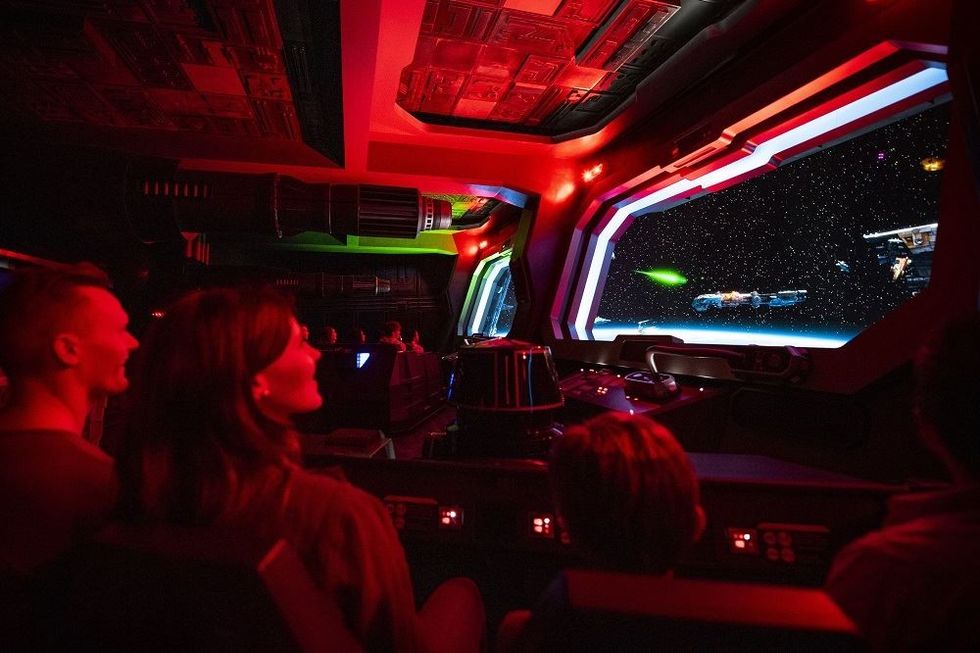 Star Wars: Rise of the Resistance
Real-time content engines also enable new interactive techniques to be explored within a dark ride experience.
For example, using LiDAR sensors or motion-capture technology allows for audience movements to be tracked and translated into the instant movement of an animatronic or LED character.
This means visitors can change part of the dark ride’s storyline by how they move and interact with the experience, helping them feel like an active participant more than ever before. It also enables theme park owners to develop ‘choose your own adventure’ style attractions that give different riders unique experiences.
The opportunities for immersive storytelling when working with reactive and real-time content are huge.
2. Map your visuals onto complex geometries
Another way to elevate your dark ride experience is to projection-map visuals onto even the most complex geometries. New, innovative features, such as the Skinned Mesh workflow in Disguise’s Designer software, are allowing theme park owners to do just this.
Dark ride designers can now project intricate visuals onto moving surfaces or unusual textures, such as fabrics, by attaching tracking markers to points on the material’s surface. That tracked data acts as a digital skeleton that can then be used to mimic the motion of a digital 3D fabric.
As the skeleton moves, the mesh responds, reflecting the fabric's natural motion. This allows for more realistic, intricate projections on moving surfaces, unlocking many cool effects you can add to your dark ride.
For example, you might have an animatronic character in a dress and want to project a new design or colours onto its surface as it moves.
Having the freedom to project onto fabrics and other materials with pixel-perfect accuracy will allow your character to tell a new story with what they wear, or even change into another outfit entirely, without disrupting the experience with a physical costume change.
3. Prepare for anything
My third top tip for elevating a dark ride is to previsualise the experience so that you can test it and ensure every visual looks as impressive as possible.
The previsualisation feature in Disguise’s Designer software enables teams to see what their dark ride content looks like in a 3D space, so they can experience what it would be like for a customer to be in the attraction without having to physically test it thousands of times, allowing them to be fully confident in the ride’s creative approach before bringing it to life.
It’s also important to build redundancy into your tech stack: in a high-stakes environment, downtime is not an option, and dark rides need to reliably work from morning to night.
Factoring in full redundancy within your media server setup - so that if one machine goes down, another automatically takes over - is crucial
While fail-safe monitoring might not be as flashy as complex projection mapping or interactive real-time content, it’s an essential part of elevating the guest experience.
If a signature ride goes down, it can lead to frustrated visitors and refund requests; so robust safety nets are crucial to prevent those failures before they impact your bottom line.