
Fotoware, a Norwegian software company that sells Digital Asset Management (DAM) solutions to organisations worldwide, has announced the launch of Content Authenticity, a new capability that gives organisations complete end-to-end support for the C2PA standard within their DAM platforms.
With Content Authenticity, institutions can record and offer cryptographic evidence of an image or video’s provenance, from capture to publication.
Cultural heritage institutions work with tangible items: actual artworks, objects, historical artefacts, and their associated stories.
A collection's trustworthiness depends on the premise that what the public views is genuinely what the institution possesses. Whether it’s digitised paintings or conservation records, each file implicitly asserts accuracy, which visitors, researchers, other institutions, and the media need to rely on.
The claim now requires supporting evidence. When an image of an object can be generated convincingly in seconds, relying solely on a credit line and an institutional logo is insufficient as proof.
What remains reliable is a verifiable record of the file itself: details about the device or scanner used, any modifications made, the responsible person, and whether an AI model was involved at any stage.
What Content Authenticity does in the DAM
Content authenticity involves verifying the origin and history of a digital asset like a photo or video. In Fotoware, this feature lets the system capture and maintain provenance data from ingestion through the entire lifecycle, whether the asset comes from a digitisation studio, a loaned photographer, a donor, or a partner organisation.
In addition to supporting the C2PA standard and preserving data, Fotoware's new capability lets users inspect content credentials in detail and view the complete, verifiable history of each asset.
Built-in search and filter capabilities also make it easy to exclude files with invalid credentials, files manipulated by AI, files that do not originate from an actual camera, and more.
"The goal is for provenance to stop being a feature that one has to actively think about. It should be maintained by default, so that compliance happens because authenticity is handled by the system and not because someone remembered to check," says Janniche Moe, chief product officer, Fotoware.
"Content Authenticity is the first release toward that, and it won't be the last."
C2PA attaches a cryptographically signed record to files, adding signed steps each time a capture, edit, crop, or export occurs. This creates a verifiable history, making digital provenance traceable.
However, all systems in the workflow must support the standard. If any system strips or ignores credentials, the chain breaks, and it becomes impossible to distinguish a faithful reproduction from a modified one. The file may be genuine, but it can no longer prove it.
"In the years to come, we expect provenance tracking to increase in importance," says Radmila Stoltz, chief commercial officer, Fotoware.
"At one point, every content owner is going to expect that the systems they use keep the provenance chain intact. We've built this now, so that organizations can take such actions immediately, instead of waiting until they're the last ones to adapt."
This record must be routinely created and maintained, not assembled afterward when doubts arise. Regulations, like the EU AI Act, now require marking AI-generated or modified content. For institutions relying on accurate publications, provenance documentation is essential, and systems must support this process.
What makes Content Authenticity in Fotoware different
The Content Authenticity feature in Fotoware, also called glass-to-glass C2PA support, maintains the provenance chain from photo capture with a C2PA-compliant camera to its display on digital channels, collections, loan agreements, or exhibition screens. As the digital asset hub, the DAM must ensure all actions comply with the standard to protect provenance data.
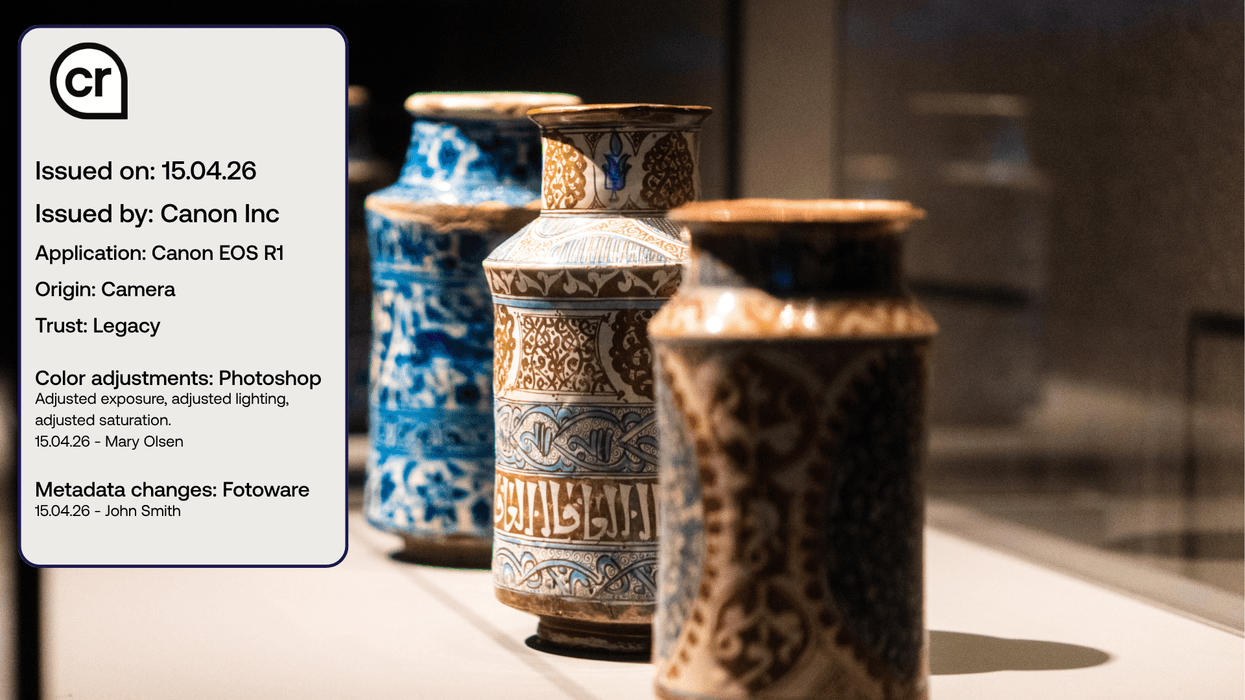
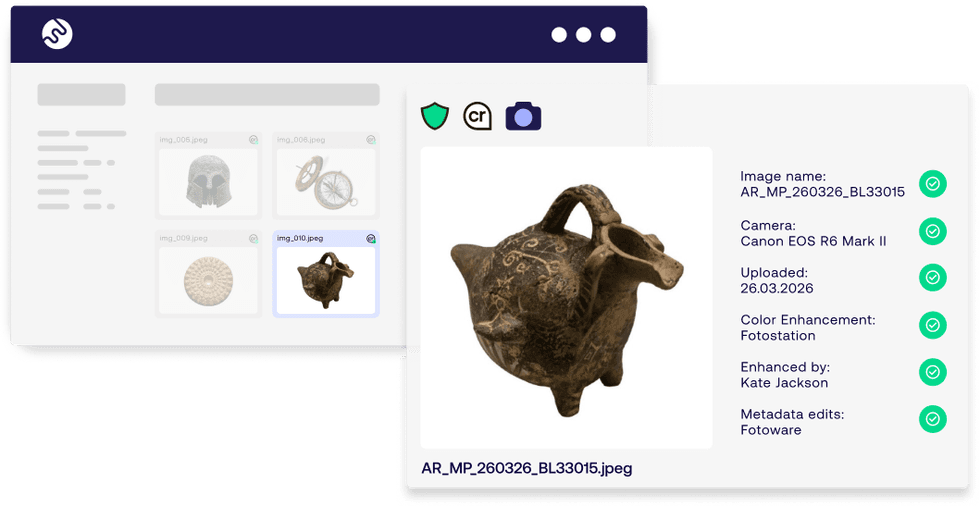 Content Authenticity enables users to verify the origin and history of a digital asset like a photo or video
With Content Authenticity, every edit, crop, or metadata change is logged in the file's history and accessible in inspection tools. Edits from third-party systems are signed and traced, ensuring a complete provenance chain.
Proof travels with the asset, even when it leaves the DAM for publication, partners, or aggregators.
"We built this together with the people who'll work with it, which is what we've always done. Speaking to real content creators, we've witnessed first-hand where provenance breaks and where compliance can compromise speed. Most of what we ship now comes from watching real workflows," adds Moe.
At first glance, supporting C2PA might just involve preserving provenance data. If that's the only function, institutions would have to use external verification tools to verify provenance. However, in Fotoware, the Content Authenticity feature lets users run detailed provenance checks directly in the system.
For instance, when an image results from combining three different images, the built-in inspection tool displays each source along with its provenance data. This is especially important for cultural heritage, where composites, restorations, and enhanced reproductions are common and legitimate practices.
The goal isn't to imply AI was never used, but to accurately describe what was done. The system not only indicates if AI is involved but also explains how and to what extent it has been used.
Integrating a verification tool into the system benefits institutions focused on efficient workflows and strong internal controls. It lets all users, from digitisation staff to curators and communications officers, verify provenance easily, without extra steps. This seamless process maintains speed and reduces the chances of human error or oversight.
"We've made content verification something everyone in the organization can use, not a specialist task," says Stoltz.
"If a communications lead can see at a glance whether AI was involved before a picture goes anywhere near publication, that's a risk removed from the business. The capability is a result of close collaboration with Canon and Reuters, with the aim of solving real-life challenges."
Fotoware considers IPTC, XMP, and C2PA the true industry standards and supports all their metadata. Though highly customisable, following established data standards is vital for DAMs to deliver lasting value and keep collection data readable long-term.
Fotoware, with extensive experience working with archives, museums, and large institutions, upholds and values industry-created standards. Coupled with SFTP delivery, supporting these standards ensures proof accompanies the asset throughout its lifecycle.
"The record is readable by any C2PA-compliant tool, because it follows the open standard rather than a format of our own. Our customers' proof belongs to them, not to us," says Moe.
Fotoware is a Norwegian software company with over 30 years of experience in Digital Asset Management (DAM) and Content Operations platforms. It develops solutions in partnership with customers, addressing their specific problems rather than following a set roadmap.
Over 850 organisations, including museums, archives, law enforcement, defence, media, entertainment, and large corporations, depend on Fotoware for fast content workflows and reliable content compliance. Headquartered in Oslo, Fotoware has a strong European presence and a global network of clients and partners.