And to be fair, story is powerful. It organizes chaos. It gives emotion direction. It lets us rehearse courage, grief, and triumph in controlled environments. Some of the most extraordinary location-based experiences in the world are deeply narrative, and all the better for it.
But somewhere in the translation from “powerful tool” to “design doctrine,” something subtle happened. Story stopped being one way to create meaning and became treated as the way, as if depth requires plot, as if impact requires exposition, as if without a backstory we are merely decorating space.
 OASIS Immersion's immersive wellness experience in Paris
Somewhere along the way, we mistook the map for the terrain.
Because meaning does not require narrative progression. It does not require three acts, character arcs, or downloadable lore. What it requires—what it has always required—is change.
A shift in perception.
A shift in emotion.
A shift in physiology.
A shift in relational presence.
Meaning requires state change. Story is one way to produce that shift, but it is not the default engine for it.
The real question is not whether an experience tells a story. It’s whether the experience moves you.
Once we recognize that, entire categories of experiential design snap into sharper focus. They are not story-poor. They’re state-rich.
Once you start looking for the shift
If you’ve been following my articles through multisensory wellness and play, you’ve already seen it: meaning doesn’t wait for exposition. In both domains, story can add flavor, but it is rarely the source of the charge.
Consider wellness. What character arc does a sound bath require? None.
It doesn’t ask you to follow a storyline. It asks you to follow your breath. To soften your edges. To let your nervous system unclench.
The impact doesn’t begin with interpretation; it begins in the body. You leave lighter, slower, clearer. Not because you decoded a narrative, but because something in you recalibrated.
This is the territory Sara Auster has spent years mapping. An internationally recognized sound artist and composer whose work moves comfortably between concert halls, museums, and meditation spaces, she understands vibration not as ornament but as infrastructure.
 Sara Auster running a sound bath inside a James Turrell installation
As she puts it:
“Sound has a direct line to the body and nervous system, shaping how we feel and perceive before the mind has a chance to narrate. In sound baths and immersive experiences, this allows for a profound shift in state, even without any story at all.”
Exactly. No plot twist required. The nervous system has already turned the page.
Take play.
What story is Pong telling? Exactly.
Two paddles. One dot. A scoreboard. That was the entire premise. Nolan Bushnell, who gave us Atari and a generation of joystick-induced euphoria, wasn’t chasing myth. He was chasing engagement.
And yet the meaning arrived anyway, not through character development but through tension, mastery, and the small electric surge of getting it right at the exact right moment.
“We weren’t trying to tell a story,” explains Bushnell. “We were trying to make something people couldn’t stop playing.”
No plot. Massive shift.
Wellness. Play.
Different domains. Same truth. When something shifts—pulse, posture, perception, proximity—meaning follows. Story can catalyze that shift, but it isn’t what makes the shift possible.
Perception is the plot
Experiential art makes this principle almost embarrassingly clear.
Take James Turrell. You enter one of his light environments, and nothing “happens” in the narrative sense. No characters emerge. No conflict unfolds. There is no beginning, middle, or end, only precisely calibrated light that destabilizes space and blurs depth until the room itself feels uncertain.
And yet something unmistakable occurs. Your eyes strain. Your balance adjusts. Space seems to inhale and exhale. You stop looking at the room and begin questioning how you see at all.
No plot. Massive shift.
Step into one of Yayoi Kusama’s Infinity Mirror Rooms and the pattern repeats. There is no storyline, no exposition, no moral resolution—just mirrored repetition and fields of LED light extending beyond visible limits.
 Infinity Rooms Image credit Tate Modern/Yayoi Kusama
Visitors don’t exit debating the narrative arc. They exit altered, suspended between awe and vertigo, intimacy and infinitude. The environment doesn’t describe infinity. It induces it.
Then there is Marina Abramović.
For 736 hours at MoMA, she sat in silence across from strangers. No script. No spectacle. No dramatic reveal. And people wept—not because a story unfolded, but because something shifted in the charged stillness between two human beings. Time elongated. Attention intensified. Meaning wasn’t narrated. It was generated.
Abramović has often explained the paradox of work like this in disarmingly simple terms: “People don’t understand that the hardest thing is actually doing something that is close to nothing.”
Strip away the objects, the narrative scaffolding, the choreography of events, and what remains is presence—raw, unbuffered, and strangely powerful. In that near-nothingness, attention sharpens until the smallest shifts in perception begin to feel enormous.
Across these works, the common denominator is not plot but recalibration. Experiential art of this kind doesn’t hand you a narrative. It adjusts perception and allows meaning to arise from the shift.
This isn’t art theory. It’s a reminder.
When nothing “happens” and everything changes, you begin to see what was doing the work all along.
So what does this mean for the field?
If this is true, if meaning is driven by state change more than narrative progression, then a few sacred cows start to look a little nervous.
For years, location-based experiential and themed entertainment companies have defaulted to story as the primary engine. Build the lore. Deepen the backstory. Expand the universe.
But what if the vastness that matters most isn’t the grandeur of the universe we construct, but the expansion it provokes within?
And here's where the thinking gets sharper and where the dichotomy between "story" and "state change" starts to dissolve entirely.
Writer, poet, conceptual artist, experience design theorist, and Odyssey Works co-founder Abraham Burickson offers a helpful correction. He argues that my fatigue with "story" is actually a fatigue with "story as a thing"—lore, myth-building, and writer-centric scripts.
To Burickson, story isn’t a string of plot points. It’s the arc of subjective state changes unfolding within a person.
He pointed this out to me, quite literally, while we were playing a game of arena-scale Pong at Moment Factory. There we were, two grown men chasing a digital square across a massive floor, and his point was impossible to miss: the "story" wasn't some hidden backstory about the paddles.
The story was the sequence of physiological state changes—the tension, the near-miss, the triumph—unfolding in real time.
"The reason narrative arcs can be effective," Burickson says, "is because they map against the movement of inner states. What is the inner experience of crossing the threshold? Of being in the belly of the beast?
"We need to understand them this way, or we risk applying formulaic slop to everything. If I play a game of pong with you, it needs no story per se because it is a moment in the story of my relationship with you."
Burickson’s point is simple: story isn’t something you add to an experience. It’s what naturally forms as people move through it. The real choice isn’t whether guests will find a story (they will) but whether you help them navigate their own arc or bury them under yours.
Once you see story this way—the audience's lived arc of inner change rather than a writer-made object—the implications become practical, not poetic. We stop asking "What story are we telling?" and start asking "What is actually changing inside the person having the experience?"
What is being shaped?
That leads us somewhere simpler and harder at the same time: understanding what is being shaped to produce that state shift.
Experience strategist, educator, and School of Experience Design founder Pigalle Tavakkoli approaches that question from a kindred perspective. She suggests that much of our confusion comes from collapsing two different things into one: story and narrative.
“Often designers focus their attention on developing a story with characters, plot, and action,” she explains. “But it is not the story itself that audiences connect with and remember long after it has taken place.”
What audiences carry with them is the underlying meaning: the why beneath the events.
Tavakkoli describes this as narrative: the connective thread that gives moments emotional gravity and allows an experience to resonate with a person’s memories, values, and aspirations.
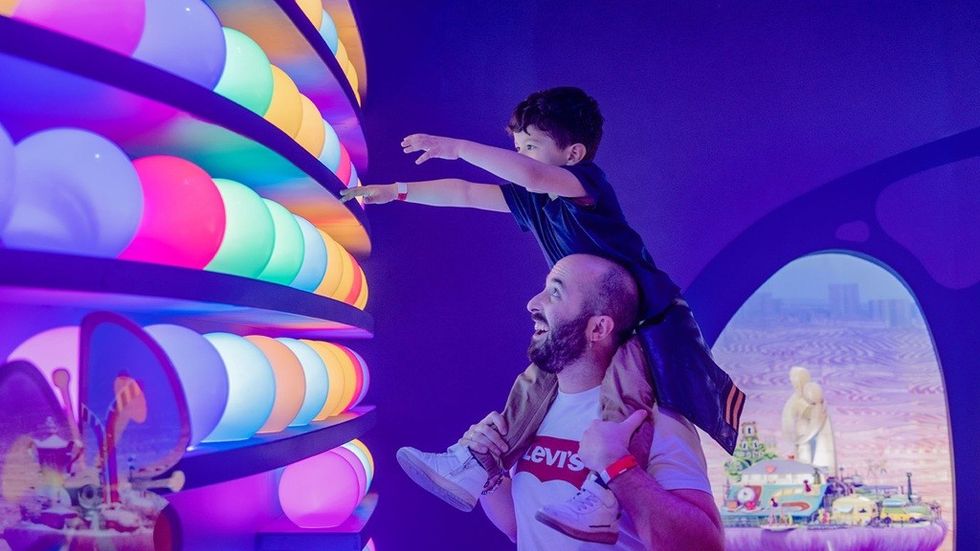
 Mundo Pixar immersive exhibition
“The story, characters, plot, and action then become tools that we select and arrange in a sequence to best represent and bring the narrative to life,” she says.
In this framing, story becomes a tool rather than the foundation. A narrative might be expressed through elaborate worlds or almost no story at all, through spectacle, ritual, stillness, play, or quiet attention.
What matters is whether the experience touches something recognizable in the inner life of the guest.
“The stories that continue to stir emotions and live in our memories,” Tavakkoli says, “are the ones that represent meaningful narratives—and the most universal narratives are those that speak to humans about being human.”
A slightly different question
And this is where the conversation shifts, not away from story, but away from assuming story is the destination.
In many design charrettes, the early instinct is still to ask: What story are we telling? It’s a reasonable question. Story aligns teams. It gives marketing language to hold onto. It creates coherence.
But coherence is not the same as consequence. Once you start designing for state change instead of narrative coherence, a few interesting things happen.
First, state-based design travels effortlessly across language. Awe doesn’t need subtitles. Disorientation doesn’t require a character arc. Adrenaline translates globally.
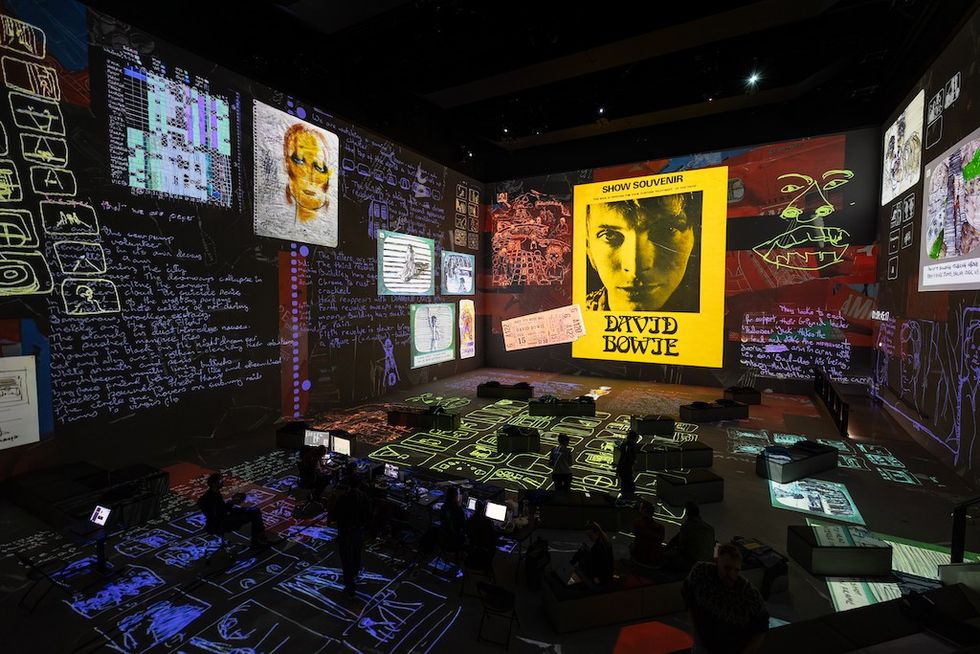
 David Bowie: You’re Not Alone at Lightroom
Second, the grip of IP dependency loosens. You don’t need an encyclopedic canon to generate intensity if the environment itself produces the shift. That doesn’t make IP irrelevant. It simply means IP isn’t the only path to significance.
Third, the narrative machinery gets lighter. Fewer plot mechanics to sustain. Less exposition to front-load. Less cognitive scaffolding before a guest feels something real.
And something else happens as well: repeatability increases. People don’t return for a new chapter. They come back to re-enter a feeling because the body never experiences it the same way twice.
If you design for state change, story becomes optional. If you design only for story, state change becomes accidental.
Story is one way to move people. Movement is the point.
Story is a tool, change is the objective
The real work of experiential design is not the construction of narrative arcs. It is the orchestration of change—change in perception, in physiology, in relational energy, in how a guest occupies space externally or internally.
When an experience shifts something in the body or mind, meaning arrives whether or not a plot has been supplied. When nothing shifts, no amount of backstory can manufacture depth.
This does not diminish story. It repositions it. Story is a design tool. State change is the objective.
Once you see that clearly, a different design discipline emerges, one less obsessed with exposition and more attentive to sensation, less concerned with lore and more attuned to leverage.
You begin to ask different questions. Not “Is the narrative clear?” but “What is moving?” Not “Do guests understand the world?” but “Are they different inside it?”
Because guests rarely recount an experience in three acts. They recount how it felt; the moment their breath caught, the instant the room seemed to tilt, the unexpected stillness, the surge, the recalibration.
They remember the shift. Story can catalyze and guide the shift. It just isn’t the shift itself.
And in experiential design, as in life, movement, not mythology, is what makes meaning matter.
This article is part of an ongoing exploration of the evolving immersive landscape: how we lost our way, who’s fighting to bring meaning back, and why it matters.
For more on what this column is all about, start with Is This Article Immersive?, where I lay out the mission: reclaiming immersion from the gimmick merchants and giving it back to those who create experiences worth disappearing into.

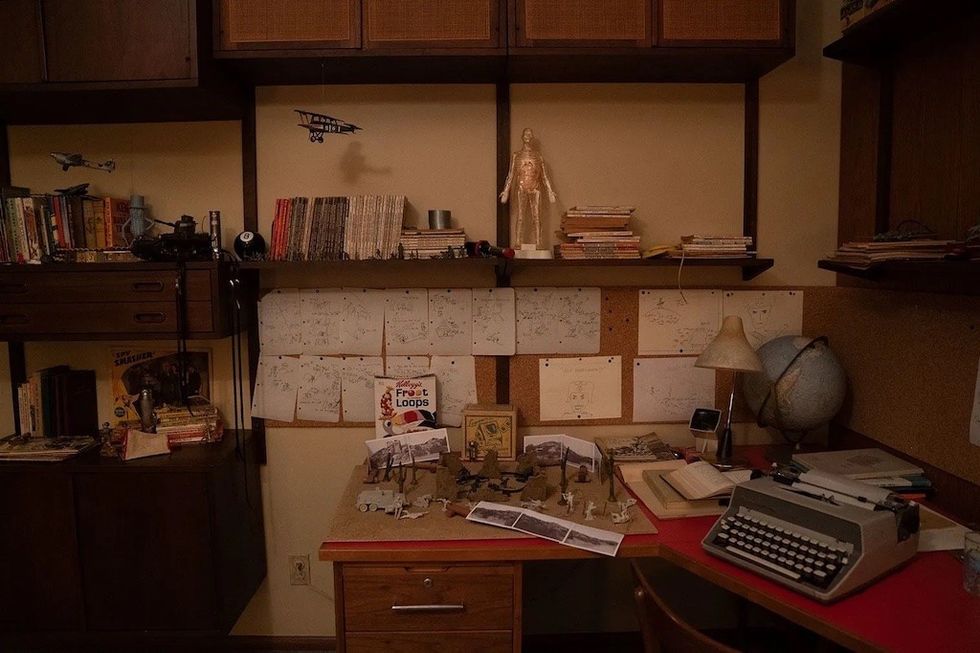 The Fabelmans- Sammy’s Phoenix Bedroom, credit NBC Universal
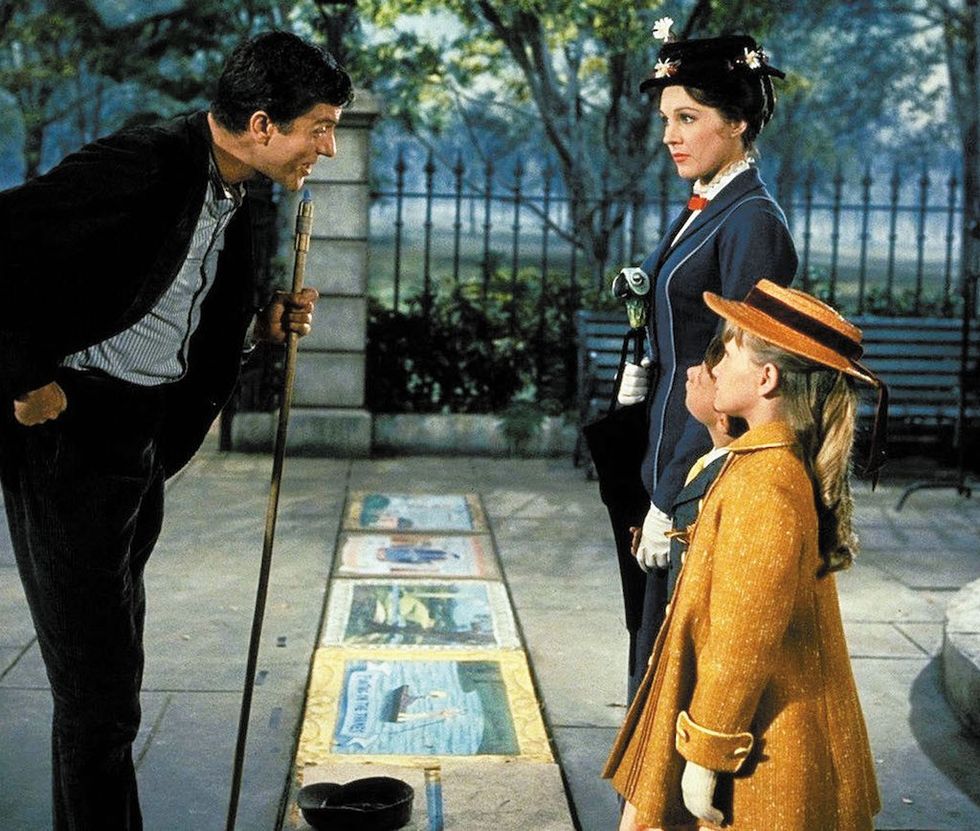 Still from Mary Poppins, credit Disney







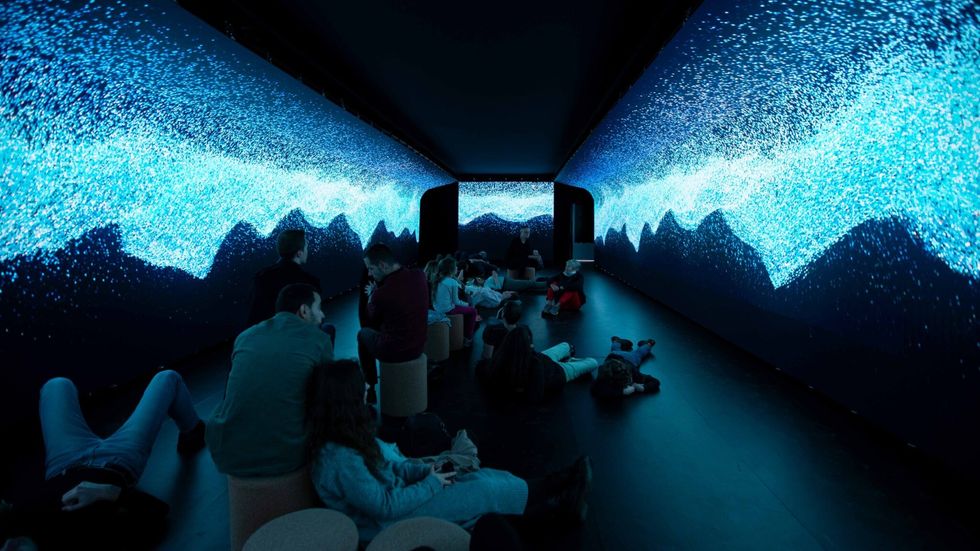 OASIS Immersion's immersive wellness experience in Paris
 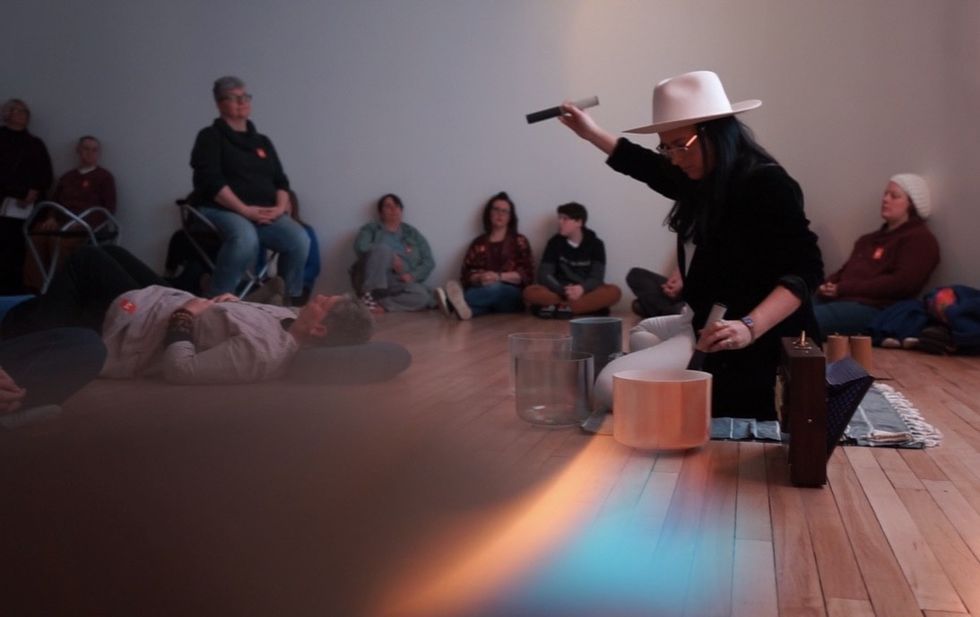 Sara Auster running a sound bath inside a James Turrell installation
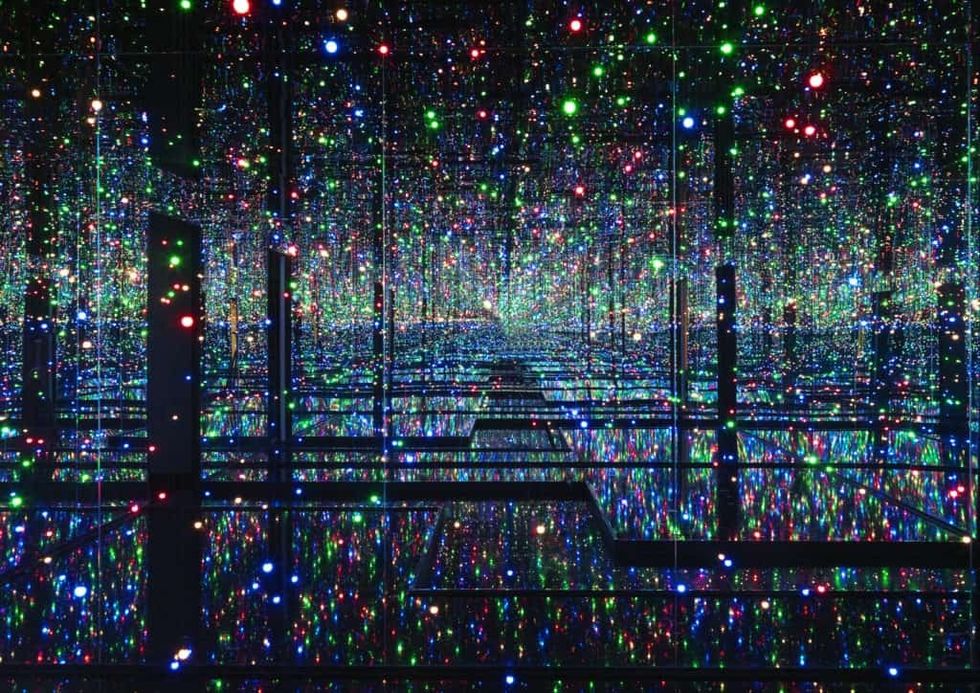 Infinity Rooms Image credit Tate Modern/Yayoi Kusama
  Mundo Pixar immersive exhibition
  David Bowie: You’re Not Alone at Lightroom