Mad Systems Inc., the award-winning audiovisual and interactive system designer and integrator, has revealed a new identity, Mad, which positions forward-thinking architecture for intelligent venues at the heart of its work.
This identity is accompanied by a new website, which sets out this vision under the headings: design, orchestrate, and inspire.
"The name reflects the full role we play, from shaping the first idea to developing the venue’s next capabilities," says Maris J. Ensing, founder and chief architect, Mad.
"We bring design, engineering, software, fabrication and systems integration together to create experiences with room to grow."
Welcome to Wonderland
This approach can be seen in action at Wonderland, Mad's demonstration and development environment in Orange, California.
Here, designers can experience technologies such as Mad Hatter™, Mad Presence™, Alice®, and Lory®.
In the head-tracked binaural audio demonstration of Mad Hatter, visitors can hear an authored spatial sound scene respond to their head movements, while Mad Presence creates spatial audio with just a couple of speakers.
 Mad's most recent innovation, Mad Hatter, takes audio beyond DSP
"The creative question immediately becomes where you could take that experience: a character, a story, a moment that draws someone into another world," says Ensing.
Meanwhile, Alice lets venues draw interpretation from approved knowledge based on a visitor’s age, interests, and appetite for detail.
Lory offers media and access options, from support for hearing aids to sign language video, captions, audio description, alternative languages, and braille, in addition to the shared experience.
"These are tools that can change the brief itself," says Ensing. "Seeing them early gives a designer more to create with, and a better basis for judging what a project could achieve. You can't design with tools you do not know about."
Interested parties are invited to bring their designers, investors and operational teams to Wonderland for a bespoke tour.
"Tell us what you want visitors to feel, what is difficult to deliver today, and what you hope the venue might do next," says Ensing.
"We can arrange a visit around the capabilities relevant to that brief, with working demonstrations and a look at work in development."
Connected intelligence
Organisations expect today's investments to support tomorrow's ambition. For example, an upgrade might begin with supporting the venue’s accessibility and ADA requirements using Alice and Lory, then grow into more connected intelligence across the venue.
"That is why the rebrand matters," says Ensing. "Our work spans the original idea, the engineering that makes it possible, and the next capability the owner decides to add."
These connected capabilities live within AV++®, with Mad Intelligence™ providing the architecture to keep them aligned with the venue's aims and intent.
Built on Mad’s QuickSilver® computing foundation, AV++ runs core audiovisual functions on standard computing and software, with planned expansion paths that can accept new software, expanded processing, and additional capabilities as needed.
This is both cost-effective and responsive, allowing functionality to evolve as the organisation responds to future opportunities. Each addition needs the right engineering and resources, with this original architecture providing a foundation to build on.
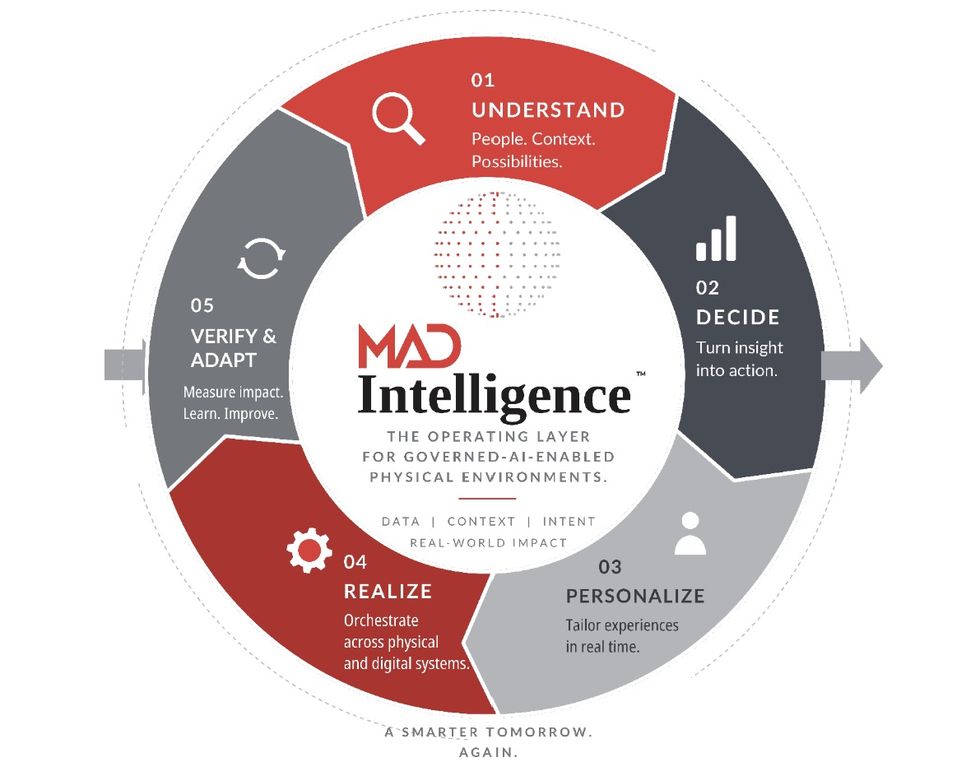 Mad Intelligence keeps the intended experience at the centre as a venue gains new capabilitiesConcept graphic courtesy of Mad
Mad Intelligence continues this approach into the experience's operation, with patent-pending architecture that connects a venue's goals with its system abilities, then checks and refines performance within defined permissions.
Additionally, the patent-pending WorldModel™ provides the wider governance architecture for intelligent venues.
This links shared context, coordinated action, and accountability, giving designers a framework for experiences that flow cohesively across exhibits and spaces, and owners a way to expand intelligence while maintaining control over privacy, permissions, and venue behaviour.
"Persistent intelligence makes the opportunity especially interesting," says Ensing.
"With the visitor’s choice and the venue’s permissions, Alice can support continuity between visits and venues, carrying forward interests and progress so the next encounter can build on the last.
"Personalization becomes something a venue can develop over time."
Earlier this year, Ensing released a two-book series on the governance, accountability, and real-world implementation of intelligent venues: Hyper-Personalized Venues: A CEO’s Guide to AI, Privacy, and World Models and The World Model: Governed AI for Hyper-Personalized Venues.