For many entertainment destinations, night begins when the lights come on.
The attractions keep running, the façades change character, music shifts, and perhaps a parade, projection show or fireworks programme appears. On paper, the destination has moved from day to night. In practice, the experience may not have changed very much at all.
What interests me is the gap between the two.
In projects I have worked on, the most difficult night-time questions are rarely about illumination alone.
They are about behaviour: where people slow down, where families want to sit, where teenagers gather, what happens around food, which routes suddenly feel empty, and what kind of atmosphere encourages people to stay rather than leave.
That is why I increasingly think of night as a different design condition altogether. The physical site may be the same, but the way people move, gather, eat, listen and read space can change enough to justify a separate brief.
What changes after sunset?
The same place can produce very different behaviour at different times of day. During daylight, visitors often move through entertainment destinations with a fairly clear attraction logic: arrive, orient themselves, move between experiences, eat, continue.
After sunset, that rhythm can loosen. People walk more slowly. Conversation and food may take up a larger part of the visit. Performances collect spontaneous audiences. A route that was simply circulation at 3 pm can become a place to linger at 9 pm.
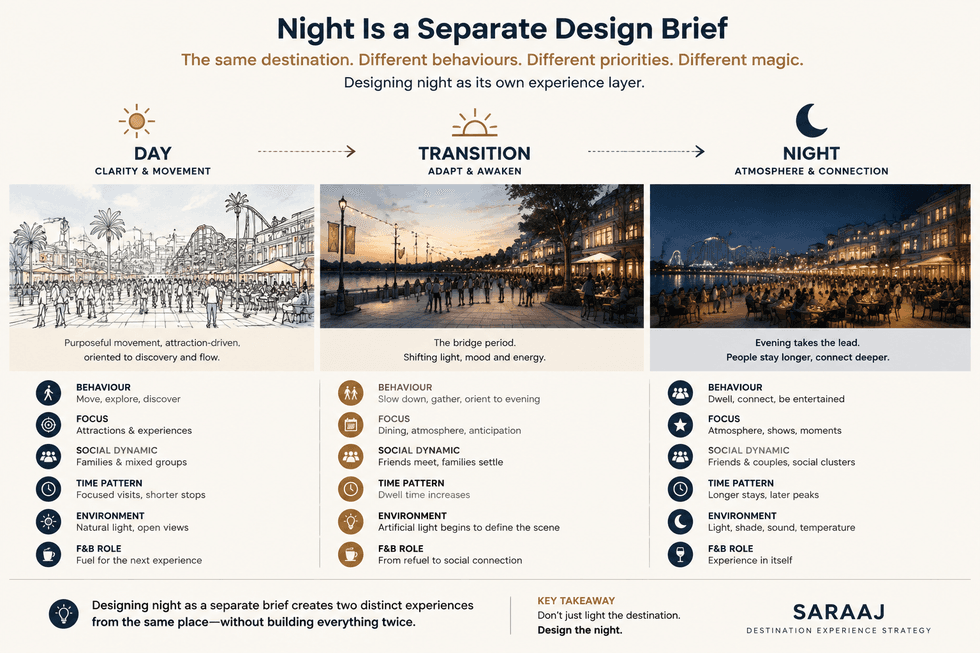 Designing night as a separate brief allows destinations to create two different experiencesImage courtesy of Saraaj
Perception changes too. Architecture loses some of its daytime hierarchy. Light decides what deserves attention. Reflections appear. Sound becomes more noticeable. Distance is harder to read. A small intervention that would disappear in daylight can carry surprising weight after dark.
This is why I am wary of treating the night-time identity as something to hand over at the end of the process. If the daytime environment is fully resolved first and the night is expected to emerge from a lighting package later, too many of the important decisions have already been made.
Good lighting is not the same as a good night
Lighting design is essential, obviously. It shapes visibility, atmosphere, orientation, safety and spectacle. But a beautifully lit place can still be an uneventful place.
A plaza may photograph brilliantly and still give people no reason to remain there. A façade can become a striking night-time image without changing the guest journey.
Even an excellent projection show can create a powerful twenty-minute moment while leaving the remaining hours of the evening largely untouched.
The more useful question is not simply how a place should be illuminated. It is what should happen there after dark that could not happen in quite the same way during the day.
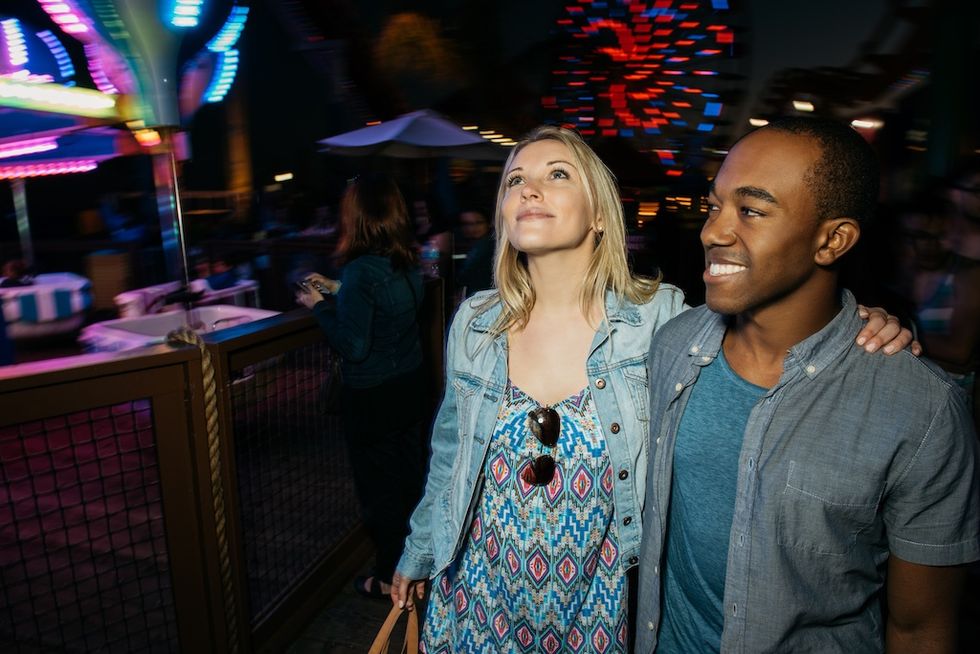 The way people interact with a destination is not that same once night falls
Once that question is asked, the brief gets wider very quickly. Food, performance, social behaviour, music, microclimate, operating hours, temporary interventions, retail and movement all enter the discussion.
Lighting is still there, but it is serving an experience rather than being asked to invent one on its own.
One site, two rhythms
There is also an economic reason to think this way. The same physical infrastructure can support two genuinely different experiences without being rebuilt twice.
A shaded plaza that works as a family rest space in the afternoon can become an evening performance setting. A restaurant terrace can move from service space to part of the entertainment programme. A pathway can become slower and more exploratory.
Landscape that sits quietly in the background during the day can become one of the main actors at night.
None of this requires the evening destination to become a separate brand or an artificial second personality. The more interesting challenge is to let the same place reveal another side of itself.
That can create an additional reason to visit without relying on another major piece of capital investment. It also gives operators more ways to vary the experience across seasons, weekends and audience groups.
Why the Middle East should take this seriously
The issue is especially relevant in the Middle East, and not only because of climate.
In many cities across the region, dinner, shopping, walking and family gatherings naturally stretch well into the evening. Public life often becomes more intense after sunset rather than winding down.
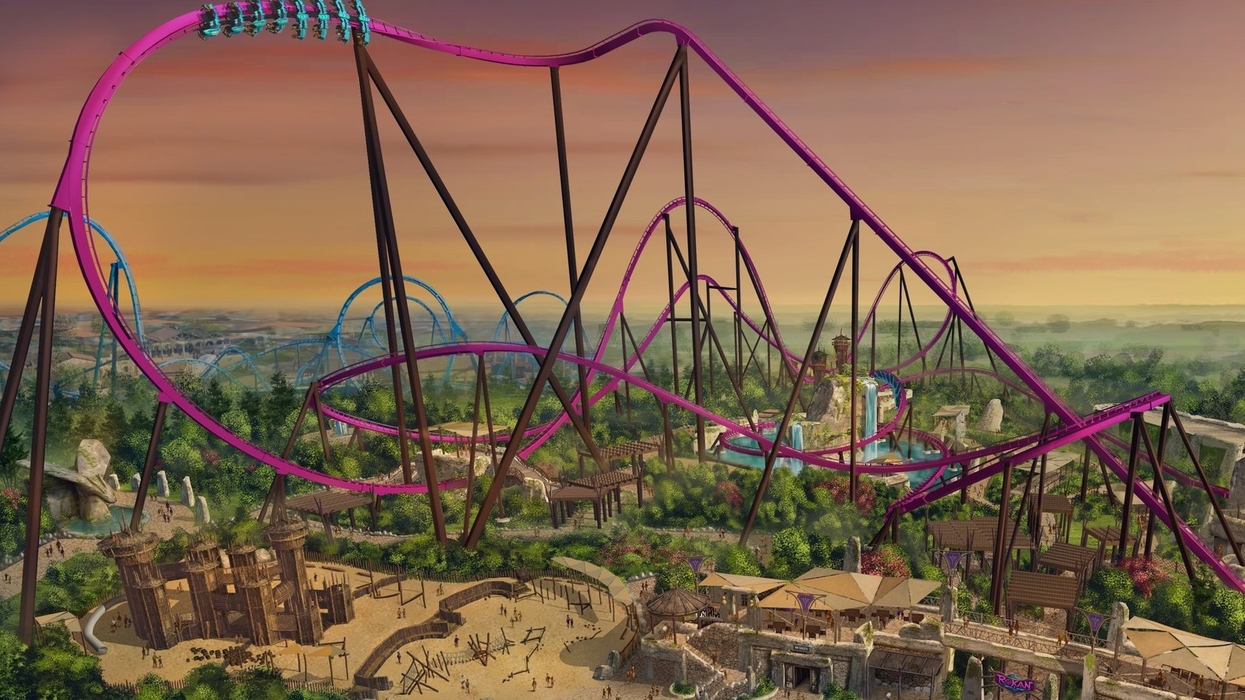
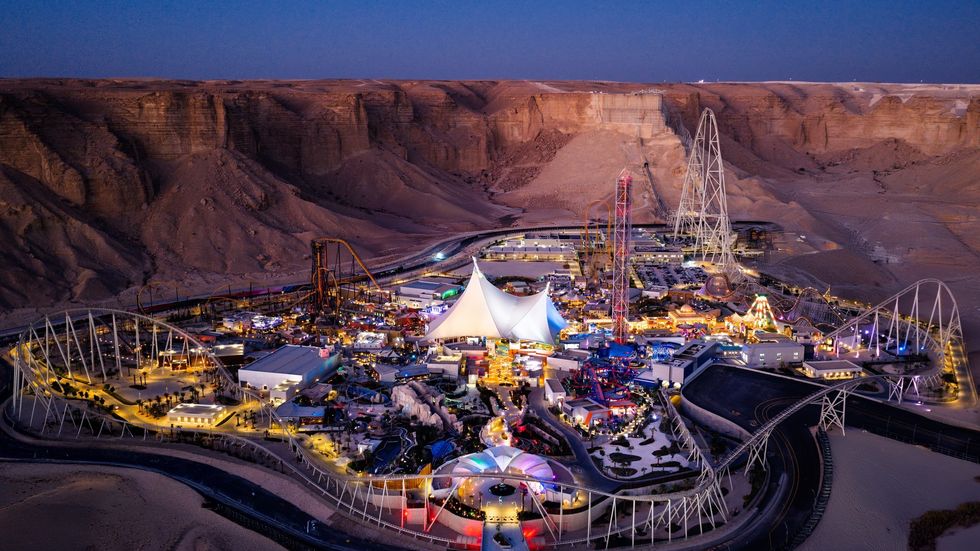 Six Flags Qiddiya City in Saudi Arabia, is designed for both daytime and evening entertainment
For a destination designer, that changes the assumption about when the 'main' experience happens. An evening visit is not necessarily a shorter version of a daytime visit. For some audiences, it may be the preferred visit.
This matters because the region is also building new entertainment destinations at a scale that gives developers a rare chance to avoid inheriting old habits.
Six Flags Qiddiya City is one visible example. Its after-dark identity has attracted attention, but the more useful lesson is how the park sits inside a wider destination that includes entertainment, dining, retail, hotels and the neighbouring East Village.
The point is not that every project needs spectacular night-time lighting.
In markets where leisure life extends deeply into the evening, night cannot remain a decorative layer added near the end of design development. It needs to influence the plan itself.
Put time into the masterplan
If night is treated as a design condition from the beginning, some very practical questions move earlier in the process.
Where will people naturally gather after sunset? Which spaces need activity rather than simply more light? Where should food remain active late into the evening? Which routes should become quieter, and which should intensify?
Where can live entertainment happen without fighting the rest of the operation? What infrastructure is needed for temporary programming?
There is also a less technical question that I think is often missed: what is the emotional arc of the evening?
We are used to thinking about spatial sequencing. We plan arrival, transition, reveal, attraction and exit. But a guest arriving before sunset, staying for dinner, encountering a performance later and discovering a changed landscape at night is also moving through a sequence.
The difference is that part of the sequence is temporal rather than spatial.
For me, this is one of the most useful ways to think about the night-time masterplan. It adds time to the usual discussion about programme, capacity and space.
The value is in what can change
Night also offers a flexible platform for repeat visitation. Buildings do not change every week, but programming can.
Seasonal events, performances, food programmes, projections, music, markets and temporary installations can make a familiar destination feel different without requiring a new permanent attraction each time.
That flexibility is not free, though. It has to be designed in.
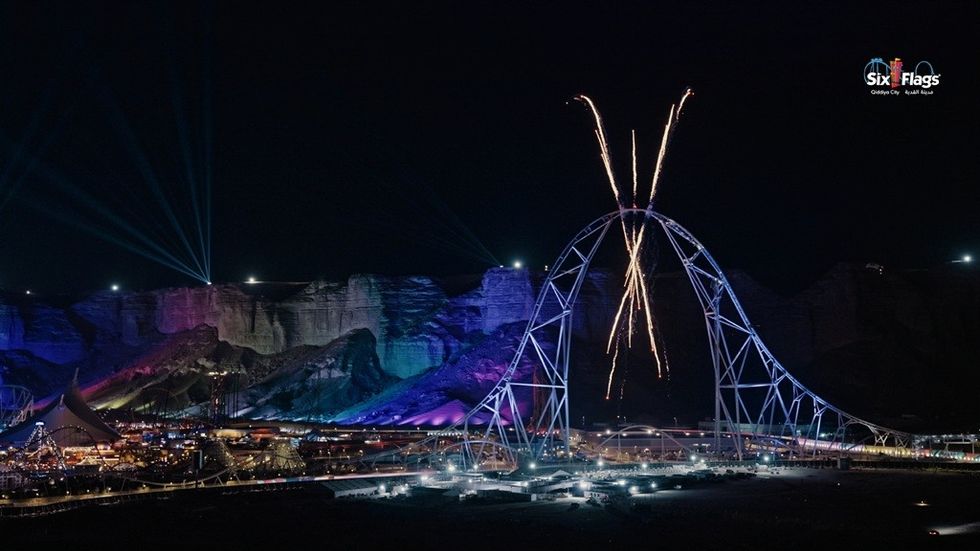 Six Flags Qiddiya City's rides, such as Falcons Flight, shine brightly at night as the park takes on a different atmosphere Image courtesy of Six Flags Qiddiya City
Power, rigging, storage, acoustics, lighting positions, flexible furniture, temporary structures, crowd movement and operational access may sound like back-of-house details. In reality, they determine how easily a destination can evolve.
A large empty plaza is not automatically a programmable plaza. A beautiful outdoor space is not necessarily ready for an event. If a destination needs major construction every time it wants to feel new, then change was never really part of the original brief.
A simple test
There is a question I have started using when thinking about these projects: if the sun never set, what part of this experience would stop making sense?
If the answer is 'nothing', then the night-time offer may not have been designed at all. It may simply be the daytime destination with better lighting.
The attractions industry is already very good at designing physical experiences. The next step is to become equally deliberate about designing them across time.
Day and night do not have to tell the same story. They do not create the same behaviour, the same atmosphere or even, in some cases, the same audience. The transition between them deserves more than a lighting cue.
The strongest destinations will not only ask what they should become when they open. They will ask what they should become when darkness arrives. For many projects, that may be where the second experience really begins.