I have a strong affection for the Southern Los Padres. It’s a pull I can’t quite explain.
The land has a beauty that can be easily overlooked, and its rugged presentation from the few roads that snake through suggests a barren, harsh terrain. But a closer look reveals something more. A willingness to endure its tough, dusty trails has rewarded me with some of the most spectacular places I have ever visited.
I recall once talking with a friend about these places.
“Don’t care much for hiking,” he said. “Dust…bugs…never really liked walking much.”
Well, yeah, stated like that, I guess I don’t care much for it either. I’ve known some who hike for the exercise, the movement, or the challenge. I think that’s great.
But for me, the physical act of hiking has never been the point. It’s always been about where hiking leads me. In a place like the Southern Los Padres, it’s the only way to get to where I want to go.
It was on one of those trails that the thought once occurred to me: I feel exactly the same way about creating sounds.
What can sound empower?
In themed entertainment, what excites me most about sound is where it leads us and what it enables.
But there is a tendency to frame sound as something that gets applied: content to select or a technology to deploy. If we’re not careful, that framing can eclipse conversations about the broader creative objectives that sound empowers.
When that happens, we skip the questions I find far more inspiring: what are we trying to achieve, and how can sound help us get there?
I recall a story about an executive who was being shown a test demonstration of a proprietary spatial audio approach. He was brought in and seated in the presentation space as techs on the catwalk above finished their preparations.
Suddenly, something snapped, people screamed, the lights went out, and a giant lighting fixture broke loose, swung inches from the executive's head, and crashed into the wall directly behind him.
The lights came up. The executive held a shocked expression, but all was calm. It had all been a sonic illusion.
The goal of the demonstration was to illustrate the effectiveness of the spatial audio, but its success stemmed from demonstrating what the audio empowered. It vividly illustrated contextual and story framing, elevating spatial audio to an intense, visceral experience.
I was not a part of the demo, but I did hear the final result in the installed attraction. As an audience member, I was not considering cool sounds or immersive technology. I was immersed in a story and invested in the dramatic events unfolding in the dark shadows above me.
This result wasn’t accidental; it stemmed from someone asking the questions I raised above: “What are we trying to achieve?” and “How can sound help us get there?”
Sound and perception
The answers to these questions aren’t always obvious, another point the Southern Los Padres helps me illustrate. From the road, much of the Southern Los Padres appears to be an expanse of badlands, desolate canyons, and mountains blanketed in chaparral.
Its biggest rewards aren’t revealed until one decides to look past the obvious, but many see no reason to get out of the car. They drive straight through, unaware of what they have missed.
How can you convey the richness of what was overlooked to one who hasn’t experienced it and doesn’t yet see the need for a closer look?
My previous article (Shaping guest perception with sounds that disappear) began a three-part effort to answer that question. The article opened with the example of a generator engine within a themed queue.
The thousands of guests who walk by this set piece each day do not consider an introduced audio element; they accept the engine as they encounter it. The sound of this engine could have just been a contextually appropriate sound effect.
Instead, it was treated as something more. It became a tool that shifts what guests in this space accept as real.
These kinds of results are extremely difficult to achieve after the fact or late in the process. The engine required a team that looked closely enough to recognize opportunities while they still existed.
Together, we shaped the design intent before the prop was constructed, allowing a speaker to be integrated in a way that naturally resonated within the engine cavity and leaked through its openings. We devised cause-and-effect strategies with the lighting team and framing strategies with the broader creative team to ensure those illusions would hold.
Our sound creation strategy directly supported these opportunities, specifically addressing and reinforcing the broader objectives. The simple sound became a powerful perception-shifting tool, but only because it was collaboratively recognized and implemented as such.
The true value of sound
The recognition is key. Sound doesn’t just embellish an experience; it can multiply the value of everything else within it.
Spaces can feel larger, rides can feel more intense, and static props can feel alive. Sound can reveal details obscured from view, reframe perceptions of objects in view, and draw attention to elements that might otherwise be missed.
Without recognizing sound’s capacity to shift the perception of so many aspects of the experience, its true value can’t be fully appreciated.
Not long ago, I was approached by someone interested in upgrading the sounds that supported visitor center dioramas. He was intrigued by what sounds could do for his space, but discouraged by an estimate he’d received from a systems implementer for hardware upgrades.
“I’m not paying that kind of money for bird sounds.”
Well, yeah, stated like that, I guess I wouldn’t want to either. For him, sound was a product—an element to thematically embellish the dioramas. As such, his reaction was understandable.
It was also a disappointing lost opportunity. Sound had the capacity to completely transform how guests would perceive and encounter that space.
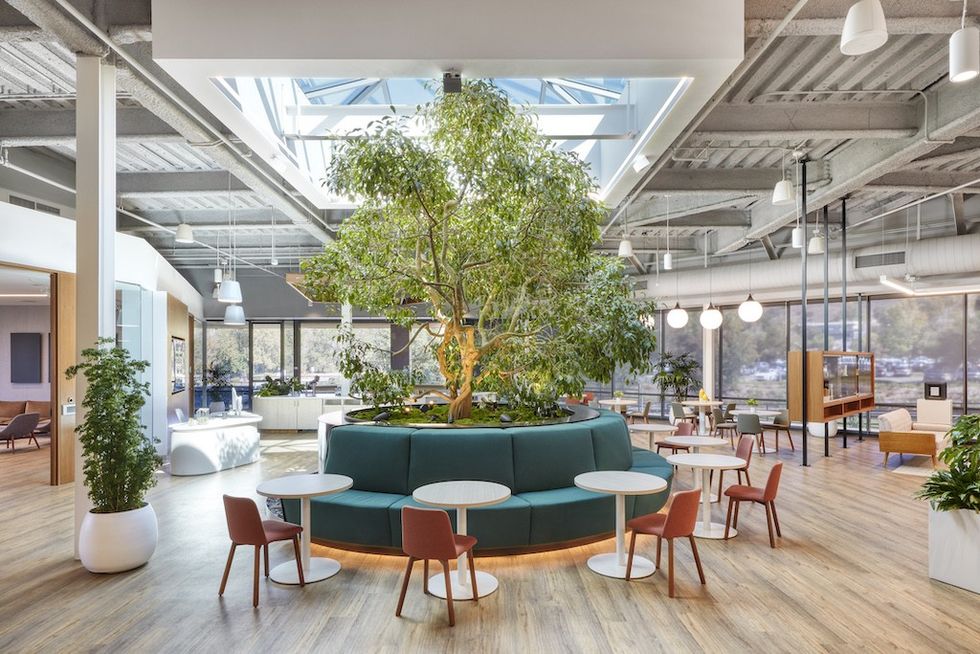 Ember's office space in Westlake Village, California, is now home to a calming and natural central space that reflects its aesthetic, featuring a nature-inspired soundscape
In contrast, we were once asked to create soundscapes for a corporate headquarters. The audio producer very quickly focused the conversation:
“There are multiple ways we could approach this. We could play a commercially available nature recording. We could incorporate a generative spatial audio system. We could deliberately craft a multichannel soundscape that changes throughout the day.
"Our recommended approach will depend on what you are trying to achieve here. What are your objectives for this space?”
The resulting conversation revealed that the real objectives weren’t “play some nature sounds” but rather to bring the outdoors in, shape an inviting space, create a productive atmosphere, and encourage people to linger.
From there, the system, design strategy, and sounds were crafted to address those objectives.
Within my own work, I almost always regard sound as the medium, not the objective. When sound is regarded as a late-stage reactionary discipline, conversations tend to focus on the question, “What needs sound?”
It's a valid question, but one that often overlooks opportunities to shape how people perceive and engage with the spaces we collectively create. These opportunities don't often announce themselves.
If we don't look for them, they can vanish before we understand what was lost.
This post is the second in a series of three by the president and creative director of Sound Sculpture Inc., exploring sound design in themed entertainment.