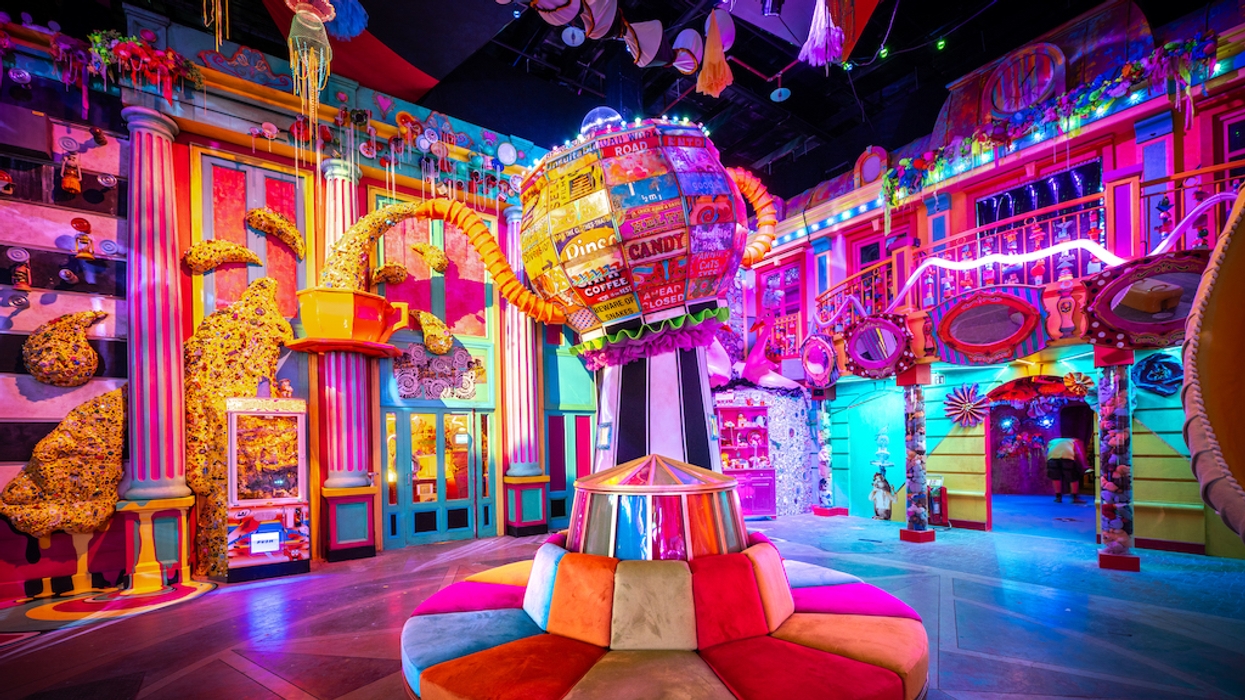
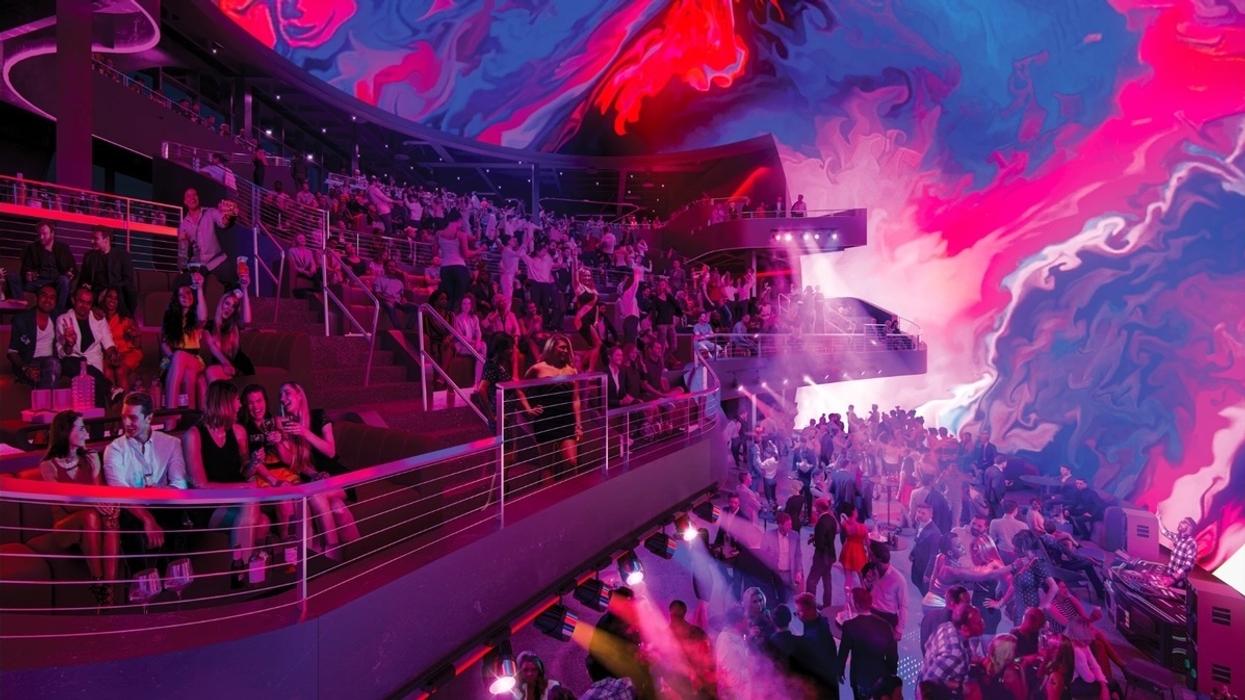
Bruno Mars’ The Romantic Tour, which began in Las Vegas in April 2026 and continues across North America, Europe, Mexico, Japan, Australia, New Zealand, and more, brings together music, live performance, and dynamic visual storytelling.
The production included a close creative and technical partnership between Belgian content creation and digital mapping studio Drop the Spoon and Montreal-based entertainment technology specialist VYV Corporation.
Bruno Mars was closely involved throughout the show’s creative development, working alongside the teams to shape its visual direction and generate ideas. He spent long hours with the creative and technical teams, discussing ideas and giving feedback as the work evolved.
Both Drop the Spoon and VYV have backgrounds in permanent theatrical entertainment, with a joint portfolio that includes major water-based productions such as Franco Dragone’s The House of Dancing Water in Macau and La Perle in Dubai.
These projects gave the teams extensive experience of combining video, water effects and live performance within complex physical environments.
That experience informs an approach to The Romantic Tour, where teams developed and refined content alongside the performance, rather than treating it as a pre-rendered backdrop. Directors, designers, programmers, and performers could iterate together in the space, allowing the visual environment to respond to the show's music, movement, and energy.
While live music tours have traditionally operated differently from theme parks and museum installations, The Romantic Tour demonstrates a creative and technical workflow relevant to the visitor attractions industry.
From Dragone to Drop the Spoon
For more than a decade, the core creative team behind Drop the Spoon worked as the internal video department at Franco Dragone Entertainment Group. The experience shaped their approach to video as a theatrical element rather than simply a technical discipline.
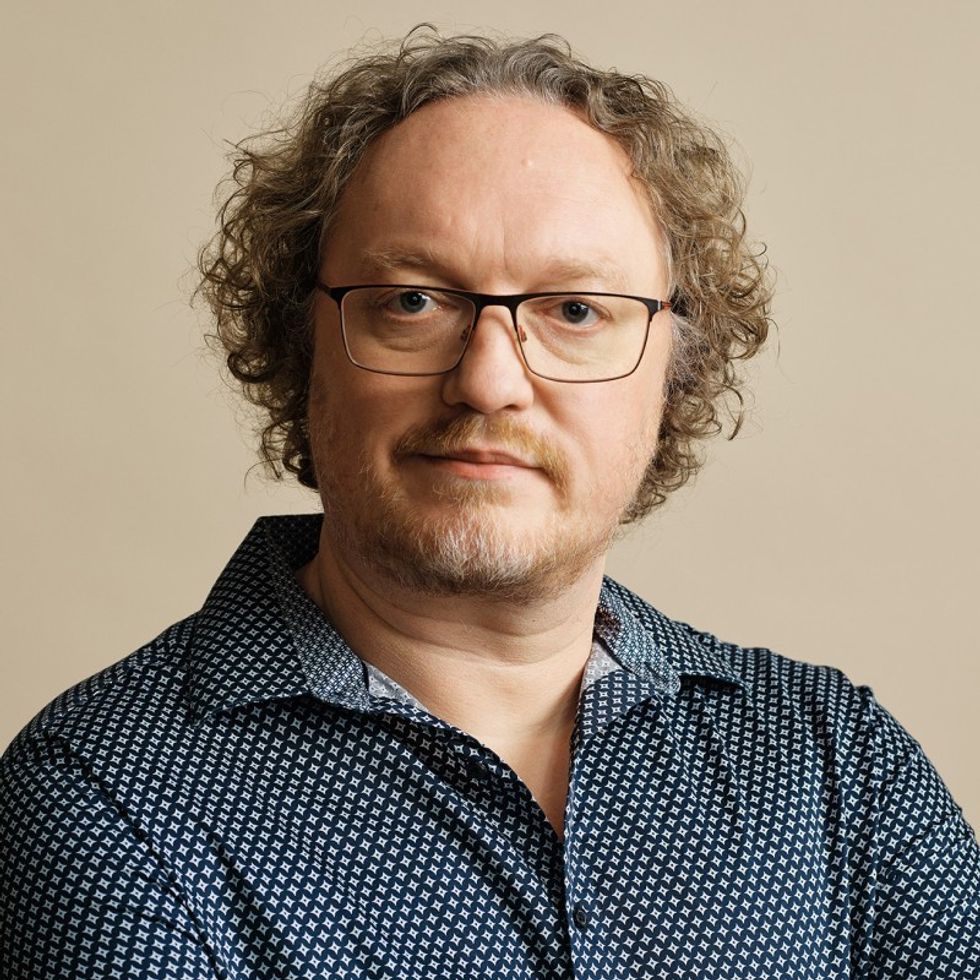
Jean-Luc Gasson, co-founder of Drop the Spoon
The Franco Dragone school required ideas to be physically realised on stage before they could be judged, explains Jean-Luc Gason, co-founder of Drop the Spoon. The team learned to develop concepts far enough to communicate their creative intent while keeping them flexible enough to evolve through the production process.
Their live entertainment work began in 2003 with Céline Dion’s A New Day in Las Vegas, followed in 2005 by Le Rêve at Wynn Las Vegas, which introduced 360-degree projection and complex spatial mapping.
Drop the Spoon and VYV first worked together in 2009 during Britney Spears’ Circus Tour, where the team used VYV’s PHOTON media server for the first time. On The House of Dancing Water in Macau (2010), they began modifying video parameters live on stage, responding directly to Dragone’s requests.
Subsequent projects increased the technical complexity, from robotic LED screens and large-scale projection on The Han Show in Wuhan (2014) to a fully projected stage floor on The Dai Show in Xishuangbanna (2015).
Choosing the right partners
For The Romantic Tour, lighting designer and co-production designer Whitney Hoversten says the team prioritised partners who could respond to Bruno Mars’ ideas without imposing their own creative agenda.
“We've had a long-standing relationship with Drew Atienza [director at VYV],” he says. “The production manager, Joel [Forman], and I are very aligned in that it's people over gear; people are really what makes everything.
“Ahead of this tour, there were a lot of things that I asked about what their PHOTON server could do, and they developed things for us. That's an incredible thing to come out of a company, to be provided that service and customisation.”
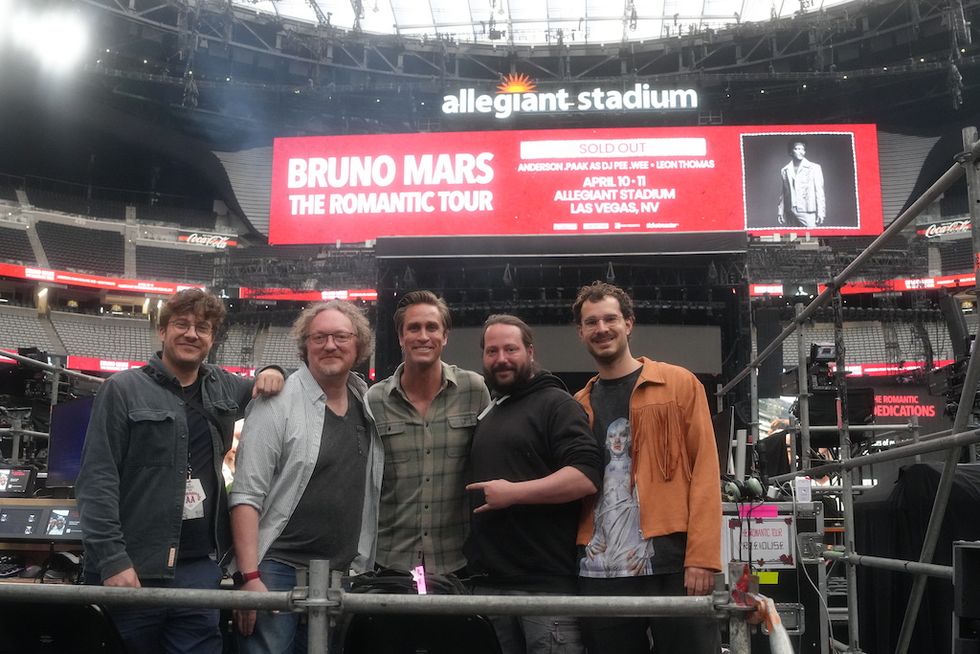
Whitney Hoversten, centre, with the VYV and Drop the Spoon on-site teams
Photo courtesy of VYV & Drop the Spoon staff
Drop the Spoon came through a recommendation from Atienza, when Hoversten and his team were looking for a content partner for some shows in Japan. “Not only were they right for that job artistically, but I liked the feeling I got when I spoke with them,” says Hoversten.
“We're not a camp that likes ego. They brought a great team of people who were all willing to collaborate and empower Bruno to deliver the show that he wants.”
“But leaving your ego at the door doesn’t mean leaving your ideas in the car,” Gason adds. “You still bring all your creativity. You just point it at the stage instead of at the mirror.”
Rather than imposing an overall creative vision, the team brought different tools and possibilities to Mars and let him shape the show: “We were showing him, ‘Hey, here's what the PHOTON server can do’ and letting him run with it.”
Supporting Bruno Mars’ creative vision
Unlike a museum installation, where digital media may be the primary focus, a live concert has a clear focal point: the performer. Gason explains the balance required between the visual environment and the live performance:
"People don't come to look at screens. They want to see Bruno. We're just there to support his vision; he's the show. So, the balance is everything; you cannot overcome or overwhelm what's happening on stage, but you need not to make the stage look empty, and that really was where the work with Bruno was important."
“Everything- the video, the lasers, the pyro, the lighting- is just an extension of him,” says Hoversten. “He’s the star of the show; it's all about Bruno.
“He likes a big show; he wants things to have wow factor. But when you put him on stage, nothing can outshine him. You can’t take your eyes off him. He owns that stage, and our work is in the background, complimenting that.”
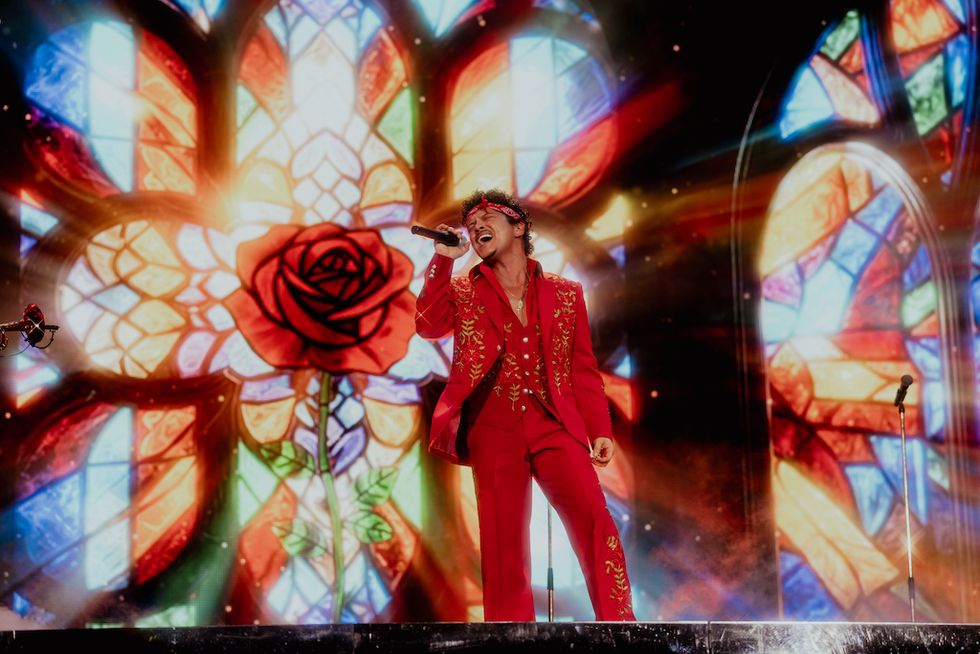
Bruno Mars on stage during The Romantic Tour
Bruno Mars Production, photographer Daniel Ramos
Gason describes Mars as a highly involved creative collaborator:
"I've rarely seen an artist working that hard. He has a clear idea, clear direction in his head, and he needs to carry it out. Like any creative, it's difficult to get a vision out of your head and make someone else understand it. In the first few days, when we were on site with him, we spent time finding a common language.
“That's happening with every director we work with because that's really the first basis.”
This was especially important for translating concepts like a detailed stained-glass backdrop effect, which had to work seamlessly with Hoversten's lighting design.
The team also had to adapt the digital media precisely to the music:
"Bruno is, fundamentally, a musician. Everything has to go with the music, and he has a very precise rhythm for everything. So that's where being flexible and being able to iterate quickly was key, being able to adapt to catch the exact music that was in Bruno's head."
Achieving this level of musical and visual accuracy within a compressed four-week rehearsal period in Nashville required a media server that could support rapid changes and iteration.
Balancing pre-rendered content with real-time effects
VYV’s PHOTON media server provided the technical infrastructure for the tour’s iterative workflow, letting the team adjust visual elements in real time as the production developed.
Gabrielle Martineau, the tour’s primary PHOTON programmer, says a key challenge was deciding which elements to pre-render and which would benefit from real-time processing.
“A lot of the work was about deciding what should remain as pre-rendered, and what can also benefit from being real-time generated,” she says.
“So, it's a bit of a balance to find which content should be just a loop or a render for the sequence and where we can add those elements on top of it to make it a bit more responsive to what is actually happening on stage.”
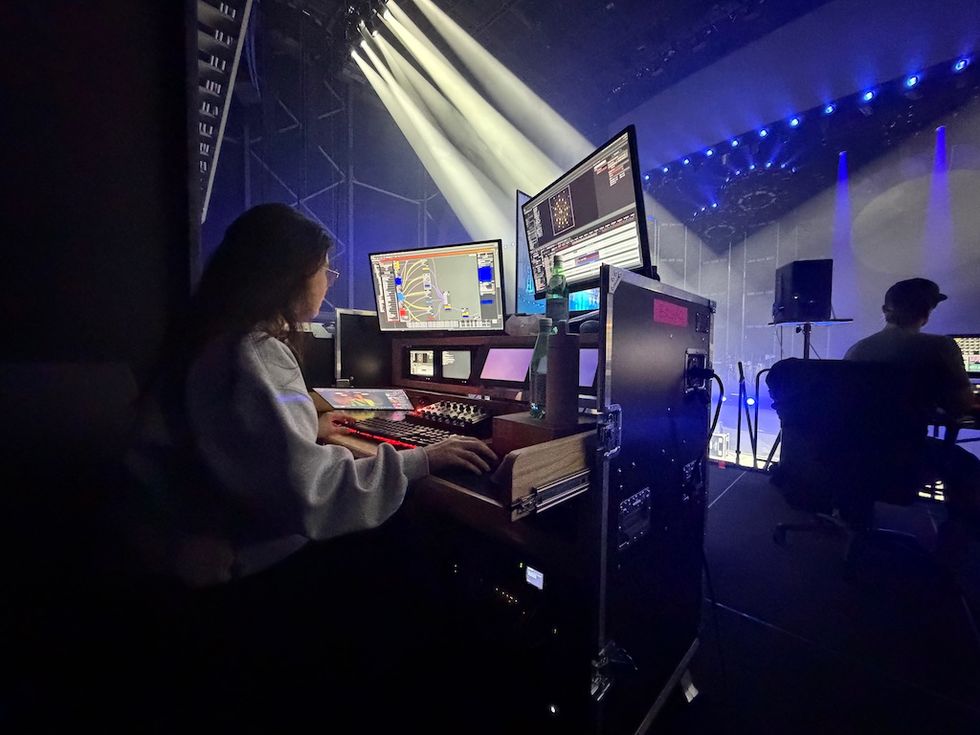
VYV's Gabrielle Martineau at work during The Romantic Tour
Photo courtesy of VYV & Drop the Spoon staff
PHOTON’s FX Graph enabled Drop the Spoon to manipulate assets directly in the live environment, using modular visual elements that could be assembled and adjusted without returning to post-production.
“Their system is built in a way that allows us to quickly iterate things from our computers directly, and we can also work with modular things, create small little bricks that we assemble into the media server directly,” says Gason.
One example came during a song featuring a flying saucer on the visual backdrop. The team used the system to place a live performer inside the saucer, creating a playful interaction between the live performance and digital content.
“In the end, we put one of the performers into the flying saucer, so you have the live guy playing piano, and the saucer is coming on the screen, moving, and he is inside the saucer,” says Gason. “Those kinds of little things are really fun.”
Hoversten adds:
“For us, it was about having the tools in place to react to Bruno and whatever ideas he came up with. As ideas came about, they had a solution.”
Building flexibility into a touring production
While real-time effects give the creative team greater flexibility, they also require technical discipline, particularly for a production touring globally. Martineau explains the balance between experimentation and reliability:
“This process is really iterative... but obviously, when you are the programmer, there's always in the back of your mind: like this show needs to be repeatable every night, and the gear is touring as well.
“You need to decide what kind of hardware you want, what you do with the software, and how you program it, so every night it's the same thing, and everyone paying for tickets gets the same experience."
“But also, there's always opportunity for improvement or changing something that they want to change, or adding songs, or doing this song one night and not this song, so it has to be flexible, even though it has to be robust.”
That repeatability also depends on careful management of hardware resources. Real-time mapping and video effects can place significant demands on graphics hardware, requiring programmers to balance visual ambition with processing capacity.
Martineau says experience is key, as multiple effects can quickly push a system towards its limits, making it important to understand how different processes interact and where processing power is best used.
Uniting creative and technical teams
The PHOTON media server's capabilities were only part of the equation. Equally important was the collaborative workflow developed for The Romantic Tour, which brought creatives, programmers, and software developers together in the same physical space.
Traditionally, video production for major arena tours is highly segmented, with creative teams developing concepts remotely, rendering assets, and handing them off to programmers at the venue. If content does not work once combined with the physical stage and lighting, changes can require further rounds of rendering and review.
For The Romantic Tour, Drop the Spoon and VYV brought those disciplines together much earlier. Gason placed his creative team directly in front of the rehearsal stage, allowing them to work alongside the technical teams throughout.
"I want to be there because I need to understand the stage; my team needs to understand what's happening. We need to live the stage. You don't design a live show on paper inside of your garage... in a live show, there's life. You need to feel the show, feel it in your bones, and that's so you can create something relevant to the show."
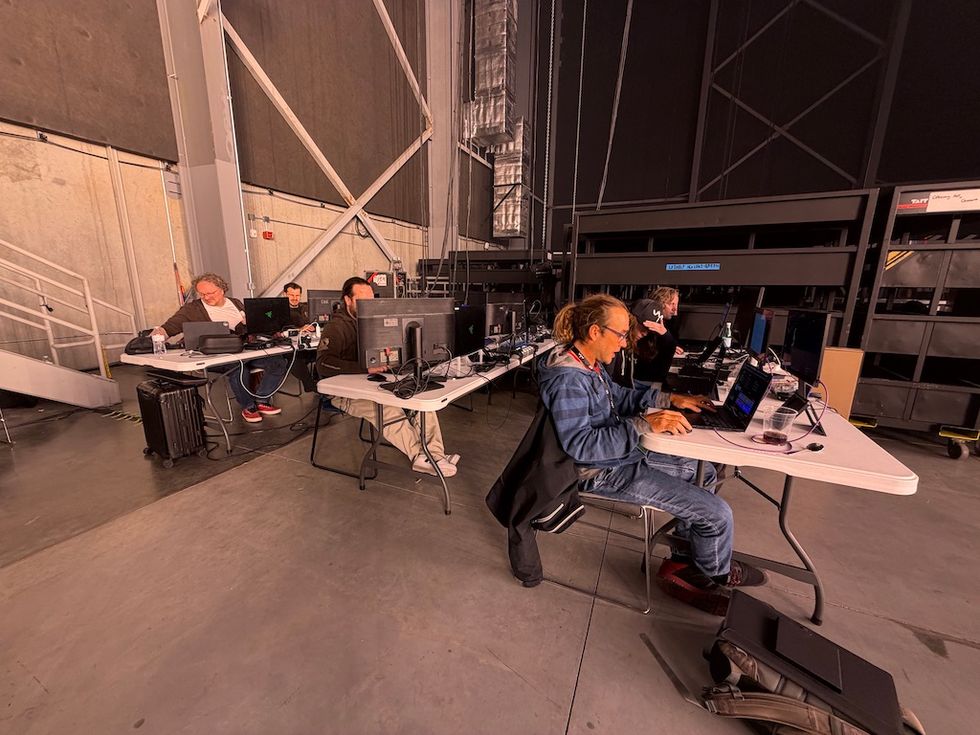
Being in the room helps the VYV and Drop the Spoon teams understand what the show needs
Photo courtesy of VYV & Drop the Spoon staff
The setup turned the rehearsal area into a space for rapid prototyping and testing.
"The idea was simple: show the director the idea on stage, for real, not on paper. If it doesn't work, we change it there and then. That ability to participate in the creative process in real time, to be in the room and shape the show as it happens, is everything to us."
VYV’s software developers were also embedded in the rehearsal room. When Gason’s team or Hoversten encountered a technical barrier, developers could reprogram PHOTON to accommodate the creative request.
"What's great for us as creatives, using and working with VYV, is that we never feel there's a technical bottleneck. We are intellectually aware of the technique, but it's never a blocking factor because they are on site."
Martineau says the close connection also made it easier to turn creative ideas into new tools:
"Because we're such a small company, we have a very good understanding of what the software can do, where the new tools we would like to build fit in.
"When we are on site together, it’s much easier to bounce ideas around like, ‘Oh, I'm trying to achieve this creatively, but there's this limitation; is it possible that maybe we can have this tool that would help us do that?’
“Five minutes later, we can say, ‘We have this new version of the software that you can try on a very big screen to see if that achieves the goals that you're aiming at.’”
Lessons for visitor attractions
“We love VYV, the support and the product they provide,” says Hoversten. “We love the people that are involved in the company. When we've had problems, and anyone who's been doing production long enough knows there are always problems, we feel we've received tremendous support.
“And then Drop the Spoon, I love the team that they brought in. I love working with Jean Luc, and they did a great job reacting to Bruno and his creative process. I can't speak highly enough about them.”
The approach Drop the Spoon and VYV took on The Romantic Tour offers lessons for attractions professionals on bringing creative and technical teams closer together.
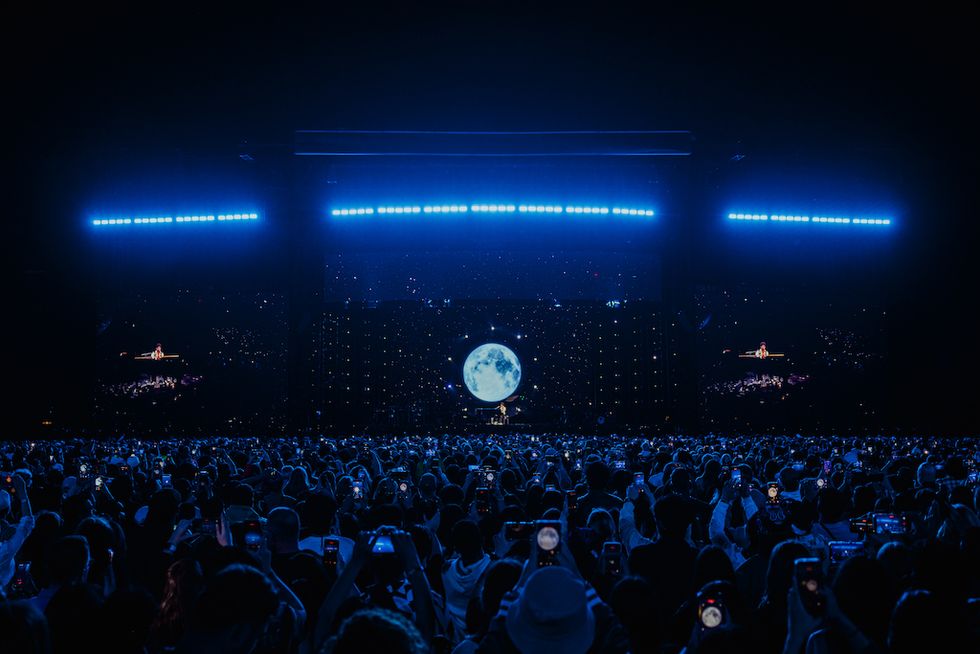
The audience enjoying Bruno Mars' The Romantic Tour
Bruno Mars Production, photographer Daniel Ramos
Large-scale projects often involve separate teams developing digital media, lighting, and physical environments, with elements coming together only late in the process.
Bringing those disciplines together earlier and developing content in the physical environment where it will ultimately be experienced creates more opportunities to identify and resolve issues while the creative process is still underway.
It also lets teams respond to the realities of the space, from lighting and sightlines to scale and audience movement, while refining ideas as the project develops.
The production highlights the value of real-time tools, allowing teams to combine pre-rendered content with live effects and make adjustments on site.
Equally important is involving technology specialists as creative partners, so technical solutions can evolve alongside the creative concept rather than forcing the creative work to fit a system designed in advance.
For attractions professionals, the lesson is straightforward: closer collaboration between creative and technical teams creates more opportunities to refine an experience before it reaches the audience. The rehearsal room can become more than a place to test a finished experience; it can become part of the creative process itself.