During From access to impact: innovation in exhibits at the Festival of Innovation, we were joined by guest speakers Josh Green, head of design, London Museum, and Tim Reeve, deputy director and chief operating officer, V&A.
They spoke to blooloop director, Alice Sarsfield-Hall, about the development of London Museum and V&A East Storehouse, and how the institutions are redefining access, authorship, and audience connection.
- Authentic storytelling. London Museum seeks to balance "grit and glitter" to ensure narratives feel real to locals while remaining globally appealing.
- Radical access. V&A East Storehouse replaces traditional storage with an open, theatrical space that puts the public directly among the collection.
- Embedded innovation. Institutions are focusing on innovative internal processes and "low-tech" wonder rather than chasing digital gimmicks.
- Community ownership. By involving local groups in the design phase, museums can break down barriers and foster a genuine sense of belonging.
- Industrial honesty. Using raw materials and functional design can create transparent, unpolished, and inspiring visitor experiences.
This session was sponsored by Museum Studio, an experience design agency specialising in providing museums, institutions and brands with comprehensive cultural services.
The 2026 Festival of Innovation took place online from 21 to 22 January. This annual event celebrates the creative ideas, products, and organisations advancing the attractions sector.
Meet the speakers
Chartered architect Josh Green is head of design for London Museum, where he is responsible for creative partnerships across exhibition and public space design for the Smithfield redevelopment, which is opening later this year.
Green leads the museum’s design studio and has shaped the institution’s overarching visual and art direction through his leadership of its new brand and visual identity.
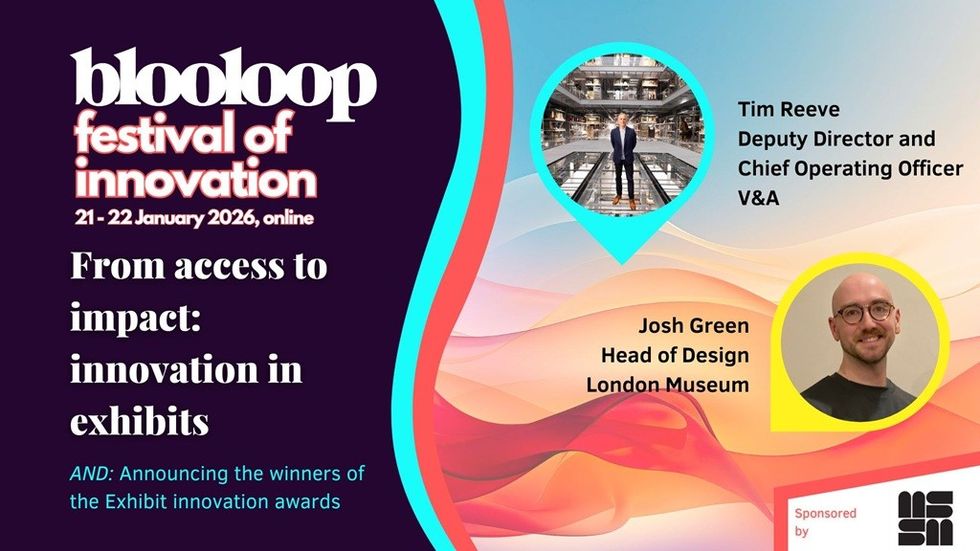 Tim Reeve and Josh Green shared their insights during the blooloop Festival of Innovation online event n January 2026
Tim Reeve has served as the deputy director and chief operating officer of the Victoria and Albert Museum (V&A) since 2013.
He spearheaded the development of V&A East Museum and Storehouse in the Queen Elizabeth Olympic Park, East London, as part of the East Bank cultural and educational legacy.
Grit and glitter
Sarsfield-Hall first spoke to Green about the Museum of London, which presents the history of the city from its first settlers to the people who live there today.
The museum is currently relocating to a new site at Smithfield Market, following the closure of its Barbican site in 2022.
This new site, set to be a world-class cultural destination, will open later this year.
As head of design, Green’s challenge is to craft a space that genuinely connects audiences from international visitors to people with hyperlocal expectations.
To achieve this, local engagement has been embedded throughout the project, from the development of the Museum’s identity to exhibits, installations, and experiences.
So far, over 100,000 Londoners have contributed to the project.
Another key element of the development process, he adds, is to avoid presenting a “sanitised version of London.”
This approach can be seen in its 2024 rebrand, which changed its name from the Museum of London and revealed a new pigeon and poo splat logo.
 The new logo for London Museum features a glittery pigeon poo, which Green says plays on the idea of the city's "grit and glitter" Image courtesy of London Museum
“For us,” says Green, “the pigeon is a universal experience, and is something that is everywhere and sees everything without judgment. And that's what we want to be, a chronicler of the city.”
This approach centres all of the museum’s activities on the idea of “grit and glitter,” which Green says expresses “the dualities and the contradictions of the city.”
“Too much grit and it doesn't have that universal appeal. It becomes really specific and unappealing, but too much glitter, and it becomes inauthentic.”
Telling difficult stories
This is a precise balancing of tone and truth, which recognises complexity without sacrificing authenticity.
“If you look in our permanent galleries, it is the story of growth. The story isn't centred on one place. It's an eternally moving feast and banquet.
“And I think that is really the essence of what we're trying to tell with the story of London,” says Green.
“It boils down to that grit and glitter. It's sometimes a really difficult history, and sometimes difficult stories have to be told. But we don't want to shy away from them.
“So, how they're told, how they are conveyed to a whole variety of audiences, is really key.”
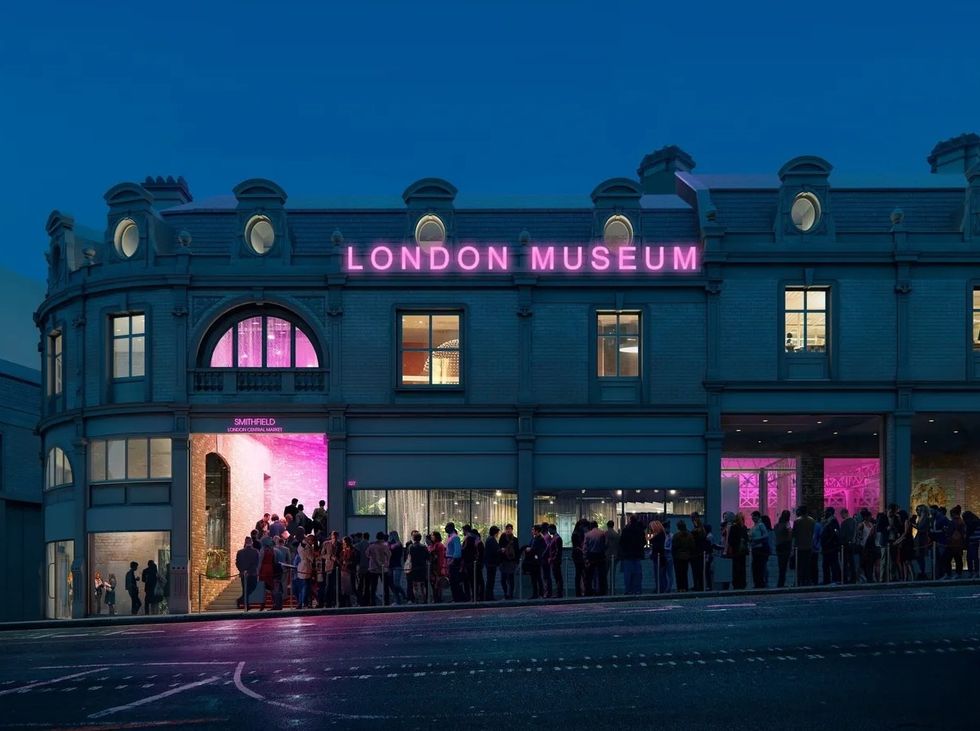 Concept art for London Museum's new Smithfield site shows visitors attending nighttime activations and events Image courtesy of London Museum
And the historic location itself tells stories of the city.
Located across a converted Victorian General Market building and the 1960s Poultry Market (set to open in 2028), the build has required extensive conservation, including the excavation of a network of lost vaults.
Such discoveries have led the base build team and contractors to treat the restoration of the buildings “almost like it was a collection object itself”, says Green.
Conducting the orchestra
This huge project comprises many threads, teams, and people. How does Green ensure cohesion?
“This isn't a single voice, and this isn't a single on-high approach to the design of the spaces,” he says.
“We've really built upon this idea that you can't be representative of London without allowing space for the creativity and the diversity of the city.”
The project includes contributions from practitioners ranging from large architectural practices to new graduates, and extending beyond the cultural sector to engage the city’s diverse talent.
As such, Green has established core design principles that are communicated and understood by all involved.
“We're creating a department store, not a supermarket. This isn't about consistency through repetition. This is about breadth of offer and cohesion through quality.
“Each individual commission and space can hold its own within this wider ecosystem,” says Green.
“I'm very aware that I'm not playing an individual instrument. It's conducting the orchestra to play in sync with one another.”
Evocative & honest
Turning to innovation, Green argues that tech should not be used for spectacle but to enhance the storytelling process.
How, he asks, can technology be used to make an evocative and honest experience?
“If your end goal is, I'm going to do this super innovative thing using this technology that no one else has ever used before… I don't think the end goal will ever be as good as going; let's talk about the story that needs to be told,” he says.
“Who we're telling it to, who we're using to tell the story. And then the means comes from that.”
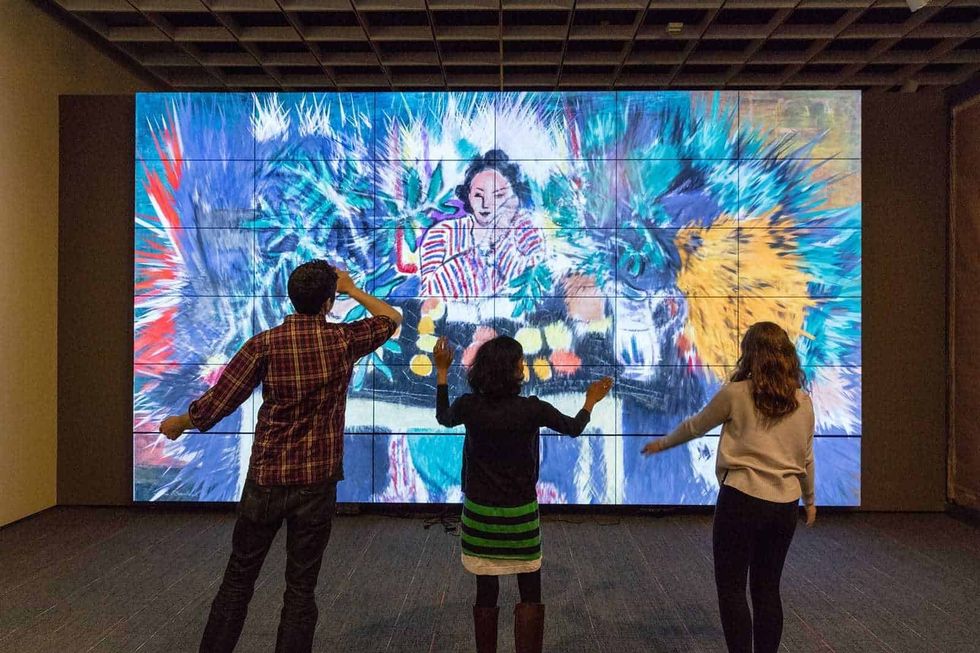 Visitors interacting with the ArtLens Gallery at The Cleveland Museum of Art, an example of where tech enhances the experience while not taking focus from the topic Image courtesy of The Cleveland Museum of Art
And storytelling remains key as museums' appeal continues to grow and their experiences become ever more incredible.
Here, Green says, it is important to ensure “it isn't done at the expense of the stories that are being told and the importance of those stories.”London Museum, he adds, benchmarks across the wider attractions industry to improve storytelling.
“It's that whole thing of different industries really understanding where the crossover is. And it's not necessarily about doing it arbitrarily… but about going, "What are those cues?"
“What are those small nuggets? Of ‘why is that audience appealing to that experience, and what can we take from it and learn?’”
Fundamentally different approach
Sarsfield-Hall then welcomed Reeve, and the conversation turned to the V&A East Museum and Storehouse.
The final piece of the V&A East project, the V&A East Museum, opened in April 2026 and is one of the UK’s largest museum developments of the decade.
It serves as the sister site to V&A East Storehouse, which launched in May 2025.
This location offers a behind-the-scenes experience with unprecedented access to over 250,000 objects and archives from the V&A.
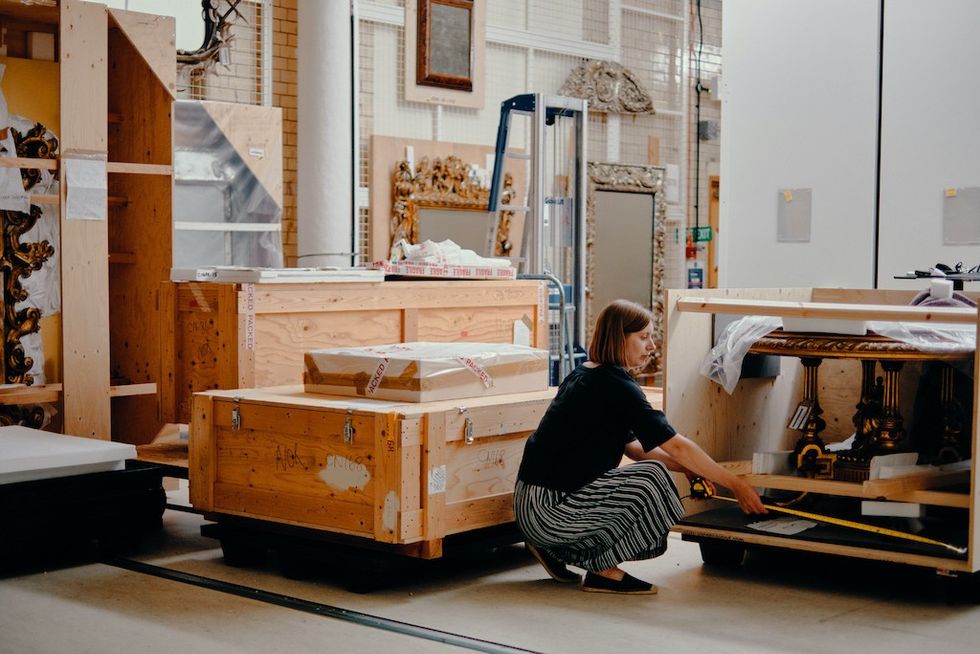 Behind the scenes at the V&A's Blythe House Stores, where large-scale furniture was measured and prepared ready to move to V&A East Storehouse. © Jamie Stoker
The project, Reeve explains, was born of necessity when the institution’s previous storage space was scheduled to close.
“We thought, okay, if we are going to have to move it, we might as well end up with something that feels fundamentally different from a traditional storage facility for a museum.”
Instead of a typical storage space, the team created an unconventional open space that allows self-guided exploration of the collection and a glimpse at the museum’s back-of-house world.
Visitors can access the collection 363 days a year, for free, without needing to book.
“Storehouse really is a storehouse. It really is where we look after everything, where we work on objects, where objects are moved around and so on,” says Reeve.
“But it is also, and has been designed to be, a genuinely accessible, self-guided cultural experience.
Model for museums
The project, Reeve hopes, will give other institutions the confidence to build on this new approach.
“People talk about how 5% of any museum's collection is accessible at any one time. And I think, to the extent that people know about it, it is a negative.
“You hold these national collections in trust for the public. Where are they? Why are you hiding it? Why can't we see them?”
This, he adds, is not about gatekeeping but about cost and security. Institutions instinctively want to share their collections but are limited by their resources.
“And confidence is a big thing when you're dealing with precious things, irreplaceable, priceless objects, national collections,” he adds.
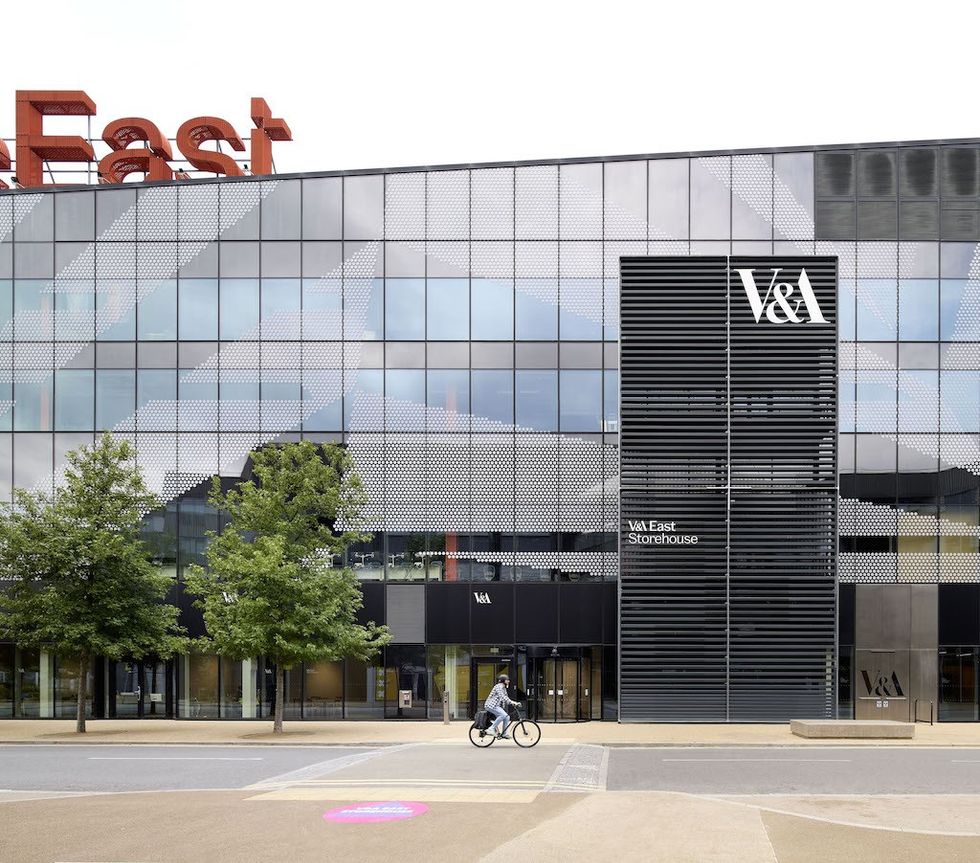 V&A East Storehouse is part of East Bank, the new cultural district in Queen Elizabeth Olympic Park. Image by Hufton + Crow for V&A
The Storehouse poses a new model for museums. While radical, it is also rigorous and based on a decade of meticulous planning.
“So confidence to do it is hopefully what Storehouse will bring. Here is a well-regarded international institution that is not going to play fast and loose with its collections—but has found a way.”
Intentional overwhelm
Storehouse seeks to both instil confidence in other institutions and its visitors.
“You can't assume that visitors are just going to immediately be comfortable being allowed to, as it were, trespass around priceless objects,” says Reeve.
“At the same time, we were really keen that Storehouse is a genuine experience. We don't want too much artifice about it. It's not a permanent gallery. It's not interpreted as a permanent gallery.
“And if we introduce too many measures to make the visitor feel comfortable with it as a new type of museum space, you break the spell.”
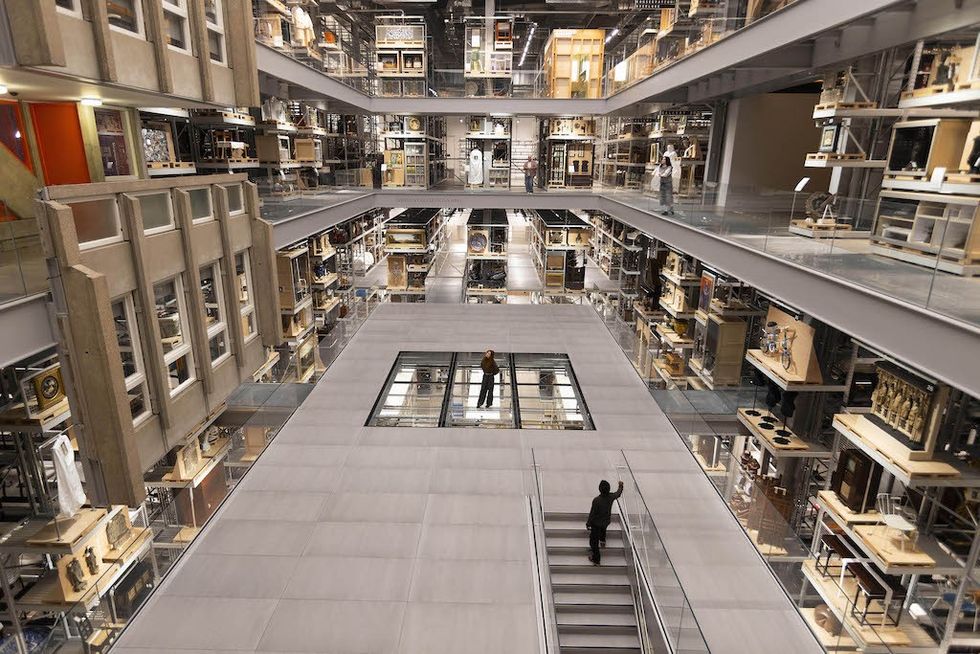 View of the Weston Collections Hall at V&A East Storehouse where the museum's objects are all on show, waiting for guests to discover them Image by David Parry, PA Media Assignments
This balancing act led to a self-guided approach that walks a line between comfort and a sneak peek.
“You're not being followed around and checked upon,” says Reeve.
“And we've designed the public network in a way that really facilitates the ability to wander. To really feel like you are somewhere you're not really supposed to be, but you're comfortable with it.”
Comfortable, maybe, but the team has purposefully chosen to embrace overwhelm. “That is part of what we want,” says Reeve, “people to feel a bit overwhelmed.”
The aim, he adds, is to evoke an “oh my god” moment through scale and theatricality, driven by the magnitude and proximity of objects without digital moderation.
Kaleidoscopic experience
The Storehouse's design emphasises its industrial philosophy with raw, functional materials, highlighting its authentic working space and inviting the public into normally hidden areas.
Here, the public has the fullest possible access and agency to decide what they want to do.
“Typically, if you go to an exhibition in a gallery, it's very focused on a particular medium, a particular period, says Reeve.
“Whereas what you've got at Storehouse is like a kaleidoscope experience, it’s all there, all at the same time.”
This approach invites visitors to make their own connections and tell their own stories.
“Visitors have to work quite hard at Storehouse, but are enjoying just not being told what to do. Using their own imagination, and working out what the creative journey is that works for them.”
Community consultation
The Storehouse is joined by the more traditional V&A East Museum, located just a 10-minute walk away.
Both were developed through extensive community consultation, which Reeve describes as “a real friend to us.”
“This is a part of London where deep research tells us that we've got a very young, very diverse, very international, very creative population,” he says.
A large proportion, he adds, feel that museums are not for them, even that museums have almost been deliberately designed to exclude them.
“We're very conscious there's a healthy degree of scepticism about V&A.
“So that time for us to get to know East London as a place, as an urban environment, get to know the people… has been an absolute godsend for us.”
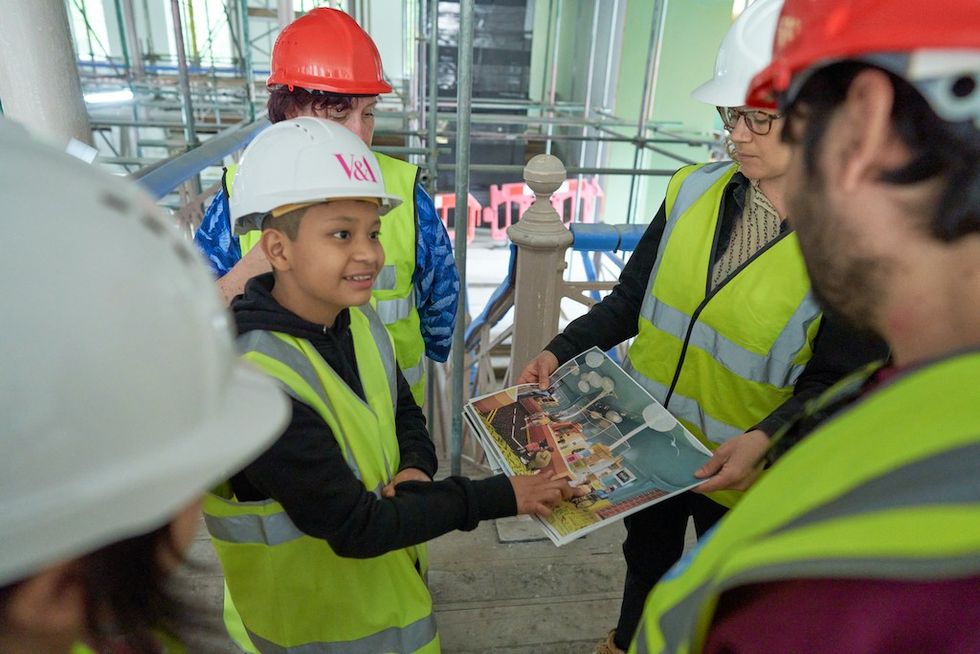 Co-creation happens across all new V&A projects: pictired here are Young V&A Youth Collective members having a tour of the Young V&A construction site, during the build phase Image courtesy of Young V&A
Initiatives such as the V&A East Youth Collective, which has engaged around 100 young people as council members, have embedded a sense of ownership in V&A East.
“There isn't much in V&A East Storehouse that we haven't discussed with the V&A Youth Collective in a very genuine way, “ says Reeve.
“They have helped us make decisions. They've made some of the decisions themselves. They've challenged us where they think we've not got things quite right.
“They've challenged us, and almost without exception, we've listened to them.”
East London as a cultural hub
While the V&A East Museum and Storehouse have an unmistakable local resonance, how do they attract tourists away from the city centre?
East London, Reeve says, has a very strong pull for tourists; it “is a big draw. There's a lot to see, there's a lot to do, it's a really fascinating part of London.”
See also: "Reflecting their hopes and dreams": creating V&A East Museum
And much of London’s international appeal is driven by culture, and these audiences, he adds, are curious and keen to explore new offerings.
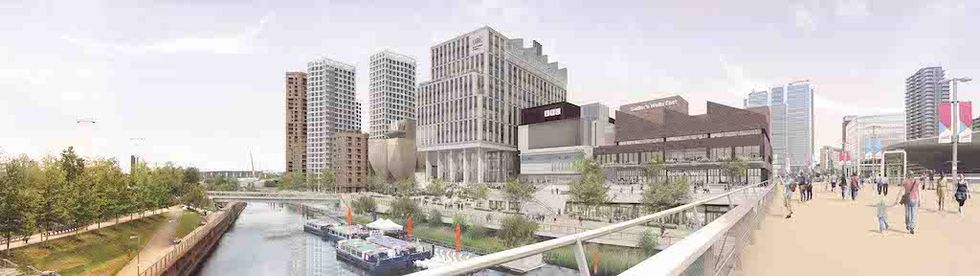 The East Bank partnership is rooted in East London's diverse communities and embodies the creative spirit and legacy of the London 2012 Games Image courtesy of London Legacy Development Corporation
“So, in that sense, what we're doing in East London, and East London itself, has got a big advantage. And obviously, we are part of a big legacy development in the Olympic Park.
“It's a great place to visit. And London and Partners and other agencies are really mindful of that.”
Immersion within museum contexts
The conversation then turned to innovations within museums. Immersive experiences, Reeve says, are important to watch.
Although he adds that he does not consider such shows as “museum experiences”, he is considering how they may be relevant to museum visitors.
“We don't want to Disney-fy what we do in museums,” Reeve says, “but there is definitely something in that space that is quite interesting for us to think about.
“So this is really where institutions like the V&A are spending quite a lot of time and brain power.
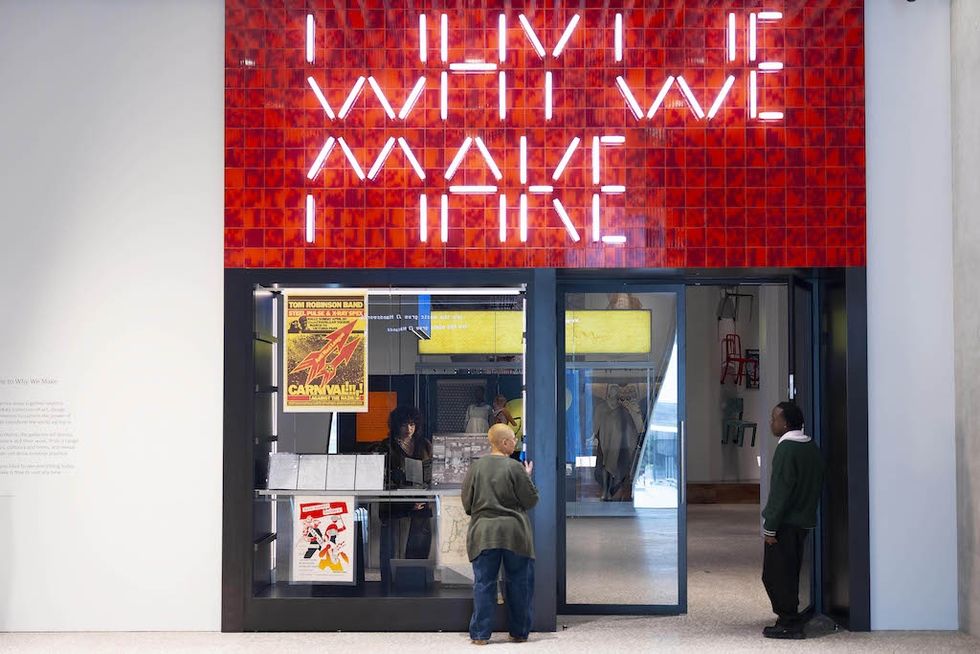 Entrance to V&A East Museum’s Why We Make galleries, which hold over 500 objects from the V&A’s collection spanning art, architecture, design, performance and fashion © David Parry for the V&A
“How can we make this a meaningful part of the experience for a V&A visitor, whilst at the same time hanging on to what we do best?
“Like Storehouse behind me, which is fundamentally a very analogue experience. And deliberately so.”