

Attractions have rarely treated every date or experience as equal. Attendance patterns fluctuate by weekday, season, school calendars, weather, and even the type of experience on offer. Pricing, naturally, has evolved to reflect those differences.
Two approaches are often discussed in this context: variable pricing and dynamic pricing. Although the terms are sometimes used interchangeably, they are built on different assumptions—particularly when it comes to the role of time.
Variable pricing: differences across events, not over time
Variable pricing establishes distinct prices for different days or events, typically based on expected demand. A midweek visit might be priced lower than a weekend ticket, or off-season dates may carry a discount relative to peak periods.
Once these prices are set, however, they generally remain unchanged throughout the sales window. A ticket for a specific Saturday may cost the same whether it is purchased months in advance or the night before the visit.
For many attractions, this approach feels familiar and manageable. It aligns pricing with broad demand expectations and is easy to communicate to visitors. The challenge is that it assumes demand unfolds exactly as predicted.
When conditions change—unexpected weather, shifts in booking pace, external events—prices remain fixed, even if the original assumptions no longer hold.
Dynamic pricing: introducing time as a decision input
Dynamic pricing starts from a similar foundation. Prices still differ by day, season, or experience type. The key distinction is that prices are not locked in once sales begin.
Instead, prices can evolve as the event approaches, incorporating new information such as booking activity, remaining capacity, and other emerging demand signals.
This does not mean abandoning structure or fairness between events. A higher-demand Saturday can remain consistently priced above a quieter Wednesday, while both adjust gradually over time.
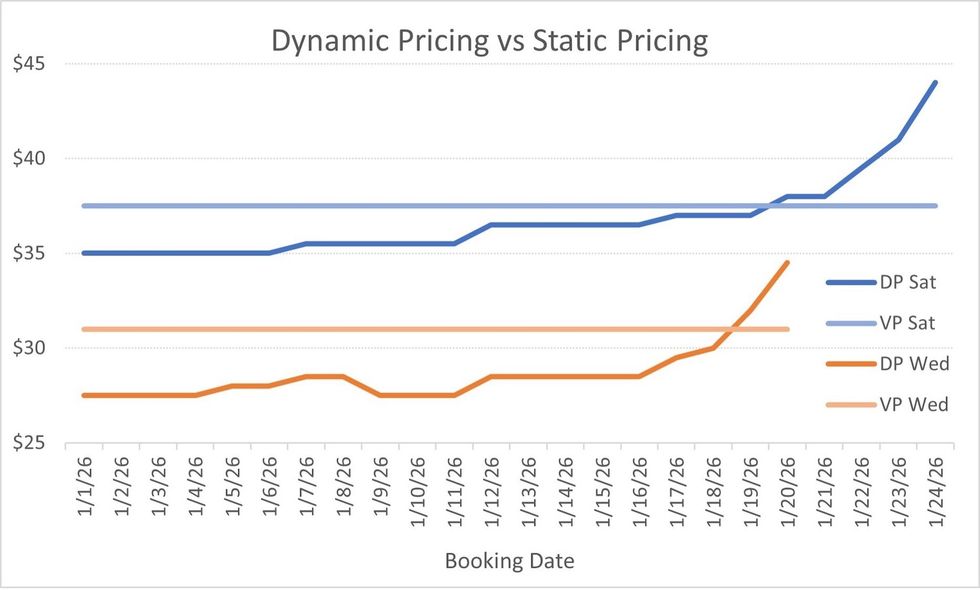 Figure 1
Figure 1 illustrates this distinction. Under variable pricing, prices for each visit date remain flat throughout the booking window, even though Saturday is consistently priced above Wednesday.
Under dynamic pricing, prices for both days adjust over time as the visit date approaches, while preserving the underlying difference in demand between a weekend and a weekday.
Seen this way, dynamic pricing is less about constant price movement and more about maintaining relevance. It allows pricing to reflect what is being learned during the sales process rather than relying solely on assumptions made far in advance.
Why time matters in pricing decisions
Treating time as an input changes how pricing performs in practice.
First, it allows pricing to respond to changing conditions. Demand is not static, and factors influencing it often become clearer as the visit date approaches. Static prices cannot reflect this evolution.
Second, it introduces a broader set of choices for visitors. Guests who prioritize certainty or affordability may choose to book earlier, while those who value flexibility may accept higher prices closer to the visit.
Importantly, everyone sees the same prices at any given moment; the difference lies in timing, not in who the guest is.
Third, adjusting prices over time reduces the pressure to be “perfect” at the outset. Instead of committing to a single price months ahead, attractions can refine pricing as real booking behavior becomes visible.
Finally, pricing objectives themselves may shift. Early in the sales window, the focus may be on stimulating demand or building momentum.
Later, the emphasis may move toward maximizing revenue from limited remaining capacity. Fixed prices cannot reflect these changing priorities.
Choosing the right framework
The distinction between variable and dynamic pricing is not about complexity for its own sake. It is about whether pricing is treated as a one-time decision or an ongoing one.
Variable pricing differentiates between events based on expected demand. Dynamic pricing adds the ability to adapt those expectations as time passes.
For attractions operating in uncertain and fast-changing environments, that difference can shape both financial outcomes and the visitor experience.
At its core, dynamic pricing reflects a simple idea: prices work better when they can learn.
Learn more about Digonex’s strategic approach to Dynamic Pricing here.
The Digonex team is also presenting an IAAPA webinar titled Seeing the Forest for the Trees: How The Morton Arboretum Translated Holiday Revenue Success Into A Year-Round Dynamic Pricing Strategy on 23 April.