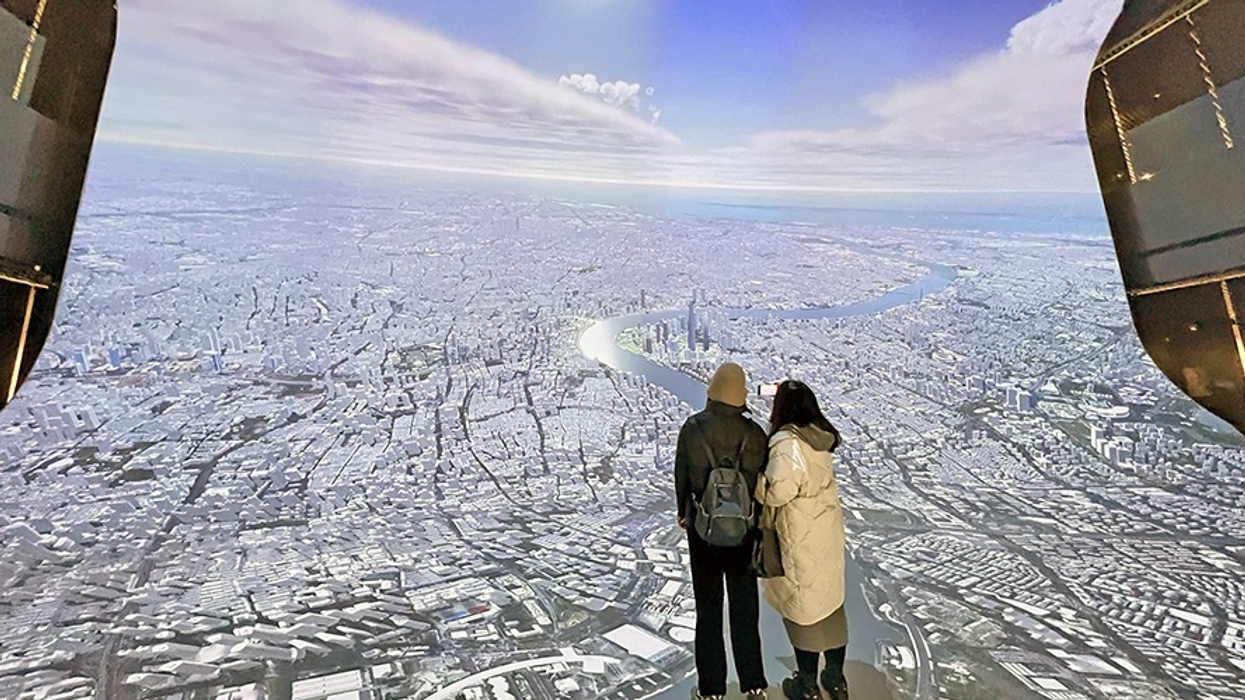

project: syntropy, a creator of technology and display solutions for dome cinemas and immersive attractions, designed, engineered and delivered the complete visual system for the Digital Sandtable at the Shanghai Urban Planning Exhibition Center (SUPEC) at People's Square in Shanghai.
This project sets an industry benchmark for immersive digital twin technology. Urban digital twins are now key to city planning and understanding, and the Shanghai installation shows what these systems can do and what it takes to achieve them.
The term "digital twin" appears in many urban planning and design tools, from smart city strategies to exhibition briefs. Its meaning varies: from a real-time, data-connected city model to a detailed 3D visualisation used for static display.
"Both have their place," explains project: syntropy. "But the distance between them — in terms of rendering infrastructure, real-time data integration and interaction design for professional multi-user environments — is significant, and worth understanding clearly before a system is specified."
Where visual appeal meets fuction
A recurring challenge in institutional digital twin setups is balancing high visual quality with functionality. A detailed city model with accurate geometry, street layout, and textures offers an engaging experience. But making the model queryable, updatable, and capable of running real-time scenarios transforms it from an exhibit into a professional tool.
This distinction matters because the institutional audience for a serious urban digital twin is rarely homogeneous. SUPEC is designed to be barrier-free, inclusive and family-friendly, serving school classes, the general public and professional visitors within the same physical space and system.
An urban planning exhibition centre must appeal to a curious twelve-year-old and also be rigorously detailed for a transport engineer reviewing mobility scenarios. These are different needs, so the visual system must be designed from the start to serve both purposes.
The Digital Sandtable at Shanghai's SUPEC, which reopened following a major modernisation programme built around this installation, exemplifies this approach.
The refurbishment of SUPEC was led by SBA Staedtebau Architekten, Germany, which was commissioned to update both the building and the exhibition concept. This included transforming the central exhibit, the physical model of the city centre at 1:500 scale, into a 5D Digital Twin of Shanghai.
The Fraunhofer Institute IFF's Elbe-Dome 2.0, which features a distinctive projection system recently upgraded by project: syntropy, served as the technological blueprint for this exhibit.
The museum's mission is to showcase the city's master plan, "Shanghai 2035," a long-term framework for development, mobility, environment, and livability goals in a complex urban environment, to diverse audiences, including students, visitors, planners, researchers, and policymakers.
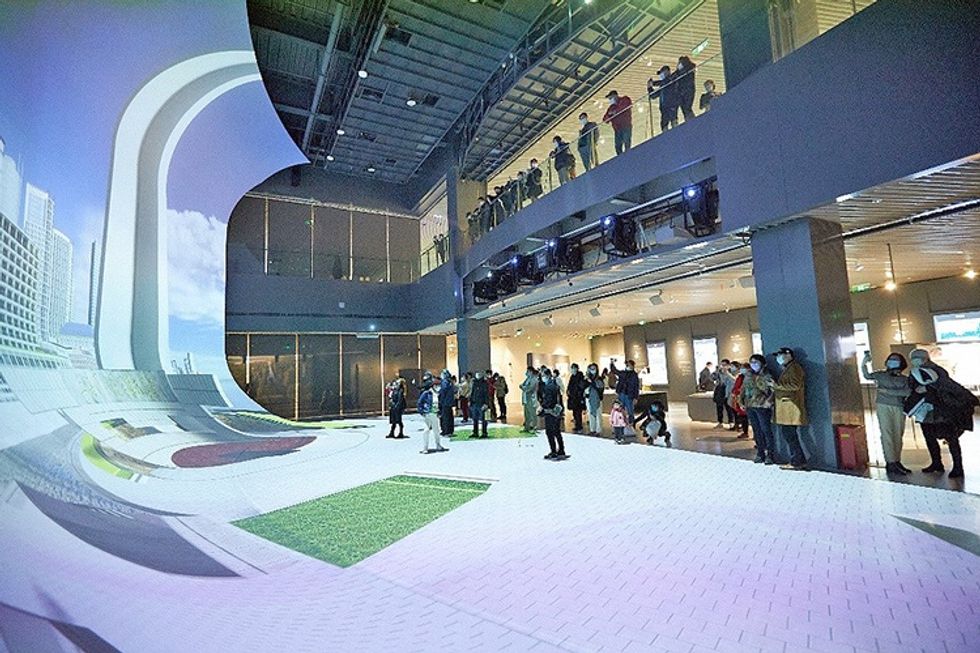
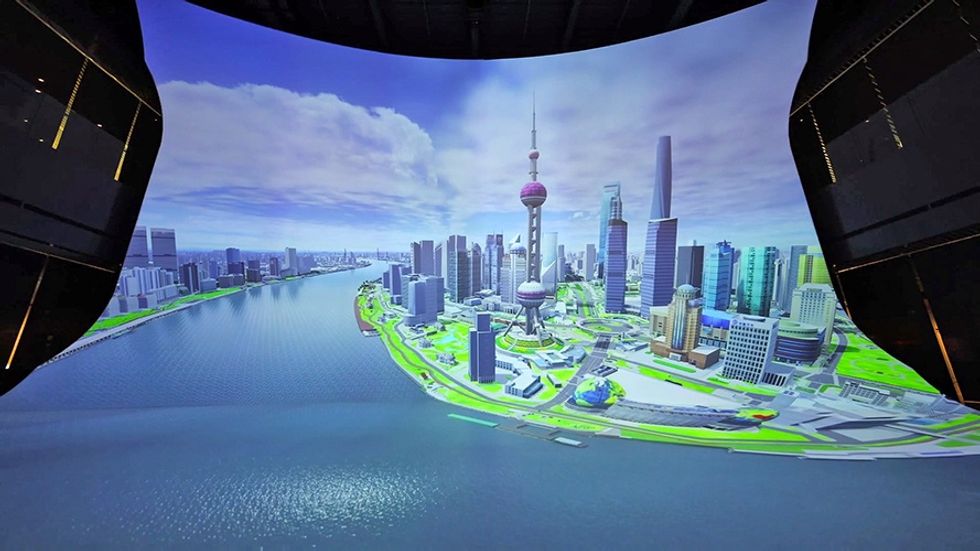
Designed and delivered by project: syntropy, the installation wraps visitors across two floors within a 20-metre-wide, 10-metre-high fibreglass projection screen whose geometry — toroidal at the upper and lower thirds, cylindrical in the centre — gives the overall surface the profile of a wave, completely enclosing the visitor in the image.
A floor projection extends the immersion downward.
A 12+11-channel 4K projection system with 3D stereo capability, managed by domeprojection.com’s ProjectionTools for automatic alignment and geometry correction, is driven by a 24-channel high-performance image-generation render cluster running a fully dynamic, real-time 3D city model of the Shanghai metropolitan area, built from official municipal data.
A 22-channel surround-sound system completes the sensory environment.
project: syntropy's work for the 5D mixed reality attraction included the creative-technical concept, system design, delivery, installation, integration and commissioning of the complete visual system, including screen, IG render cluster, surround sound audio system, media control, as well as the initial calibration and the final training of the operating staff.
Multipurpose design
"What makes this installation a meaningful reference point is not its scale — though the scale is significant — but its interaction architecture," says project: syntropy.
Multiple high-end tracking systems enable the installation to switch between visitor experience, VIP presentation, and expert urban planning modes, with selectable eyepoints supporting stereoscopic accuracy. GIS data layers, mobility simulations, planning scenarios, and environmental analysis can be overlaid and updated in real time.
An upper-floor VIP area supports meetings and presentations.
The model is designed to be expanded and modified continuously as the city evolves. On-site maintenance is handled by project: syntropy's local staff, ensuring operational continuity without dependence on international support logistics.
The SUPEC installation illustrates that effective digital twins rely on robust system design as much as visual impact. Delivering real-time, city-scale rendering across a complex multi-screen environment requires dedicated hardware, network capacity and careful calibration from the outset—far beyond a single-machine setup.
At the same time, professional use demands sophisticated multi-user interaction, enabling different users to engage simultaneously without disrupting the shared experience. This calls for advanced tracking, control systems and interaction logic, not just standard interfaces.
Crucially, long-term value depends on an open, adaptable data architecture. Systems that can evolve with new data and scenarios remain relevant, supported by ongoing local expertise, while static models quickly become obsolete.
Digital twins for the attractions industry
The project: syntropy team explains that the lessons from SUPEC are not specific to Shanghai or to planning museums. Any institution commissioning a digital twin visualisation, like a science centre, transport authority visitor facility, corporate innovation centre, or government smart city showcase, faces the same structural choices.
The visual system, data architecture, interaction design and rendering infrastructure are tightly interdependent. Crucially, the installation’s purpose, whether for public engagement, professional use, or both, must be defined early, as each requires fundamentally different systems.
The SUPEC Digital Sandtable shows that it's possible to create an installation that combines public engagement and professional utility in a single system.
It requires advanced systems integration, takes longer to specify and commission than simpler exhibits, but results in a useful tool for professionals and provides visitors with insight into the complexity of a living city.
As urban digital twins become central, infrastructure decisions made during design will determine how much potential is realised.
Institutions with a mandate to communicate complex urban, environmental or infrastructure futures to mixed audiences, such as science centres, national planning authorities, smart city agencies, expo pavilions, corporate innovation hubs and transport operators, are finding that the Digital Sandtable model's technical ambition translates directly to their contexts.
The project: syntropy team is experienced in adapting this approach to widely varying briefs, scales and budgets.
Digital twins can serve multiple roles across sectors: from theme parks and science centres to expos, transport networks and cultural institutions, supporting design, public engagement and long-term planning.
What unites these use cases, says the company, is the need for a system, like SUPEC, that can serve both public and professional audiences on infrastructure built for long-term use, not just initial deployment.
Previously, project: syntropy collaborated with a team of specialists to deliver Odyssey Malta, the new flying theatre in Malta’s landmark Mercury Tower development.