Known for its heritage trains and trackless road trams, Severn Lamb is expanding its electric vehicle portfolio to meet the wider mobility needs of visitor attractions.
The Warwickshire-based manufacturer has traditionally focused on guest transport, with tracked trains, trams and road trains used across theme parks, resorts and other destinations. It is now broadening its offer to include compact electric vehicles for behind-the-scenes operations, from maintenance and security to housekeeping and logistics.
As attractions become larger and more complex, operators need mobility solutions that support both the visitor experience and the day-to-day running of the site. Severn Lamb's expanded EV portfolio is designed to address both.
Blooloop speaks to Patrick Lamb, managing director of Severn Lamb, about the changing mobility needs of visitor attractions and the role of electric vehicles in supporting guest and back-of-house operations.
Beyond the guest journey
Electric propulsion is not new to Severn Lamb, explains Lamb. “We have been developing battery-electric passenger transport solutions for many years. What has changed is the breadth of the requirements we are being asked to meet.”

Patrick Lamb, managing director of Severn Lamb
Severn Lamb's customers increasingly need more than vehicles for transporting large groups of visitors. They also need smaller vehicles for accessible transport, staff movement, maintenance, security, landscaping and other site operations.
“Expanding our portfolio allows us to support that complete mobility picture, from compact passenger and utility vehicles through to higher-capacity shuttles, road trams and rail systems."
"It is a natural extension of what Severn Lamb has always done: understanding how people and equipment need to move around a destination and providing the most appropriate solution.”
The invisible network behind the visitor experience
When discussing transport at visitor attractions, the focus tends to be on the highly visible elements: the entrance tram, the themed train circling a safari park or the scenic monorail. Behind these systems, however, is a continuous network of back-of-house logistics.
This behind-the-scenes movement of people, equipment, supplies and waste is vital to keeping a site running. Problems within this network can ultimately affect the guest experience.
"Visitors may never see most of the work taking place behind the scenes, but their experience depends upon it being carried out efficiently,” says Lamb.
“Maintenance teams need to respond quickly, catering and retail supplies must reach the right locations, waste has to be removed, landscapes and facilities must be maintained, and security staff need to move around the site effectively.
"At zoos, there may also be equipment and supplies required for animal care.”
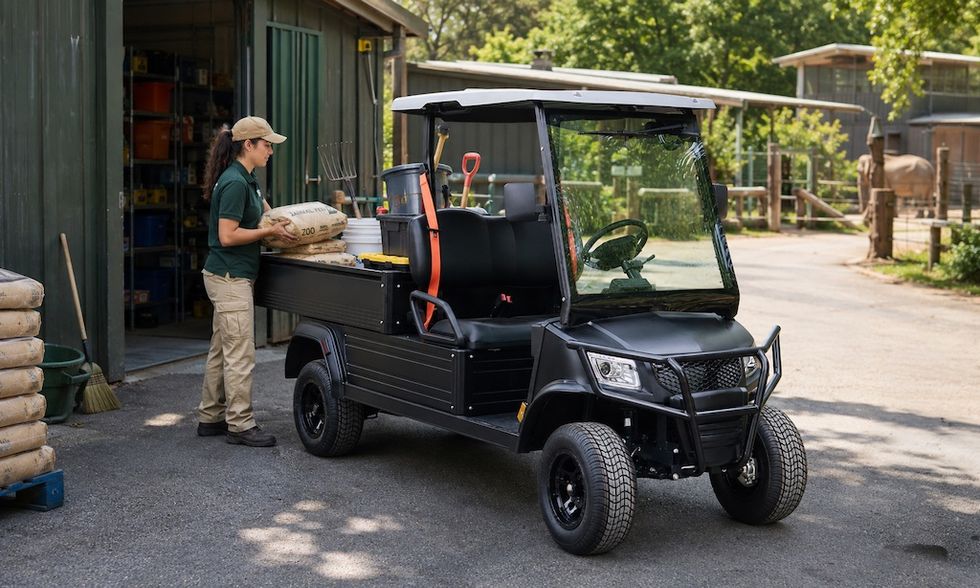
Severn Lamb's utility vehicles are used in zoos, aquariums, theme parks and more
An appropriate back-of-house fleet can therefore improve productivity while also helping a site remain clean, safe and welcoming.
“It is an essential part of the overall guest experience, even if it is rarely visible."
Traditionally, attractions relied on conventional vehicles to handle these tasks. However, a conventional van or larger utility vehicle driving through a tranquil botanical garden or near sensitive animal enclosures can break the immersion that theme parks and heritage attractions work to maintain.
"We are seeing growing interest from operators who want to replace conventional vehicles with something cleaner, quieter and better suited to the environment in which they are working," says Lamb.
"Many attractions operate across large or complex sites, but the majority of their daily journeys are relatively short and predictable. Staff may be transporting tools, supplies, waste or small groups of people throughout the day, often using vehicles that are larger than the task requires.”
Compact electric vehicles are well suited to this type of work.
"They are easy to manoeuvre, can be configured for different operational roles and can return to a central location for charging. Sustainability targets may begin the conversation, but efficiency, practicality and operating costs are increasingly important factors too."
Expanding the electric fleet
Partnerships with WAEV Inc. and EVX Mobility support Severn Lamb's expanded EV offering.
Announced in June 2026, Severn Lamb's partnership with WAEV Inc. brings WAEV's Compact Mobility and Utility EV ranges into its portfolio. US-based WAEV offers light-duty electric vehicles supported by a network of dealers and service centres.
The partnership also gives Severn Lamb access to WAEV's dealer and service network.
The partnership with EVX Mobility adds passenger-focused electric vehicles to complement the WAEV utility and compact range, including the Solar Shuttle.
"The continued development of our electric vehicle offering marks an important step for Severn Lamb," says Lamb.
"By building on our partnership with EVX and introducing WAEV's Compact Mobility and Utility EV ranges, we are expanding the range of sustainable solutions available to our customers and strengthening our ability to support a wider variety of operational needs."
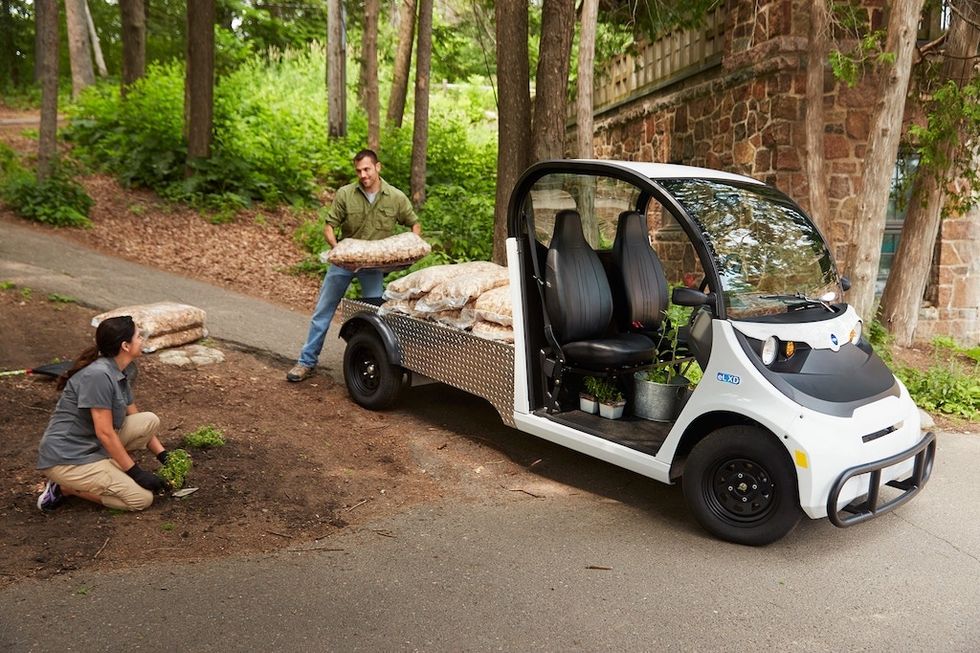
The GEM el XD is used for a range of applications such as maintenance, landscaping, logistics and site support
WAEV's product line offers durable utility electric vehicles built for demanding site operations. Models including the Bigfoot, GEM eL XD and Fusion Utility are designed for applications including maintenance, landscaping, logistics and site support.
"The greatest value is generally found in frequent, repeatable journeys where a conventional van or larger utility vehicle would be inefficient or intrusive," Patrick Lamb says.
"Utility EVs can transport tools, maintenance equipment, landscaping materials, deliveries and waste around a site. Compact passenger vehicles can support security patrols, staff movement, inspections and the transport of guests who require additional assistance."
For example, utility vehicles can be configured to carry maintenance equipment, landscaping materials and other bulky loads. They can also support catering, retail restocking and waste collection, particularly where staff and visitors share routes.
Their smaller footprint can be useful at attractions where staff and visitors share routes, reducing the physical presence of service vehicles.
"Different configurations allow operators to choose a vehicle suited to the task rather than adapting their operation around a standard vehicle," Lamb explains.
Supporting the guest journey
Alongside its utility vehicles, Severn Lamb's expanded portfolio includes compact passenger vehicles for resorts, gardens, historic sites and campuses.
The portfolio includes the GEM e2, e4 and e6, the wheelchair-accessible GEM WAV, GEM Ambulance, ShuttlePro XL and Fusion Passenger. Applications include guest and VIP transport, staff journeys and security, while the GEM Ambulance is designed for medical response teams operating on busy sites.
Accessibility is another important factor to consider, with features including wheelchair ramps, flexible seating and space for mobility equipment.
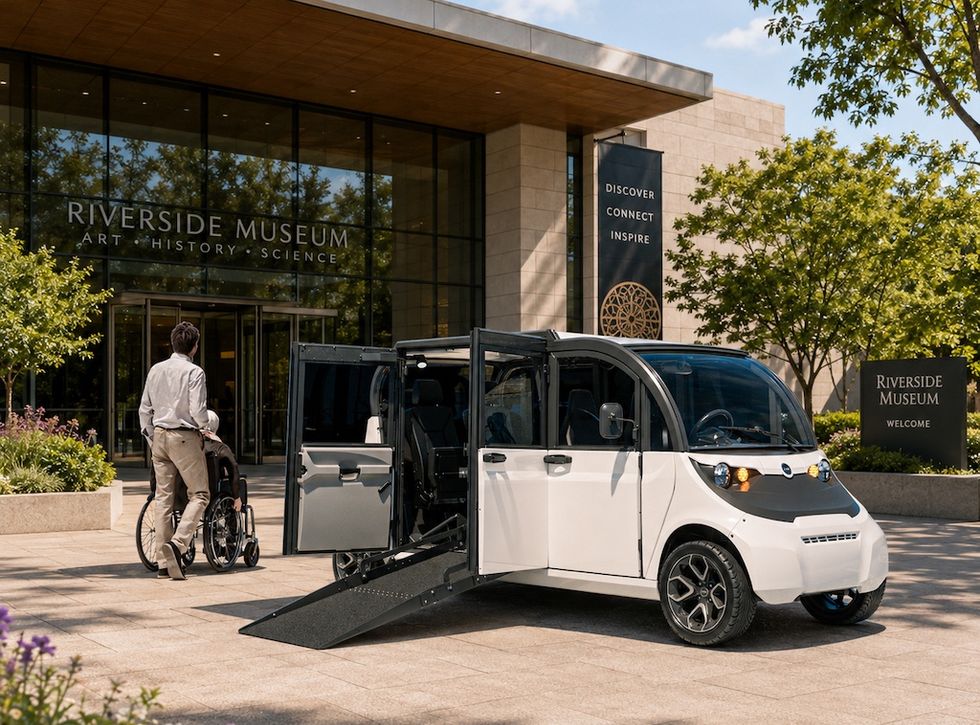
Electric vehicles can also make the guest journey easier
"Accessibility increasingly needs to be considered from the beginning of a transport project rather than added later," says Lamb.
"Attractions serve guests with a wide range of mobility requirements, including wheelchair users, older visitors and people who may find it difficult to cover long distances.
“The wider fleet also needs to provide enough flexibility to support individual journeys as well as larger-group transport. Good accessible transport should feel like an integrated part of the visitor experience, not a separate or secondary service.”
For higher-capacity routes, Severn Lamb also offers the EVX-powered Solar Shuttle.
"The Solar Shuttle bridges the gap between compact passenger vehicles and our larger road tram and rail solutions. With configurations for approximately 11 to 24 passengers, it is suited to regular routes around attractions, resorts, gardens, campuses and heritage destinations.”
The Solar Shuttle features a solar-assisted roof, wheelchair access and fleet-management capabilities.
Planning for real-world conditions
For visitor attraction operators, electrifying a fleet requires more than replacing petrol or diesel vehicles with electric equivalents. Operators need to understand how vehicles will be used day to day, from mileage and payload to terrain, operating hours, and seasonal demand.
Lamb says the process should start with the task, not the technology: "Operators need to understand actual daily mileage, payload, passenger numbers, gradients, road surfaces, operating hours and seasonal peaks.
“The vehicle must provide sufficient real-world range with an appropriate margin, while charging needs to fit naturally into the operating schedule. Payload and towing capacity should be assessed carefully, because an unsuitable vehicle will create inefficiency regardless of its power source."
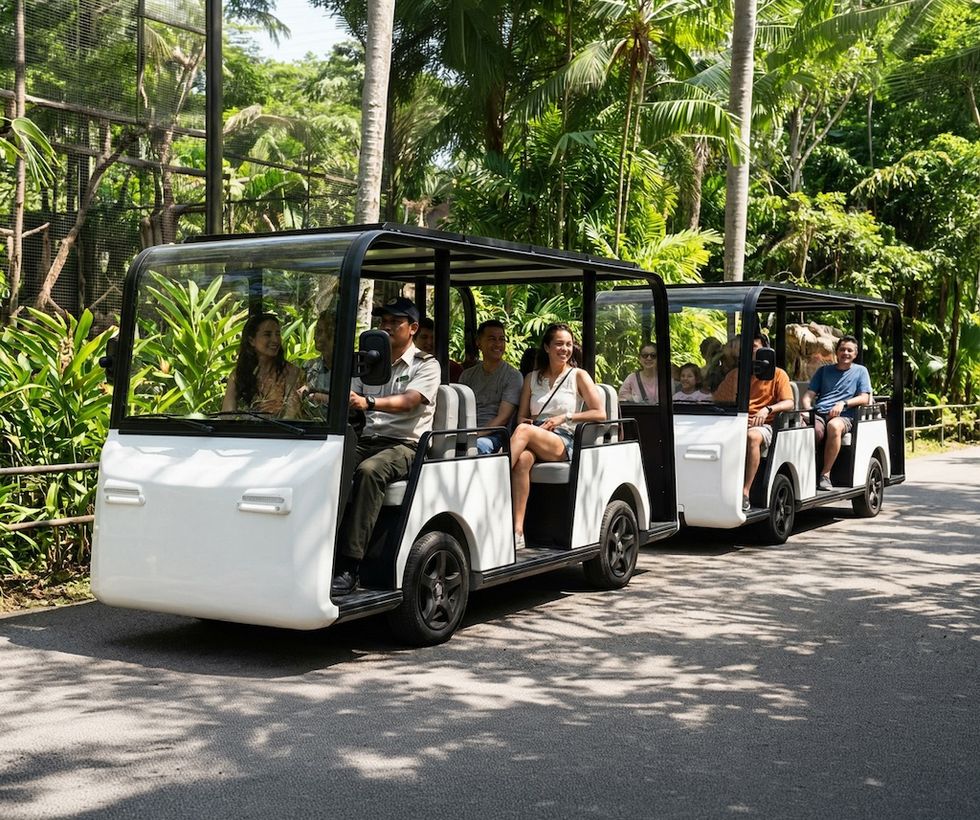
Solar Shuttle bridges the gap between compact passenger vehicles and Severn Lamb's larger road tram and rail solutions
Key considerations include the vehicle's duty cycle, terrain, climate and charging requirements. Attractions may also need to account for gradients, gravel or cobbled surfaces, weather conditions and charging requirements. Charging can be scheduled around operating patterns, whether overnight at a depot or during planned breaks.
Seasonal peaks are another important consideration. Designing a fleet around an average operating day can leave operators short of capacity when visitor numbers are highest.
"One of the clearest lessons is that the operating environment is often more complex than it initially appears.
"The busiest day of the year, rather than an average day, can reveal what a transport system really needs to deliver. Route conditions, gradients, weather, accessibility, charging opportunities and maintenance support can all influence the correct solution.
“We are also seeing greater interest in flexible layouts and fleet-management technology, as operators want better visibility of how their vehicles are being used. These conversations reinforce the importance of listening before proposing a product.”
Making the business case
While sustainability targets may prompt fleet electrification, operators also need a clear commercial case for investing in electric vehicles. That means looking beyond the purchase price to total cost of ownership, including energy, servicing, downtime and residual value.
"The strongest business case is often found in vehicles completing frequent, predictable journeys and returning regularly to a central base," explains Lamb. "This makes charging easier to plan and allows operators to make full use of the vehicle throughout its working life.”
Beyond reducing tailpipe emissions, electric vehicles can offer lower energy costs, reduced routine maintenance and quieter operation. Quieter operation is particularly valuable in visitor areas, around animals and near hotels or accommodation.
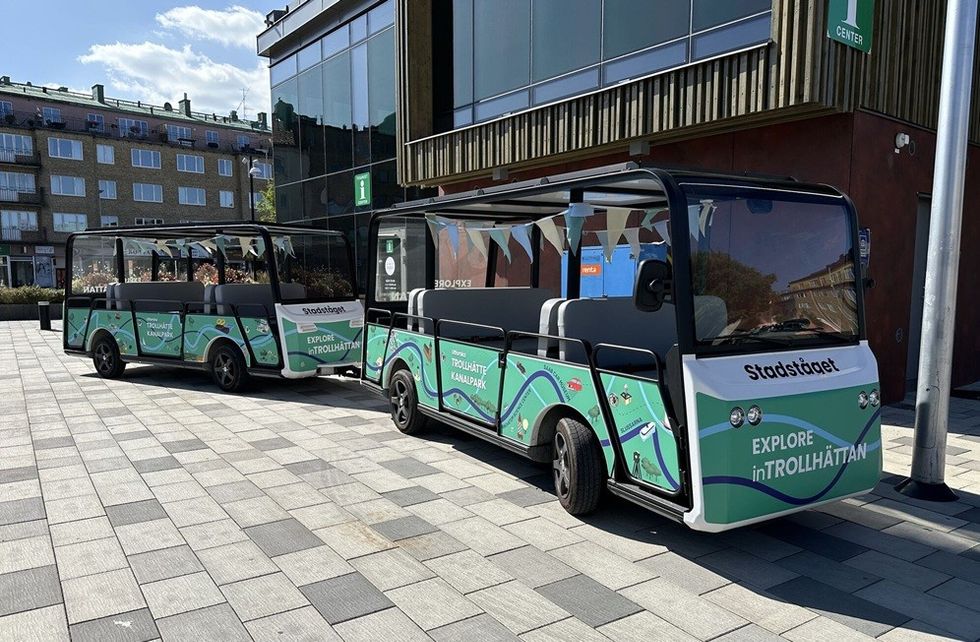
The Solar Shuttle in action
The business case should therefore consider the vehicle's full operating life, including purchase cost, energy, servicing, downtime and residual value.
"Space is extremely valuable at most attractions," says Lamb.
"Routes may be narrow, shared with pedestrians or constrained by existing buildings, landscaping and historic infrastructure. A compact EV can negotiate tighter spaces, require less parking and operate with less disruption than a conventional road vehicle.
“This is particularly useful at heritage sites, gardens and established attractions where routes cannot easily be widened or altered.
Towards more connected fleets
As attractions move towards lower-emission operations, site fleets are likely to become more electric, connected and tailored to specific tasks.
Rather than relying on one vehicle type, operators can combine compact passenger vehicles, utility vehicles, shuttles, and larger transport systems to meet the needs of different routes and tasks.
Lamb expects this shift to accelerate over the next five to 10 years, with data and smart technology playing a growing role.
"Attraction fleets will become increasingly electric, connected and task-specific. Rather than using one type of vehicle for every purpose, operators will build integrated fleets in which compact passenger vehicles, utility platforms, shuttles and larger transport systems each perform the work for which they are best suited.
“We are also likely to see greater use of fleet data, smarter charging and more emphasis on accessibility, whole-life costs and service support. The transition will not happen at the same speed everywhere, but the overall direction is clear."
Fleet-management systems and telematics can give operators greater visibility into vehicle location, battery performance, and maintenance needs, while smarter charging can help them manage energy use and costs.
The expansion of electric vehicles reflects a broader shift in how attractions approach site mobility. Electric vehicles can increasingly support both guest-facing transport and the back-of-house operations that keep attractions running.
For operators, the challenge is likely to be less about choosing between electric and conventional vehicles and more about determining where different types of electric vehicles can deliver the greatest operational value.
As fleets become more specialised, the emphasis will be on matching vehicles to the realities of each site, from guest transport and accessibility to maintenance, logistics and other back-of-house needs.
"Severn Lamb wants to be a long-term mobility partner within that transition, combining our established experience in passenger transport with a much broader electric vehicle portfolio,” concludes Lamb.
“Our aim is to help operators select the right solution for every part of their site, from behind-the-scenes operations to the guest journey."
Meet the Severn Lamb team in London at IAAPA Expo Europe 2026 from 22 – 24 September at booth #S1416 and in Orlando at IAAPA Expo 2026 from 17 – 20 November at booth #S3728 and #S3832.