
Museum of Ice Cream has spent ten years being accused of not being a museum, which may be true but is also beside the point. Nobody enters a pool of plastic sprinkles expecting to emerge with a firmer grasp of the Dutch Masters.
The better question is what people are buying when they pay to climb into it.
I attended the grand-opening celebration for its new Las Vegas flagship at Area15 with my partner, Maria, and our preteen and teenagers, which made us a useful little control group.
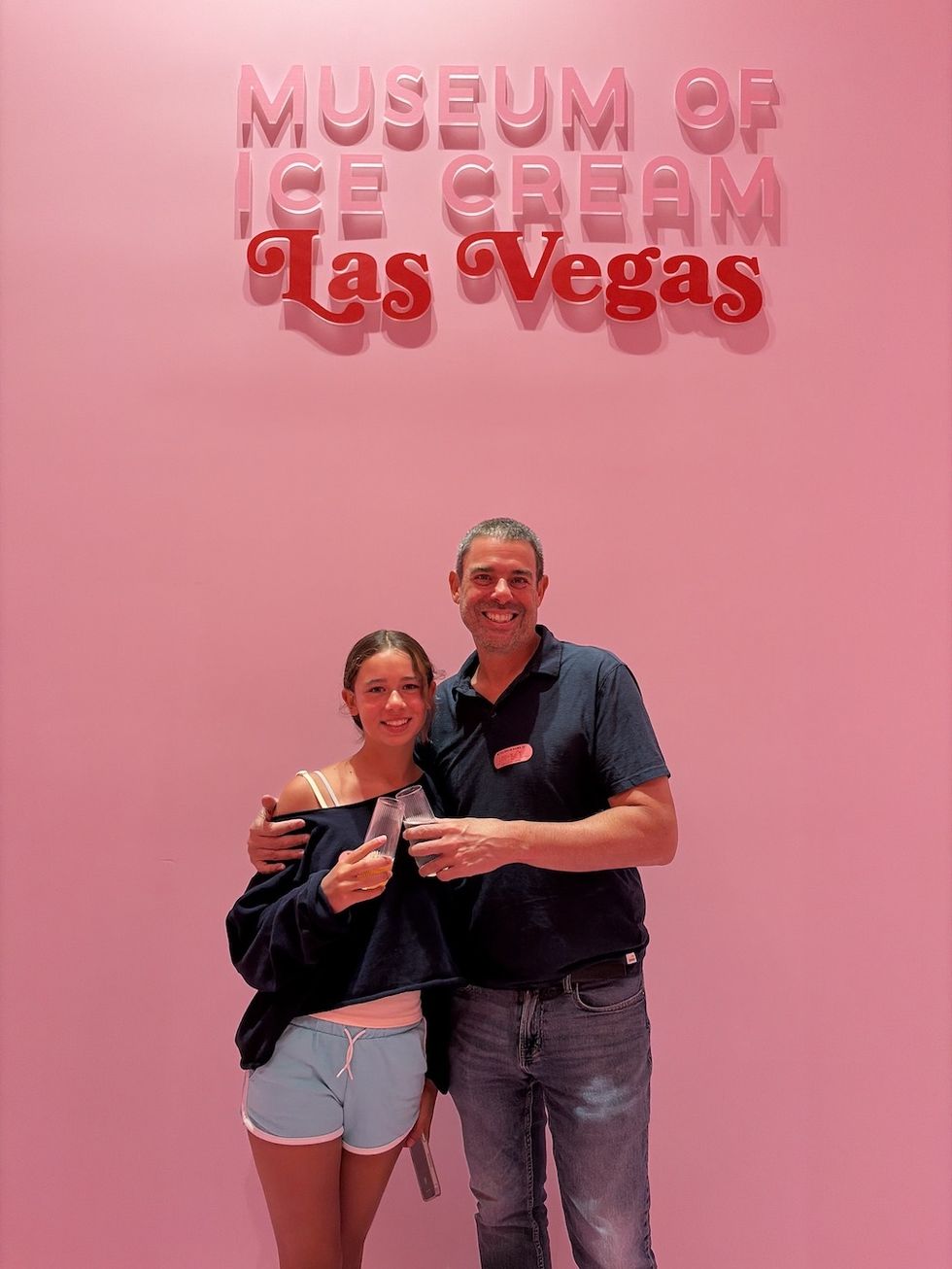
Lou Pizante and family attended the opening of Museum of Ice Cream in Las Vegas
Image courtesy of Lou Pizante
We arrived in the usual family formation: parents in charge, the youngest prepared to enjoy herself without committee approval, and the older kids maintaining the careful neutrality of “pre-men” who would prefer not to be caught wanting anything too much.
Most family entertainment preserves those roles. There is an intended audience and an accompanying one. Children play. Parents supervise. Teenagers stand at a dignified distance and make clear that their presence should not be mistaken for consent.
Museum of Ice Cream is designed to make that arrangement difficult.
The permission business
Its Las Vegas location is the largest yet: nearly 30,000 square feet, with fourteen immersive environments, slides, games, theatrical encounters, an ice-cream buffet and, inevitably, the sprinkle pool.
There are costumes, oversized props, a cake-shaped wedding chapel and a casino dedicated to the proposition that games of chance can be improved by replacing money with cones.
It is not subtle, although subtlety would be a peculiar demand to place upon a venue whose principal structural material appears to be fondant.
The original New York pop-up opened in 2016 and was quickly classified as a “selfie museum,” a category that sounded descriptive for about six months and accusatory ever after.

Museum of Ice Cream first opened as a pop-up in New York City
Image courtesy of Museum of Ice Cream
The criticism was not entirely wrong. These places understood, earlier than many traditional attractions, that the visitor no longer wished merely to look at the picture. The visitor wished to enter it, improve it with their presence and send evidence to everyone they had ever met.
At its worst, the category became a brightly colored factory for producing proof that fun had occurred. But the photograph was never necessarily the whole transaction. Sometimes it was merely the receipt.
What Museum of Ice Cream actually sells is permission.
Children require very little of it. Give them a slide, a costume or a room full of objects they have been told not to throw, and they will understand the assignment before the safety briefing is over.
Adults are more difficult. We have been trained to stand at the edge of things, hands in pockets, waiting for a placard to explain why enjoyment is culturally significant.
Teenagers occupy the dangerous middle ground. They remember how to play but have recently discovered witnesses.
How grown adults fall
So the modern immersive attraction builds an elaborate permission structure, and it builds it primarily for the adults, because the adults are both the wallet and the problem.
The colors announce that solemnity has been suspended. The hosts model enthusiasm at a pitch no unpaid person could sustain. The rooms issue instructions disguised as invitations.
The props are sized so that dignity becomes a logistical impossibility; it is difficult to project executive authority while lowering yourself into a vat of anything, and the museum knows this and has planned accordingly.
I watched it happen to myself in real time. I entered the sprinkle pool as a man with a considered opinion about the sprinkle pool. I emerged having lost a race to my twelve-year-old and a shoe to the sprinkles, and holding, for reasons I still cannot reconstruct, a giant inflatable cherry.
Somewhere between those two states, a transaction had occurred, and I had not been consulted about it.
The teenagers held out longer, as teenagers are engineered to. What undid them was not the museum. It was the sight of their parents already thoroughly undone.
Adolescent cool depends on being the only person in the room withholding consent. It does not survive the discovery that the adults have stopped keeping score. There is no dignity to protect once your dad is wearing a paper crown and your mom is winning at cone roulette.
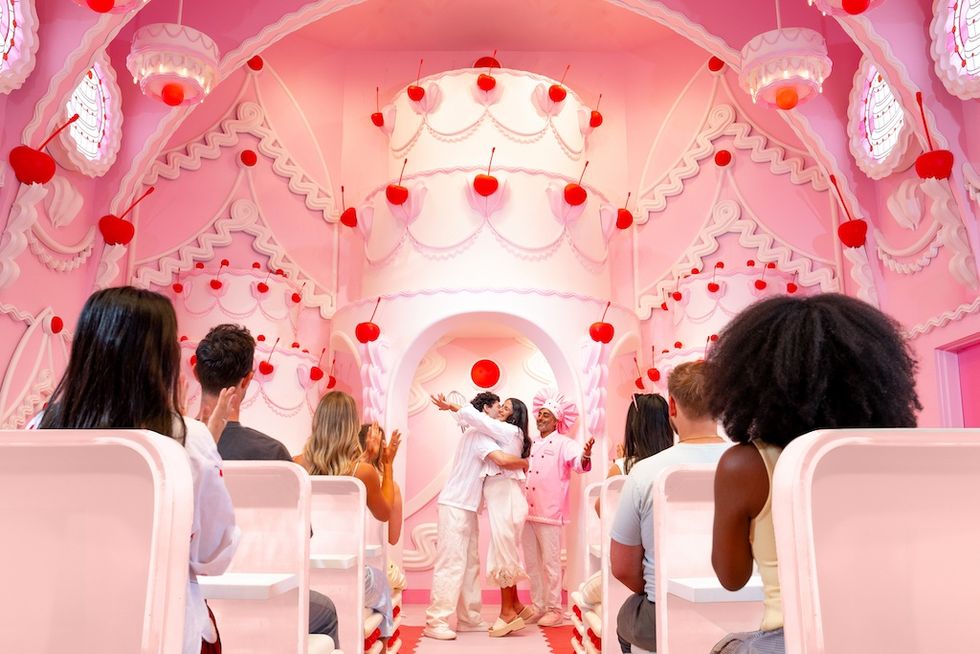
In true Vegas fashion, Museum of Ice Cream's latest location features room designed like a chapel
Image courtesy of Museum of Ice Cream
None of this is improvised. Manish Vora, co-founder, co-chief executive, and therefore the man ultimately accountable for my missing shoe, treats the collapse of adult composure not as a happy side effect but as the product specification.
“We lead with joy on purpose, because many adults won't get there on their own, especially in public,” he explains, brushing a piece of fudge from my collar without breaking eye contact or stride.
“Every experience at Museum of Ice Cream Las Vegas is built to lower the cost of participating, so a parent doesn't have to decide to have fun, they just end up immersed in it.
"That's the design goal: permission to stop performing composure for a few hours of nonstop play, unlimited ice cream, and multi-generation bonding.
"In many ways, we call it a ‘Museum of Ice Breaking’ as much as a Museum of Ice Cream."
He's right, but there's a further layer. Moving through the experience together, something more interesting became clear. The museum was not simply making adults feel younger. It was making age briefly less important.
The same plane
The preteen did not need persuading. The teenagers required only the plausible deniability provided by everyone else behaving just as foolishly. Maria and I stopped pretending we were there primarily to supervise or conduct market research.

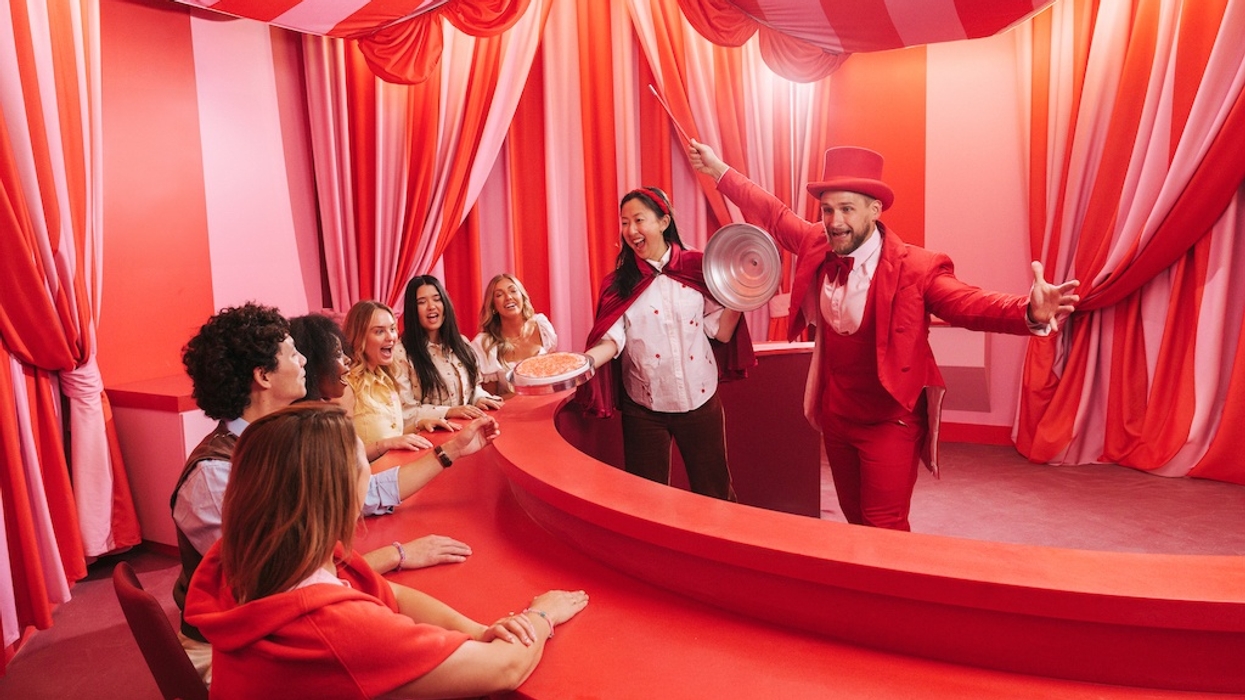
Visitors at Museum of Ice Cream's new Area15 location enjoying the Big Top
Image courtesy of Museum of Ice Cream
Nobody became a child again, exactly. We simply became less committed to occupying our assigned ages.
That may be the rarer achievement.
Plenty of attractions bring different generations into the same building. The unusual ones bring them onto the same plane.
And when that happens, parents cease to be merely facilitators. Teenagers cease to be reluctant dependents. Children cease to carry the entire burden of visible delight, which is a heavy thing to ask of one small person for an entire afternoon.
Everyone is confronted with the same ridiculous proposition and given the same choice: remain outside it, or enter.
A district built to lower your guard
Las Vegas is the natural laboratory for this because it has always been in the permission business. It permits extravagance, appetite, reinvention and behavior later filed under "not really us."
Museum of Ice Cream offers a gentler edition of the city's core product: not permission to misbehave, exactly, but permission to behave like someone who has not yet learned to be embarrassed by delight.
Area15 matters for a related reason, and it is the more important one. A single impossible attraction can feel like a stunt that owes you an explanation. A district full of them quietly revises the definition of normal.
By the time visitors reach Museum of Ice Cream, they have already wandered through invented worlds, stood under monumental art and treated elaborate make-believe as an ordinary way to spend a Tuesday.
The self-consciousness has been worn down a few attractions ago.
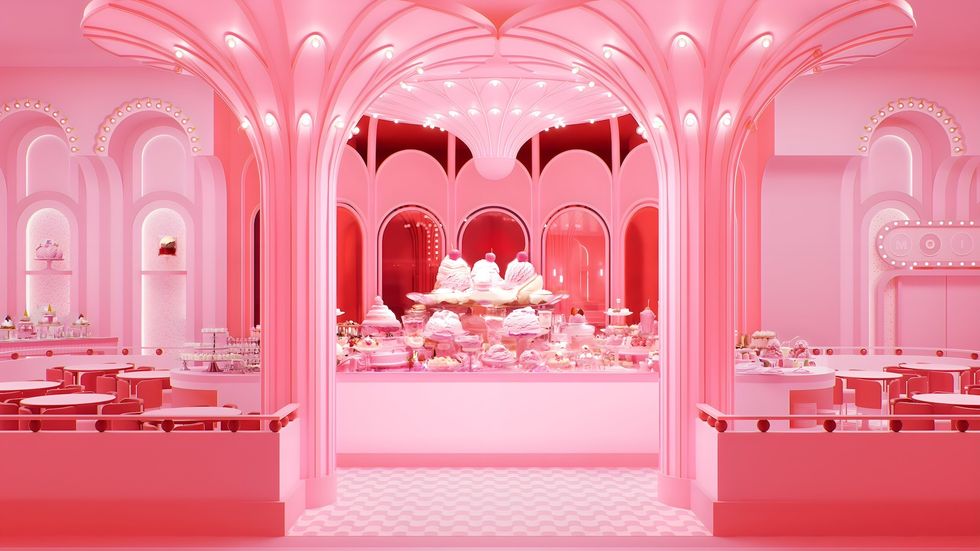
Museum of Ice Cream is the latest tenant at the Area15 entertainment complex
Image courtesy of Museum of Ice Cream
Area15 does not merely collect unusual experiences. It lowers the social cost of surrendering to them, so that each venue inherits a guest who has already agreed, somewhere back near the entrance, to stop being difficult.
Winston Fisher, Area15's chief executive, is a longtime champion of location-based experiential, a man who long ago traded conventional square footage for the more speculative business of wonder.
He says Area15 is "built on a simple belief: that discovery, creativity, and self-expression are things people are hungry for and rarely given permission to feel."
He adds: “Put enough wonder in one place and something shifts — the physical becomes a world, and a guest stops performing and starts participating.
"Museum of Ice Cream understands this in its bones. They’re pioneers who helped launch this category, and what they’ve created in Las Vegas is a new high-water mark that will help define the industry for the next decade.”
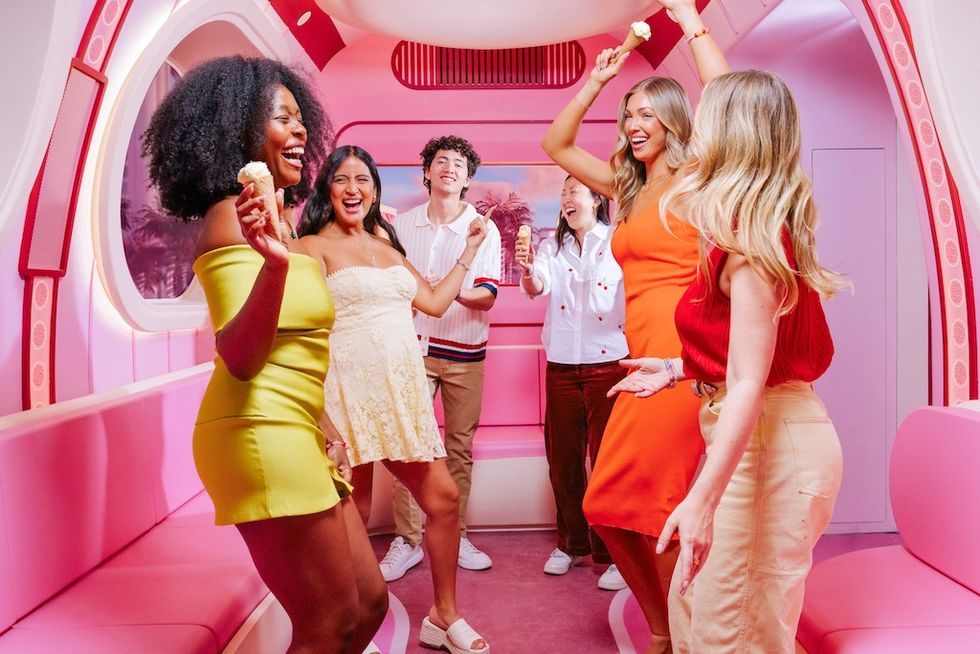
Guests enjoy the Party Bus at Museum of Ice Cream at Area15
Image courtesy of Museum of Ice Cream
None of this means the critics are wrong to be suspicious.
Commercial play can curdle into compulsory play, and there are few things more dispiriting than being ordered to have fun by a cheerful person with a two-way radio clipped to their belt and a clear coiled earpiece in one ear, visibly monitoring the hourly throughput.
An attraction can confuse noise with energy, participation with engagement, and the manufacture of photographs with the manufacture of memories.
The museum, therefore, has to earn the surrender it requests.
It succeeds only when the instructions fall away, and guests begin responding to one another rather than to the staff—when the slide becomes a race nobody scheduled, the costume becomes a family joke that will outlive the trip, and the photograph is delayed because something is happening that nobody wants to interrupt long enough to document.
The least foolish person in the room
But some of the criticism aimed at places like this may quietly reveal the very condition they are built to relieve. We have become skilled at treating self-consciousness as a form of sophistication.
Standing at the edge can be discernment. It can also protect a comfortable advantage: I am the observer, not the observed. The person clever enough to explain the joke, not foolish enough to climb into it.
The critic beside the sprinkle pool may be seeing the experience with perfect clarity. The critic may also be guarding the one privilege the experience asks everyone to give up: the privilege of being the least foolish person in the room.
That matters well beyond a building full of dessert puns.
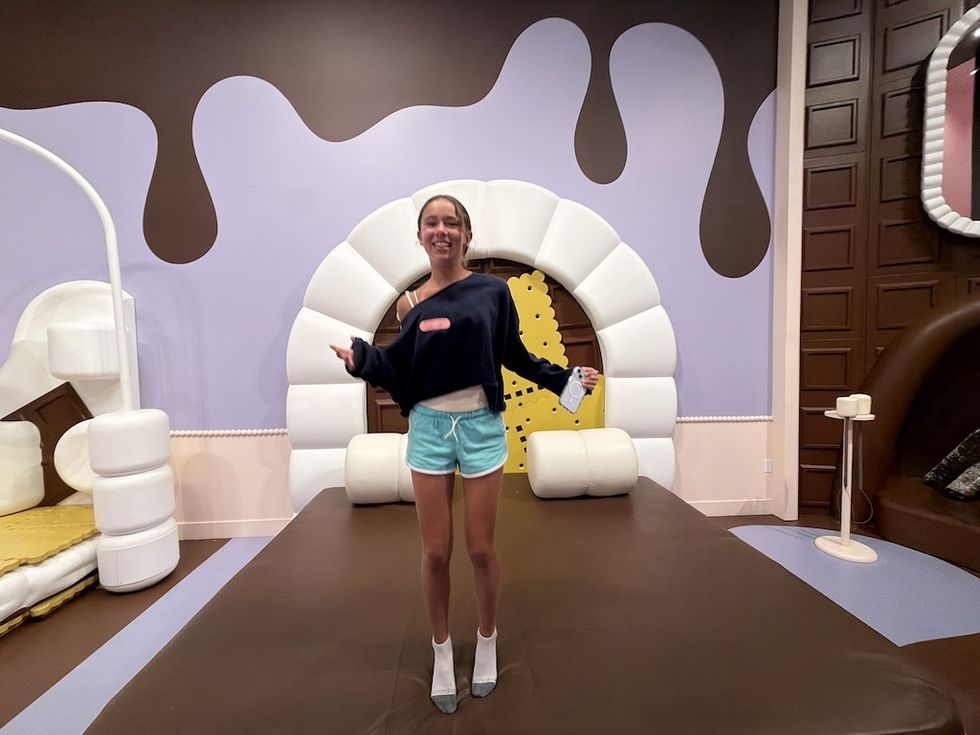
Museum of Ice Cream breaks down the usual family hierarchies and invites the same level of silliness from everyone
Image courtesy of Lou Pizante
Much of the experience economy is engaged in the same quiet work, loosening the rules people carry with them. The product is not simply spectacle. It is a temporary exemption from the narrow band of conduct that adulthood has approved and insurance has blessed.
For families, that exemption may be especially valuable because family life is built almost entirely from unequal roles. Parents decide. Children depend. Teenagers resist on principle.
Everyone is continuously aging into a new relationship with everyone else, usually without discussing it. Shared leisure tends to place us in the same location while leaving that hierarchy fully intact.
For a little while, Museum of Ice Cream flattened it.
The test, then, is not whether the Las Vegas Museum of Ice Cream is photogenic. Of course it is, that is the least demanding thing you can ask of a room.
The test is whether the photographs eventually stop—whether the machinery of participation works well enough that visitors forget to document themselves having fun because, for a few minutes, they are too busy actually having it.
The sprinkles are not the art. They may not even be the alibi. They are the leveler. Inside them, the parent, teenager, preteen, and critic all look equally absurd and have roughly the same difficulty getting back on their feet.
Which is to say, Museum of Ice Cream did not make us children again. It did something rarer.
It gave us an age at which we could all meet.
This article is part of an ongoing exploration of the evolving immersive landscape—how we lost our way, who’s fighting to bring meaning back, and why it matters.
For more on what this column is all about, start with Is This Article Immersive?, where I lay out the mission: reclaiming immersion from the gimmick merchants and giving it back to those who create experiences worth disappearing into.