
One of my earliest theme park memories is from early childhood, standing in front of a small cave near the entrance to Bear Country at Disneyland. Inside, Rufus the Bear was sleeping. From the pathway, I could clearly hear his snores resonating within the small cave.
My mind was full of questions. “Who is Rufus?” “Why is he so tired?” “Can he hear us?”
I was not the only one whose imagination was captured. Rufus became a favorite character as the unseen stagehand in the Country Bear Vacation Hoedown (and subsequent Bear Band shows).
When the land became reimagined as Critter Country, Rufus’ cave was relocated to Splash Mountain, where he continued to nap until Br’er Bear took over residence in 1992.
Rufus has persisted over decades. Notably, he is a character defined entirely by story framing and sound. Hearing him, I do not perceive Rufus “sound effects” — I perceive Rufus himself.
Through this framing, guests picture Rufus for themselves, filling in the blanks. Sound, for Rufus, is not an embellishing detail but a foundational perceptual medium for understanding who he is and what he’s up to.
Sound that shape what we believe
Rufus helps me illustrate what I have been describing over three articles.
Sound, as a perceptual medium, can shape how we understand, perceive, and interact with environments, characters, and experiences.
Sounds may function as thematic embellishment, story articulation, or even sonic spectacle. But many of the most powerful sounds are not perceived by guests as introduced audio elements at all, but as the natural, authentic sounds of the places themselves.
Perhaps it’s simply the nature of default questions and production processes, but sound tends to be framed as an additive element or a thematic embellishment.
Scope documents may define technical standards and describe what things will sound like. Asset lists may attempt to define what sounds are needed.
But meaningful discussions about what sound itself will accomplish throughout the experience? These discussions are critical, but can sometimes take some coaxing.
Sounds that successfully shift what guests believe to be true rely on the collaborative efforts of multiple disciplines (not just the sound team) who understand what these sounds can achieve.
 The case of Rufus in his cave shows how sound is not merely something guests hear; it is often how they come to understand what they believe is present
There was nothing complicated about the sounds of Rufus, but the result was so much more than “Snore Sound Effect.” Rufus was brought to life by a combination of scenic, story, sonic, and spatial decisions. Those decisions created the conditions that allowed sound to shape guest perception.
The purpose of this set of articles has not only been to highlight the potential of perception-shifting sounds, but to show that they depend on this very kind of collaboration. I close the series with four considerations that can help set the conditions for success.
Recognize the value and potential of sound as a perceptual medium
I began this article series by discussing sounds that disappear: perception-shaping sounds that change how guests perceive and understand the experience.
When we broaden our discussions to include “how can sound help us achieve the broader creative objectives of this experience?” opportunities begin to surface.
The irony of these sounds is that when they are at their most successful (blending so well into an experience that listeners forget they are hearing sounds from a speaker at all), they often go unnoticed as an introduced sound element.
By recognizing this category of sound, we begin to highlight its potential as a perceptual medium. When we broaden our discussions from “what needs sound?” to include “how can sound help us achieve the broader creative objectives of this experience?” opportunities begin to surface.
Establish alignment
No amount of excellent sound design or immersive sound systems will produce these perception-shifting results in a vacuum. Success depends on alignment and early collaboration between disciplines.
When clients describe their experience to me, I imagine myself as a guest moving along each moment of the timeline. What do I experience? What draws my attention? What do I understand at each moment?
As I ask questions to help clarify, I frequently find that the creative leads I’m speaking with are also thinking this way — imagining themselves as guests moving through the experience. My goal is to build on that common framework, working to understand how sound will shape the experience we are imagining.
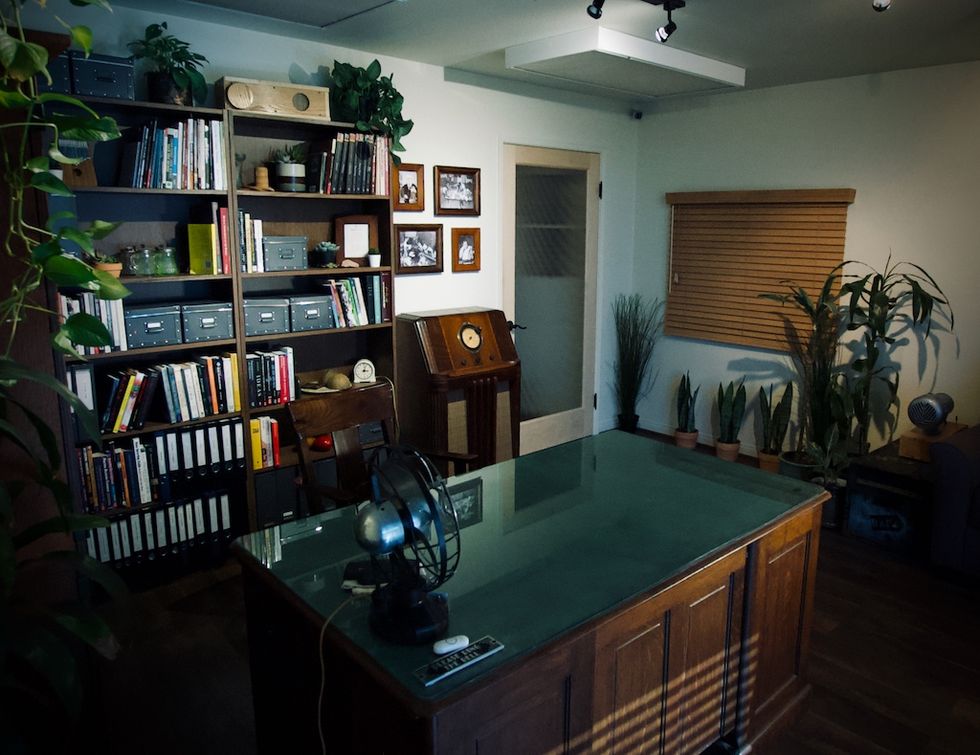 Herrington's first creative output often involves sitting at his desk to draw up a sonic blueprintImage credit Ben Herrington
A sonic blueprint builds on this exercise, articulating what sound needs to achieve from a creative objective standpoint. Almost without exception, my first creative output is some form of sonic blueprint in writing.
The blueprint exists not to articulate what the sounds are, but what the sounds must achieve. It is an early tool for establishing creative alignment.
Within these projects, a wide array of disciplines work to execute ambitious creative visions and solve unusually complex challenges. Creative leads have to make agonizing decisions about tradeoffs and priorities.
The blueprint exists to help inform those decisions, without attempting to impose a particular approach. It articulates my understanding of the creative intent and surfaces misalignment as quickly as possible.
Critically, it highlights opportunities and elegant solutions while they still remain.
Foundational flexibility
It is not uncommon for people to view sound creation as a late-stage activity in the production pipeline. But opportunities diminish, and new challenges surface the longer this kind of work is delayed. At the same time, it is reasonable to want to avoid spending design hours on work that may (will) change.
The ideal balance, I’ve found, is sounds that are introduced early and refined over time. More specifically, a flexible palette of sounds that grows more detailed and accurate as the project develops.
In practice, this approach can trade reactive problem solving for informed sonic adaptation.
Flexible palette approaches have a second critical benefit. In my earlier article, I described the sensation of no longer hearing a sound I was working on, but accepting it as part of the environment.
“Try a different sound” does not produce that result, but a well-crafted, adaptable palette of sounds can.
Studio work can encourage these results by prioritizing flexible material. Ultimately, though, the people in the field (sitting on the ride vehicle or within the show spaces) must be able to intuitively and artistically react to what they perceive and believe.
Inform creative decisions
We can find early opportunities to illustrate where sound addresses creative objectives, mitigates complex challenges, and surfaces issues that need collaborative attention.
These opportunities can take different forms such as mockups, pre-visualizations, prototypes, or animatics. I view these not as a means for simulating a final result, but as a way to clearly communicate my understanding and intent, so the team can meaningfully respond.
The key is to leverage opportunities to present sounds in a broader context, allowing teams to assess for themselves how well sound meets the experience's broader creative objectives.
When sound becomes a key tool for informing creative decisions by shifting how the creators perceive their project, its value becomes self-evident.
I recently returned from a sound presentation on a ride vehicle prototype for a project years away from opening. Our entire goal was to present sound prioritized as a perceptual medium.
We knew the team was receiving the sounds as such when the conversation quickly moved from what things sounded like to what sound achieved and how it could shape the experience.
Instead of me attempting to describe what sound can do, the team experienced it firsthand, offering them valuable insights into the experience they are crafting. Despite existing animatics, concept art, and models, the producer remarked, “This is the best representation of the experience yet.”
When sound becomes a key tool for informing creative decisions by shifting how the creators perceive their project, its value becomes self-evident. In the early stages of a project, this kind of perception shapes and informs the efforts that follow.
Sounds that shape guest perception are among the most potent tools available to these project teams. When crafted correctly and collaboratively, they can change how guests perceive every aspect of the experience. But they rely on a different kind of thinking — a consideration not only of what guests will hear, but what they will believe.
When I build them, I don’t want guests to think my work sounds good; I want them to believe the bear is in the cave.
This post is the third in a series of three by the president and creative director of Sound Sculpture Inc., exploring sound design in themed entertainment.