Set against the North Dakota Badlands, the Theodore Roosevelt Presidential Library (TRPL) combines immersive storytelling, interactive technology, and historical artefacts with ambitious environmental targets.
Delivering that combination required close coordination among the architectural, exhibition, and technology teams.
The 96,000-square-foot facility includes more than 40,000 square feet of exhibition space. The project is also designed to achieve Full Certification under the Living Building Challenge, alongside LEED Platinum and SITES Platinum.
Developing the story before the building
Unusually, before architectural design began, the Theodore Roosevelt Presidential Library Foundation established the institution's purpose and narrative, commissioning Future of StoryTelling (FoST) to develop a Story Guide. Matt Briney, vice president of communications at TRPL, explains:
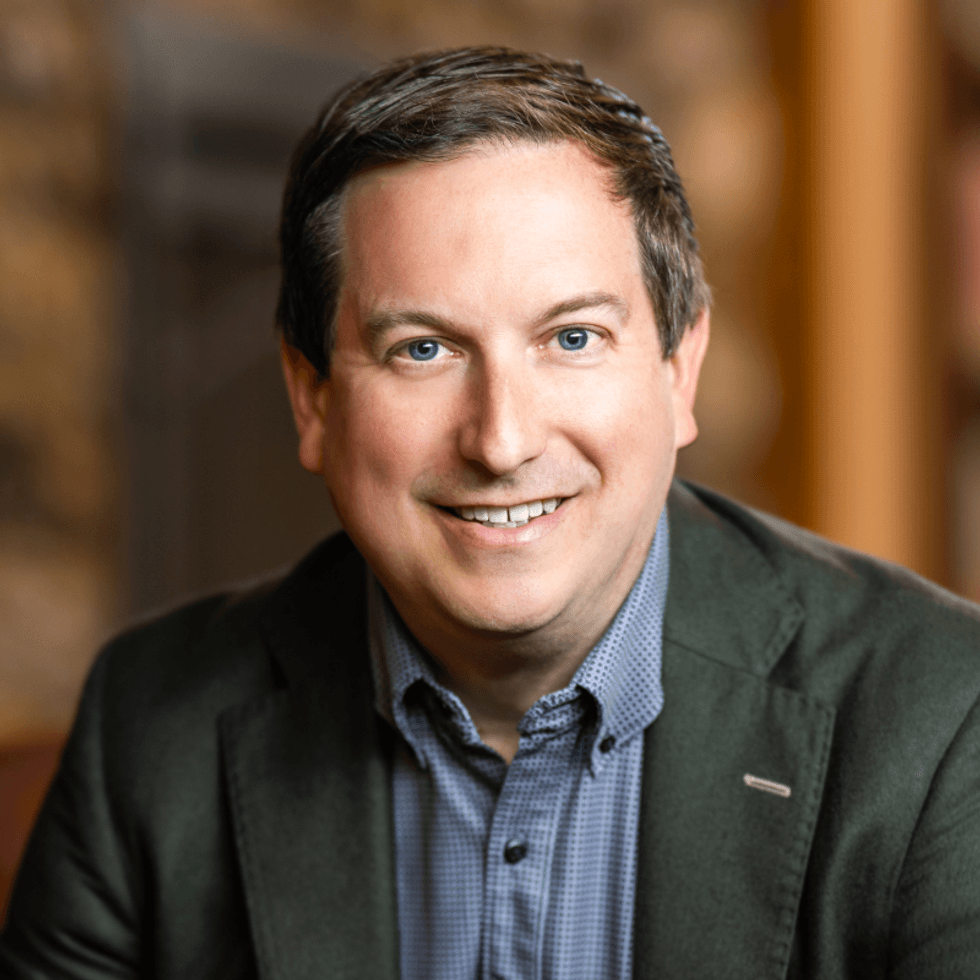
Matt Briney, vice president of communications at TRPL
"Before we had the land or the building, before we even had any money for the project, FoST helped us to lay out the blueprint for what we wanted to do, and how it should impact the community, and the surrounding region, and the nation and the world…all the environmental targets that should hit and all the stories that it should tell.”
The aim was to use Roosevelt's life to encourage visitors to reflect on their own roles in citizenship, leadership and conservation, rather than simply learn about the 26th US president.
This narrative-led approach shaped the design process. Snøhetta served as architect of record, working with JLG Architects and exhibition designer Local Projects, alongside media and technology partners including Electrosonic, Cortina Productions, RLMG, and Redglass Pictures, and Blue Rhino for scenic fabrication.
Charlie Melcher, founder and CEO of Future of StoryTelling, says: "We wanted it to be a people’s library that uses TR’s life to inspire guests and instil in them the pillar principles of citizenship, leadership, and conservation.”
The challenge was to help visitors learn from Roosevelt rather than simply learn about him, adds Jake Barton, founder and chief creative officer of Local Projects: “We wanted visitors to leave thinking and inspired deeply about their own values and choices.”
Architecture rooted in the landscape
The Badlands are closely tied to Roosevelt's personal history. Following the deaths of his wife and mother in 1884, he found solace there.
The building was designed to sit within the landscape rather than dominate it. Its sloping green roof echoes the surrounding buttes and provides an accessible outdoor space planted with native prairie vegetation.
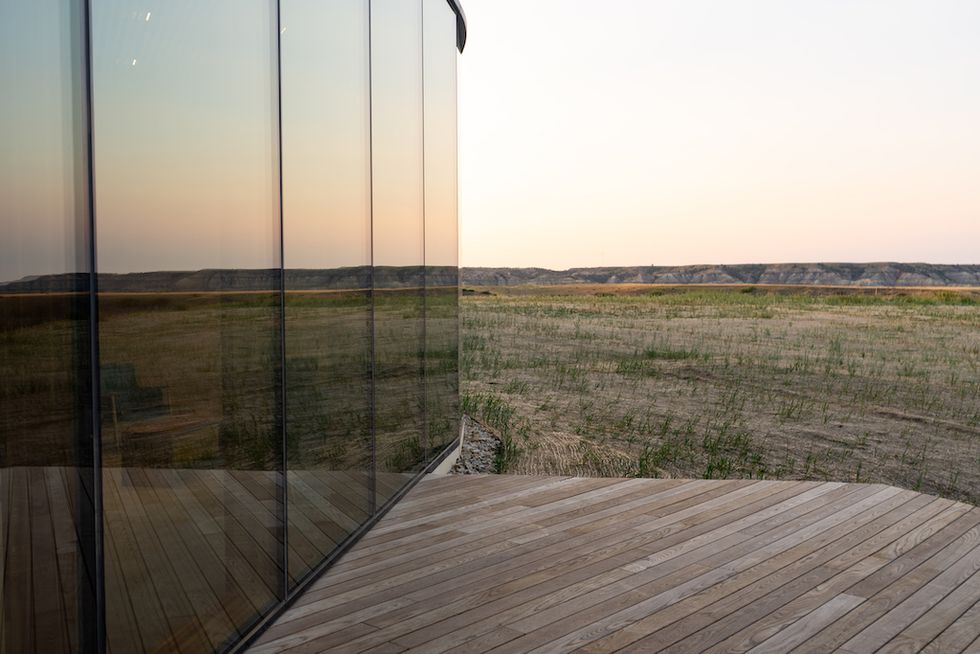
The Theodore Roosevelt Presidential Library is designed in harmony with the landscape
Image courtesy of TRPL
The relationship between building and landscape continues inside. Floor-to-ceiling glazing frames views of the Badlands, while a 26-foot rammed-earth wall in the lobby reflects the geological layers of the surrounding rock formations.
"It's that combination of the architects working with the exhibit designers at the same time to be able to create those moments where the building and the nature blend together," says Briney.
Sustainability as a design requirement
Environmental performance was a priority from the outset. Roosevelt's legacy of protecting over 230 million acres of public land naturally grounds the library's sustainability goals.
TRPL's sustainability framework sets targets for net-zero energy, water, carbon and waste.
The library is designed to achieve Full Certification under the Living Building Challenge (LBC), alongside LEED Platinum and SITES Platinum. The LBC requires performance to be demonstrated over 12 consecutive months, assessing areas including energy, water, materials, place, health and happiness, equity, and beauty.
The library combines an efficient envelope, solar photovoltaics and ground-source geothermal heating and cooling. A closed-loop system treats, filters and recycles water, reducing reliance on municipal supplies.
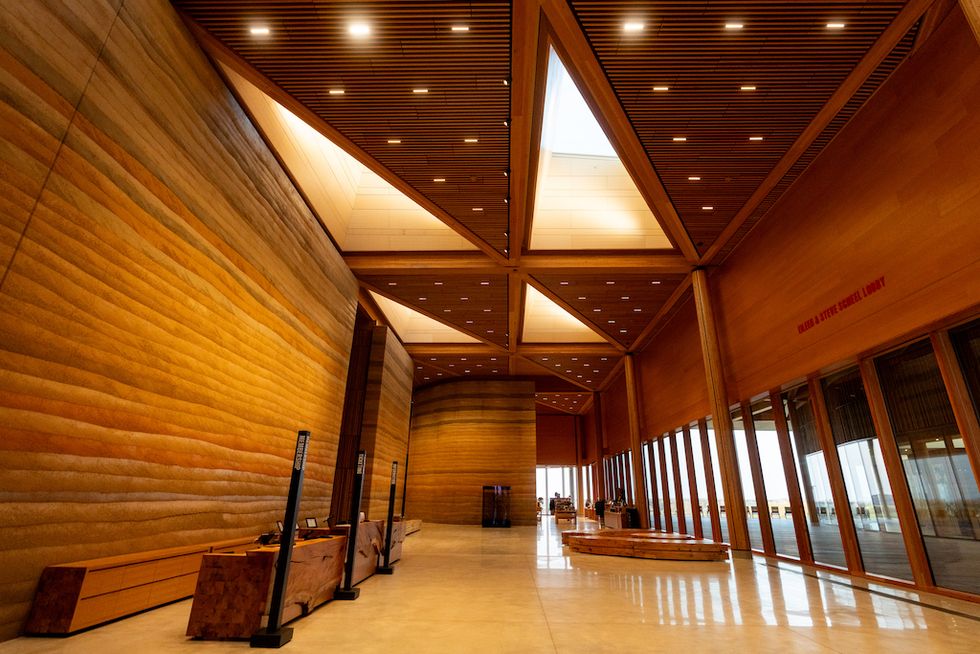
Sustainability was a core value from the beginning, for both building design and exhibit design
Image courtesy of TRPL
The sustainability targets also influenced decisions within the exhibition itself, says Peter Vikar, physical design director at Local Projects:
“Our immersive rooms rely heavily on media…At the same time, the building targeted rigorous sustainability certifications, so the team had to reconcile high-performance AV with strict energy goals.
“By introducing energy modelling early in the exhibit design process, energy use became an active design parameter that helped shape the creative approach. We deployed low-wattage lighting and presence sensors that dim illumination and media during quiet periods.”
Engineering immersive technology at scale
Dimensional Innovations served as the prime experiential exhibit contractor for the library's galleries, overseeing delivery of the exhibition programme and translating the designs into physical environments.
Paula Neston, cultural practice executive at Dimensional Innovations, says the team treated the physical builds and the technology as one system from the outset:
“Interactive displays, lighting and concealed AV were developed in parallel with the scenic fabrication, requiring ongoing coordination among Local Projects, along with Electrosonic, VLS, RLMG, Cortina, and Redglass, who were working from the same picture as the fabricators.”
Electrosonic developed the technical design for the exhibition systems, coordinating specialist manufacturers and software providers to meet the creative brief within the building's environmental constraints.
The 30 exhibition spaces incorporate interactive stations, linear theatre presentations, projection-mapped environments and custom games, supported by a network of specialist technology providers.
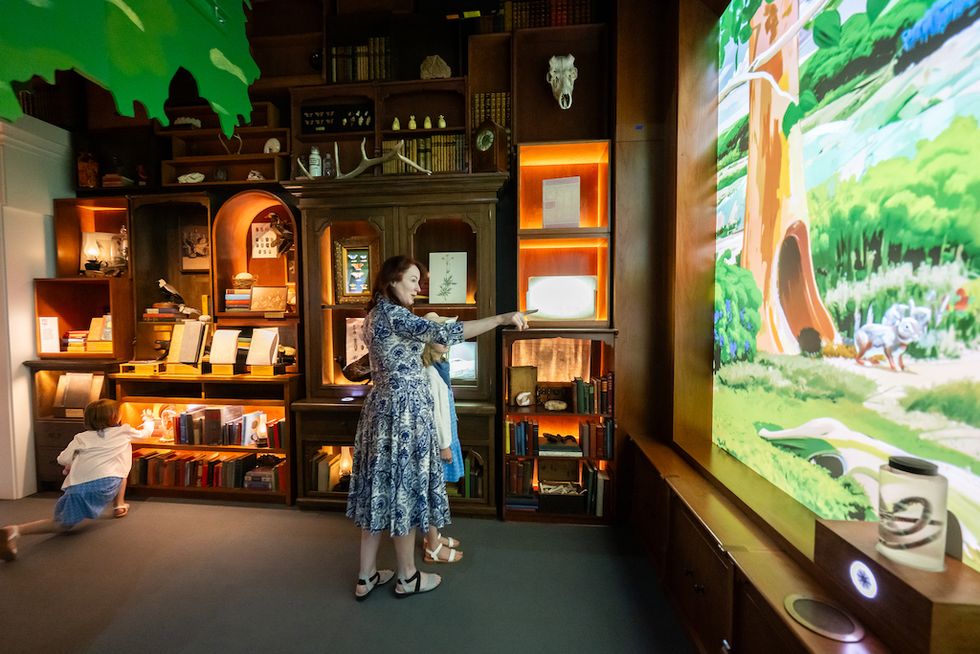
The guest experience at LRPL includes interactive stations, theatre presentations, projection-mapped environments and custom games
Image courtesy of Electrosonic
Energy efficiency influenced equipment selection and system design. Electrosonic’s equipment choices, automated power sequencing and lower-draw LED technology reduced power consumption by more than 20,000 watts and thermal load by 90,000 BTUs across the project.
Briney highlights the importance of achieving these savings without compromising the visitor experience: "One of the remarkable things that Electrosonic has been able to do is to maintain our energy requirements while also creating an experience that our founding CEO said that he wanted children to drag their parents to."
Fabrication and installation also had to be coordinated around the remote site, sustainability requirements and the planned opening date of 4 July 2026.
Neston says the Dimensional Innovations divided fabrication between specialist partners, allowing different elements to be developed concurrently. This involved translating historical references and early design drawings into buildable environments while meeting material and performance requirements.
“We combined modern fabrication with refurbished and repurposed antiques to create durable, technology-integrated spaces that complement the building’s incredible architecture.”
Coordination continued into the finished installation: "Two things held it all together," explains Chris Conte, global ambassador and executive consultant at Electrosonic.
"First, every exhibit was programmed against a single master clock, so the experiences run in sync across the building. Second, Electrosonic designed the media and control network. We specified it to ensure enough bandwidth and proper traffic management.
“That let us control and monitor every audio, video, computer, and control component, with nothing left unaccounted for in the system design."
Personalisation across the visitor journey
A library-wide RFID system connects visitors to experiences. At registration, each receives a wristband linked to their profile.
At Trailblazer stations, visitors can make decisions, cast votes, register opinions and customise exhibit media. A separate Seek and Find activity features 44 animal figures concealed throughout the exhibition scenery. Tapping a figure with a wristband triggers its call, illuminates it and records the discovery.
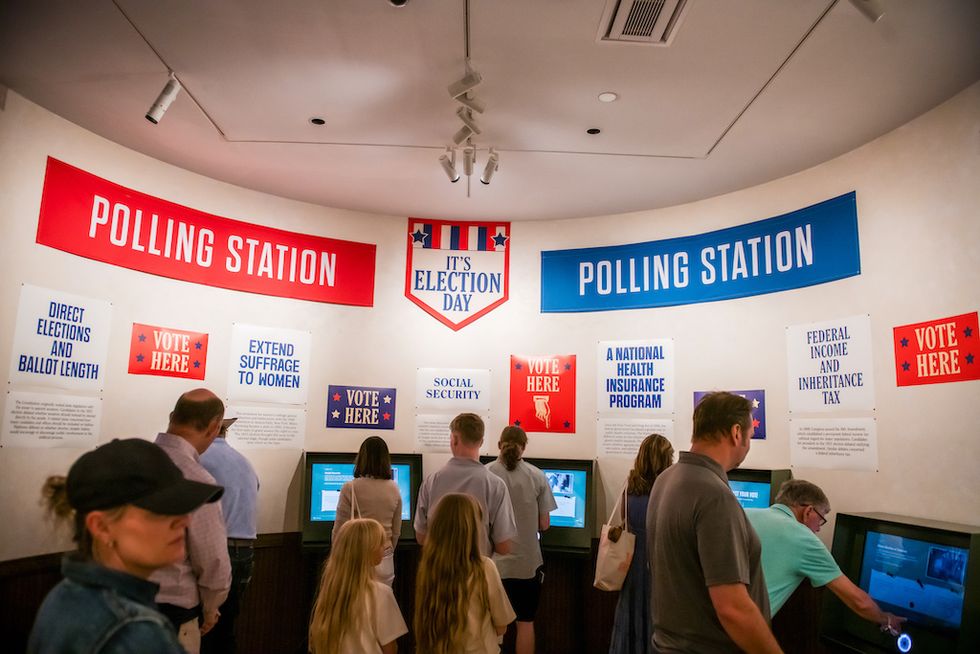
Interactive exhibits throughout the library help to personalise the guest experience
Image courtesy of Electrosonic
Electrosonic developed tap-point modules that combine RFID readers, lighting, directional speakers, and network controls to provide immediate feedback.
"The creative team wanted every tap to feel responsive, with both visual and audio feedback," says Conte.
"For the Trailblazer stations, we designed and engineered a solution in which a ring light around the RFID target illuminates and a sound file plays each time a wristband is read. Across those stations, each tap point had to work as a small system of its own, with RFID reading, lighting, audio, and network control working together.
"Because every tap is logged against the visitor’s identifier, the system tracks their path through the museum. At the end of the visit, they can pull up a map and see their journey in graphic form."
From historical objects to immersive environments
The experience pairs traditional museum displays with immersive recreations of places and episodes from Roosevelt's life. The distinction between the two was central to the visitor experience. Barton explains how the approach was intended to move visitors between historical understanding and emotional engagement.
“[Local Projects] partnered with Snøhetta on the experience design for the entire project, and developed a spine of a narrative traditional museum gallery, with immersive Adventure Galleries all around it, creating a visitor experience that transports visitors between the cognitive and emotional.
“We ultimately found that the legacy of Theodore Roosevelt is as a man of action and a man of letters, and his museum puts visitors through that.”
The Memory Train, with media by RLMG, recreates a late-19th-century Pullman carriage and takes visitors through a pivotal period in Roosevelt's life. Designed by Local Projects, it combines period-inspired finishes with media in the windows and audio embedded in the walls.
Creating the impression of movement required close coordination between the scenic and audiovisual teams. Neston explains that Dimensional Innovations worked with Electrosonic to build the rumble equipment into a floating floor, while the walls were anchored separately to remain still.
Acoustic wall panelling also helps isolate the carriage from the neighbouring gallery, designed as a quieter, contemplative space.
Even the wallpaper contributes to the narrative, incorporating quotations from Roosevelt's love letters to his first wife, Alice.
“Most guests will simply feel like they’re on a train, and making that feel effortless took close collaboration,” adds Neston.
Elsewhere, the Elkhorn Ranch Cabin and Cowboy Campfire experience combines a physical log cabin, interactive books and projected imagery. Christie projectors and media produced by RLMG create life-sized cowboy shadows on a rock surface, turning animated figures into shadow puppets around a simulated campfire.
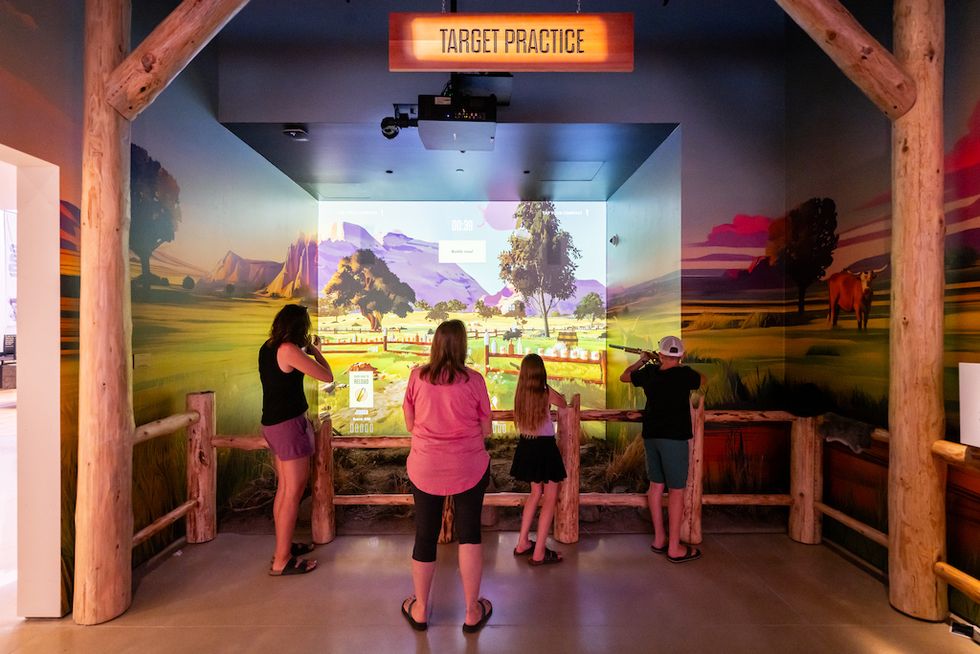
Visitors try an interactive target-practice game at TRPL
Image courtesy of Electrosonic
“Moving back and forth between history and personal experience helps visitors process what they’re learning while staying engaged, and leave something for everyone, from young kids to serious history buffs,” adds Barton.
Other galleries explore Roosevelt's experiences in the American West, the Amazon and Cuba. Cattle Roundup and Target Practice combine physical components with optical tracking and projected content, while the Amazon Expedition uses Christie projectors and media produced by RLMG to create a panoramic jungle environment with spatial audio.
Marta Monge, art director at Local Projects, says: “The biggest lesson was that there’s in fact no single way to bring complex history to life. With such a broad audience, it’s important to create multiple entry points, meeting visitors where they are and offering different ways to connect with the material.”
Testing immersive environments
Creating convincing projection environments required testing with the materials used in the finished galleries. Media developer RLMG worked with exhibit fabricators and technology partners to assess how content would appear.
“Testing on the actual wall samples led us to adjust our approach to the animation’s visual styles so that the imagery felt believable on the physical surface,” explains the RLMG team. “Later, we collaborated closely with Scalable and ESI on mapping the space and with Smart Monkeys on programming the media.
“That partnership helped ensure this complex experience looked seamless and beautiful, and sounded amazing, for visitors."
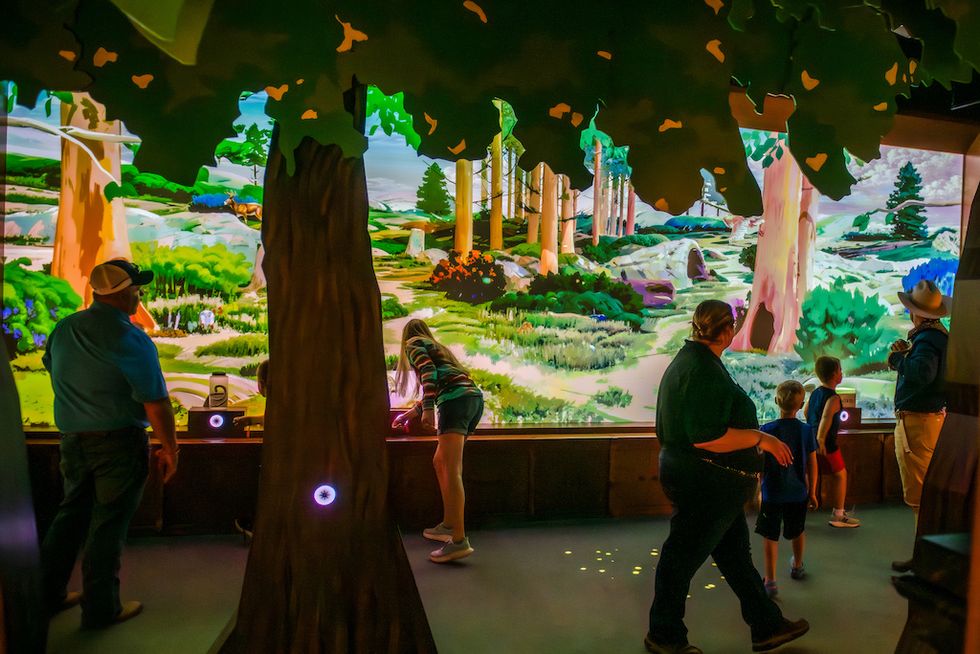
Creating the immersive environments at TRPL called for collaboration between all the project teams
Image courtesy of Electrosonic
Full-size mock-ups also helped RLMG refine complex projection environments and games before installation.
"Designing for large-scale projections, prominent media in several rooms, and full games meant building and testing at full size early in the process, which allowed us to iterate in a timely fashion required for the project timeline.
“Near constant communication with our content, hardware, exhibit design, and concept partners created a lively and evolving design environment and, ultimately, an imaginative museum experience.”
Technology had to support the narrative rather than become the attraction in its own right, adds Carolyn Merriman, director and executive producer at Future of StoryTelling:
"Technology should always be used in service of the story. Otherwise, it risks falling flat and becoming dated very quickly. We like to start by imagining the experience we want to create without any constraints, and then gather a creative and technical team to explore the many ways we might bring that vision to life."
Melcher adds:
"There’s no technology just for technology’s sake; all of it is there to create a more meaningful, inspiring, educational, and human experience.
“In some ways, the museum is one of the most technologically advanced of our day, but you wouldn’t know it from looking at the building or walking around inside. The TRPL feels very classic, with real wood and natural light—it doesn’t feel like a tech museum."
Bringing Theodore Roosevelt to life with AI
Talk with TR is a conversational AI experience in which visitors ask questions of a photorealistic digital representation of Theodore Roosevelt. In a White House-inspired setting, they can interact with the president's virtual likeness.
Electrosonic specified the audio, video and control systems supporting the interaction, including a large LED display designed to present Roosevelt at a realistic scale.
"This was one of the most challenging experiences in the museum, though the hardest part was the AI software and not the AV hardware,” says Conte.
“[Electrosonic’s] role was to listen closely to the content creators developing the AI, understand their design intent and how visitors would actually speak to and interact with the figure, and then specify the audio, video, and control systems that would make that exchange feel natural.
“The most important decision was the display. For Roosevelt to look and feel as real as possible, size and image quality mattered a great deal. Through research and demonstrations, we settled on a DetaiLED Diamond Series 0.9 mm COB LED display, roughly 17 feet wide by 10 feet high (about 5.2 by 3 meters).
“It delivers a beautiful, realistic image of the AI-generated Roosevelt at a scale that draws visitors in.”
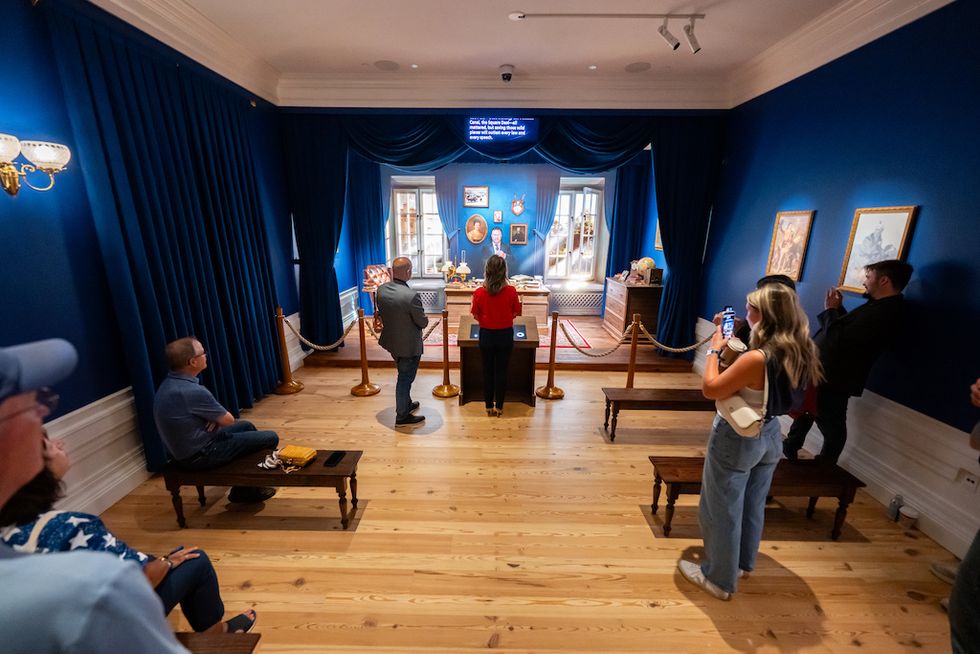
Guests at TRPL can converse with President Roosevelt thanks to AI
Image courtesy of Electrosonic
Cameras detect when a visitor enters the room, prompting Roosevelt to invite them closer. The visitor holds a push-to-talk microphone to ask a question and hears the response through the room's speakers. Their RFID wristband also lets the experience pull from their earlier choices.
TRPL, FoST, Cortina Productions and Microsoft's AI for Good Lab drew on Roosevelt's extensive written archive and historians' research to inform the model and establish safeguards.
FoST’s Melcher explains: "We were incredibly fortunate…because he was such a prolific writer. To train our LLM, we were able to use the nearly 40 books that he wrote, as well as hundreds of thousands of his letters and hundreds of articles and speeches. That’s very rare.
“We also licensed a number of books by historians to feed into the model so we could train it on information that was essential, accurate, and truthful.
"The real danger is that AI is still prone to hallucinations and mistakes, which is not what you want in a museum. Even once we had trained the model on TR’s archives, there was a lot of work to be done to make it as accurate as possible.
"We also had to install guardrails to protect our guests from attempts to break the AI or get it to say things that would be inappropriate."
Ending with the visitor
The final gallery brings the library's central idea into focus by shifting attention away from Roosevelt and towards the people who have explored his life.
In the People's Library, visitors encounter a large video wall overlooking the Badlands. Tapping their RFID wristband one last time reveals a personalised profile reflecting the values they expressed during the visit.
"The last gallery is not about Theodore Roosevelt," Briney says.
"It matches you with an archetype, an animal from the Badlands, and pairs you with a Theodore Roosevelt quote, and that's an amazing experience too, for people to get out of this world and realise that actually this entire exhibit experience is about them.”
Lessons for attraction developers
Naomi Seixas, executive account director at Local Projects, describes how the narrative remained consistent as the project evolved:
“That throughline—a chronological journey anchored in a clear conceptual vision—remained constant from concept design through production, even as individual exhibits evolved through the contributions of interdisciplinary design teams.”
Neston adds: “TRPL, Local Projects, and Future of StoryTelling kept the narrative at the centre of every decision. When creative or technology development continued after a space was built, the partners reimagined it together to keep it aligned with the story.
"That shared focus is what held it together.”
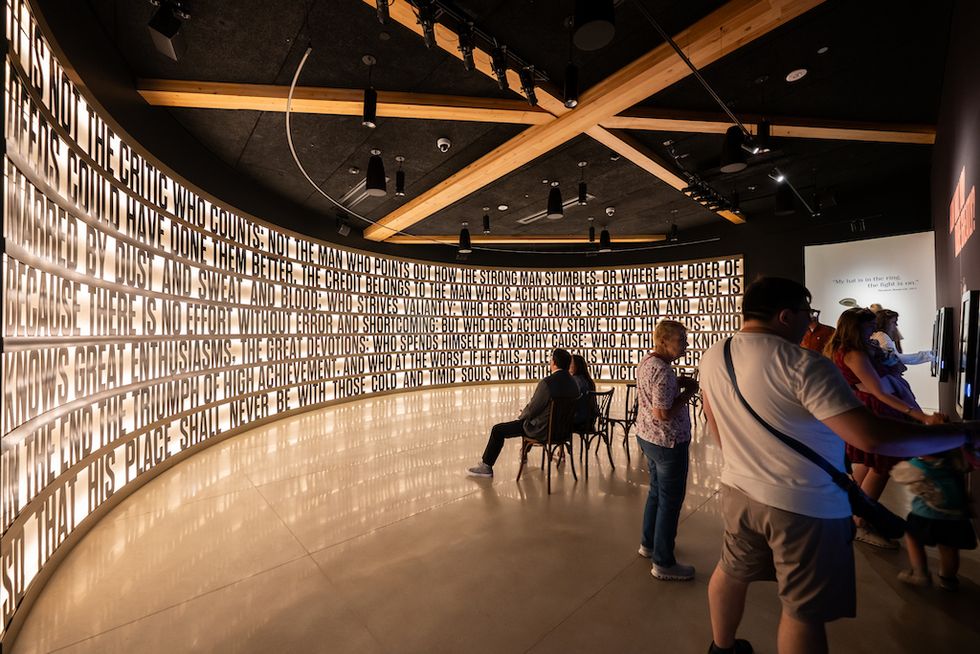
TRPL uses Roosevelt's life to encourage visitors to reflect on their own roles in citizenship, leadership and conservation
Image courtesy of Electrosonic
Conte advises that bringing specialists in before designs are finalised is essential: "Integrators, technology partners, and specialists can advise on what’s feasible, what it will cost, and how it will fit into the building. That advice is far more valuable during planning than after the design is locked.
“This includes the building itself. Power, cooling, structural loads, cable paths, and acoustics need to be settled with the architect and general contractor well before the technology arrives, because equipment that shows up before the building is ready costs time and money.”
Long-term operation is another consideration, particularly for attractions that rely on interactive technology and AI, he adds. "Plan for the whole life of the experience, not only the opening day.
“Maintenance, spare parts, software licenses, staff training, and content updates are real costs, and interactive and AI-driven exhibits especially need ongoing support. Decide early who will operate and maintain them, and budget accordingly.”
The project brings together several ambitions that attraction developers increasingly need to balance: meaningful visitor engagement, original content and environmental performance. Briney adds that that combination is central to what makes the library distinctive:
"I think for us, it's creating a different type of museum experience-one that people can really interact with. It's that combination of the kind of escape room, Meow Wolf experience with a museum that also can house original artefacts... I also think that there's a lot that we're pushing the envelope on for energy use, conservation, and sustainability.
"And I think that we will be a leader in that."