AI is evolving, and most attractions are now looking seriously at where it fits. So far, the answer has mostly been behind the scenes: reporting, forecasting, customer service, the work of running the business more efficiently.
All useful. But it leaves one fundamental part of the attraction experience underserved, and it is the part the operator stands to gain the most from: supporting the guest who is in the venue right now.
By pointing its most powerful new tool at the edges of the guest day, the industry is neglecting the high-value hours when the guest is actually on-site, says Attractions.io.
- Growth opportunity. While attendance numbers for many operators are flat or declining, overall revenue is growing, indicating significant untapped potential in secondary spend like food, retail, and premium experiences.
- The in-visit frontier. Current AI investments in the attractions industry are focused on pre-visit (chatbots) or post-visit (analytics), neglecting the high-value ‘in-visit’ phase where operators have the most control over the guest's environment.
- The power of orchestration. Unlike static tools, ‘guest orchestration’ uses an AI decisioning layer to integrate live venue data and guest preferences, enabling real-time, proactive, and personalised recommendations that treat each visitor as an individual.
- Action over insight. This moves from simply surfacing information for human operators to act on later, to having AI autonomously execute ‘last-mile’ actions such as timely, personalised messaging.
- Personalised, enhanced experiences. The ultimate goal is to treat each visitor as an individual in the moment, helping operators increase yield and guest satisfaction by delivering relevant, one-on-one recommendations through the guest's own device.
The guest experience platform behind Merlin Entertainments, the Kennedy Space Center Visitor Complex and Chester Zoo’s mobile apps, Attractions.io has spent 17 years building the technology guests use throughout their visit.
This gives the company a deep understanding of how guests and operators actually behave on the day.
 Attractions.io's founder and CEO, Mark Locker (left), and VP of product, Peter O'Dare (right) Image courtesy of Attractions.io
Founder and CEO Mark Locker and VP of product Pete O'Dare spoke to blooloop about why the on-site experience is the most under-used opportunity for AI in attractions, and about the approach they call guest orchestration.
The growth opportunity
According to recent IAAPA reports, attendance is flat or falling for many operators. Yet, despite this concerning trend, revenue is increasing, with over 50% driven by non-admissions.
This in-visit phase, Locker believes, represents an underutilised revenue stream and a compelling proposition.
“The opportunity is there. We're seeing it in the data. You can still grow without attendance increasing.”
So how can operators benefit? Locker says that in-visit engagement is “undertapped generally,” under-resourced by marketing teams, and overlooked strategically.
 Guest orchestration communicates with visitors on site using their own mobile phonesImage courtesy of Attractions.io
“The marketing spend on secondary revenue is often not proportionate to what it brings in. Yet the visit is the one part of the journey where you have most control. That's the opportunity,” he explains.
“Once they're with you, they're with you for the day, and they're in your environment that you completely control. And so there's actually lots of opportunity to have more direct influence over increasing the ‘second bite of the wallet’.”
The challenge is that the in-visit experience is exactly where traditional marketing falls short. Context, such as weather or queues, changes by the minute and no scheduled campaign, dashboard, or chatbot can keep pace.
This, says Locker, is a problem AI is well-suited to solving because it can reason and make decisions in that context as it changes.
Guest-first thinking
But if the opportunity is that clear, why has it gone untapped?
Locker and O'Dare argue that the tools available to the industry fall short of supporting the active, on-site visit.
When on-site, some of the challenges visitors encounter are physical, such as accommodating a group's varying physical capabilities, ages, and heights.
"If you're a family and you've got a group of kids of different ages, the main thing is how to keep everyone happy,” says Locker.
“Where should I go first? What rides can each of my kids actually do, given the restrictions? What shows would they like?
“And how do I mix that up?"
Navigating queue lines, finding food everyone likes, and locating the nearest loos all add to the complexity.
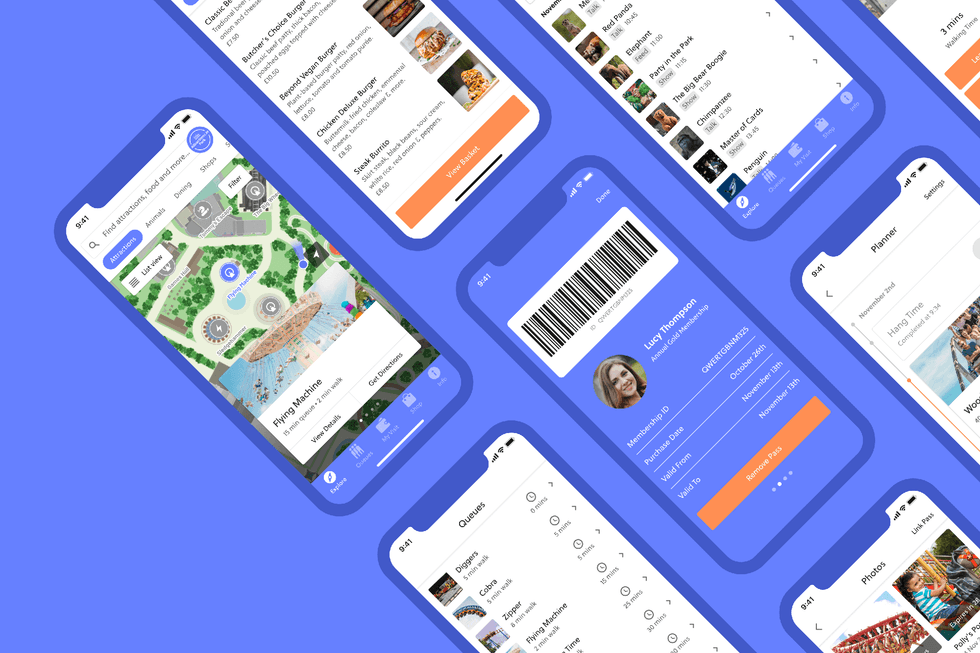 Through working with over 150 venues, Attractions.io has built a detailed undestanding of the in-visit experience Image courtesy of Attractions.io
Yet little of this friction is captured. And where systems do exist to record these actions, they operate in silos or communicate with each other on the back end, rather than in the guest layer.
With millions of guest interactions from more than 150 venues, Attractions.io has a deep understanding of the challenges guests encounter during their visit and is uniquely placed to return to first principles to solve them.
“We're in this very unique and lucky position where we really understand those problems deeply,” says O’Dare.
“So, we're taking all that knowledge and that data that we hold and using it to say, what are the biggest opportunities for us to solve and make it better for guests?”
What does AI look like in a live visit?
Guests ask hundreds of questions during a visit, from where to go next to what to do if it rains.
To answer any of these, you need to know who they are and who they're with, have a current picture of what is happening across the venue, and have a way to communicate the answer quickly.
No team can do that for thousands of guests at once. However, AI can.
AI can hold a guest's context and the venue's live state together, decide what would genuinely help, act on it quickly, and repeat as the day shifts.
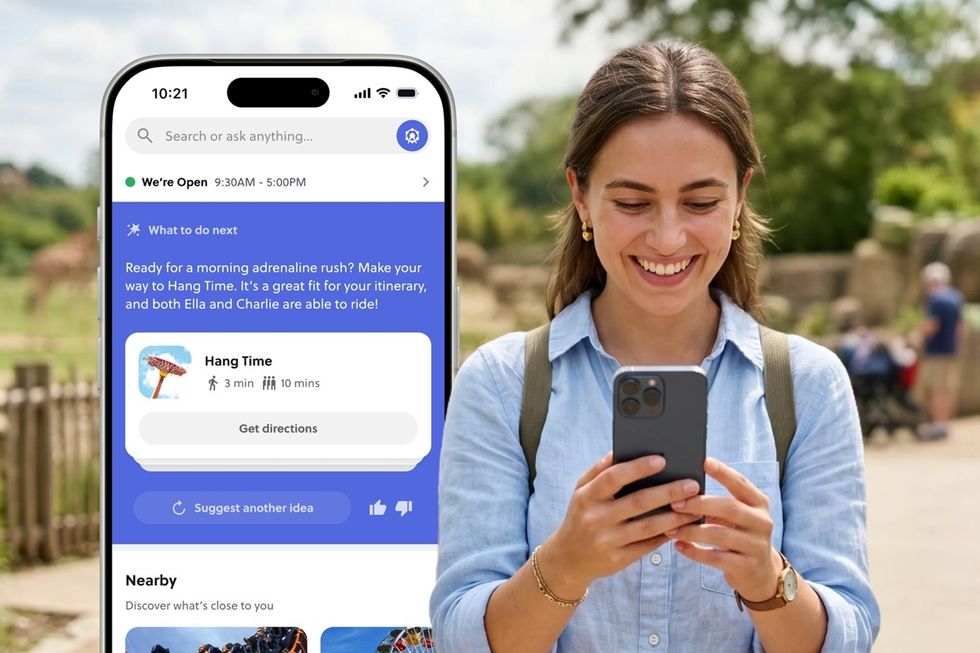 Guest orchestration acts like a VIP concierge to help guests make the most of their visitImage courtesy of Attractions.io
For example, it knows if a visitor has finished a ride and it’s past lunchtime. It can then make predictions about what they might like to eat based on their party’s preferences.
Going further, it can serve as a VIP concierge, adding suggestions for things to do along the way: “effortlessly surfacing these things as you go, using all that context,” says O’Dare.
Many people associate AI with conversational chat interfaces, and these are excellent for answering questions. However, discovery requires a different approach that lets visitors get recommendations without needing to know what to ask.
In response, Attractions.io has created a solution that embeds an AI decisioning layer directly into the app experience. This sits on top of an operator’s existing technology and uses live information to determine the single best next moment for each guest without requiring prompts.
“Our role is to really understand what guests want,” says Locker, “and be there for them proactively.”
Introducing guest orchestration
This approach is known as ‘guest orchestration.’
“If you think of the metaphor of the orchestra, the individual instruments are what operators already have, their existing technologies and systems,” says Locker.
“They've got ticketing and email, the website, they might have a mobile app. They've got all these different components and technologies that go into it. And they have a lot of data that's collected from that.
"What's missing is anything that makes them play together. That's the orchestration."
AI, says Locker, provides the reasoning that brings all of these systems together.
“We think of it as hands, a brain, and a voice.
“The hands reach into the operator's existing systems and pull out what's needed. The voice is the guest's own phone that they carry in their pocket.
“The brain is the new part — that's the AI.”
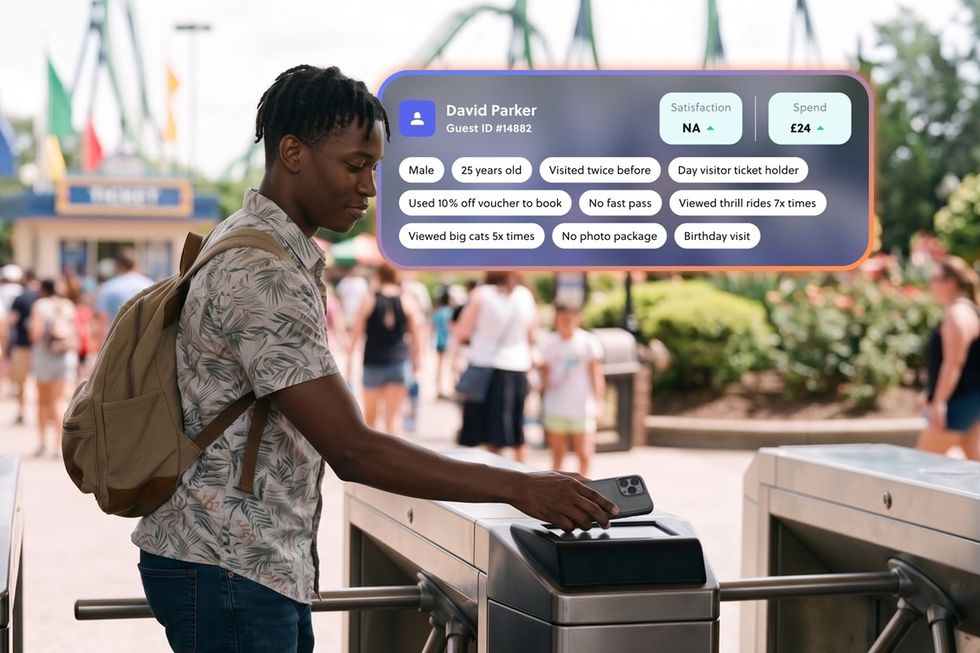 Guest orchestration unlocks hidden data at the gate to deliver an enhanced in-visit experienceImage courtesy of Attractions.io
Like a human team member, AI can reason for the individual visitor, drawing on information such as group interests, current weather, or live wait times to decide on the best message to show in the interface.
“The whole is greater than the sum of its parts,” says Locker. “Individually, each of these systems is fine. Orchestrated, they're something else entirely.”
And this approach is scalable.
“We're working on features that take very little operator input to deliver an amazing amount of return for guests,” says O’Dare.
Accessible approach
O'Dare argues the barrier to getting started is lower than most operators assume.
"The vast majority of attractions already have the information that would make AI capable of supporting the in-visit experience. What's missing is the orchestration of that data."
The information needed falls into two broad categories, Locker explains:
“It needs two things: who the guest is, and what's happening around them. Often you already know more than you think. A ticket type or an app profile can tell you whether you're looking at a family or a couple.
 Guest orchestration can be effective with small amounts of data, and needs just visitor and live context informationImage courtesy of Attractions.io
“And live context data, such as the current weather or your opening hours, is usually easy to get hold of. You can start with what you have and add as you go.”
“Obviously, the more context you have, the better those decisions will be,” says O’Dare. “This is promising for attractions that have mature ecosystems and data.
“But it's also really promising for venues that don't have massive data lakes and teams to go get that information. You can start small and still get massive benefits for guests.”
Additive, not dismissive
Not only does this type of orchestration need little in terms of data, but it also sits on top of the operator's existing stack.
"Nobody wants to rip out the systems their whole operation runs on," says Locker. "This approach to AI builds on top of what you've already got."
Attractions.io already connects to more than 30 attraction management solutions, from ticketing and POS platforms to photo providers and live queue feeds.
 Guest orchestration is additive - it sits on top of a tech stack and builds on the operators existing systemsImage courtesy of Attractions.io
“We have a library of connections across the most popular systems in all different categories for the industry, so you can just turn it on and configure without needing to worry.”
“We're interoperable,” adds O’Dare. “We are just focused on the guest experience, not as a vendor for ticketing or photos or anything else. We sit on top, and it allows us to make the best decisions for the guest without being distracted.”
Trust and control
Many operators worry about losing control if they hand over direct messaging to AI. At Attractions.io, these concerns are overcome by a careful, iterative approach that builds trust over time.
“We've spent a lot of time making sure we really understand the problems and approach things safely,” says O’Dare.
“We’re looking for many small moments and personalisations that in aggregate lead to a big outcome. Those things give a feeling of a really good experience over time, rather than trying to turn it up to 100 immediately.”
By demonstrating the technology's effectiveness in these small moments, operators’ trust will begin to grow. And with this trust comes cultural change.
 Attractions.io's careful approach builds trust for organisations that are cautious of AIImage courtesy of Attractions.io
O’Dare says: “It’s not going to happen overnight. But by deploying even the sprinklings, you start to see whether those initial guest-orchestration actions have an impact on the things you care about as operators.
“Are more guests feeling like they got what they wanted out of their visit? Are they actually getting on more experiences and activities, and is overall satisfaction increasing?
“If you start to see that, that would be the cultural shift.
“It's okay to not control every message if we have a culture that continually allows us to monitor how these systems are performing and understand the controls.”
Unlocking visit potential
The case for pointing AI at the visit itself comes down to three things.
It is the part of the day operators control most completely, and increasingly where their growth has to come from. It is also the part no team can truly personalise by hand while conditions keep changing throughout the day.
Finally, it is the only stretch of the guest journey that remains largely unpersonalised, which means the ground is still unclaimed.
The barrier is also lower than most operators assume. Nothing has to be replaced, and no data practice has to be built first. Most of what AI needs to start enhancing the in-visit experience is already sitting in the systems they use every day.
“This is unlocking an opportunity to personalise the visit more than ever before, in a world where there's a big opportunity to drive revenue from post-gate activity,” says Locker.
“For the first time, you can talk to every guest one-to-one, on site, knowing who they are and what's going on around them. That is a huge accelerant for increasing per-cap through your second-gate sources.
“You can get three times the engagement if you send a message at the right time. Get the moment right and the spend follows."