
The results of blooloop’s first business confidence pulse survey are in, revealing fascinating insights into the minds of leaders in the attractions industry.
The respondents are executive leadership, directors, or owners with responsibility for investment in their organisations across all sectors, including theme parks, zoos, museums, and immersive experiences worldwide.
The survey took place between December 2025 and the end of January 2026. [Clearly, recent events in the Middle East may significantly impact action, but we hope the results are still useful as an indication of how our industry leaders think about strategy in a turbulent world.]
Key takeaways
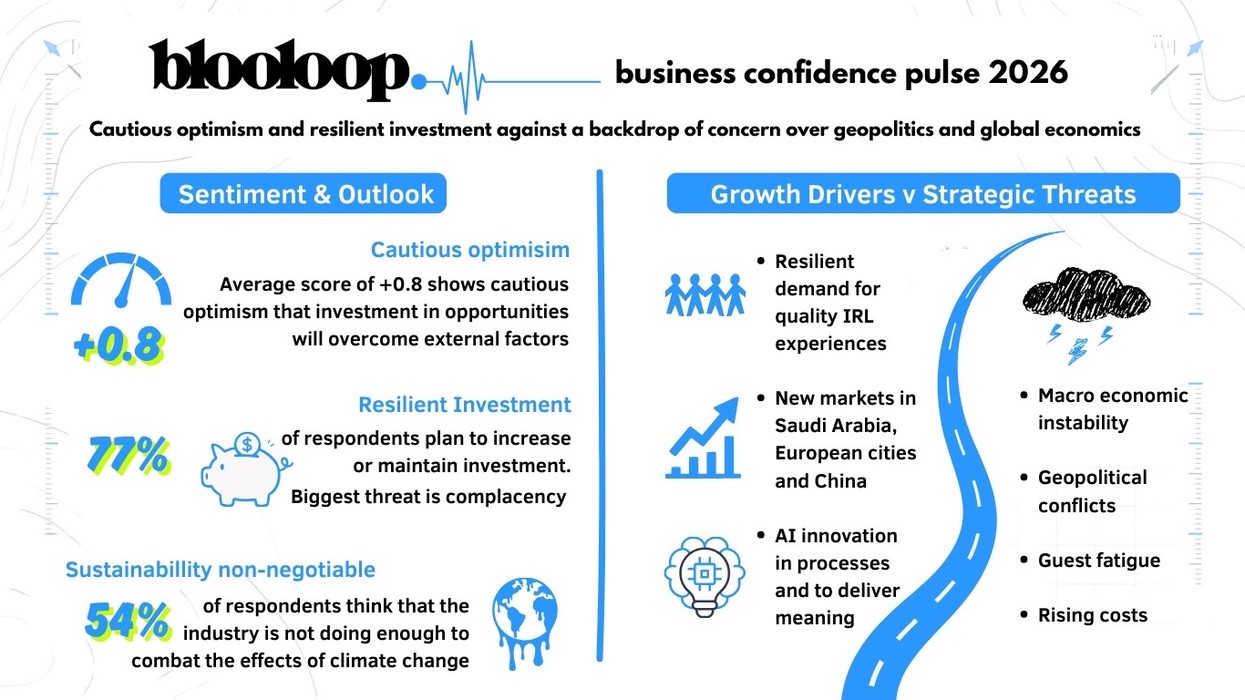
The overall message is one of cautious optimism, set against a backdrop of concern over geopolitics and global economics.
However, business leaders are signalling that they intend to invest, believing that the biggest risk in this uncertain and rapidly changing environment is complacency and failure to evolve.
Amid the noise of macro-instability, opportunities exist to deliver meaningful experiences to a public that remains willing to pay for high-quality, transformational entertainment.
Key takeaways include:
- Cautious optimism despite global economic and political uncertainty
- Investment paradox - overwhelming majority of leaders are looking to increase or maintain investment - the biggest risk is complacency in a rapidly changing world
- Confidence that consumers will continue to value innovative, meaningful, high-quality experiences
- Opportunities to utilise AI to create transformational experiences and streamline operations
- Over half of leaders believe our industry is not doing enough to address the risk of climate change
 Of the Oak Image credit Royal Botanic Gardens, Kew & Marshmallow Laser Feast
Cautious optimism
We asked respondents for an overall confidence rating (+5 being most optimistic and -5 being least) for 2026 - a “gut feeling”.
Overall, this averaged out to a cautiously optimistic +0.8. However, whilst most respondents fell somewhere in the middle, there were some polarised views, ranging from -4 to +5.
In particular, respondents based in the US were overall more pessimistic than average, and, perhaps unsurprisingly, showed the biggest polarisation.
Risk factors
External factors were the biggest drag on confidence. Almost every negative or neutral sentiment cited "macro-economic conditions" or the "geo-political situation".
Specific concerns included:
- The US Administration and economy: multiple respondents cited uncertainty regarding the US economy, foreign policy, and tariffs as top concerns.
- Cost of doing business: inflation and "higher costs" are squeezing the bottom line, leaving customers with "less spendable income".
- Guest fatigue: one respondent warned of "guest fatigue" and a "rush to the lowest common denominator” with copy-cat experiences.
Investment paradox
Despite worry over economic and political instability, our business leaders remained more positive about opportunities and their own organisation’s potential to thrive. 77% of leaders are increasing (50%) or maintaining investment (27%).
Of the remainder, only 4% said they plan to actively reduce investment.
As one respondent noted, the biggest threat is "complacency," and the solution is "redefining connection". Another executive warned that believing "what worked before will continue to work now" is dangerous.
Opportunities
Opportunities noted included new markets, high-quality, meaningful experiences, and new ways of operating with AI.
Despite geopolitical fears, many organisations are looking to grow their physical footprint or enter entirely new regions. Specific regions noted were Saudi Arabia, Europe, and China. There is a move toward creating "destination 'Mecca' experiences" - global flagships that justify a dedicated trip.
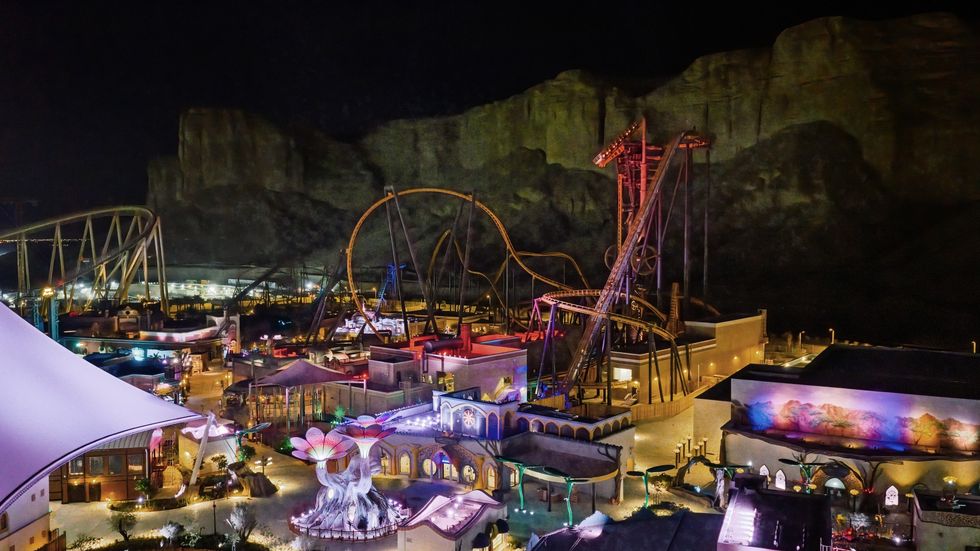 Six Flags Qiddiya City
In addition, European cities were seen as sites for steady growth.
Quality came through as a key differentiating factor. Creating transformative “money can’t buy experiences”, as well as "cultivating meaningful cultural experiences” and "redefining connection" were highlighted as ways to cut through with consumers when disposable income is tight.
People still want IRL experiences, but the offer needs to be something more transformative rather than transactional.
AI was seen as an opportunity to innovate, both to streamline operations and to amplify meaning for guests.
Climate risk
54% of respondents thought the industry should be doing more to combat the impacts of climate change. However, 31% said they didn’t know whether the industry was doing enough, suggesting a knowledge gap among many executives.
The growing impact of extreme and unpredictable weather was noted as an increasing vulnerability for outdoor operations, one that is already being experienced.
There is also a growing awareness that sustainability is no longer a "nice to have" but a critical operational imperative and something that guests increasingly expect.
One respondent argued that if attractions do not redefine their value around conservation and community, they risk losing "public trust and generational engagement”.
In conclusion
As at the start of this year, leaders were optimistic that the public’s desire for high-quality experiences and opportunities in new markets would justify increased investment, despite a backdrop of economic and political uncertainty.
Whilst leaders are clear that turbulence seems the new normal, the best way to combat risk is to evolve.
Thank you to all our respondents who participated. We truly value your input. The blooloop business confidence pulse will return in 2027.