As cruise operators continue to compete in terms of experience, onboard attractions have evolved far beyond traditional pools and theatres.
Play, interactivity, and social entertainment are vital to how cruise lines differentiate their ships, and for nearly 10 years, Greenspan Projects Ltd, a creative design and build specialist, has helped to shape that evolution.
With Seatrade Cruise Global 2026 taking place this April at the Miami Beach Convention Center, Greenspan talks to blooloop about its expanding portfolio of cruise ship projects.
The team is also looking forward to the next phase of innovation: launching the tech-infused mini golf experience, Puttify, for the cruise industry and broader marine leisure market.
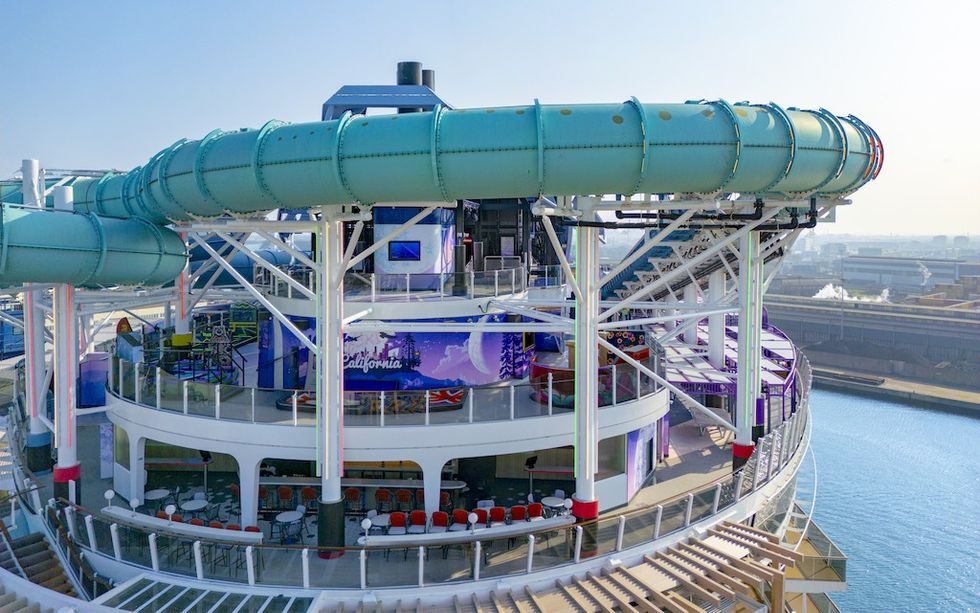 Norwegian Luna
In today’s experience economy, cruise ships are more than just places to stay; they are floating theme parks, social hubs for competition, and immersive destinations.
As the industry prepares to meet in Miami, suppliers like Greenspan are facilitating this shift from simple recreation to sophisticated, high-capacity attractions that increase revenue and guest enjoyment.
Bringing a turnkey approach to the cruise sector
Greenspan, already a global leader in designing and building themed play areas and immersive environments on land, started its cruise journey with core projects that demonstrated its ability to operate in challenging environments.
Early installations, such as the adventure golf course for TUI Marella Cruises and the bespoke play area delivered onboard Utopia of the Seas for Royal Caribbean, served as important testing grounds.
These projects helped establish the company’s credentials in delivering engaging play environments within the constraints of a ship, from spatial limitations to strict safety and durability standards.
Greenspan has often worked as a subcontractor to marine specialists, demonstrating that its turnkey philosophy of managing concept, design, fabrication, and installation can be successfully applied at sea.
The company manages every stage of a project, including handover and ongoing support, without the need for external consultants or labour. Maintenance and safety support can also be provided on a perpetual basis, offering cruise operators reassurance about long-term performance and compliance.
Stephen Carr, marketing manager for Greenspan, says:
“This comprehensive service model has become a key feature for us and a differentiator to many of those we are bidding against for the work.

"By truly handling the entire process, we have reduced the friction often encountered by clients in multi-vendor projects, a vital benefit when a ship is in dry dock and every hour counts.”
New projects for Norwegian Cruise Line and more
In 2026, Greenspan’s maritime portfolio is expanding into more ambitious and technically complex areas. The company recently completed new themed play zones for Norwegian Epic in 2025, strengthening its relationship with Norwegian Cruise Line.
Following this, the team worked on an attraction on Norwegian Luna, which welcomed its first guests on 10 March 2026.
 Norwegian Luna
This project marks Greenspan’s most ambitious cruise attraction to date: a high-tech outdoor mini golf experience covering two decks from experience design company Holovis, for which Greenspan provided manufacturing and installation support.
Looking ahead, Greenspan confirms that multiple new cruise projects are already in development for both Norwegian Cruise Line and Regent Seven Seas Cruises, the latter of which has recognised the value of working directly with the company and benefiting from its turnkey delivery model.
While details remain confidential, the company is actively in the design and development phase across several vessels.
Designing for the realities of the marine environment
While cruise attractions may share creative DNA with land-based experiences, designing a cruise ship differs fundamentally from creating spaces for shopping malls or holiday parks.
The marine environment presents severe operational challenges, with attractions continuously exposed to saltwater spray, strong winds, UV exposure, and constant vessel movement.
This means that choosing the right materials is vital, says Carr.
“For instance, with the mini golf projects we are currently working on, we needed to research and replace the elements that are not protected from the harsh conditions, such as our wood, with sustainable and durable materials suitable for the task.”
Puttify: rethinking mini golf for modern cruise guests
At Seatrade 2026, Greenspan will introduce Puttify, a pioneering mini golf concept designed to meet the evolving demands of experiential leisure and, increasingly, cruise entertainment.
Puttify has already proven to be a successful land-based tech mini golf experience in FECs and location-based entertainment venues, and its entry into the marine market comes at a timely moment.
“Cruise operators have already realised that land-based vacations are evolving their offerings to give guests more. In reaction, some cruise companies now have their own island archipelagos, and some are taking onboard experiences to the next level.
“With this shift, Puttify, as the up-and-coming competitive socialising experience on land, is perfectly poised to make an impression in cruise too,” says Carr.
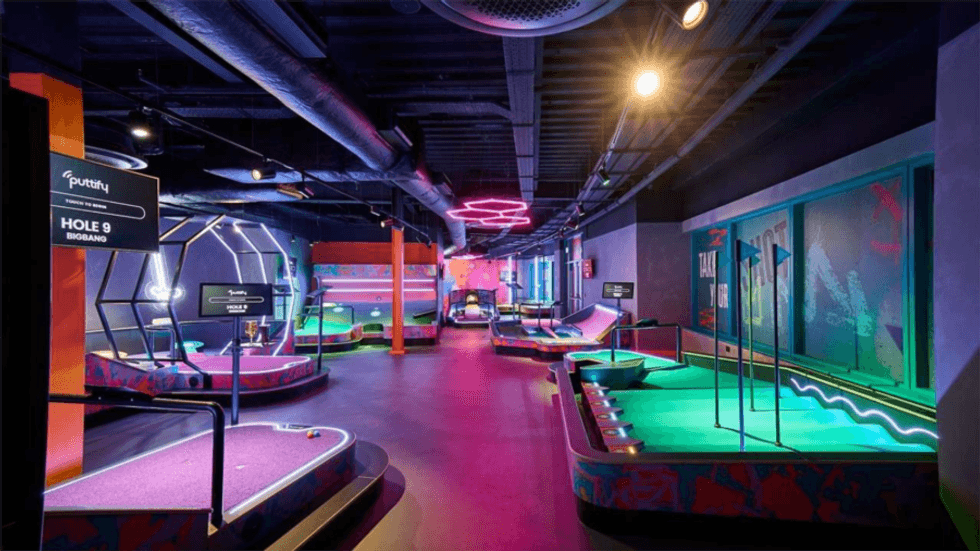
Puttify at Center Parcs Woburn Forest
Unlike traditional tech-enhanced models, all gameplay technology is built directly into each hole, removing the need for custom clubs or balls that require charging, replacement or complex maintenance.
Plus, the entire experience runs on a local network, meaning no reliance on a permanent or even a reliable internet connection.
“The entire customer experience only needs them to reach our kiosk, get a code and go and play,” adds Carr, highlighting the frictionless experience that makes it an appealing concept for operators, both on land and at sea. He also adds that it is “extremely staffing efficient,” requiring little oversight or support.
For a cruise ship with limited staff resources, this is a game-changer.
A higher-throughput solution for a favourite attraction
In the cruise industry, throughput—the number of guests who can experience an attraction per hour—is a key metric. A typical mini golf course often faces bottlenecks; for example, if a family struggles on a particular hole, the entire course can come to a halt.
Puttify introduces a non-linear, three-shot gameplay format that significantly changes this dynamic.
Live system reporting data from installed Puttify systems shows that throughput is typically 1.5x that of traditional mini golf courses, allowing more guests to enjoy the attraction in a single day without sacrificing the guest experience.
“The non-linear experience is key,” says Carr. “It means that holes don't have to be played in order. Head up to an empty hole, sign in with your group code and play what's free.”
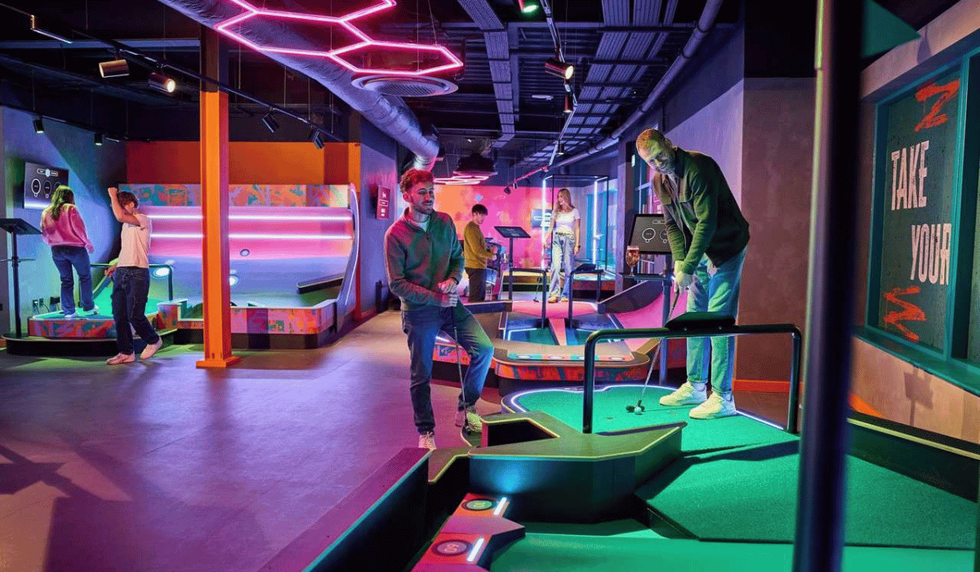
Puttify at Center Parcs Woburn Forest
This “shotgun start” style approach alleviates the queuing pressure that troubles onboard attractions.
From an operational perspective, this is particularly relevant for cruise environments. Puttify’s autonomous operation means minimal-to-zero payroll uplift, while faster play cycles and smoother guest flow help maximise revenue from limited onboard space.
Furthermore, the game design is crafted to promote dopamine and speed, with the three-shot play format stopping players from getting stuck endlessly hacking at the ball.
“It is expressly designed to be more enjoyable than traditional mini golf. Players rack up points, every shot scores — more enjoyment and engagement guaranteed,” Carr adds.
Creating value per square foot
Space efficiency is one of the biggest challenges onboard any vessel. Every square foot must generate value, and Greenspan has addressed this directly in Puttify’s design.
“Whilst Puttify holes have been designed as a modular product with a fixed footprint, what we have done is create a new collection of small footprint holes that still offer the same Puttify experience,” says Carr.
The modular system allows operators to scale the experience to suit available deck space, and the seven new reduced-footprint holes, developed specifically for marine installations, preserve gameplay quality while recognising space as a premium commodity at sea.
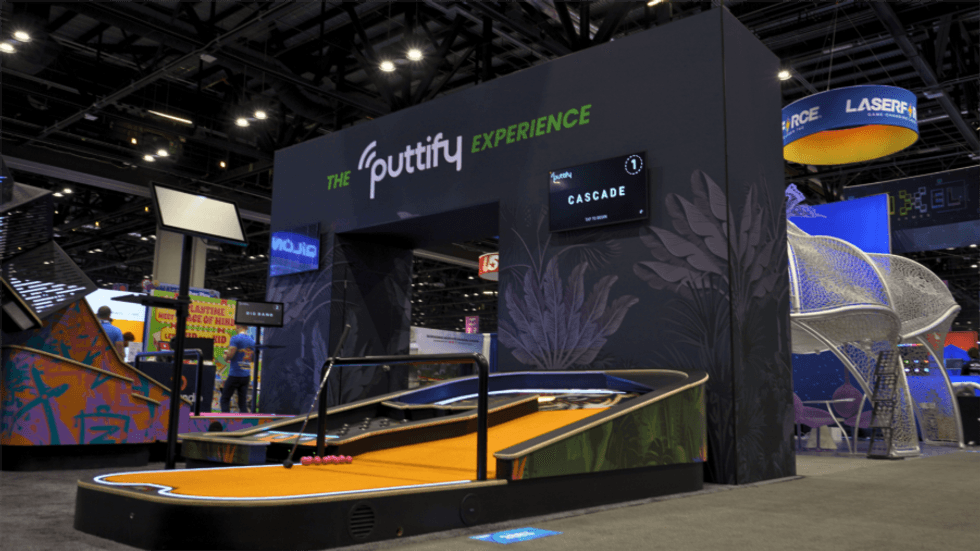
This modification enables operators to install a high-tech attraction in tighter deck spaces without compromising the core experience.
By using only a few of these smaller-footprint holes per course, Greenspan can significantly reduce the space required while still fully complying with accessibility standards such as ADA requirements, which are essential for modern cruise lines.
For cruise operators, the proposition is clear: higher throughput, strong guest engagement, reduced staffing requirements and a future-proof attraction that aligns with modern expectations for interactive, social entertainment.
Stronger ties between the cruise and attractions industries
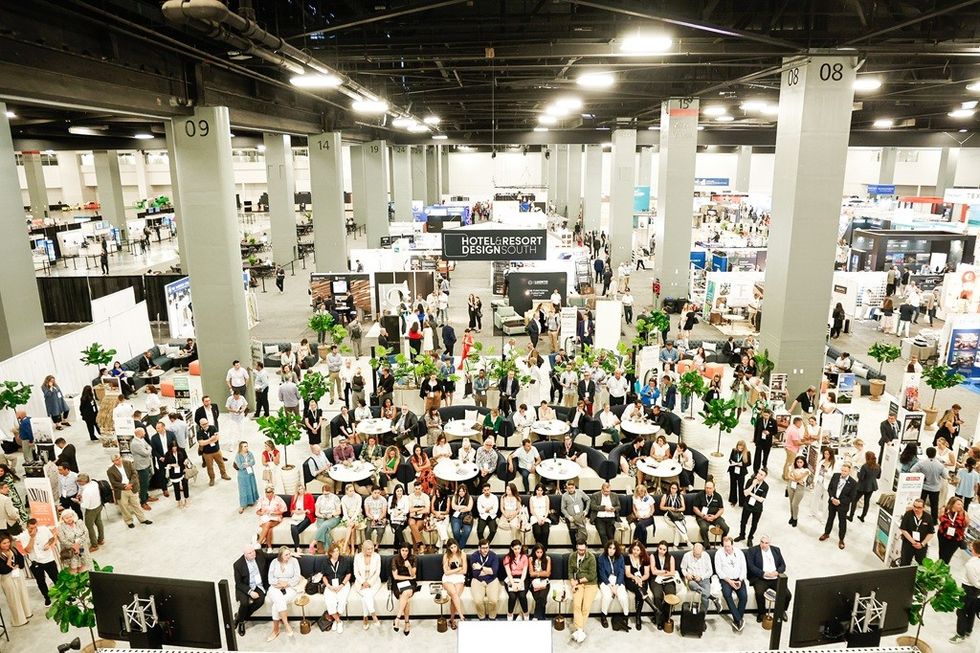
The upcoming Seatrade Cruise Global 2026 aligns with a period of increased collaboration between the cruise industry and the wider attractions sector.
IAAPA, the global association for the attractions industry, recently announced a strategic partnership with Seatrade, a move aimed at enabling attraction providers to connect more directly with cruise decision-makers.
“It’s great to see the cruise and attractions industries coming together more formally,” Carr says.
“I expect this partnership will be welcomed by brands on both sides, creating greater exposure and encouraging partnerships that help us all do more business together.”
This partnership highlights a growing trend already touched on: cruise lines are increasingly looking to land-based attractions for ideas, and vice versa. However, Carr points out a significant, possibly underutilised, opportunity for Greenspan: private islands.
As cruise lines develop their own exclusive island destinations, they are no longer restricted by the limited space of a ship's deck. “We have 50 years behind us working on land, building the kind of attractions you simply do not have the space to create on a cruise ship,” says Carr.
He points to the rise of “premium putting” courses: large-scale, 6,000- to 20,000-square-foot facilities that use real golf design philosophy mixed with adventure golf playability:
“Private islands could provide an enjoyable golf experience through a beautifully designed artificial putting course or pitch and putt that delivers the golfing thrill cruise-goers desire, without the usual upkeep, maintenance, and staffing requirements.”
This vision hints at a future where the passenger experience seamlessly transitions from a tech-enabled Puttify game on Deck 16 to an expansive, landscape-integrated adventure golf course on a Caribbean cay.
See also: Not your average mini golf: Albatross blends technology, storytelling, and social play
Greenspan continues to support the cruise sector
Seatrade Cruise Global 2026 is expected to be a major event. Taking place from 13–16 April 2026 at the Miami Beach Convention Center, it attracts over 11,000 attendees and more than 75 cruise line brands.
Greenspan will feature a live Puttify hole at its booth, enabling attendees to experience the gameplay firsthand.
The company’s ability to switch between supporting manufacturing for partners like Holovis, delivering bespoke projects for leading cruise operators, and deploying proprietary technology such as Puttify demonstrates its versatility within the sector.
As the boundaries between theme parks, resorts, and cruise ships continue to blur, and operators look to invest in standout guest experiences, Greenspan Projects is well prepared to navigate these waters, focusing on turnkey delivery, operational efficiency, and immersive storytelling.
The company’s combination of marine expertise, turnkey delivery, and next-generation play concepts positions it firmly at the intersection of attraction innovation and life at sea.