The Obama Presidential Center, a 19.3-acre campus in Chicago’s Jackson Park, officially opened to the public on 19 June 2026.
Alongside programming spaces, a fruit and vegetable garden, the John Lewis Plaza, a playground, and Home Court, a key highlight is the Obama Presidential Center Museum, spanning four main exhibition levels and roughly 40,000 square feet.
Rather than serving only as a retrospective of a single administration, the museum encourages visitors to consider their own role in civic life. Architecture, immersive media and accessibility are woven throughout the experience to support that goal.
To realise that ambition, The Obama Foundation brought in multimedia design studio batwin + robin (b+r) to lead the museum’s linear media design.
Working alongside exhibition designer Ralph Appelbaum Associates (RAA), accessibility consultants, and local Chicago creatives, b+r oversaw the creation of more than five hours of original media across 41 experiences, a four-year creative collaboration that ran from late 2022 through spring 2026.
Intricate media design
Designed as a vertical journey through the Obama presidency and the movements which shaped it, the museum presented an unusually ambitious canvas for linear and immersive media.
For batwin + robin (b+r), translating the vision into a cohesive visitor experience across multiple floors became one of the project's defining creative challenges. The project was led by the b+r team, including co-founder Linda Batwin O’Donovan, working closely with The Obama Foundation to realise their vision.
Sara Pasch, director of integrated media at the Obama Presidential Center Museum, says b+r's role went well beyond content production:
"batwin + robin served as the executive producer of the linear media, assembling a broad team of specialists and then bringing everything together into one visual language, while still allowing individual creative voices to shine."
Pasch says this joint approach ensured visitors experience the museum as a single story rather than a collection of separate exhibits.
"Visitors don't experience this as a project made by many different firms. They see a sweeping, comprehensive story that feels cohesive, and batwin + robin were central to making the media feel unified, even with all those partners involved."
b+r brought together a curated group of creative partners, each providing their own expertise to different parts of the media storytelling.
This included two local Chicago-based studios, Digifé and Manual Cinema, alongside Aggrey Company, Buffalo Grass Media, sound designer Jeremy S. Bloom, and licensing specialists SearchWorks and Loudspeaker Music Group.
“We started the project with monthly meetings for all the filmmakers to discuss our storytelling approaches,” says Molly McBride, b+r’s director of production for the project.
“It was a unique opportunity for a group of filmmakers to build a supportive space for peers to share ideas."
Story first
Although the museum includes large-scale projections, the media team says technology was always meant to support the stories rather than become the attraction itself.
While high-tech installations can easily distract from the core message, at the Obama Presidential Center restraint was a guiding principle.
"RAA and The Obama Foundation were extremely thoughtful in their implementation of media experiences, says Megan Gargagliano, principal and creative director at b+r.
“They considered the most effective technology for the content rather than relying on passing tech trends. In this project, there was a lot of restraint across all of the disciplines."
Valerie Chin, principal at b+r, echoes this, noting that The Obama Foundation’s ethos was always "content first.”
"They were always questioning, what is the purpose of this aspect of the design, or what does it convey? They want the story to be primary.”
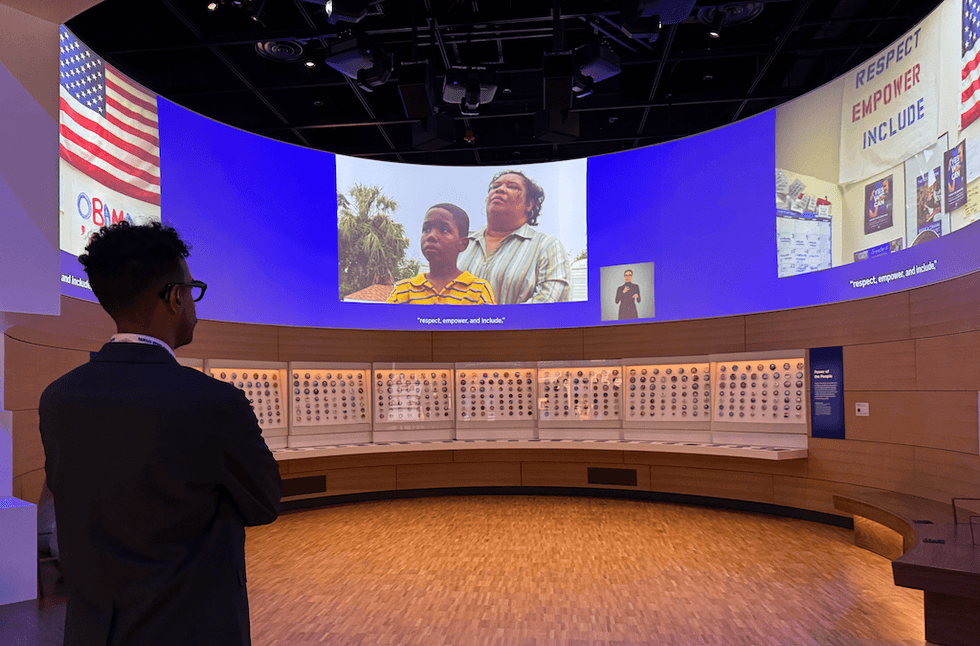
The Obama Presidential Center Museum in Chicago features Yes We Can, an immersive film projection on a 53-foot curved canvas.
Image courtesy of batwin + robin
Delivering that content required continuous collaboration with The Obama Foundation's internal media and review team, whose detailed editorial process guaranteed historical accuracy while refining complex stories into experiences that often lasted only a few minutes.
As a result, the digital elements feel integral to the exhibition rather than add-ons. The media team also worked closely with Ralph Appelbaum Associates to ensure visual continuity between the exhibition design and the digital storytelling.
RAA says batwin + robin's greatest contribution was knowing the emotional role media needed to play:
“batwin + robin were extraordinary media partners because they understood the emotional responsibility of this project,” explains Aki Carpenter, vice president and chief creative officer at RAA.
“In exhibitions, visitors most remember the stories they feel emotionally connected to, so it was essential that the media connect with people on a human level.
“[The] media experiences had to do a great deal of work to convey the story of the Obama presidency and provide historical context, ultimately carrying much of the museum’s emotional force. batwin + robin brought tremendous emotional intelligence to this work, approaching the project with grace and true collaboration.”
A wider narrative
That emphasis on emotion served a wider purpose. From the outset, the exhibition team positioned Barack Obama's presidency within the wider story of civic participation.
Pasch says President Obama wanted visitors to focus on the people behind social and political change, not only on his own story: “That is really a thread that is woven throughout the museum.”
Rather than beginning with Obama's early life, the museum opens with the wider history of the social and political forces that shaped both his presidency and the country.
"The story of the presidency actually begins with the stories of people on whose shoulders Barack Obama stood and who participated in progressive movements of the 19th and 20th centuries," Pasch says.
"The president wanted the story to start that way to ground people in the idea that this is about people over time who worked and continue to work to create change and to push for a more inclusive society.”
This shift from individual agency to collective action, described by the team as moving from "me to we", shapes the entire museum.
The building's architecture reinforces this theme. "The form of the building is inspired by the idea of four hands coming together, the idea being that many hands shape a place, that people come together to do big things," Pasch explains.
Furthermore, the exterior of the museum features text from President Obama's "You Are America" speech, delivered on the 50th anniversary of the Selma to Montgomery marches, putting forth a public call to action to everyone who visits.
Architecture shaping immersive media
While batwin + robin developed the museum's media experiences, Ralph Appelbaum Associates shaped the spatial narrative that those experiences inhabit.
The building's vertical form became an integral part of the storytelling, with visitors ascending from the social movements that influenced President and Mrs Obama through the presidency before ultimately being asked to consider their own role in civic life.
"That upward journey gave us a powerful spatial metaphor, democracy as something built over time and through many voices, actions, and generations,” says Carpenter.
To shape that journey, RAA developed what Carpenter describes as an "emotional score", a framework for balancing moments of contemplation, spectacle and participation throughout the galleries.
The aim was to guide visitors naturally between moments of deep reflection, immersive energy, and ultimately, an invitation to act.
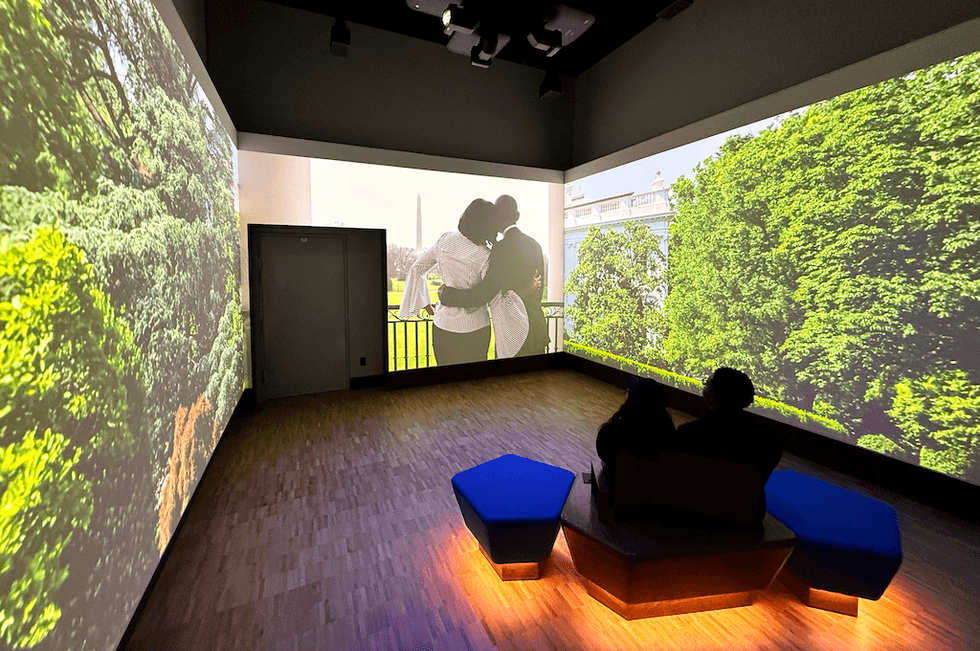
Panorama of a Presidency, an immersive three-walled installation at the Obama Presidential Center Museum
Image courtesy of batwin + robin
"It was about moving visitors from hope to action," Carpenter says. "We thought about these shifts almost musically—where the experience should build, where it should pause, where it should become more tactile, and where it should invite visitors to act.”
That emotional pacing is reflected throughout the galleries. Large-scale projections sit alongside handcrafted animation, intimate audio experiences and documentary filmmaking, allowing each level to establish its own tone while maintaining a consistent emotional journey.
"In many cases, the architecture can help determine whether media should feel expansive, intimate, directional, ambient, or participatory, just by the nature of the story and its location within the space," Carpenter adds.
Power of Words
Dominating the museum's central atrium is Power of Words, an 88-foot projection installation visible across all four exhibition levels.
Conceived early in the project and visible from multiple vantage points throughout the building, the massive canvas features excerpts from the speeches of President and Mrs Obama, alongside the voices of predecessors, changemakers, artists, and everyday people.
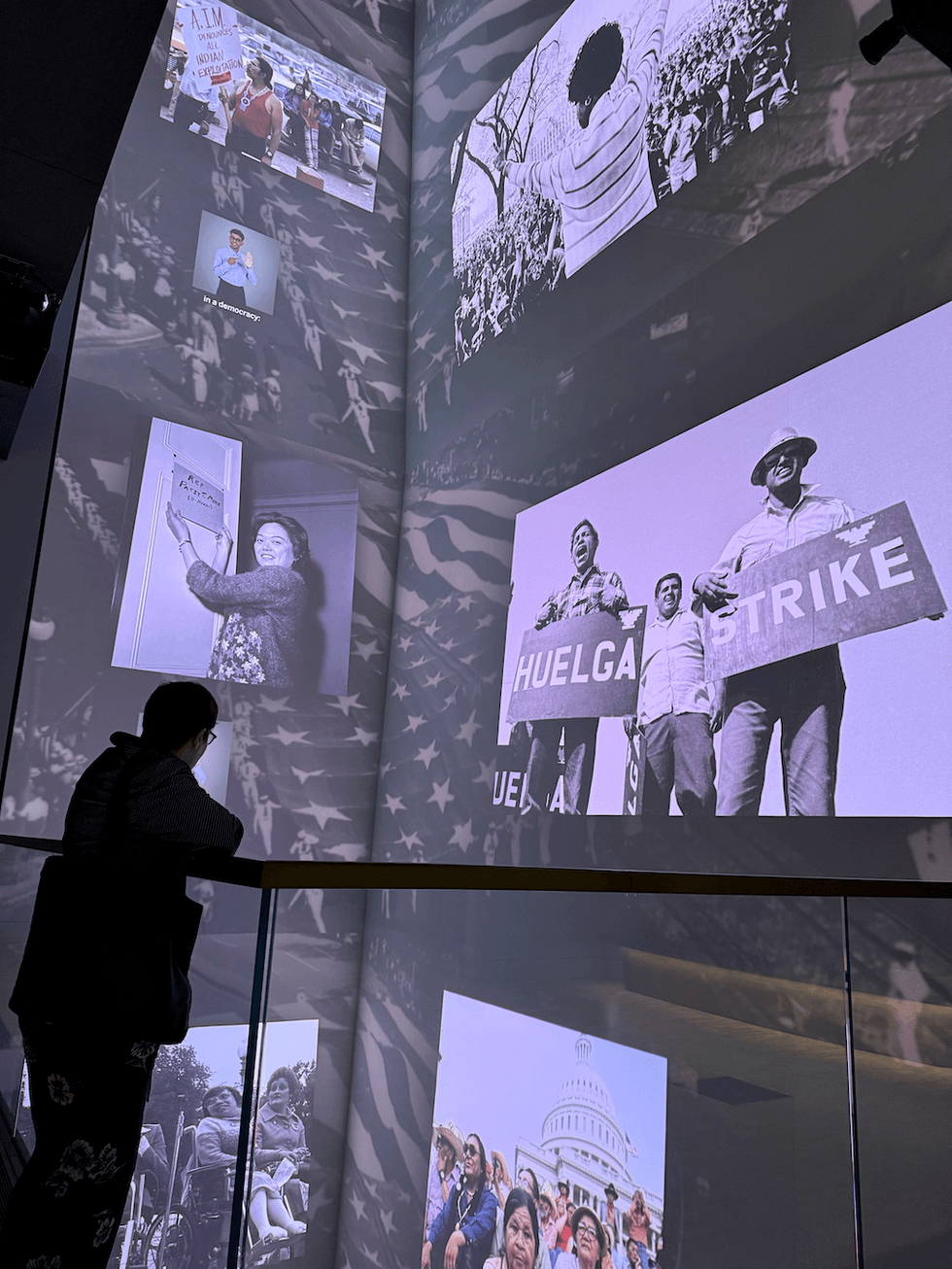
An 88-foot projection installation, Power of Words, is visible across all four exhibition levels, anchoring the visitor journey both physically and thematically
Image courtesy of batwin + robin
It anchors the visitor journey both physically and thematically, revealing new perspectives as visitors encounter it from each exhibition level.
Because of its scale, the installation underwent an extensive development process, including digital renderings, virtual reality visualisation and a week-long projection test in March 2024, during which two floors of the installation were mocked up ahead of a visit by President Obama.
Earlier prototype sessions at a Chicago studio in late 2023 allowed the team to project several exhibits at full scale before installation began.
Pasch says the prototype sessions depended heavily on b+r's technical leadership:
"batwin+robin were supportive partners throughout our large-scale prototyping. They brought real technical proficiency to the process and were great partners in executing the critical prototyping moments that allowed the final design to come together so seamlessly."
Because of the building’s distinctive architecture that tapers outward on Levels 2 and 3 and inward on Levels 4 and 5, the projection surfaces vary dramatically, b+r explains. Media content was carefully distorted so straight lines appeared visually true from every viewing angle.
Seven edge-blended projectors create a continuous image across the four-storey installation, with Scalable Displays handling automated geometric calibration.
Sound design
“Power of Words provided an opportunity to direct audio not only horizontally, but also vertically. With such a large canvas, this gives sound a powerful role to direct the visitor’s attention. It also provides a critical tool to unify, or separate, the four vertical viewing listening areas from each other whenever needed,” says sound designer Jeremy S. Bloom
“That work began with the amazing sound system and acoustics design from SH Acoustics and integrated by BBI Engineering, giving us a canvas of 80 speakers, divided into 18 channels.
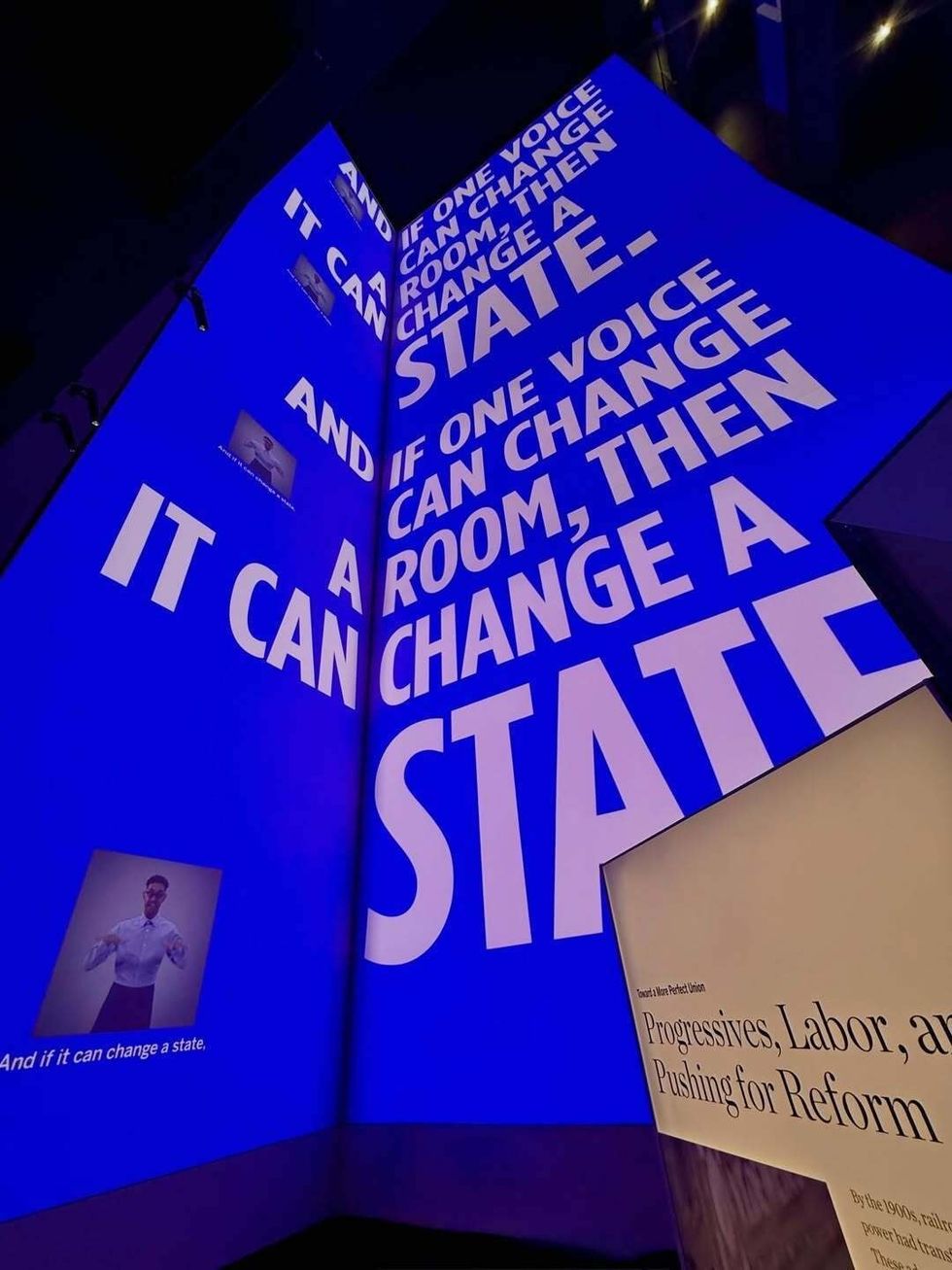
The Power of Words installation at the Obama Presidential Center Museum features striking imagery and artwork, cinematic video, and expressive graphic text
Image courtesy of batwin + robin
"The system offers options for horizontal immersion, vertical separation, bass, and a special channel for voices shared between all four levels during takeover moments.”
Creatively, the canvas had to operate in multiple modes. At times, it operates as a Level Intro, providing thematic context for the floor a visitor stands on. At other times, it shifts into show takeovers, sweeping sequences that animate the entire vertical canvas and unify the museum in a single emotional moment.
Chin says: "The challenge for that is, how do you tell a different story on each level at the same time, while also keeping it cohesive? So, that was a little bit of a puzzle.”
To solve this, b+r utilised shared visual backgrounds across all four levels. The design of the Level Intro video content appeared consistent across all levels, so while the audio and content varied by level, the look was the same.
Bloom says:
“Music plays an especially critical role in anchoring moments where content across the four levels differs. Thanks to the amazingly collaborative and cross-disciplinary spirit of batwin + robin, our team was able to anchor otherwise competing content with a completely unified musical score.
"This serves both to mask any residual bleed between levels, and ensure that the experience of moving between levels is completely cohesive without the dissonances of clashing musical scores.”
Designing accessibility from the outset
Rather than treating it as an afterthought, accessibility was embedded into the project’s DNA from day one.
"It's an extension of President Obama's legacy in a way, his commitment to providing access, and so at a fundamental level, it was always going to be a part of our forward thinking in this exhibit," says Pasch.
To achieve this, the museum relied on prototyping and early consultation with the disability community. Two years before opening, the team built a half-scale physical prototype of the 88-foot Power of Words wall to test projection alongside the scale and legibility of text and sign language.
"We knew that we had to figure it out technically, but also creatively…How big would heads look at that scale? What scale should the text be to be able to take it in?" Pasch says this early testing reduced risk and refined the finished installation.
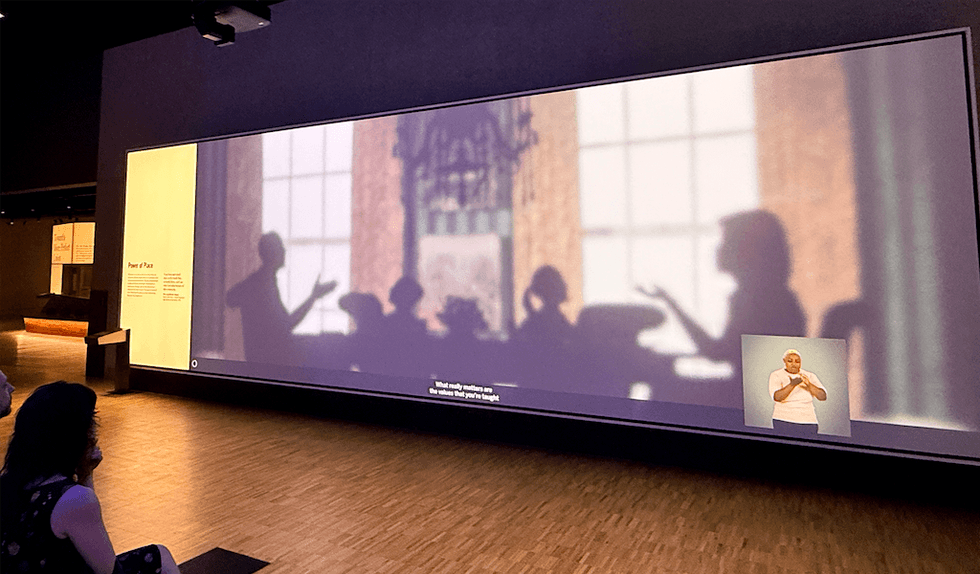
The immersive digital installations at the Obama Presidential Center Museum integrate ASL, captions, and audio descriptions, accessibility being a key part of the project from the start
Image courtesy of batwin + robin
For the media team at b+r, integrating American Sign Language (ASL) and audio description into the media without compromising the creative vision was a major undertaking.
Accessibility was embedded throughout production through workshops, community consultation and collaboration with Commissioner Rachel Arfa of the Mayor’s Office for People with Disabilities in Chicago and directors of artistic sign language (DASLs), including Ty Giordano, Storm Smith and Crom Saunders.
The ASL interpretation is baked right into the visual content on the screens, a decision that called for careful spatial planning.
"Each canvas is a different size and shape, and so we had to think about where the ASL is placed so it feels consistent throughout but also is prominent enough so that people can actually see what they're signing," says Chin.
During the installation phase, ASL and captioning were handled as separate media layers, allowing the team to fine-tune their placement.
An experience for everyone
McBride says: “The high visibility of the Obama Presidential Center Museum meant that the way certain concepts were translated would set a standard for interpretation in the US Deaf community, and our team took this responsibility very seriously.
"Lively discussions between deaf directors, interpreters, and the commissioner of Chicago's Mayor's Office for People with Disabilities became deep philosophical considerations over terms and government program names.
“We also learned that when a film included multiple speakers—and many of ours had eight or more—sign language reading viewers needed interpreters to change every two speakers in order to clearly follow the conversation.
"As a result, we assembled a cast of six ASL interpreters who rotated roles throughout the films, making it much easier for viewers to identify who was speaking and follow the dialogue.”
Working with consultants Ashleigh Bragg, Thomas Reid, and Video Caption Corporation, the team implemented audio descriptions accessible through headphone jacks near each film.
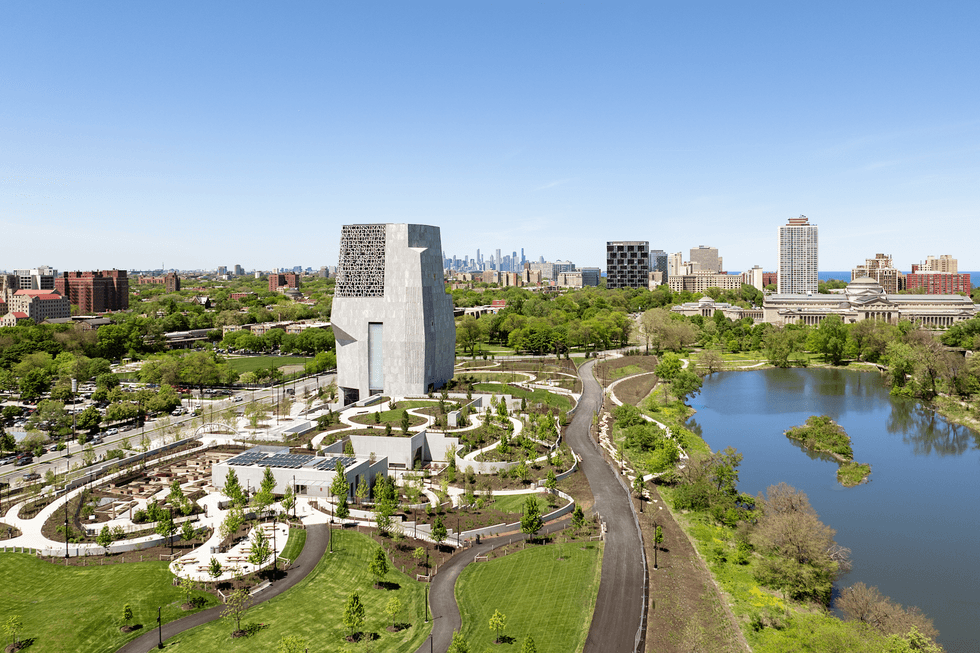 The Obama Presidential Center is a 19.3-acre museum campus in Chicago’s historic Jackson Park
Image courtesy of The Obama Foundation
This allows visitors who are blind or have low vision to plug in and hear a dedicated audio description channel alongside the main soundtrack.
Physical accessibility was similarly prioritised. Renowned Chicago artist and designer Norman Teague contributed custom-designed, inclusively crafted wooden benches for the galleries, integrating armrests that assist visitors in standing back up.
The result is a museum that feels welcoming to all, proving that inclusive design is simply good design.
"We have seen, as the museum has opened, that accessibility and inclusive design benefit everyone," Pasch says.
"The ASL interpretation in the films is on screen consistently, and the quality of that ASL, through our casting and production work with batwin + robin and our accessibility partners, brings a real joyfulness to the content.
"It brings a different kind of life to the work that visitors, not just Deaf visitors, have noticed and pointed out."
Reflecting on the practical lessons from this project that could help other institutions move toward a more inclusive model from the outset, the b+r team advise a holistic approach:
“Who are the members of your community who are being left out of the conversation? Invite them in and discuss what their needs are; there may be compromises, but it can be a small step that leads to bigger steps being taken.”
A collaborative project
As guests begin exploring the newly opened Obama Presidential Center Museum, the creative teams are contemplating what this project means for the future of exhibition design. The blending of monumental architectural forms with emotive digital media and uncompromising accessibility has created a genuinely human museum experience.
For Pasch, that cohesion was one of the project's greatest achievements, with b+r bringing together dozens of contributors into a media experience that visitors encounter as a single, unified story.
For the team at batwin + robin, the museum's success lies in its ability to move beyond its subject matter and engage visitors. Gargagliano emphasises that the intention of the media design was always to empower the guest:
"It's what we wanted, and it's what the foundation wanted, but it's really a sense of hope and a desire to participate... making sure that people feel included in the process and that their inclusion can provoke change, big or small.
“The president was really clear that he wanted to put the lens on the team that helped make these changes, on the everyday citizens who are part of this or who inspired the work…flipping the mirror back at the visitor, so that they feel like they are a part of the story or can be a part of the story, which was a through line that connected to every single piece.”