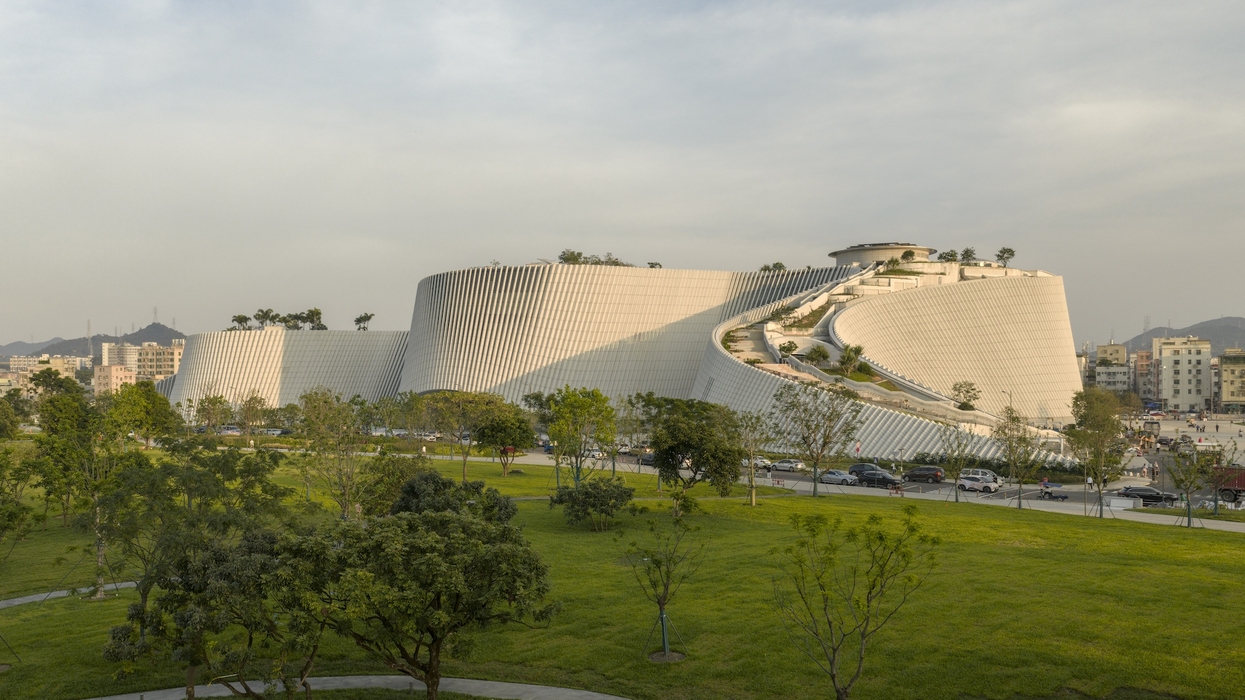

The Shenzhen Natural History Museum, one of the world’s largest new natural history museums and the biggest in South China, has opened to the public.
Designed by the 3XN, B+H Architects, and Zhubo Design consortium, the museum covers over 100,000 square meters.
Intended as both a civic landscape and a museum, it integrates architecture, ecology, and public space into a unified experience, featuring a walkable public roof that extends the natural ground plane and encourages daily use beyond the gallery thresholds.
From the city, the museum presents a flowing geological shape, with a granite façade and carved openings. Inside, visitors encounter a series of cave-like passages, atria, terraces, and framed views.
Kim Herforth Nielsen, founder, senior partner, and creative director at 3XN, says:
“Nothing in nature is square. Nature is amorphous, dynamic, and always in formation. From the beginning, the ambition was to create not a building, but a piece of landscape that had always been there – shaped by local geology, water and time.
"That idea has been carried all the way from the competition stage to the museum that opens today, a place where the story of our planet is experienced as a physical journey through terrain, light and space.”
See also: The 20 most visited museums in Asia
Exploring the Earth's history
Inside, eight themed exhibition halls lead visitors through 4.6 billion years of Earth’s history, starting from the universe's origins, progressing to the emergence of life, dinosaurs, and human evolution, and concluding with the ecological systems shaping Shenzhen and the broader world.
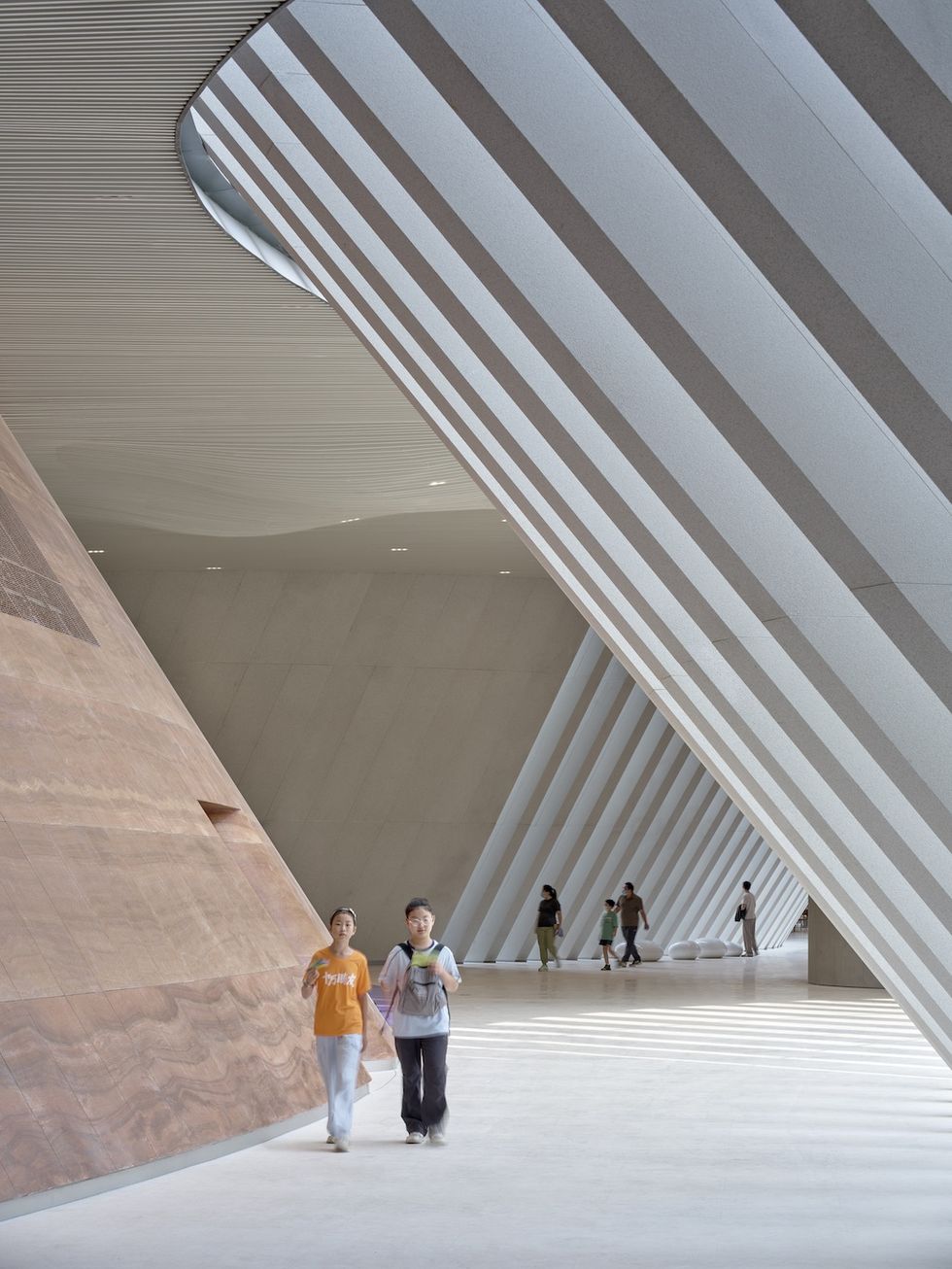
Shenzhen Natural History Museum traces 4.6 billion years of Earth’s history in a cutting-edge building
Image © Adam Mørk
The museum displays animal, plant, mineral, and fossil specimens, complemented by large-scale installations and media environments that link global natural history stories with the distinctive mountains, rivers, and seas of South China.
The architects collaborated closely with exhibition designers Atelier Brückner and Museum Studio to develop the scenography for the main galleries. They used curved walls, cone shapes, and vertical structures to craft immersive, media-rich environments that vividly animate the exhibition narrative.
Throughout the museum, specimens, large-scale installations, and cinematic media are integrated with the architecture, encouraging visitors to become active participants in the natural history story.
David Stavros, senior design principal and former executive VP for Asia at B+H Architects, says:
“Transforming this ambition into a world-class natural history museum demanded far more than delivering a building of exceptional scale and complexity. It called for architecture, engineering, landscape, exhibition planning and construction expertise to work seamlessly together.
"Central to this is the roof park, which extends the museum into Shenzhen’s civic landscape, inviting visitors to experience it as part of the city itself. The result demonstrates what multidisciplinary collaboration can achieve when design ambition, delivery expertise and technical rigour come together.”
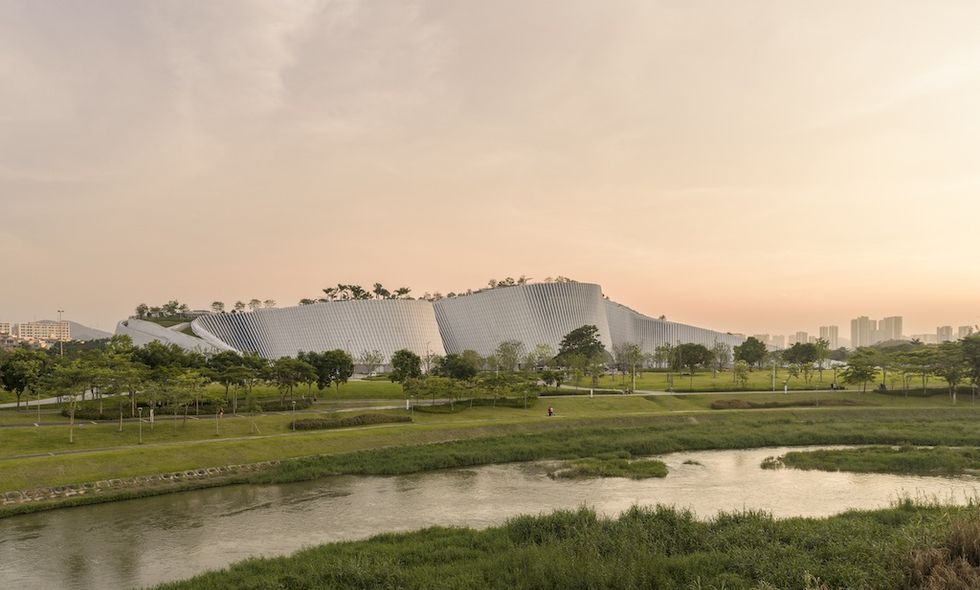
Shenzhen Natural History Museum features a roof park, which extends the museum into Shenzhen’s civic landscape
Image © Adam Mørk
Nan Zhaoxu, director of Shenzhen Natural History Museum, adds:
“Shenzhen Natural History Museum is designed to interpret the laws of natural evolution and present the geographies of Shenzhen in a global ecological perspective. It brings together collections and research that trace 4.6 billion years of Earth’s history, but it is the architecture that makes this story tangible.
"By turning the museum into a living educational landscape – from the roof park to the cone‑shaped galleries – it allows visitors from Shenzhen and around the world to experience science, nature and place as one continuous journey that is specific to its place.”
Earlier this year, Chinese e-commerce and technology company JD.com announced plans for the new JD Museum in Shenzhen, China. Due to open in late 2027, the JD Museum will focus on contemporary visual and performing arts and will be located in the new headquarters of JD.com in Shenzhen.